
Student Work Wednesday- Featuring Sarah Thompson
This week we’re highlighting the work of Gastronomy graduate, Sarah Thompson. Sarah completed a project in which she recreated a historical recipe for the Cookbooks and History course taught by Karen Metheny here at Boston University’s Metropolitan College.
The Nameless Cake
The Nameless Cake—I feel kind of bad for this cake because in Malinda Russell’s 1866 A Domestic Cook Book, this recipe is placed among so many other named cake recipes but I think this one has just as much to offer! To show this cake the love and attention it deserves, I decided to try my hand at making the recipe. While the ingredient list was ever so simple, that’s pretty much the extent of the recipe: an ingredient list. There was no mention of temperature at which the baking should happen, nor was there a time given for how long the cake should be in the oven. There was no mention of any type of pan that is suggested to use. It is clear that Malinda Russell assumes her readers have baked many cakes in their day and they can infer the instruction portion. Another challenge was equating a “teacupful” to something I had in my kitchen arsenal. I decided I would use ½- ¾ of a coffee mug and call that a teacupful. It seemed to work, but I know the result could have been a little different had I been more accurate with my decision-making.
Student Work Wednesday- Featuring Nicole Baker
This week we’re highlighting the work of Gastronomy student, Nicole Baker. Nicole completed a project in which she recreated a historical recipe for the Cookbooks and History course taught by Karen Metheny here at Boston University’s Metropolitan College.
Sutton's Island's Corn Cake of 1889
How does one recreate a recipe from 1889 with little to no information beyond the ingredients? Well for one, we start with what we know, which is experience in food, baking, and cooking, thankfully! The Sutton Island Cookbook is a compilation of recipes collected by someone working in the Sutton Island kitchen from the years 1889-1897. This island is a part of the Cranberry Isles off the coast of Mt. Desert Island, which is modern day Acadia National Park.
The majority of these recipes, themselves, are clippings from what seems to be a multitude of sources, but there is the occasional handwritten recipe sprinkled throughout. The compiler even notes that this cookbook is also seen as a scrapbook. Perhaps these recipes were ones they admired to make, enjoyed themselves, or with which they accommodated guests for meals on the island.
For this recipe recreation in our Cookbooks and History class, I chose the “Corn Cake” recipe on page 73 of the book (Fig 1). Since the recipe only lists ingredients, there was a lot of room for trial and error. Because of the absence of directions, I felt this recipe would be quite a journey to embark on, and perhaps bring me more confidence in my baking skills. While there was plenty of room for interpretation and trial, I did want to get this recipe right on the first go, so as not to waste ingredients.
Student Work Wednesday- Featuring Celeste Femia
This week we're highlighting the work of Gastronomy student Celeste Femia. Celeste completed a project in which she recreated a historical recipe for the Cookbooks and History course taught by Karen Metheny here at Boston University's Metropolitan College.
Recreating a 19th Century Orange Fritter
In my search to find a historical recipe for recreation, I stumbled upon a gem from the late 19th century, "Miss Corson’s Practical American Cookery and Household Management" by Juliet Corson. Juliet Corson, an instructor, and superintendent at the New York Cooking School, collaborated with the Commissioner of Education to create this cookbook that went beyond regional boundaries. Published in 1885, this cookbook is a compilation of recipes contributed by locals from the Western and Southern regions of the United States.
Gastronomy for Good: Daily Table’s Mission-Based Gastronomy
Today, we are highlighting more work from students in Steven Finn's course: MET ML626 - Food Waste: Scope, Scale, and Signals for Sustainable Change. This is another post from Megan Perlman.

Traditional notions of gastronomy may conjure up a vision of white-toqued students making milles-feuilles, a critic with a notepad at a fancy restaurant, or the study of how terroir and farming methods impact a region’s grape varietal. While these certainly belong in the purview of gastronomy, Boston University’s Master of Arts in Gastronomy also affords us the opportunity to learn more about the social, cultural, and historical intricacies of how food and people connect. This includes connecting with local food activists and organizations making a difference in our communities.
There has never been a greater need for activism. The statistics are bleak. With rising cost of living showing no signs of abatement, an estimated 1.9 million adults in Massachusetts went hungry last year. The Harvard Political Review further explains the problem: “Residents of lower-income areas may be miles away from their nearest source of fresh, nutritious food…Fast-food chains and easily accessible corner stores sell mainly non-nutritious ‘junk’ food. Available fresh food, if there is any, is then much more expensive than ultra-processed alternatives, worsening the lack of access to healthy foods by low-income residents.”
From Global to Individual: Getting Personal with Food Waste
Today, we are highlighting work from students in Steven Finn's course: MET ML626 - Food Waste: Scope, Scale, and Signals for Sustainable Change. This post comes from Emily Shawn.
But I don't contribute to the global food waste problem, right? I'm not the one throwing away my meals and clogging up landfills.
Am I?
Household waste matters, and way more than I thought.
I'm sure I'm not alone in thinking that I'm just not that wasteful. I usually finish my leftovers. I do my best to get through the finicky salad mix before it wilts. I compost, for goodness’ sake. I'm not really part of the global food waste problem. Am I?
I, like many consumers, have grown into the habit of thinking of food waste on a grand scale--that the waste produced by restaurants, businesses and agriculture is so extreme and severe that my small efforts as one individual person cannot possibly have any significant effect. Yet--and disastrously so--this "not my problem" attitude is not unique to me, nor are my thoughts that my personal waste is insignificant. When this same "not my problem" idea is echoed by the millions of people in Massachusetts, the United States, and the world, individual household food waste is in fact a driving factor in how sustainable we as humans can be with our food and our resources.
Saving the Planet in a Tasty(?) Way: Eat Bugs
Today, we are highlighting work from students in Steven Finn's course: MET ML626 - Food Waste: Scope, Scale, and Signals for Sustainable Change. This post comes from Megan Perlman.
With the world's population forecast to reach nine billion by 2050, food production will have to nearly double to keep up. Yet our planet simply cannot provide the water, land, and resources to sustain us at this pace. Livestock, especially beef, is a particularly inefficient use of resources per calorie consumed.
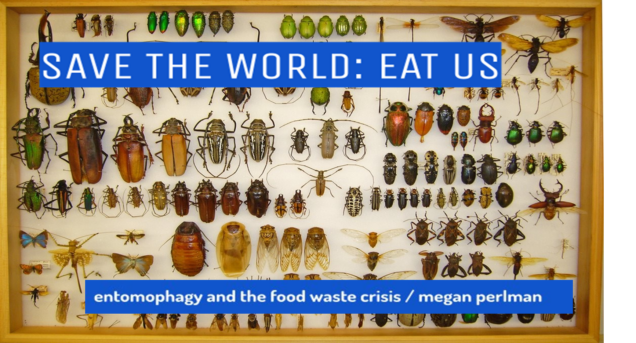

Enter: micro-livestock. The United Nations’ Food and Agriculture Organization’s groundbreaking 2013 paper, Edible Insects: Future Prospects for Food and Feed Security suggests that entomophagy can help food security and the planet.
Commonwealth Kitchen: Innovating for a Sustainable, Equitable Food System
Today, we are highlighting work from students in Steven Finn's course: MET ML626 - Food Waste: Scope, Scale, and Signals for Sustainable Change. This post comes from Sarah Thompson.
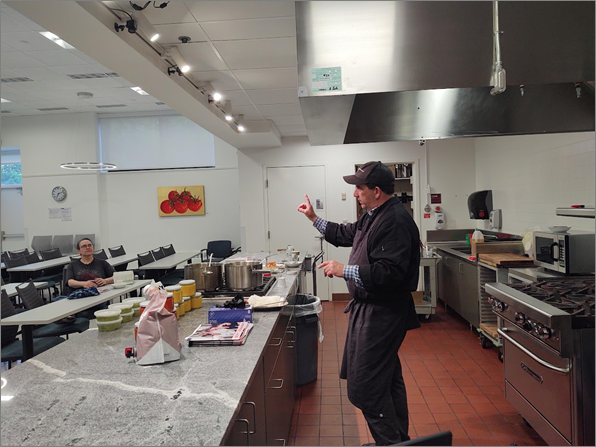
If you are in Massachusetts, chances are, sipping on Madhrasi Chai, snacking on GRIA nuts, or dining at Clover Food Lab, you have enjoyed the fruits of labor of those in the Dorchester-based culinary incubator, Commonwealth Kitchen. In our Global Food Waste class (MET ML 626), we had the pleasure of hearing Kevin Doherty speak on his innovative work as Director of Culinary Operations at Commonwealth Kitchen.
Course Spotlight: Sociology of Taste

MET ML 716, Sociology of Taste, with Dr. Connor Fitzmaurice, will be offered as a 14-week online course for the Fall 2023 semester (Sept 5-Dec 18).
Course Description:
Taste has an undeniable personal immediacy: producing visceral feelings ranging from delight to disgust. As a result, in our everyday lives we tend to think about taste as purely a matter of individual preference. However, for sociologists, our tastes are not only socially meaningful, they are also socially determined, organized, and constructed. This course will introduce students to the variety of questions sociologists have asked about taste. What is a need? Where do preferences come from? What social functions might our tastes serve? Major theoretical perspectives for answering these questions will be considered, examining the influence of societal institutions, status seeking behaviors, internalized dispositions, and systems of meaning on not only what we enjoy--but what we find most revolting.
Fall registration is now live. This class is open to graduate students and upper level undergraduates. Non-degree seeking students may register here.
Student Work Wednesday- Featuring Kelly Fernandes
This week we're highlighting the work of Gastronomy student Kelly Fernandes. Kelly completed a project in which she created a summer program for the Food Waste course taught by Steven Finn here at Boston University's Metropolitan College.
Here's Kelly's vision for the project:
In one of my reflections, I spoke about creating a summer program that would be beneficial for low-income children. I decided to expand on that idea and used the blog post to showcase it.
I geared the content to show that SDGs can be achieved on smaller scales, starting with a small group within the community. I do think more SDGs can be touched with a similar model. Quality education can come in many forms and by teaching kids how to farm/harvest and subsequently cook, we are teaching them fundamentals and potentially minimizing future food insecurity.
This is an out-of-the-box approach but I do believe that we can reduce food waste by connecting younger generations to the source of their food, detailing how much effort goes into growing foods and why it is important to buy/consume only what is needed.
Course Spotlight: Urban Agriculture
Urban Agriculture
Urban Planning and Food Studies
MET ML 714 A1 (Summer 2- 2023)
Course Description:
Climate change demands immediate action and, to withstand altered temperatures, people need to eat healthy food and be active. Lessening drought in Africa or reducing food shipments are tasks beyond the reach of citizens but, with close-to-home urban agriculture, everyone can say, “I can do that.”
Through lectures, readings, and site visits, this interactive urban planning/gastronomy course will explore home vegetable gardens, leased plots, community gardens, and parks/sidewalks. Students will be challenged to come up with new ideas to increase the production of locally-grown vegetables and have more hands in the soil.