News
Guenther Lab brain-machine interface research featured in Christian Science Monitor
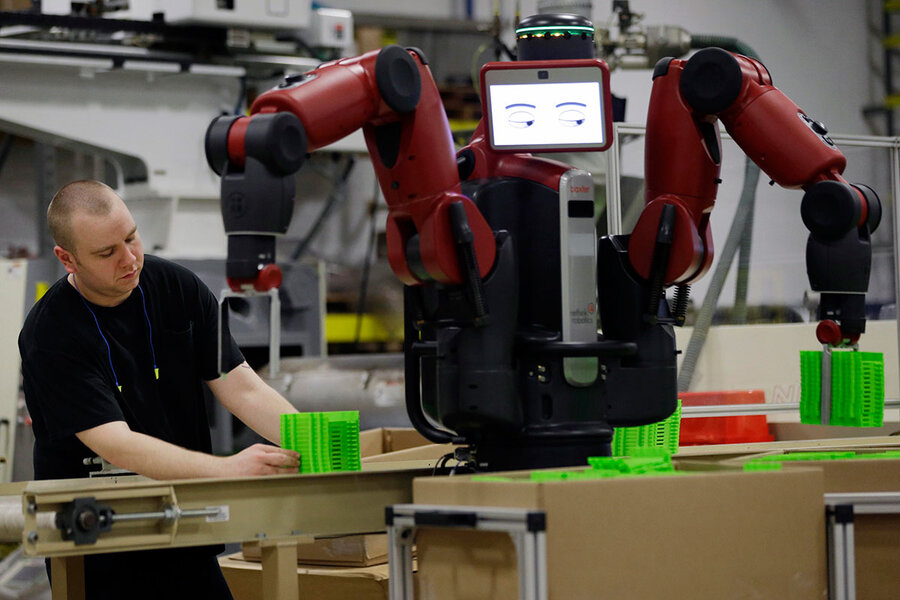
Our brain-machine interface that detects when a human observer sees a robot making a mistake was featured in an article on human-robot interactions in The Christian Science Monitor titled: Robot communication: It's more than just talk. This article discusses work at Boston University as well as MIT and the University of Massachusetts, Lowell.
Guenther lab members present at the 7th International Conference on Speech Motor Control
The Guenther Lab's Principal Investigator, Frank Guenther, and Assistant Director, Jason Tourville recently attended the 7th International Conference on Speech Motor Control held in Groningen, the Netherlands. The conference, which takes place roughly once every 5 years, brings together colleagues from leading research groups that study speech motor control and related disorders.
During the "Windows on the Brain" session, Dr. Tourville discussed efforts to leverage the lab's large database of speech production fMRI data to identify reliable functional boundaries within the speech motor control neural network. Later in the session, Dr. Guenther described a framework that we have developed to quantitatively assess neurocomputational models of speech production using neuroimaging data.
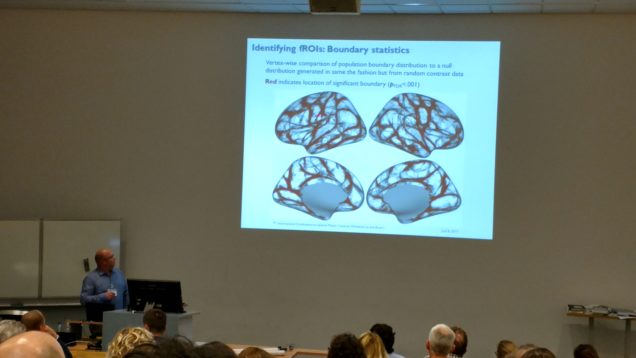
Presentation given by Assistant Professor Jason Tourville.
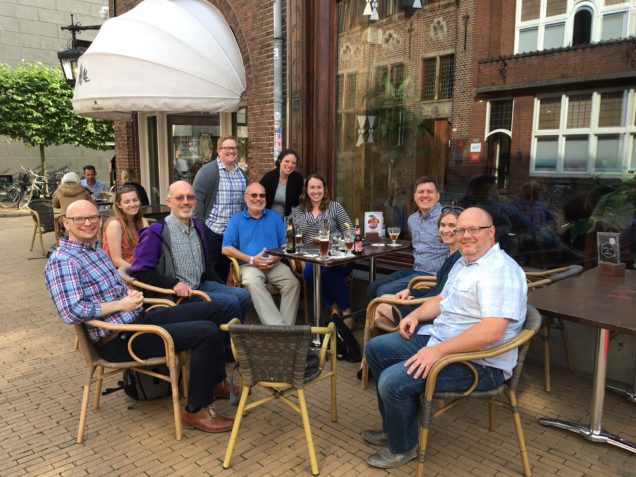
Enjoying some down time in Groningen, from left: Dr. Jason Whifield, Anna Gravelin, Dr. John Houde, Gabe Cler, Dr. Frank Guenther, Liz Heller Murray, Dr. Cara Stepp, Dr. Jay Bohland, Dr. Catherine Theys, Dr. Jason Tourville
Press coverage of our error-detecting robotic brain-computer interface
Our brain-computer interface that detects when a human observer sees a robot making a mistake has gotten a lot of press coverage in the past two weeks, including articles on NPR, Newsweek, Canadian Broadcast Corporation, Wired, New Scientist, Discover, and over 100 other popular and scientific news outlets. Congratulations to Guenther Lab PhD student Andrés Salazar-Gómez as well as our collaborators in the Rus Lab at MIT's Computer Science and Artificial Intelligence Laboratory!

Oculomotor brain-computer interface article published
Decoding of intended saccade direction in an oculomotor brain-computer interface
In collaboration with Prof. Earl Miller's lab at MIT, several lab members, including first author Nan Jia, worked on a novel BCI paradigm involving the eye movement system in the brain. By implanting microarrays in multiple prefrontal areas in monkeys, high online BCI performance was achieved using novel LFP signals. This study is one of the first to demonstrate and explore the feasibility to utilize the oculomotor system for BCI purposes.
Dissertation Defense – Nan Jia
Notice of Dissertation Defense
Nan Jia
Candidate for the degree of Ph.D. in Cognitive and Neural Systems
Title: DEVELOPING AN OCULOMOTOR BRAIN-COMPUTER INTERFACE AND CHARACTERIZING ITS DYNAMIC FUNCTIONAL NETWORK
Friday, December 9, 2016
1:30 pm
CompNet Building Room B02
Boston University
Graduate Program for Neuroscience
677 Beacon Street
Boston
(Advisor: Professor Frank Guenther)
Dissertation Defense – Andrés F. Salazar-Gómez
 Notice of Dissertation Defense
Andrés F. Salazar-Gómez
Candidate for the degree of Ph.D. in Computational Neuroscience
Title: ERROR-RELATED POTENTIALS FOR ADAPTIVE DECODING AND VOLITIONAL CONTROL
Friday, December 2, 2016
10am
CompNet Building Room B02
Boston University
Graduate Program for Neuroscience
677 Beacon Street
Boston
(Advisor: Professor Frank Guenther)
Article in Spectrum highlights lab’s autism research
Guenther lab research was highlighted in an article in Spectrum, titled, "Imaging study hints at compensation in verbal teens with autism". This article discusses a talk titled, Neural bases of language phenotypes in Autism Spectrum Disorder, given by Jennifer Segawa at this year's Society for Neuroscience conference in San Diego. This research was a collaboration between the Guenther lab at BU and Dara Monoach and colleagues at MGH.
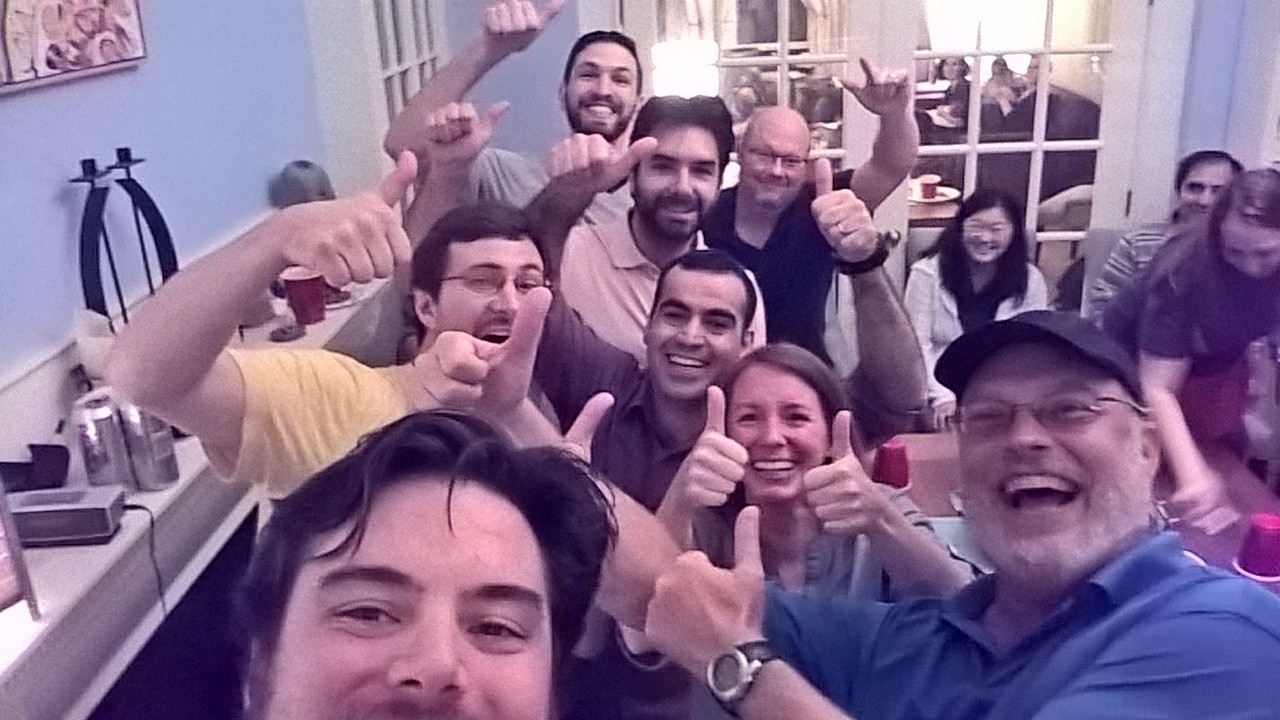
Winners of Annual Flip Cup Competition!
Saul Frankford selected as NIH T32 Predoctoral Trainee
 Saul Frankford has been selected as a predoctoral trainee for a Boston University Institutional Training Grant (T32) from the NIH/NIDCD. He will receive multidisciplinary training to prepare him for an academic career in communication sciences and disorders.
Correcting Robot Mistakes in Real Time Using EEG Signals
Lab member Andrés F. Salazar-Gómez worked on the paper titled, Error-related potential for human-robot interaction: Correcting Robot Mistakes in Real Time Using EEG Signals.
In this project we are using EEG signals to automatically detect errors made by a robot. Our work focuses on identifying Error-related Potentials (ErrP), EEG signals generated in response to an observed or executed error, to correct in real time a robot’s selection. Our results demonstrate the potential of ErrPs for seamless robotic control, and moves closer towards the goal of real time intuitive human-robot interaction.
This video is part of results submitted to the IEEE International Conference on Robotics and Automation (ICRA 2017) in the paper “Correcting Robot Mistakes in Real Time Using EEG Signals”.