News

AEJMC 2019 presentations by BU COM faculty and students

By Susannah BlairAugust 6th, 2019in Homepage

This week, communication scholars, practitioners, and educators from around the world are congregating in Toronto, Canada for the Association of Education in Journalism and Mass Communication (AEJMC)'s 102nd annual conference. Many members of the BU COM community—including some of the CRC's research fellows—will be in attendance to share their scholarly work and convene with colleagues around this year's theme, "Investing in Our Futures."

Below is a list of AEJMC conference presentations and panels featuring BU COM and CRC-affiliated faculty and doctoral candidates (click image to view full-size):

More

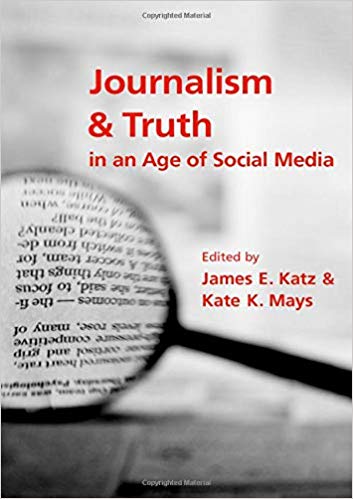
New book edited by CRC fellows James Katz & Kate Mays, “Journalism & Truth in an Age of Social Media,” now available

By Susannah BlairAugust 6th, 2019in Homepage

Truth qualities of journalism are under intense scrutiny in today's world. Journalistic scandals have eroded public confidence in mainstream media while pioneering news media compete to satisfy the public's appetite for news. Still worse is the specter of "fake news" that looms over media and political systems that underpin everything from social stability to global governance. 

This volume aims to illuminate the contentious media landscape to help journalism students, scholars, and professionals understand contemporary conditions and arm them to deal with a spectrum of new developments ranging from technology and politics to best practices. 

Fake news is among the greatest of these concerns, and can encompass everything from sarcastic or ironic humor to bot-generated, made-up stories. It can also include the pernicious transmission of selected, biased facts, the use of incomplete or misleadingly selective framing of stories, and photographs that editorially convey certain characteristics. This edited volume contextualizes the current "fake news problem." Yet it also offers a larger perspective on what seems to be uniquely modern, computer-driven problems. We must remember that we have lived with the problem of people having to identify, characterize, and communicate the truth about the world around them for millennia.

Rather than identify a single culprit for disseminating misinformation, this volume examines how news is perceived and identified, how news is presented to the public, and how the public responds to news. It considers social media's effect on the craft of journalism, as well as the growing role of algorithms, big data, and automatic content-production regimes. As an edited collection, this volume gathers leading scholars in the fields of journalism and communication studies, philosophy, and the social sciences to address critical questions of how we should understand journalism's changing landscape as it relates to fundamental questions about the role of truth and information in society.

Click here to purchase

James E. Katz is Feld Professor of Emerging Media at COM, where he directs its Division of Emerging Media Studies. He has been awarded a Distinguished Fulbright Chair to Italy, fellowships at Princeton, Harvard, and MIT, and the Ogburn Career Achievement Award from the American Sociological Association. Dr. Katz is an elected fellow of the International Communication Association and the American Association for the Advancement of Science (AAAS).
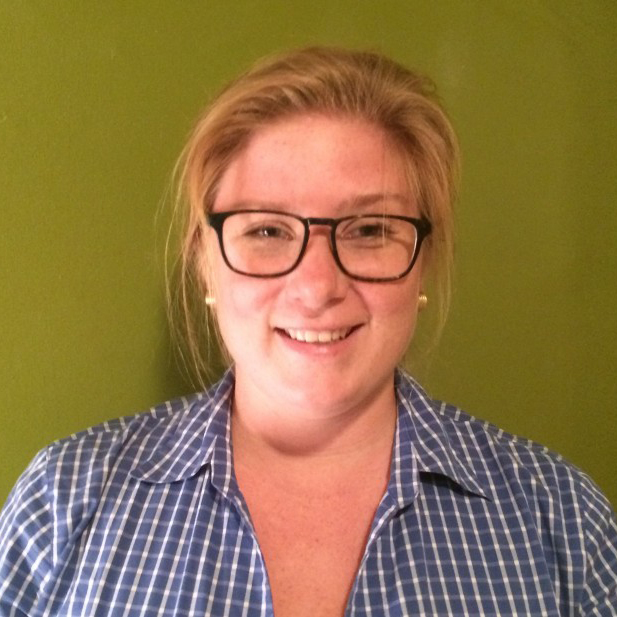
Kate K. Mays is completing her PhD in Emerging Media Studies at COM and is a Graduate Student Fellow for computational and data-driven research at the Rafik B. Hariri Institute for Computing and Computational Science & Engineering at Boston University. She has presented her research findings at a variety of international conferences and in several journals. After graduating from Georgetown University, she worked in the publishing industry before coming to Boston University for advanced studies.

CRC fellows Lei Guo and Chris Wells featured in BU Today’s series “Big Data, Big Impact”

By Susannah BlairJuly 17th, 2019in Homepage
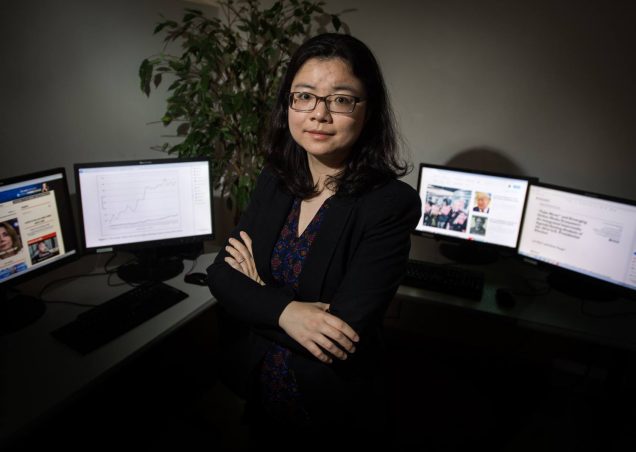
Photo by Cydney Scott, courtesy of BU Today

As Boston University begins to invest its resources and expertise in the emergent field broadly referred to as "big data," BU Today has published a multipart series exploring the promises, consequences, and future of data science. Part Five of this series—titled "Big Data, Big Impact"—features insights from two of the CRC's faculty fellows, Lei Guo (Assistant Professor, Emerging Media Studies) and Chris Wells (Assistant Professor, Journalism). 

Both Guo and Wells have worked extensively with big data, both as a research method and as a topic of interest in and of itself. Their research utilizes computational methods to explore online media phenomena such as fake news, filter bubbles, and the influence of algorithms on news consumption.

Full story available on the BU Today website: "What You Read and Watch is Changing Media Forever"

An artifact from the CRC’s early days—our first-ever newsletter

By Susannah BlairJuly 2nd, 2019in Homepage

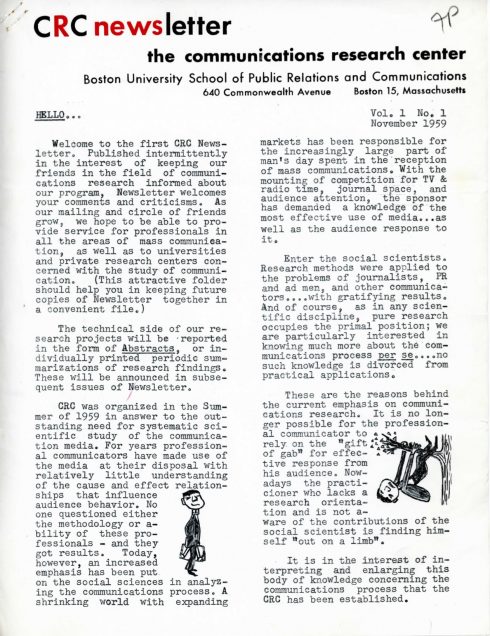
Recently, the Communication Research Center received an unexpected and exciting email. Attached was a scanned copy of the first-ever CRC newsletter, published in November of 1959 (the year the CRC was established).

We are so thrilled to have this documentation of the CRC's rich history and hope you enjoy learning about the center's early research endeavors as much as we have.

Many thanks to John W. Holman for getting in touch and mailing us the original document, which will be framed and displayed at the CRC.

Learn more about the history of the CRC (article by Dr. Michael G. Elasmar)

Dr. Melvin DeFleur honored with AEJMC’s Distinguished Service to Research Award

By Susannah BlairJune 28th, 2019in Homepage

Dr. Melvin DeFleur, a former professor of communication at Boston University and renowned communications scholar, was posthumously awarded the Association for Education in Journalism and Mass Communication (AEJMC)'s Eleanor Blum Distinguished Service to Research Award. 

Dr. DeFleur conducted pioneering academic research in the communications field, authoring over a dozen books—including the widely-cited textbook “Theories of Mass Communication," which has been translated in 10 languages. At Boston University, he served as both a faculty member and chair of COM's Mass Communication, Advertising and Public Relations department. In 2011, the Communication Research Center created the Dr. Melvin DeFleur Distinguished Lecture Series, a tribute to his groundbreaking contributions to mass communication research and his valued membership at the CRC. 

The award will be presented during the AEJMC's August 2019 Conference in Toronto, Canada.

Prof. Jim Cummings’ “screenomics” research featured in The New York Times

By Tanvi ShahJune 7th, 2019in Homepage
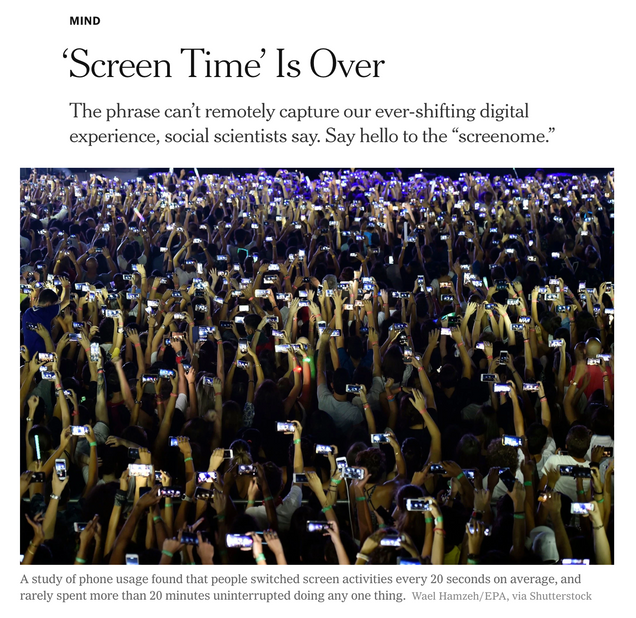
Screenshot courtesy of The New York Times

New York Times article about the changing nature of our digital experiences cites a recently-published paper in Human-Computer Interaction co-authored by the CRC's Jim Cummings.

The concept of "screen time" has been long used to understand how—and for how long—individuals interact with their devices. But as more applications have become available to internet users, understanding people's digital experiences and how often they switch between tasks has become more complicated.

"Consider what a person can do in just the time it takes to wait for a bus: text, watch a comedy skit, play a video game, buy concert tickets, take five selfies, each with a different set of cartoon ears," explains The New York Times' Benedict Carey. 

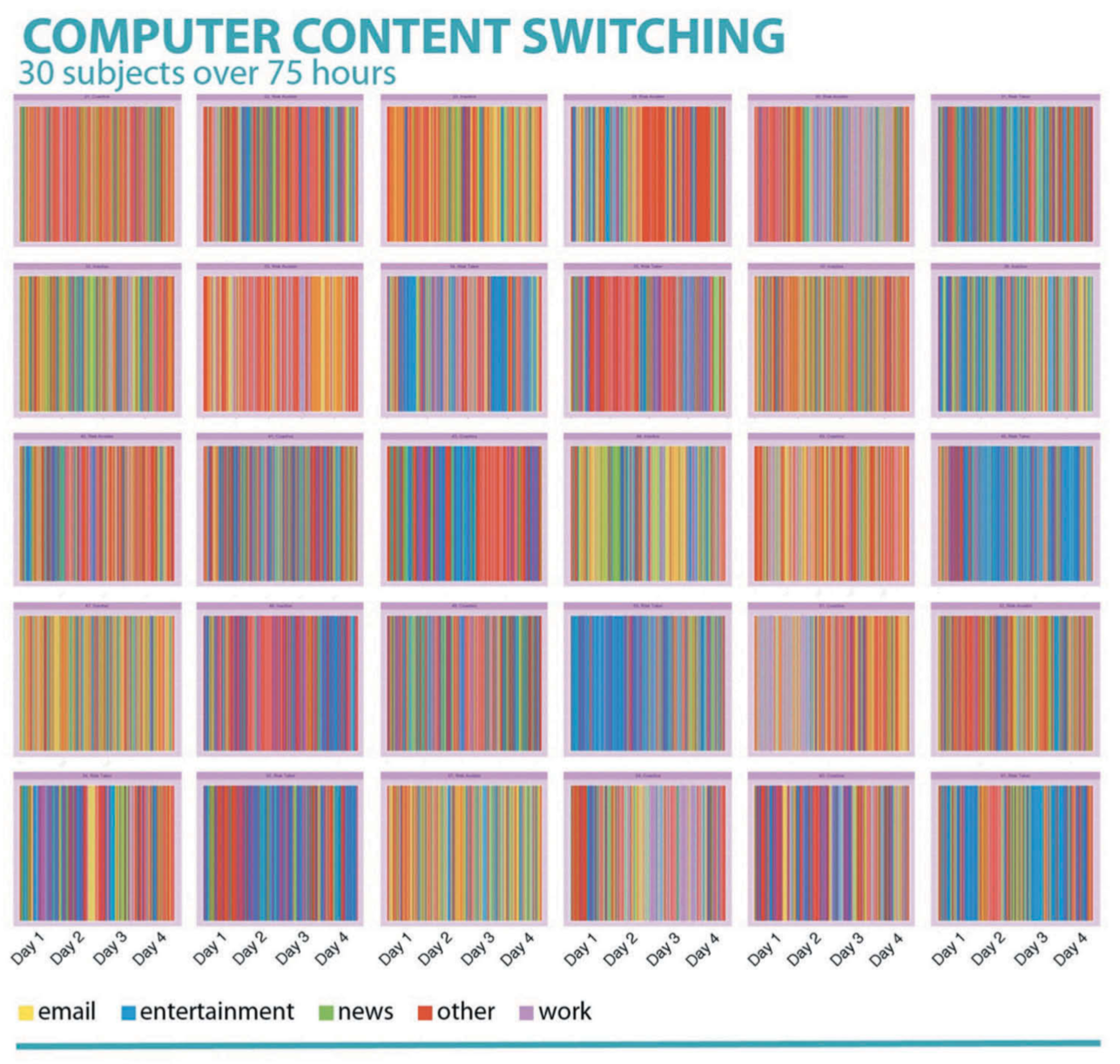
As a response to this newfound complexity and fragmentation of experience, Cummings and his co-researchers documented, via screenshots, the digital activity of 30 participants. The resulting digital records, they write, are best conceived of as "screenomes"—adapted from the word "genome."

Researchers reported that, on average, participants switched from one screen activity to another every 20 seconds and spent hardly 20 minutes on one continuous activity. Their findings were presented as a stream of color-coded graphs (shown at left) depicting what kind of activities individuals used their screens for—entertainment, news, or work, for instance—and how they switched between these tasks.

Quoted in The New York Times' piece, co-author Byron Reeves (Professor of Communication at Stanford University) explained the significance of their proposed "screenomic" framework.

“It’s very counterintuitive to say at this stage, but the fact is, no one really knows what the heck people are seeing on their screens. To understand what’s happening, we need to know what exactly that is.”

CRC scholars and faculty to present at 69th annual ICA conference

By Susannah BlairMay 20th, 2019in Homepage

Many CRC fellows will be attending the 69th annual International Communication Association conference, which is taking place from May 24th to May 29th in Washington, D.C. COM scholars and faculty will be presenting their recent research projects in interactive poster sessions, panels, and paper sessions.
Below is a list of upcoming ICA presentations by CRC-affiliated professors and doctoral candidates: More

Prof. Patrice Oppliger unpacks the “tweencom girl” genre in latest book

By Susannah BlairApril 26th, 2019in Homepage

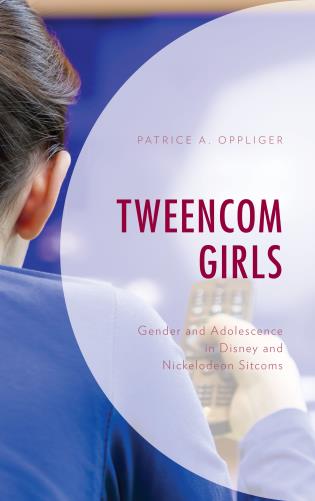
Patrice Oppliger’s latest book, Tweencom girls: Gender and adolescence in Disney and Nickelodeon Sitcoms, is now available via Rowan & Littlefield.

Dissecting popular Nickelodeon and Disney Channel programs, Oppliger—a CRC fellow and Assistant Professor of Communication at Boston University—offers a critical take on how girls in the transition between pre-teen and teenage have been represented in mainstream children’s television.

Along with extensive examples of various character portrayals over the past 25 years, Oppliger also provides practical advice to parents and educators of young women exposed to this messaging.

“Such an in-depth look at the tweencom genre is long overdue,” writes Nancy Jennings (University of Cincinnati) in a review of the book. “The arguments are rich, and the examples are abundant and deep. Opplinger’s read of female stereotypes and girl power stretches beyond princess culture and provides fresh constructions of key tropes and themes.”

Professor Oppliger’s book is accessible in libraries all over the U.S. and available for purchase here

Can you spot sponsored content? Prof. Michelle Amazeen’s study reveals few of us can

By Susannah BlairMarch 19th, 2019in Homepage

In today's ever-shifting online media landscape, "native advertising"—sponsored content that is integrated into a publication without being readily recognizable as promotional—has become increasingly commonplace across digital news platforms. The question then arises: How do individuals perceive native advertisements and are they able to differentiate them from non-promotional editorial content?

Michelle Amazeen (Assistant Professor in BU's Mass Communication, Advertising, and Public Relations department) and Bartosz Wojdynski (Assistant Professor of Journalism at the University of Georgia) sought to explore this question in their recently-published paper. Utilizing the Persuasion Knowledge Model as a framework, Amazeen and Wojdynski measured respondents' cognitive responses to sponsored content. The paper, which was funded by the American Press Institute, also incorporates data about how individuals' traits can influence how easily persuaded by native advertising they may be.

The researchers also tested respondents to see if they could correctly identify content that was sponsored—and, their results show, fewer than 1 in 10 could.

Amazeen and Wojdynski write that a contributing factor in whether respondents were able to spot a paid piece of content was how transparent a sponsor was regarding a paid partnership with a publication. Even when they are knowingly looking at a paid piece of content, however, “people are more receptive to what they’re looking at if they know what they’re reading,” Amazeen told BU Today.

The study also found that younger and more educated individuals were more discerning when it came to spotting native ads. But in cases where respondents weren't able to recognize sponsored content, a substantial portion of them reacted negatively once they realized they had been duped.

“I think it’s contributing to people thinking that news media are sharing fake news,” Amazeen explained to BU Today. “Trust in media is at an all-time low…. I’m not suggesting it’s only from native advertising, but I think it’s a contributing factor.”

Sarah Krongard and Prof. Mina Tsay-Vogel receive attention for research on binge-watching and attitude formation

By Tanvi ShahMarch 13th, 2019in Homepage

With digital streaming platforms such as Netflix and Amazon Prime rapidly expanding their selections of original programming, there is no shortage of opportunities for television fans to “binge” their favorite dramas. But what are the effects of binge-watching behaviors, particularly when the content consumed features graphic violence?

In their recently published scholarly article, Sarah Krongard (Ph.D. candidate in the College of Communication's Division of Emerging Media Studies) and Mina Tsay-Vogel (Associate Professor in the college's Department of Mass Communication, Advertising & Public Relations) draw on empirical research to tackle this question.

"We have control over content, but also technology has control over us," Tsay-Vogel told Boston 25 News in an interview about the research, which explores how exposure to certain television themes relates to individuals’ perceptions of the world. The study examined the violent nature of the most popular binge-watched programs as its focus—Krongard, Tsay-Vogel, and a team of students used quantitative methods to classify the nature and justification of the shows’ on-screen violence.

Exploring a phenomenon known as “mean-world syndrome,” the research team reports that “viewers who spend more time consuming commonly binge-watched online original programming are more likely to see others in the world as mean and less likely to perceive them as altruistic.”

In their article—which has been featured in BU Today, Pacific Standard Magazine, International Business Times and on Boston 25 News—Krongard and Tsay-Vogel also discuss how race and gender can play a role in prejudice formation. They report that the programs analyzed commonly depicted non-white individuals as sexually-threatening while white individuals were more likely to be cast as perpetrators of non-sexual violence.

“In particular, white perpetrators tended to be the ones who were morally justified in their behavior,” Krongard told BU Today. “Non-white perpetrators did not have that privilege.”

Watch the full Boston 25 News segment below: