News

Emma Longo Receives Inaugural Nelson Undergraduate Research Award

By Lindsy GoldbergJune 20th, 2023in Homepage

In May 2023, research conducted by COM undergraduate student Emma Longo was awarded the inaugural Nelson Undergraduate Research Award from the University Research Opportunities Program (UROP). The Boston University Nelson Undergraduate Research Award was established in 2023 by a BU alumni donation from Mark (COM’88) and Ruth Gallagher Nelson to support students conducting research in communications.

Her research, which will be continuing this summer, is supervised by Dr. Michelle Amazeen.

Abstract: Using a rhetorical analysis, this study examines how fossil fuel companies portray climate issues in two native advertisements from the New York Times and the Washington Post. Native advertisements, which appear like posts that belong to platforms, are one of the ways fossil fuel companies attempt to share information on climate science. By investigating the covert advertising strategies used by fossil fuel corporations, researchers can better understand origins of climate misinformation and climate denial.

Longo's research has also been accepted for presentation at the Association for Education in Journalism and Mass Communication (AEJMC)'s annual conference in August. Congratulations, Emma!

Survey: With dating apps, we doubt them but don’t drop them

By Burt Glass

Americans doubt dating apps are the best way to find a successful relationship and they certainly don’t trust them – but they’re apparently unwilling to give up on apps like Match, Tinder and Hinge in the search for their true soulmate.

Those are some of the takeaways from the latest Media & Technology Survey designed by Boston University’s College of Communication and conducted by Ipsos earlier this month.

For every one respondent who agreed that “dating apps are the best way to find a successful relationship these days,” almost three disagreed (15% vs. 39%).

Further, respondents don’t fully trust what they read and see on dating apps. More than 60% of respondents agree that “most people lie on dating apps,” while only 4% disagree. Four times as many respondents agree than disagree that “dating apps are filled with too many machines posing as real people (known as chatbots) to be trusted” (39% vs. 11%).

The prospect of artificial intelligence technology improving dating apps didn’t seem to boost their confidence. Only one in six agreed that “dating apps that use AI, meaning computer-powered artificial intelligence, will lead to more successful relationships.”

Yet three times as many respondents agree than disagree that “people can find their soulmates on a dating app” (41% vs. 15%).

“Dating apps feel like they have so much potential for the people who use them. There is a sense that the ideal person is just one swipe away so you can’t give up, because what if?” says Kathryn Coduto, an assistant professor at Boston University College of Communication whose recent research has focused on dating apps technology.

Read the full story here, BU Brink coverage here and Boston Globe coverage here.

Survey: Americans leery of social media bans for journalists who post content owners don’t like

By Burt Glass

Twice as many Americans disagree than agree with owners of social media platforms, like Twitter, banning journalists who post content they don’t like.

That’s according to the latest Media and Technology Survey from Boston University’s College of Communication conducted by Ipsos, which asked Americans whether the owners of social media networks should be allowed to ban journalists who post information that the owners of the networks don’t like. Only 21% agreed with such a move, while 46% disagreed and 33% neither agreed or disagreed.

Read the full article, which includes media contact information, here.

Access the associated December 2022 Ipsos survey data here.

Letter from the Director: December 2022

By: Michelle Amazeen

As the Fall 2022 semester wraps up, there is an impressive number of new faces and activities at the CRC to reflect on. We welcomed four new faculty research fellows: Dr. Nivea Cannali Bona, Lecturer, Media Science; Dr. Katy Coduto, Assistant Professor, Media Science; Dr. Pablo Miño, Assistant Professor, Public Relations, and Dr. Emily Saidel, Lecturer, Television Studies. We also welcomed 3 new PhD student fellows: Nicole Hash, Dongpeng Huang, and Yihan "Danny" Jia.

Given the University’s commitment to involving students in research, the CRC once again had a busy semester in facilitating fellows’ efforts to recruit students as research participants via our SONA research participant management system. The SONA pool gives students an opportunity to become involved with various research activities across COM while earning course credit for doing so. This semester, 17 studies were conducted, recruiting students from 26 different COM courses to participate in 24 research opportunities.

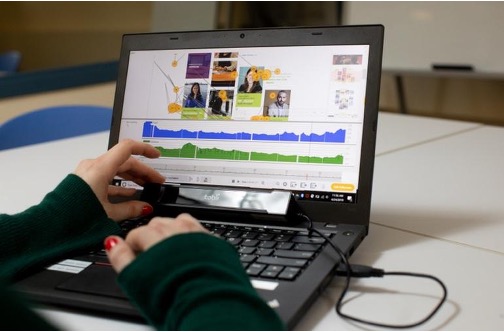
Our fellows have also been using the CRC’s biometric technology which includes devices for measuring heart rate, sweat levels in the skin, and eye movements. Our Lab and Research Manager, Lindsy Goldberg, has been certified by iMotions on use of this technology and has hosted numerous classes and individual students for demonstrations of our iMotions equipment. She has offered workshops on biometrics in media effects research with specific modules on galvanic skin response, facial expression analysis, and eye tracking. A quick primer on demystifying biometrics is available here.
With the assistance of Master Lecturer Anne Danehy, the CRC continued its Media and Technology Survey highlighting the expertise of several of our fellows. The questions were administered by Ipsos, the market research company, using their eNation Omnibus, a nationally representative online survey that measures attitudes and opinions of 1,000 adults across the United States. We fielded one survey about artificial intelligence in the workplace, led by Dr. James E. Katz along with two PhD students, Ekaterina “Katya” Novozhilova and Dongpeng Huang. The other survey involved public perceptions of climate change, led by Dr. Arunima Krishna and Dr. Chris Wells.

The CRC hosted numerous events this fall. Our Colloquium Series, which originated in 2009, consists of monthly research presentations that highlight current and original research of faculty in COM. Our Fall Colloquium Speakers were Dr. Patrice Oppliger (September) and Dr. Charlotte Howell (October). Every semester, the CRC also invites a distinguished scholar from outside the university to share their outstanding scholarship, expertise, and experience with the BU community. Our Fall 2022 DeFleur Distinguished Lecturer was Dr. Sarah Banet-Weiser (University of Pennsylvania).  The CRC also co-sponsored a panel with COM’s Career Services on Careers in Communication Research. The panel included COM alumni discussing their current research jobs and offered tips to students about how to enter the burgeoning field of communication research.

I am incredibly grateful for the commitment and hard work of our staff this fall. Lindsy has been nothing short of outstanding in managing the CRC. She has been involved in every aspect of upkeeping the center, offering workshops on our technologies, overseeing technology and facility reservations, promoting the news and accomplishments of the CRC research fellows and our lecture series, overseeing the creation of this fall’s newsletter, and much more. Sadly, we are saying goodbye to our longtime graduate assistant, Jenna Vigre as she completes her MS in Advertising this semester. She has been a tremendous asset to the CRC with her creative design skills and assistance in promoting and administering our events. We wish you the best, Jenna, as you embark upon your professional career!

Finally, I will be on a much-anticipated research sabbatical in the Spring 2023 semester. The CRC will be in the very capable hands of Interim Director, Dr. Michael Elasmar, with Lindsy continuing as Lab and Research Manager. I will return as CRC Director in the fall of 2023.

I wish you all a joyous and restful holiday season.

Letter from the Director: October 2022

AI: Cause to Rejoice or Frankenstein-like Foreboding?

Artificial intelligence (or AI) has moved from science fiction to mainstream computer science. No longer is it simply the lore of Frankenstein-like creations but rather something that people use in their everyday lives. For instance, web searches using Google rely upon AI. So do the recommendation systems in Netflix and Spotify. If we command Siri or Alexa to do something for us, it is AI that allows them to understand our speech.

As AI advances, the possibilities of its partnering with humans on everyday tasks or even outright replacing humans are becoming increasingly realistic (e.g. self-driving cars). A recent COM Media & Technology Survey examined how the American public feels about AI replacing humans in certain professions. To gain a better understanding of what AI is and what the survey results reveal, I’ve turned to CRC fellows from our Division of Emerging Media Studies. Dr. James Katz is the Feld Professor of Emerging Media and Director of the Division. Ekaterina “Katya” Novozhilova and Dongpeng Huang are PhD students with research interests in AI.

When I asked what AI is, and why it is of interest to communication researchers, Katz explained:

AI is designed to do things that people can do, only much faster and also has its own kind of creativity and learning activities. As such it has the potential to transform society, and therefore is of interest to those of us who study society and its communication processes.

For Novozhilova, AI systems have become frequent human interlocutors. “From children talking with Siri/Alexa to the use of chatbots in therapy by teenagers and adults to the interaction with social robots in senior citizens' homes -- AI might become our lifetime conversational partner,” she said.

One of the things that intrigues Huang about artificial intelligence is that “it is not a living organism, yet it exhibits life-like qualities. AI is able to transmit information and even create information, which makes it a communicator and a social actor.”

When asked what aspects of AI their research examines, Katz indicated, “I am interested in understanding how the public perceives the benefits and risks of AI, and how they might wish to see policy towards AI changed or improved.” Both Novozhilova and Huang are interested in how the public perceives AI in various workplace settings. “Our current study hopes to understand how Americans feel about replacing humans with AI for a variety of jobs,” Huang said.

“Consistent with previous research,” Novozhilova explained, the survey results indicated that “women, people with less income, and older citizens are less welcoming of AI in various occupational roles.” Conversely, Huang added that “Men, minorities, and higher income groups are generally more open to AI replacing human jobs.”

Among the several professions examined in the survey, “the public was most inclined to see journalists replaced by AI compared to other professions,” said Katz. “To me, this suggests that people have reservations about the quality of human-based journalism in the current environment.”

The survey also asked about AI replacing certain religious occupations such as spiritual advisors and leaders of religious congregations. “AI is currently being adopted in various forms by religious congregations” noted Novozhilova. For instance, she said, “robot priests have been recently introduced in Germany, Japan, and Poland. As such, one avenue from which the decisions regarding the controversial employment of algorithms is coming from is religious ethics.” Added Huang, “The spiritual dimension is something we often think of as exclusively human. We wanted to see what the public would think when such a boundary is broken.”

The results revealed that, “Although people have some interest in having AI play a role in their religious lives, there was not a high degree of enthusiasm” explained Katz. Furthermore, observed Huang, “We were surprised to find that whether people were religious or not seemed to have nothing to do with their views on AI replacing religion-related jobs.”

Yet, the fact they found any interest at all suggests an under-explored dimension of technology in society. “It will be valuable to see if over time new generations begin to heavily seek spiritual guidance from AI entities” said Katz. “If so, this will be an historically unprecedented change in religious life.”

CRC fellows Briana Trifiro & Alexander Rochefort, Associate Professor Chris Wells published in Mass Communication & Society

By Rachel SchlesingerSeptember 16th, 2022in Homepage

Congratulations to Briana Trifiro and Alexander Rochefort, CRC graduate fellows in the Emerging Media Studies doctoral program, and Associate Professor Chris Wells, on their published paper in Mass Communication & Society. The paper analyzes a variety of media content (i.e. articles, TV coverage, and Facebook postings) on their coverage of the April 23 2020 White House COVID-19 Task Force press briefing and the way in which these media narratives affect partisan trust. Their results reported that on both ends of the political spectrum, many of the narratives produced in the media have contributed to resentment and distrust in voters and viewers.

To view the full paper, visit https://doi.org/10.1080/15205436.2022.2116719 

Communication Research Colloquium Series Hosts Dr. Patrice Oppliger

By Jenna VigreSeptember 16th, 2022in Homepage

CRC Fellow Dr. Patrice Oppliger, Assistant Professor of Communication, will be discussing her latest book, Transmasculinity on Television, on Thursday, September 22, 2022, from 3:30-4:30 pm in COM 209 — as part of the Boston University Communication Research Colloquium. This talk will take a closer look at 44 transmasculine and nonbinary characters on broadcast, cable, and streaming services between 2000 and 2021. She notes that significant changes have occurred since the 1999 film Boys Don’t Cry release, primarily the increase in transgender producers, writers, and actors playing those roles.

Letter from the Director: September 2022

Back-to-School!

Welcome to the Fall 2022 semester at COM’s Communication Research Center! As our fellows embark on another academic year, generating new knowledge through research and theory building, the CRC continues to facilitate these efforts to address society’s communication-related challenges.

Given Boston University’s commitment to involving students in research, the CRC will once again administer its SONA research participant pool facilitating fellows’ efforts to recruit students. The SONA pool gives students an opportunity to become involved with various research activities across COM while earning course credit for doing so. Instructors who are interested in including their courses in the Fall 2022 SONA pool should reach out to our Lab and Research Manager, Lindsy Goldberg at lindsyg@bu.edu.

Our fellows also have access to the CRC’s biometric technology which include devices for measuring heart rate, sweat levels in the skin, and eye movements. We have software for the experimental design, execution, and analysis of these psychophysiological measurements. Lindsy has been certified by iMotions on use of this technology and will be offering training workshops for interested students and faculty. For a quick primer on demystifying biometrics, you can read more here.

As a means to help fellows provide thought leadership, the CRC will be continuing its Media and Technology Survey. Monthly survey questions are administered by Ipsos, the market research company, using their eNation Omnibus, a nationally representative online survey that measures attitudes and opinions of 1,000 adults across the United States. We piloted the program in February 2022 on the topic of media trust. You can read the results here. If you have an idea for a topic for a future survey, please email me (mamazeen@bu.edu).

To engage our community, the CRC will be hosting numerous events this fall. Our Colloquium Series, which originated in 2009, consists of monthly research presentations that highlight current and original research of faculty in COM. We are pleased to announce our Fall Colloquium Speakers:

September – Dr. Patrice Oppliger (Thursday, September 22nd at 3:30 pm)
October – Dr. Charlotte Howell (Thursday, October 27th at 3:30pm)
November – Dr. Chris Chao Su (Friday, November 4th at 3:30pm)

Every semester, the CRC also invites a distinguished scholar from outside the university to share their outstanding scholarship, expertise, and experience with the BU community. In recognition of the pioneering and inspirational contributions of Dr. Melvin L. DeFleur to the field of mass communication research and his service as a venerable and inexhaustible member of COM, the faculty members of the CRC have named the DeFleur Distinguished Lecture Series in his honor. We are pleased to announce that our Fall 2022 DeFleur Distinguished Lecturer will be Dr. Sarah Banet-Weiser who will be joining us on Wednesday, October 19th at 4:00 pm. More details about all our speakers and their topics are forthcoming.

We are also pleased to announce that the CRC will be co-sponsoring a panel with COM’s Career Services on Careers in Communication Research (Thursday, October 13th at 5:00 pm). The panel will include COM alumni discussing their current research jobs and offering tips to students about how to enter the burgeoning field of communication research.

Finally, the CRC has some new faces we would like to welcome. We have four new faculty research fellows:

Dr. Nivea Cannali Bona, Lecturer, Media Science
Dr. Katy Coduto, Assistant Professor, Media Science
Dr. Pablo Miño, Assistant Professor, Public Relations
Dr. Emily Saidel, Lecturer, Television Studies

We also have 3 new PhD student fellows:

Nicole Hash
Dongpeng Huang
Yihan "Danny" Jia

Returning on our staff this year with Lindsy is Jenna Vigre (MS in Advertising) as well as a new staff member Rachel Schlesinger (MS in Media Science).

Whether you are new to the CRC or a returning member we wish you a productive and satisfying semester filled with opportunities for growth and new learning.