
Welcome New Gastronomy and Food Studies Students for Fall 2020 (part 4)
We look forward to welcoming a wonderful new group of students in our fall 2021 classes, and hope you will enjoy getting to know a few of them here.
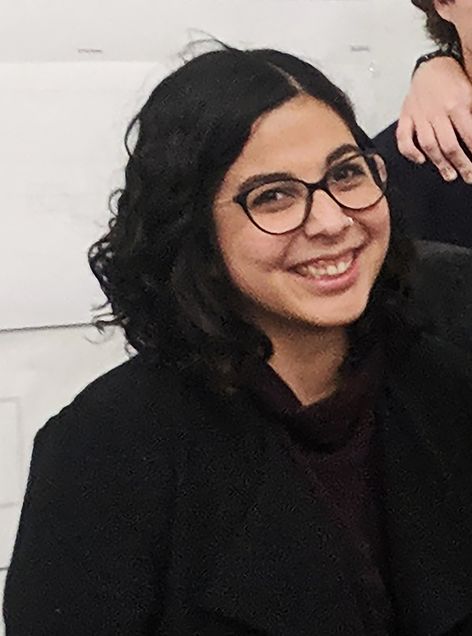 Stephanie Sang Delgado’s life has always revolved around food. From making, eating, and baking, not only would she cook or bake as a stress reliever but also as a way to connect to her upbringing. Being Cuban and Chinese, and born and raised in Puerto Rico, her childhood was mostly focused on her three cultures, and specifically, those cultures through food. As she grew up, she started to focus her time on social justice and was a Martin Luther King Jr. Scholar at Ithaca College, but food never left her mind. She would spend her time baking and cooking for her roommates and classmates. After Ithaca, Stephanie wanted to explore a new passion, architecture and went to graduate school at The Ohio State University. It wasn’t until she graduated and worked on the design of a culinary school that she realized the relationship between architecture and food. She wants to pursue an MLA in Gastronomy to further understand how food is studied and the methodology behind it to enhance her architecture research. Stephanie is a licensed architect and educator. She runs a small experimental award-winning practice called office ca. She currently teaches as a lecturer at Texas Tech University and Virginia Tech. Most recently, she was the Visiting Teaching Fellow at The School of Architecture at Taliesin and has taught at The Ohio State University and Columbus College of Art and Design.
 Jessie Rives is very excited to be joining the Gastronomy program! Originally from rural New Hampshire, and with a few stops along the way, she has happily resided in Boston for over ten years. Her passion for food is longstanding, having spent some of her childhood living at a farm-school in upstate New York. Although her gardening is now limited to her patio planter boxes, someday she hopes to have a large, bountiful, backyard plot.
Jessie has worked in many restaurants over the years, in both front and back of house roles, and truly enjoys the dynamic energy of the food industry. Eventually she would love to open a small cheese, wine, and specialty food shop similar to one of her favorite establishments in Boston, Formaggio Kitchen. Jessie has had the fortune to travel quite extensively and has always been fascinated by the inextricable tie between a culture and its food and culinary traditions.
She feels very lucky to have attended culinary school at The Cambridge School of Culinary Arts and earned her Level III certificate in the WSET program and hopes to utilize the knowledge gained from these programs in her studies at BU!
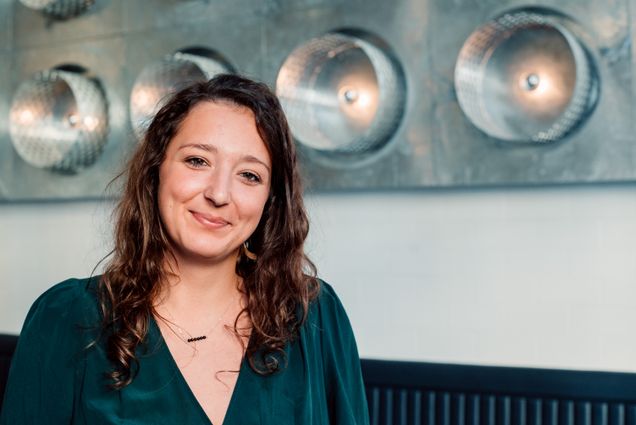 Madeline Blair has lived in the Somerville/Cambridge area for about about 3 and a half years. Having lived in Lake Tahoe for a period of time completing undergrad and working, she enjoyed moving back to New England and the abundance it has to offer. Madeline grew up in a small farm-town in Connecticut. She values the idea of food as nourishment and values connecting with the earth through sustainable farming practices.
In the last month, she has been working on an exciting new venture, SolBe Provisions providing weekly seasonal food shares to the community by exploring culinary curiosities and the local-food ecosystem. She has spent time visiting, volunteering and connecting with farmers and the local communities.
She enjoys living in Somerville and having small dinner parties at her plant-filled home with her roommate. Madeline thrives when cooking and enjoying good food and drinks with others. Her favorite sandwich will always be a classic tomato sandwich in the middle of August. She has a great appreciation for the simplicity of a few delicious, quality ingredients coming together as one.
Madeline enjoys traveling which has given her great appreciation for different cultures, cuisines and lifestyles. Her experience in the restaurant industry has allowed her to grow and explore food and wine in depth and has ultimately encouraged curiosity to study at BU.
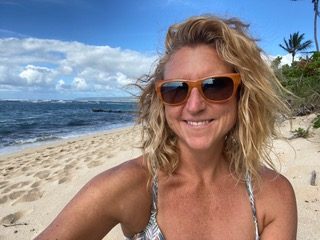 After working in national security for 15 years, Cynthia Archibald decided to pursue her passion for nutrition. She earned an MS in Holistic Nutrition in 2017 and began working in her community on Oahu’s north shore. She provides nutrition counseling, delivers community talks, partners with local farms, and continues research and writing. As she's learned more about the connection between diet, food production and the health of our planet, her interest has shifted toward issues of food security and sustainability.
These issues are uniquely relevant to the islands of Hawaii, where she's lived for 13 years. Hawaii, which boasts some of the most ideal farming conditions in the world, has become almost entirely dependent on imported food. These issues led her to focus her community engagement on helping people understand how their food choices affect their health, their local economy, the environment and their security. However, she's concluded that in order to influence our society on a greater scale, she needs to further her knowledge on food systems, anthropology and food policy.
In her spare time she can usually be found in the ocean - swimming, surfing or paddling - or in the mountains running on trails or camping with her husband and black lab. Unsurprisingly, She is a hard core foodie and loves concocting creative internationally-inspired meals from locally-sourced veggies. She’s incredibly excited to join this cohort of like-minded folks!
Welcome New Gastronomy and Food Studies Students for Fall 2020 (part 3)
We look forward to welcoming a wonderful new group of students in our fall 2021 classes, and hope you will enjoy getting to know a few of them here.
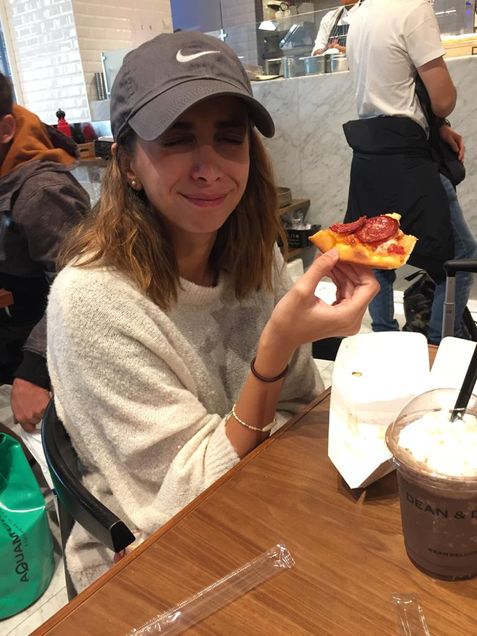 Salma Serry is an Egyptian writer, researcher and filmmaker. She grew up in Dubai where it is mundanely normal to have tangy Palestinian zaatar on Afghani naan for breakfast, hearty Persian Ash-e-jow soup for lunch, and smokey Yemeni Mandi for dinner after snacking on street-cafeteria Punjabi Samosa that is washed down with the quintessential British Vimto. And so naturally, she found a perfect fit in exploring the interconnectedness of food in the Middle East as a cultural product with all the rich yet complicated politics, histories and flavors the region carries.
After working in the media industry for 10 years, Salma’s work now focuses on researching and documenting the media, film and food scenes with special interest in finding answers in history in order to understand contemporary socio-cultural issues and questions. She has an MA in Television and Digital Journalism from the American University in Cairo and has produced a number of films and projects on the history of Biryani, food safety in the Egyptian streets as well as a video installation that maps the immigrant food culture in Al Ras area of Dubai. In order to further develop her food research and writing skills, she has joined BU’s Gastronomy program this fall in hopes of strengthening her multidisciplinary practice and pursuing her obsession in everything falafel and hummus.
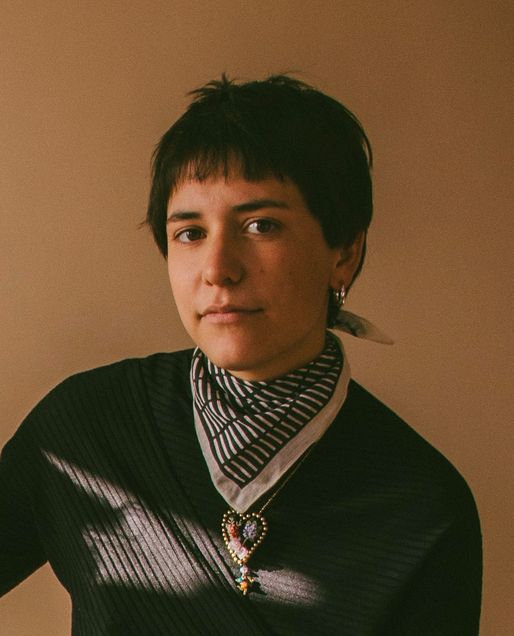 Born in Guadalajara, Mexico, María José Córdova immigrated with her family to Dallas, Texas at just a year old. Since then, she has grown up straddling the hyphen in Mexican-American.
Curious to live in a different place, María José went to study English and French at Boston College. Learning languages led María José to teach English for a year in the French Basque country. There, María José began to appreciate both the simplicity and possibility contained in different foods. Cooking transformed from a household chore into a practice of intuition and passion.
At the end of her year, María José walked through France on El Camino de Santiago for thirteen days. This pilgrimage crossed cities, villages, vineyards, pastures, and farmlands. The visual and gustatory experience of food along the way was nourishing, replenishing, and always delicious. The regional view of food as a way of life inspired María José to return to Boston and become an apprentice at Siena Farms.
While at Siena Farms, María José worked her way up to becoming Harvest Manager and Greenhouse Manager. The demands of the job brought sore muscles but immense satisfaction. After learning the basics of growing vegetables, María José moved out of the farms and into the kitchen of Sofra, one of Boston’s most beloved cafés. The atmosphere of respect for Turkish culinary heritage and the importance of our local food systems at Sofra seemed to represent a culmination of Maria Jose’s previous experiences.
Through the gastronomy program, María José hopes to study ways that the restaurant industry can prioritize the values of equity and sustainability in their kitchens and dining rooms.
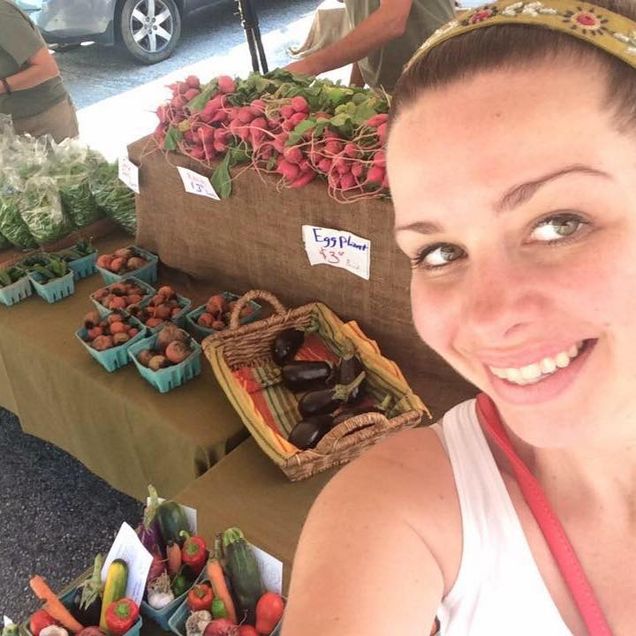 Corey Davis lives in Richmond, VA with her husband and their 3-year-old son. She graduated with a degree in Theater and Dance from James Madison University. As often happens, while working in the Richmond theater scene, Corey found herself also working in the restaurant industry. During that time, she developed a passion for food, wine, and spirits. That excitement ended up leading to a transition into Food and Beverage sales where she has been working in different capacities for the past 7 years. She is currently a National Account Manager at a beer wholesaler in Richmond, working with national convenience and grocery chains. However, over the years she has learned that a traditional salesman she is not - not in the crunching numbers sense anyway. But it’s different when a sale happens organically, when she is able to share something she’s excited about with someone who needs it.
With that, Corey has transitioned this passion into starting Lifeis4Tasting social media pages. It began as a way for her to share the food and drink that she was enjoying at home and around town, but it has morphed, as she has, to be a tool for supporting local farmers, cooking with fresh ingredients, and lifting up the Richmond community and surrounding areas. During this time, she also started working seasonally at the Farmer’s Market with Black Creek Farm, an amazing produce farm located just outside of the Richmond area. Through this, she has made many great relationships with other farmers and vendors. She has continued to learn more about Virginia’s food system, what grows there, and how to use it. She continues to share what she has learned with others and with her family, and is excited to continue that growth at BU.
Welcome New Gastronomy and Food Studies Students for Fall 2020 (part 2)
We look forward to welcoming a wonderful new group of students in our fall 2021 classes, and hope you will enjoy getting to know a few of them here.
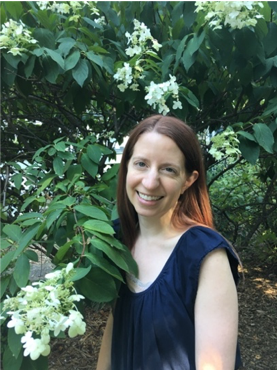 After living in several regions of the United States, Anne Howard settled in the great food town of Chicago upon graduating from Northwestern University. Her professional background includes time in marketing and advertising, where she learned not to copy-edit restaurant menus right before lunch. She spent several years reading resumes as a communications recruiter and enjoyed a side gig as a restaurant mystery shopper, the closest she’ll ever come to being a food critic. A chance meeting with an alum of the Gastronomy program led her to begin taking classes remotely, and she’s thrilled to now be officially enrolled in the program.
Raising two school-age children has caused Anne to think a great deal about food, and how the foods of our childhood affect us our entire lives. She’s interested in all things connected to food and kids: school lunches, food allergies, nutrition, marketing, the development of taste, etc. She’s also inordinately excited whenever she manages to grow something edible in her small, shaded urban garden.
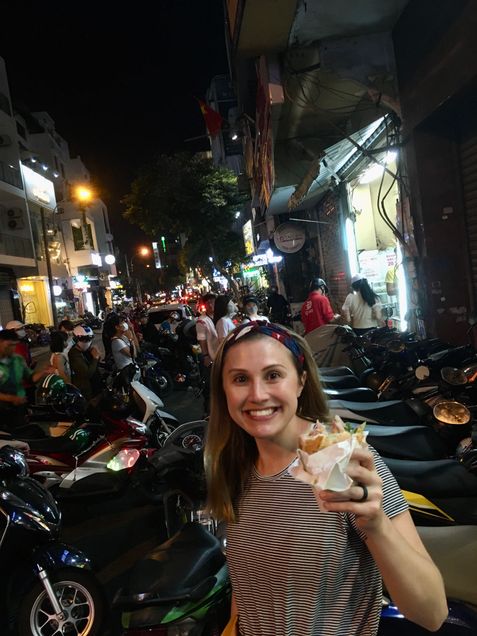 Erica Conte joins the Food Studies program from Chicago, Illinois where she has lived for the past 5 years. Prior to Chicago, Erica lived in New York and is originally from New Jersey.
Erica spent the first part of her career in advertising but had an itch for something more. It wasn’t until she began working at a foodservice research and consulting firm that she started to examine her own relationship with food as well as the deep complexities around food systems. Erica always loved food and continues to test her spice tolerance regularly, but it wasn’t until this role that she became curious about how food made her feel, how food is labeled, or marketed.
Erica works with restaurants and food manufacturers that are looking for insights to help move their business forward in a dynamic and intricate industry. Having been in this industry for 4 years, Erica has become passionate about food policy, sustainability, and creating an equitable food system. On a pursuit to dive deeper into this field, she learned about the Food Studies program and is thrilled to get started in the fall. Erica looks forward to strengthening her knowledge in an area that has become an increasingly large part of her professional and personal life.
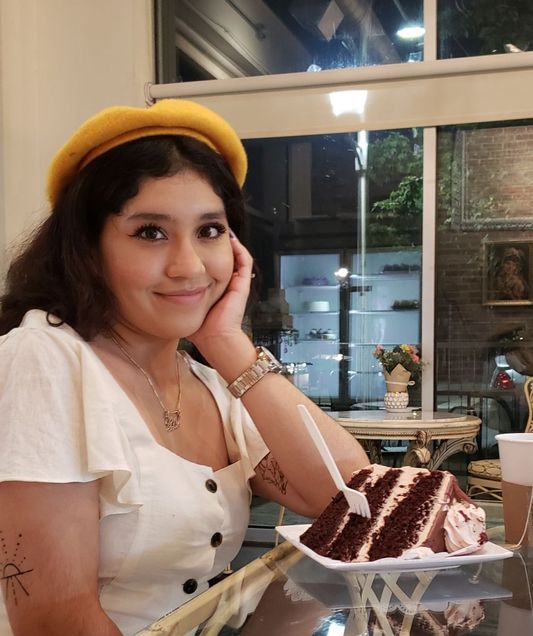 Edith Dimas was raised by Mexican immigrants in the southwest side of Chicago. She spent most of her childhood weekends watching her mother cook while hearing her mother tell stories of her childhood in rural Mexico. Edith would spend her summer vacations watching PBS cooking shows, writing down recipes, and cooking for her family.
Having received a Sociology degree from Roosevelt University, Edith pursued working in non-profits and doing community work. While she enjoyed working with the community, her passion for food was rekindled when she and a group of co-workers decided to start a community garden. She tended the garden every day and enjoyed learning about the veggies and plants that blossomed in the garden.
With her reawakened love for food, Edith has since been working in a food bank, allowing her to work with food and do community work. Edith is enthusiastic about being part of the Gastronomy program. She hopes to learn and research the history of Mexican and indigenous cuisines.
Welcome New Gastronomy and Food Studies Students for Fall 2020
We look forward to welcoming a wonderful new group of students in our fall 2021 classes, and hope you will enjoy getting to know a few of them here.
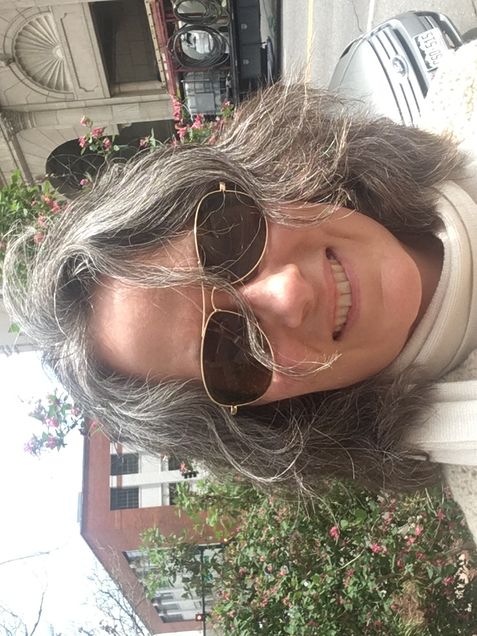 In the 1970s, people didn’t eat cardamom ice cream, at least not in Tulsa, Oklahoma, where Gretchen Kurtz grew up. But one night, staying up past bedtime to ring in the New Year with her parents, Gretchen tried it, and realized there was a world of flavor she’d never heard of. Since then, she’s spent her life learning about foods, cooking techniques and recipes, and is especially drawn to what they say about the people and culture that produced them.
After graduating Princeton with a degree in comparative literature, Gretchen worked for several years in Paris, London and New York, where she spent weekends mapping out and visiting the cities’ best bakeries, tea salons and bistros. If the internet had been a thing back then, she would’ve surely started a blog about her experiences. Later she transitioned to food writing, first as an editor/writer at magazines and newspapers in New York City and Denver, including the New York Times and the Denver Post, and ultimately eating her way to a job as restaurant critic for Westword, an alt-weekly in Denver. After seven years in the role, Gretchen decided it was time to have different conversations about food than “what’s the best restaurant?” and happily discovered BU’s gastronomy program.
Though restaurants have been her niche, Gretchen never lost the thrill of home cooking, and loves nothing more than going to a farmers market, picking out peaches, tomatoes, squash and basil, and heading straight into the kitchen. To her, one silver lining of this pandemic has been the time to teach her three normally-busy teenagers how to braise, macerate, and make stock.
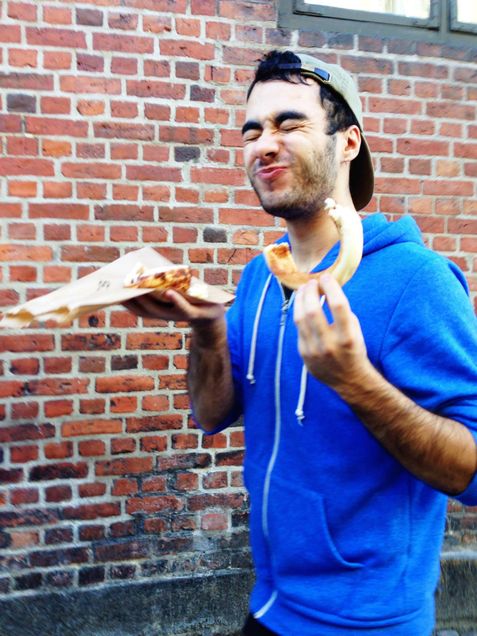 Julian Plovnick is a local guy hailing all the way from the distant streets of Brookline, MA. His obsession with food began when he was gifted his first knife set for his bar mitzvah (which he still uses to this day) along with a copy of Good Housekeeping's Children's Cookbook. Having noticed that he spent more time in the kitchen than on the dance floor, the caterer of the party offered Julian the opportunity to help her out with future events as a server and kitchen assistant. Thus, Julian's culinary journey began.
Fast-forward a couple years, and Julian received his English degree at Vassar College in New York's Hudson Valley (conveniently located 20 minutes away from the Culinary Institute of America). After graduating, he combined his love of food with his editorial talents at a variety of food-focused companies such as Clover Food Labs, culture: the word on cheese, and ezCater, where he's spent the last 4 years. Julian's ecstatic to continue along on his culinary journey within BU's Gastronomy Program, where he plans on furthering his skillset in food writing, recipe development, and business operations.
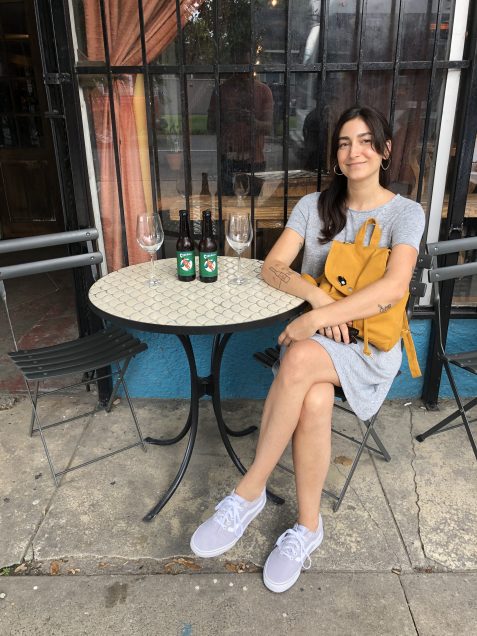 Marie-Louise Friedland was born and raised in her family’s French restaurant in San Antonio, Texas and from her time there as a child, she has had a passion for the Food & Beverage industry. She started with waiting tables in high school and branched out to try everything from being a cheesemonger to working in catering to becoming a Certified Sommelier as a way to fuel her passion.
It was while working as a captain and Sommelier in Austin that she knew she wanted to travel as much as possible to learn about wine so she packed up everything and headed to San Francisco. It was there that she worked as a Manager and Wine Director, pushing her to immensely grow her palate. These positions allowed her to travel to famous wine regions but also allowed her to develop management and team building skills.
Following the desire to keep growing within the industry she moved back to Texas and explored more of the management side of restaurants. It was seeing the industry from this vantage point that pushed Marie-Louise to apply to a program that can equip her with the necessary education to help progress the industry forward. She is excited to join Boston University’s Master’s in Gastronomy program because she knows graduate school will give her the well-rounded understanding of all issues pertaining to the Food & Beverage world outside of restaurants. When she isn’t studying she is probably playing with her cat Billy, cooking something with her husband, record shopping or reading some Stephen King.
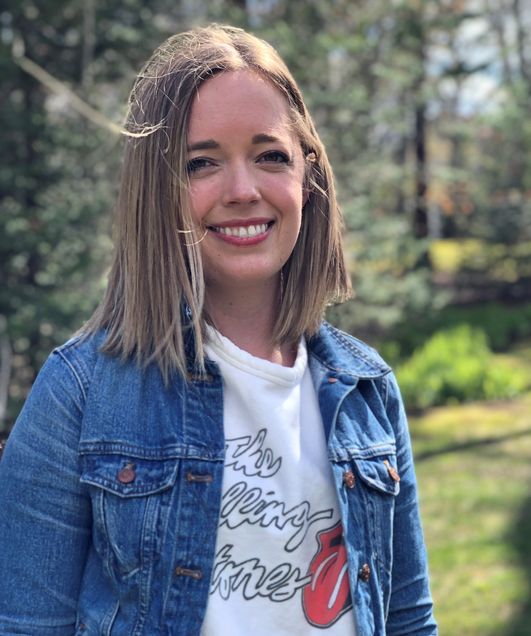 Haley Ornitz was born and raised in the Northeast surrounded by many creative family members, who inspired her to develop a passion for the arts and working with her hands at a young age. She studied Art/Art History at Bucknell University and has worked at non-profit and for-profit arts organizations in New York City and Boston for the past 10 years. Throughout her life, Haley has channeled her energy into many tactile crafts, including painting, calligraphy, pottery, knitting, and cooking, her favorite form of creative expression. She is excited to build upon her passion for food by pursuing her MLA in Gastronomy, a topic she became interested in for many of the same reasons she was drawn to Art History as an undergraduate. Similarly to studying society through a painting or an art movement, she loves learning about culture, history and political economies through the lens of a particular dish, type of regional cuisine or aspect of the food system. In addition to her studies, she is looking forward to exploring how she can apply her experience in the arts to a creative and meaningful career in the food industry. In her free time, Haley loves cooking and eating with family and friends, reading cookbooks cover to cover, and spending time outside with her husband and dog, Ranger.
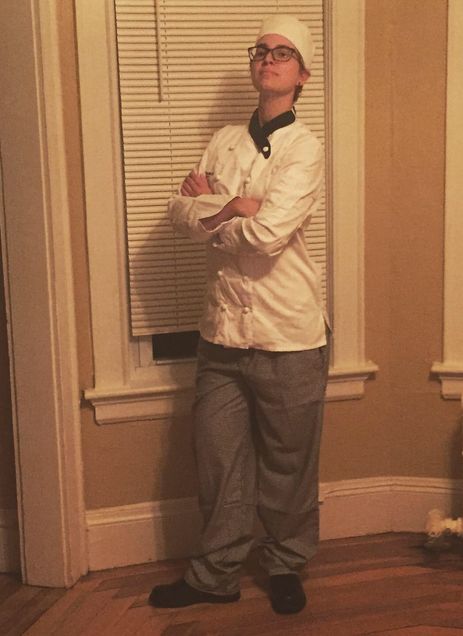 Bella Brookes first developed an interest in food preparation at the age of two, when she learned that messes were okay if it was because you were covering a cake in chocolate frosting and sprinkles. Originally from central Florida, she spent her formative years in Boulder, Colorado. Her formal interest in food was piqued when she spent four years getting a bachelor's in Cognitive Science in L.A. and was fully immersed in an international food culture. So much was the interest in food that she decided to completely turn her life around and spent one year at Johnson & Wales University's Pastry program in Rhode Island.
Bella took several jobs in bakeries in different locations before deciding to pursue the academic aspects of food and culture. She thinks her professional training will provide a practical background for studying the interactions between food and culture. Her current goal is to work in a publishing environment that focuses on food history and the evolution of food from straightforward sustenance into the nuanced and prominently social culture it is today.
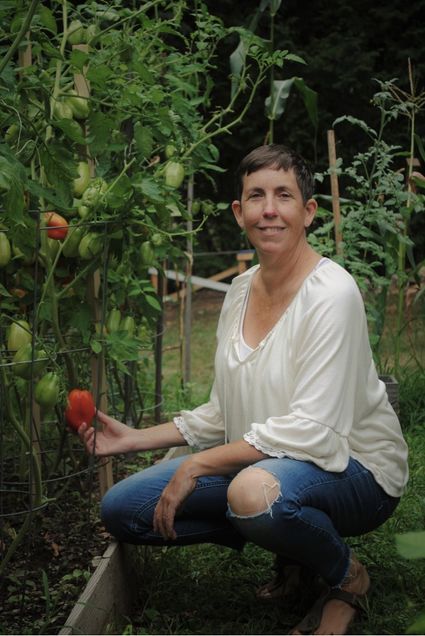 Jen Wood is from Worcester, Massachusetts where she has been a licensed massage therapist and small business owner for over 16 years. She received her B.A. in Anthropology, with a concentration in Environmental Sustainability, May 2020 from Southern New Hampshire University. Her passion for food history and culture came out of her early college years as an anthropology student at New Mexico State University in the early 1990s, after reading anthropologist Marvin Harris’s work on cultural food customs and taboos. While cooking and baking have been an interest since childhood, the plan to study food and anthropology became clear thanks, in part, to nutritional anthropologist Deborah Duchon and chef Anthony Bourdain.
As an undergrad, Jen researched and wrote on the history of the noodle along the ancient Silk Road, the influence of breakfast cereal on pop culture, the problem and solutions of world-wide food waste, and focused her capstone on food insecurity in the world of Ethiopian khat farmers. As a massage therapist, she speaks to clients about their food choices as an approach to physical and mental healing. Jen’s downtown Worcester massage office is decorated with beautiful photos of food from around the world.
Jen is excited to begin a new education and career path with an open mind to what awaits her in the food studies realm. She brings along her husband, dog, cat and four hens on this life changing adventure. Jen loves hosting friends and family for feasts, especially if she grew the ingredients. Founded with her husband Chris, Woodstello Urban Farm was created as a fun Facebook page in spring of 2020, to connect with loved ones during the Covid-19 pandemic, with hopes to grow from a backyard garden into a small working farm, homesteading life, and recipe blog.
Food Justice and Prison Abolition
Gastronomy student Danielle Jacques calls on the community to sign this petition, written by BU Students Against Mass Incarceration, demanding that the university cuts ties with Aramark, one of the largest food service contractors in the country which services state and federal prisons as well as BU dining halls.
By Danielle Jacques
At first glance, the two topics in the title of this post may appear to have little to do with one another. Those of us who study the world through food may contend that the issue of food and prisons is peripheral rather than central to our discipline. On the contrary, we believe that our research has historically ignored the integral role of the carceral state in our food system, and that any world where the values of food justice are to succeed on a societal scale is necessarily a world without prisons.
The US prison system is hardly a few steps removed from its roots in slavery. In the wake of the Civil War, the convict lease system filled southern plantations with the free labor of formerly enslaved African American men. Though the program officially ended in 1910, both states and private companies continue to profit off the labor of incarcerated men and women, who are disproportionately black and brown. The recent wave of anti-immigration policies, which have increased hostility towards undocumented farmworkers, has also increased use of prison labor in agriculture throughout the US. As Reese and Carr point out in their recent Civil Eats piece, a just food system requires abolishing the “plantation-paradigm” that was built into our agricultural economy hundreds of years ago.
Research that unpacks the ills of industrial agriculture in the US often does not sufficiently acknowledge that our food system rationalizes incarcerated individuals as subhuman, and therefore disposable. But incarcerated people are not simply units of labor, producing the food that feeds this country for free. As human beings, they must also eat. And somehow, state and federal prisons with collective budgets of over $8.5 billion per year get away with feeding a population of 2.3 million incarcerated people for less than $2, per person, per day.
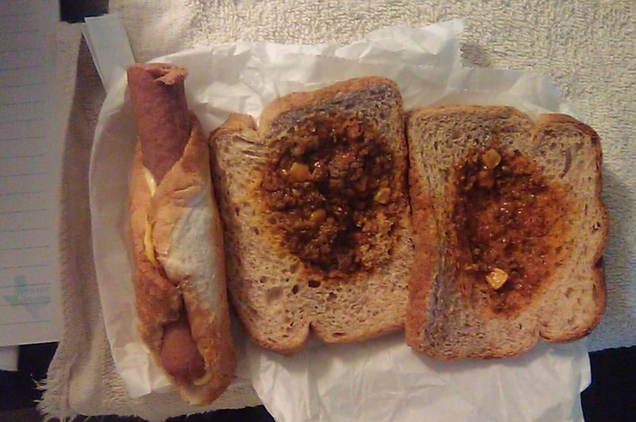
This is where Aramark comes into the picture. In Prison Food in America, Camplin details the business of feeding prisoners. Private contractors like Aramark have become popular in both federal and state prisons, with prison populations at as much as 137% capacity, because they promise to cut down both work and budgets for administrators. Since contracts are negotiated in advance, Aramark profits more by cutting food costs to the absolute bare minimum. And since there are no official food safety or nutritional protocols in prisons, there is no accountability.
We hear about the foods that people suffer through in prison anecdotally. Accusations of maggots, mice, and feces in Aramark’s meals have made headlines in recent years. “There's no imagining the cartoonish dishes that landed in front of us, like bologna soup” writes Stephen Katz. Camplin highlights an instance where portion sizes were reduced from two pieces of bread and a spoonful of vegetables to one piece of bread and half a spoonful. A woman who is five months pregnant eats plain, cold noodles for the fourth day in a row. Cafeterias run out of milk and soda is watered down. Even still, some prisons have reduced the number of meals per day from three to just two.
According to Al Gordon, who worked in an Aramark-run cafeteria while incarcerated, “you could eat six portions like the ones we served … and still be hungry. If we put more than the required portion on the tray the Aramark people would make us take it off. It wasn’t civilized. I lost 30 pounds. I would wake up at night and put toothpaste in my mouth to get rid of the hunger urge. The only way a person survived in there was to have money on the books to order from the canteen, but I didn’t have no money. It was especially bad for the diabetics, and there are a lot of diabetics behind bars.”
Given that environmental racism causes chronic diseases to disproportionately affect the same communities that are over-policed in this country, this example illustrates some of the layers of violence perpetrated against black Americans through food. Furthermore, according to Conley and de Waal, systematic food deprivation as a form of punishment, which has become the status quo in our prisons, qualifies as a “starvation crime.” Until Boston University cuts ties with Aramark, our tuition dollars will continue to fund these abuses.
But Aramark is only one piece of the ever-expanding prison-industrial complex, which, in the face of opposition, has adapted at every turn to meet the demands of its administrators and stakeholders. In 2018, for example, NPR broke the story of an Alabama county sheriff legally syphoning off $750,000 from his county’s prison food funds to buy a beach house. The “keep and retain” law, which dates back to the 1930’s, effectively incentivized cutting the costs of feeding prisoners by freeing up any savings from the food budget for the sheriff’s personal use. Outrage ensued, and in 2019 the law was changed, prohibiting sheriff’s from keeping the leftover money for themselves. But earlier this year, two counties in Alabama succeeded in amending their local constitutions in order to reinstate the law.
There is no question that every link in the prison-industrial food chain is, by design, exploitative and inhumane. A business model that incentivizes starving people for profit cannot be reformed. It must be abolished. For this reason, fighting for food justice means demanding nothing short of prison abolition. But as Reese and Carr point out, “as a terrain of struggle, abolition is as much about building the institutions, relationships, and worlds we want to live in as it is about dismantling those we reject.” It takes bravery and imagination to create a world that has never existed, but this is precisely the urgent and necessary work that must be done.
Course Spotlight: Cookbooks and History

What can cookbooks and recipes tell us about an individual? A community? A culture? What does the language of the recipe say about systems of knowledge and ways of thinking about the world? The movement of ingredients and food technology? The transmission of cooking knowledge? Does the analysis of historical cookbooks have contemporary applications?
In the “Cookbooks and History” course, Dr. Karen Metheny will help students consider these questions through a survey of historical cooking texts and in-class exercises. Students will examine cookbooks as a source of culinary history and a window into the changing material culture, practices, spaces, and relationships associated with food preparation and consumption. In addition, students will examine cookbooks and recipes as social documents that reveal the presence of social and economic hierarchies, networks and alliances, and political, economic, and religious structures. They will also examine these documents as cultural texts that reveal the construction of ethnic, gendered, and other identities. Students will study and analyze a selection of cookbooks from different historical periods and geographic regions leading to a final project and paper.
This class will meet on Monday evenings, from 6 to 8:45 PM, starting September 14th. The course is open to graduate students and advanced undergraduates. Non-degree students may also register. Please contact gastrmla@bu.edu for more information.
Food & Visual Culture: Student Photography
Gastronomy students in the Summer Session course, Food & Visual Culture, had the pleasure of taking a virtual field trip to food photographer, Nina Gallant's studio. Nina explained the contemporary food photography workflow process, and students were able to witness and engage in a client-driven project.
Nina then gave the students a challenge: "Create a message using food. Use this time and space to bring focus to a word or words that respond to the crazy world we are currently living in. You can spell a word or phrase, or simply create a still life using food and non-food items to express your idea, emotion, memory, daydream, or message. Use this assignment as a time and space to create a response to the zeitgeist we are participating in. Consider this photo an album cover for your life right now."
Here are some of the beautiful and thought-provoking images the students styled and photographed:
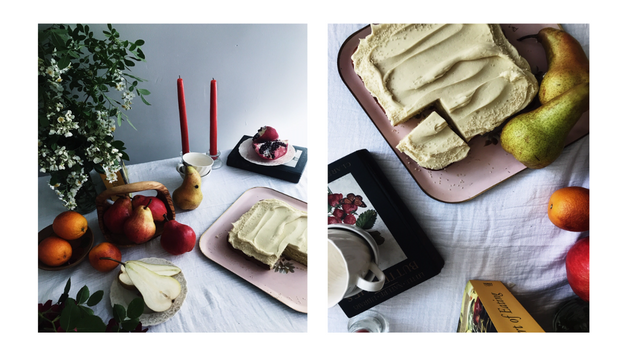
Since being quarantined, I have developed a deeper relationship with the concept of home. I wanted to create an image that reflected the mood and atmosphere I try to foster in my home. Inspired by 17th century Dutch still life paintings, home, to me, is a little bit moody and a place to reflect, recharge and appreciate small details like late afternoon light coming through the window or brown speckles on a ripe pear.

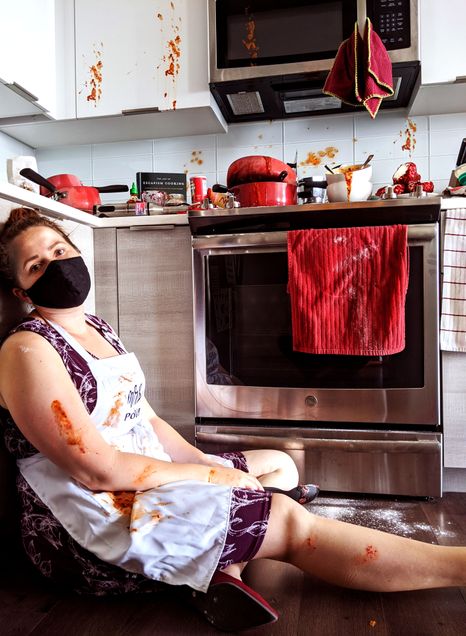
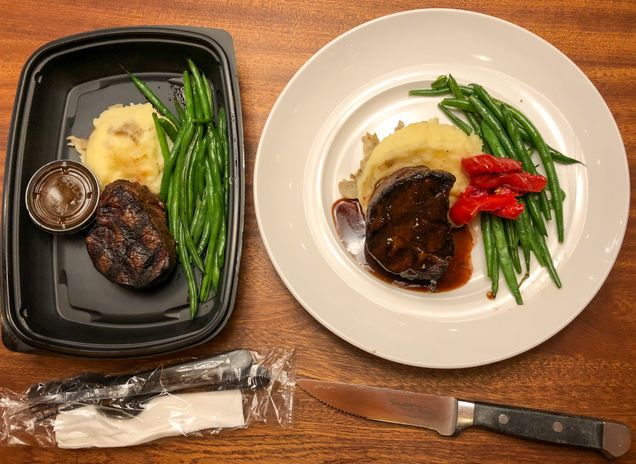
Anonymous woman: Quarantine Cooking
This photo attempts to represent the stress, anxiety, loneliness, and unpaid labor many people, especially female identifying individuals, have been burdened with during COVID-19 quarantine.
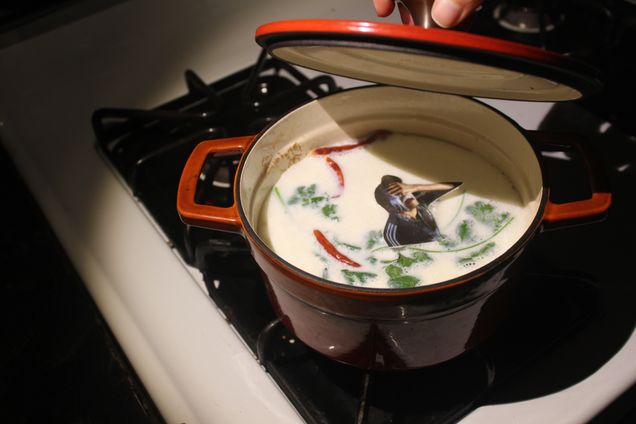
Pictured inside the pot, a photo of an unnamed protestor by John Minchillo/AP Photo.
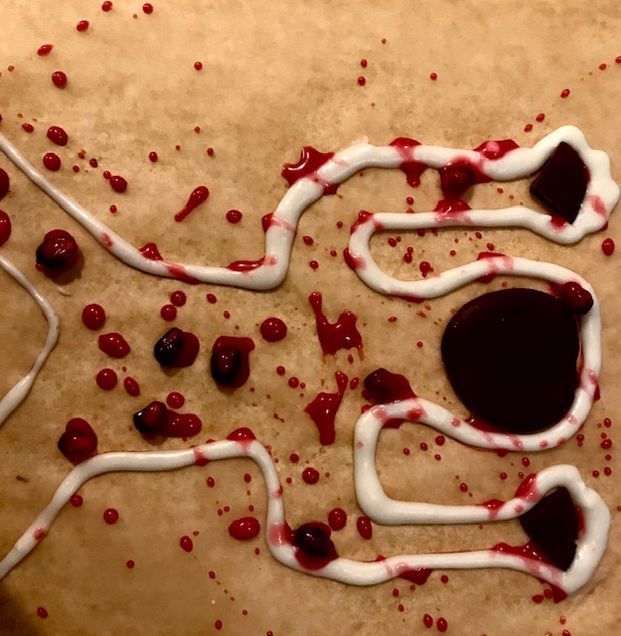
This photo derives from less of a concrete idea, and more of a sensation. The pairing of coconut milk and chilis has marked my quarantine cooking endeavors, and one night as I listened to stories of the Black Lives Matter protests around the world, my face began to burn. I had touched it with the same hand I used to drop chilis into a pot of coconut milk and fish. In response, I thought of the countless images of protestors getting tear-gassed around the country, and how their eyes, throats, and skin burned as fellow protestors tried to soothe their pain, pouring milk and frothy sodium bicarbonate mixtures down their faces. In response to the tear-gassing of protestors (peaceful or otherwise) and the recent spotlight on the US’ oldest pandemic (white supremacy), I created this photo to explore the ideas of discomfort, control, white privilege, and as many of classmates pointed out, horror. I don’t think I’ll ever settle on one ‘meaning’ for it; with each time I view this image, its message changes, evoking all kinds of discomfort on a personal and societal level.
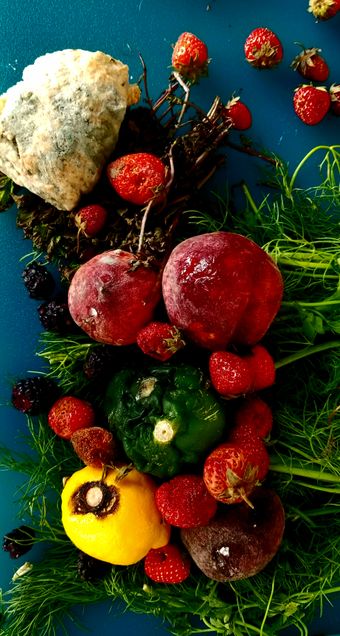
In response to the recent protests and uprisings against systemic racism and state sanctioned violence, an excuse that I have heard a lot lately is, “It’s only a few bad apples.” However, most people fail to finish this well known phrase: “A few bad apples ruin the whole bunch.” When composing this image, I didn’t have any bad apples on hand, but I used what was available to me. I chose the style of a still life oil painting to bring attention to the way that our society’s values, and what we deem beautiful.
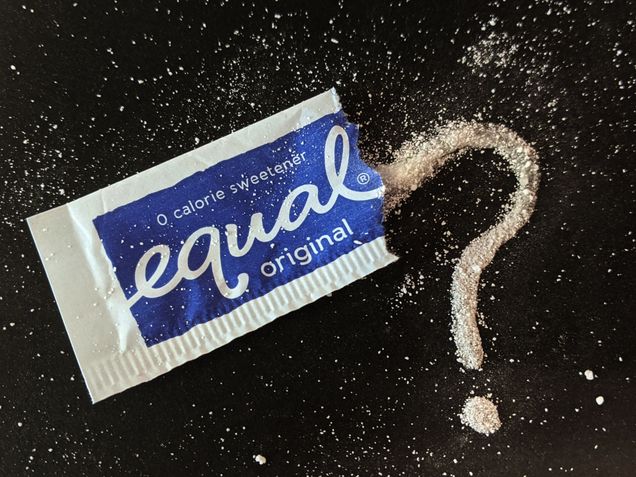
The Perfectly Neglected Carrot
What are the criteria for the fruits and vegetables you buy at the store? Perhaps the unblemished tomato, round firm oranges, or perfectly straight carrot? Unconsciously, many people pick up those that are aesthetically pleasing, yet 40% of it will be left uneaten. In light of the current food insecurities and ongoing fight towards preventing food waste, are you neglecting your food at home?
This photograph utilizes food items to spell a word in order to create double meanings; highlighting the characteristics of the food being photographed as well as societal events. The word, “Rise,” written into the flour, encourages transformation. Rising is not just what bread does, it is also a call to rise up against racist systems and industries to make them more just, diverse, and inclusive.
Course Spotlight: Race, Ethnicity and Food
Dr. Megan Elias will be teaching Special Topics in Gastronomy: Race, Ethnicity and Food during the Fall 2020 semester. This 4-credit course will examine how constructions and experiences of race and ethnicity shape and are shaped by foodways. Both positive and negative definitions of racial and ethnic identities delimit access to and use of different foodstuffs and preparations. In this class we explore these processes, focusing particularly on North America. We will read widely in the literature, paying close attention to intersectional scholarship to understand how limitations related to race, ethnicity, class, religion, gender and sexuality reinforce each other and are also challenged and resisted together. Students will be responsible for participating in and sometimes leading discussion, completing regular writing assignments and designing and completing a semester-long research project.
This class will meet on Wednesday evenings, from 6 to 8:45 PM, starting on September 2nd. The course is open to graduate students and advanced undergraduates. Non-degree students may also register. Please contact gastrmla@bu.edu for more information.
Course Spotlight: U.S. Food Policy and Cultural Politics
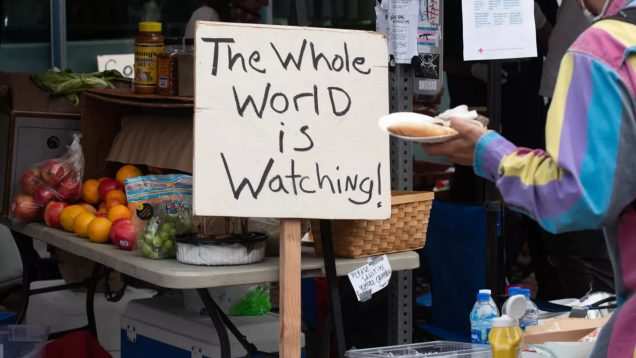

In response to the food-system challenges of pandemic and structural violence, Dr. Ellen Messer has been revising MET ML 721, "US Food Policy and Cultural Politics" to integrate themes from our cutting edge conversations. New formats and materials include integration of new readings and Zoom recordings on food-security issues associated with pandemic and racial disparities, new films and videos associated with struggles for land and food rights in different US locations, podcasts featuring the voices of new community leaders of color, and strengthened sections on gardening and labor issues.
We invite you to read the updated course description:
This course overviews the forces shaping U.S. food and nutrition policies, diets, and cultural politics in the twenty-first century. Special emphases in 2020 include critical responses to the COVID-19 pandemic and nation-wide demands for an end to all forms of racial and ethnic violence and injustice. Course resources and discussions cover the history of U.S. domestic food policy, the Farm Bill, “self-reliance” versus “comparative advantage,” and "sustainability/resilience" versus “efficiency,” and rights-based vs needs-based approaches as drivers of American agricultural, dietary, and food-regulatory policies. All topics and sessions integrate consideration of the multiple ways nutrition policies intersect with health disparities associated with systemic racism, inequalities, and violence. Using Greater Boston as a reference case in point, these discussions critically examine how 2020 nutrition-policy efforts by civil society and government align goals and actions to move forward from hunger to health, and use an “equity lens” to link short-term thinking with longer term outcomes. Concluding sessions probe responses to the question, “Is there a human right to food in the United States?”-- what additional actions are required?
"Food systems," "food chains," and "dietary structure" provide major analytical frameworks for tracing how food moves from farm to table, and the role of local through national government and private for-profit and non-profit non-government institutions in managing these food flows. Within each and considering the food system as a whole, course materials and discussions examine structural violence and persistent inequalities, and the ways policy, practice, and performance mitigate or exacerbate nutritional differences and enlarge or restrict the many voices of those impacted.
Class projects throughout the term explore how the current context affects particular food categories and food value chains, and the ways institutions are developing new strategies and tactics to address recent challenges. Assigned readings about regional food-sheds will draw on Northeast and
New England case studies, but participants joining from a distance will be able to contribute comparative information and experiences from their home locations, where comparable multi-sectoral “food security” and “sustainable food systems” initiatives intersect with “globalization from below.” These policy discussions constructively analyze the multiple layers of regulations and policies, and civil-society organizations and networks, which shape U.S. food systems and food chains at federal, state, municipal, and community levels. They highlight the significance of policy, practice, and performance that influence the varying outcomes and impacts of federal programs at state and local levels.
Objectives:
- Learn the basic structures, operations, and functions of U.S. federal, state, and local food agencies; their connections to non-government food agencies; and the ways these organizations manage official and parallel (supplementary) food systems, more or less effectively, to ensure everyone in the U.S., without discrimination, has access to nutritionally adequate food.
- Engage the challenges of preventing overweight, obesity, and associated chronic disease in the US food and policy context, including challenges to de-link ethnic, racial, and economic disparities from adverse nutritional-health outcomes.
- Be able to use USDA and FDA web-based information platforms for commodity policy analysis and advocacy, and critique associated structural inequalities associated with farm and nutrition programs.
- Understand sustainable food systems models, methods, and materials, as these motivate food-policy councils’ analysis, strategies, and actions; and recent efforts to include more diverse community voices in these processes.
MET ML 721 A1, US Food Policy Cultural Politics will meet on Tuesday evenings, from 6 to 8:45 PM, starting on September 8th in on campus/Learn from Anywhere format. The course is open to graduate students and advanced undergraduates. Non-degree students may also register. Please contact gastrmla@bu.edu for more information.
Black Lives Matter
Dear Gastronomy community,
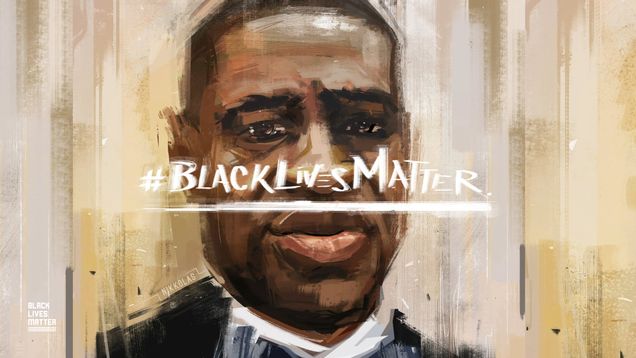
We write today in solidarity with George Floyd, Breonna Taylor, Tony McDade, their families, and those protesting injustice and police brutality across the country who have been met with a brutal, militarized police force. It is with sadness and rage that we add to the growing list of victims David McAtee, a chef and owner of Yaya’s BBQ who was known as “a community pillar,” who “fed the police for free and didn’t charge them nothing,” who was shot and killed by police during protests in Louisville on Monday.
We have heard the calls to action, read the pleas for justice and reform, seen the links to donate and the numbers to call. Perhaps we have opened our wallets or shown up at rallies to demonstrate our support. Perhaps, given the context of an unprecedented global pandemic, we have not been able to do as much as we would like. Perhaps we simply do not know what to do, where to put our time, our resources, and our energy.
We write today to urge our fellow gastronauts to answer these calls, not just today or this week, but in everything that we do as food industry professionals, scholars, and activists.
Let us not forget that the US agricultural industry depends, and has always depended, on the exploitation of marginalized racial minorities. That the hospitality industry was first envisioned in the context of enslavement. That many of Boston’s famed food enterprises, like rum and baked beans, depended on the byproducts of sugar produced by enslaved laborers. That food access is a question of economic justice and housing justice; that food justice efforts must therefore reckon with the fact that racial wealth disparities (the net worth of white Bostonians is on average 31,000 times higher than that of Black Bostonians) are generational and institutional. That land ownership in this country is steeped in anti-Black racist policy, and that Black farmers continue to document discrimination at the local, state, and federal levels of government.
In short, majority white-led food policy, institutions, industries, and even activism, are all involved, directly or indirectly, historically and into the present, in racist systems that perpetrate violence against Black Americans. Those of us with racial privilege, who are over-represented at the highest echelons of our fields, must act, and our action must be ongoing.
As individuals we must:
Read and cite Black scholars, writers, and activists. Across specialties and platforms, we must amplify black voices. In food media and academia alike, we must push back against the dominant discourse that the white experience is the only experience, or the only experience that matters. We must hold ourselves accountable for doing this work every day.
Divest from the prison industrial complex. We must do the research at the personal and institutional level. Are our program funds, our retirement savings, or the investments of our friends and families growing due to the forced labor of disproportionately Black prisoners? Are we aware of all the companies (like Whole Foods) that depend on prison labor? Are we considering this when we “vote with our dollars?”
Restructure and redistribute wealth. This does not mean a one-time donation to a bail fund (still, please donate to a bail fund!). This means monthly payments to organizations who are doing the work to address racial injustice and violence (in its many forms) against Black Americans. This means using our skills, expertise, art, connections, and platform to raise money for these organizations (regardless of the news cycle). This means making the choice to dedicate our free labor to these causes. Please see this piece in Civil Eats for a list of organizations working towards food and land justice for Black Americans.
Vote in the interests of the most disenfranchised members of our community and country. This does not come down to a single election. This involves reading and listening to the voices, stories, experiences, and needs of the most marginalized, and then voting in their interests over our own.
Support black businesses. Please see this list of Black-owned restaurants in Boston, to begin with. All those anti-racist book recommendations? Buy them from Frugal Bookstore.
As a community we must:
Make an official statement that the Gastronomy program is 100% in solidarity with the Black Lives Matter movement, shared on all social media platforms including the Gastronomy Facebook page, Instagram, blog, and email. We must join the list of over 100 Boston University organizations pledging their support of the Black Lives Matter movement by partnering with Boston University’s Black Student Union (UMOJA organization) in their fundraiser.
Compile and promote resources that support the Black community and challenge systemic racism in the food industry, including but not limited to books, podcasts, websites, businesses, etc. Encourage students to utilize these resources.
Require that students and faculty address, analyze, and challenge systems of racism in their coursework. Academia in general, and food studies in particular, is overwhelmingly white. It is our duty to:
-
Address and challenge the predominantly white demographic that this discipline consists of and caters to.
-
Actively reflect on and challenge ways that systems of racism shape representation, power, and authority in the realm of food.
-
Acknowledge and analyze how race affects our positionality and privilege in the understanding of foodways in the classroom, in our work, and in any other platform in which we critically discuss food.
-
Integrate and uplift classwork, readings, speakers, and businesses from communities of color to help dismantle dominant white-centered discourse in academia.
The above are actions that we must all take, individually and collectively, to the degree that we are able, as often as we are able. But this list is not exhaustive. We ask students and faculty to respond with one action item, no matter how small, that they will be taking to address racism in their work and move towards a discourse of anti-racism in food studies.
In the words of Audre Lorde, “there is no such thing as a single-issue struggle because we do not live single-issue lives.” We cannot remain silent on these issues and ignore the role of racial oppression in our industry. We who love studying and working with food must recognize the institutional, systematic racism embedded in the field and actively work to undo it.
This program’s solidarity is crucial during this time. Please do not choose silence. Stay connected, stay engaged, and stay safe.
Our best,
Elizabeth Weiler
Danielle Jacques
Elizabeth Weiler and Danielle Jacques are candidates for the MLA in Gastronomy