Metamaterials: Medical Imaging and MRI
We develop metamaterials that enhance MRI by engineering local electromagnetic fields using structured arrays of resonant elements. By boosting signal-to-noise ratio without increasing magnetic field strength, these systems enable faster, higher-quality, and more accessible imaging. This work establishes a scalable pathway toward intelligent, wearable, and portable MRI technologies.

Magnetic resonance imaging (MRI) stands as the gold standard in modern healthcare diagnostics, yet its complexity, high cost, and lengthy procedure times limit its universal accessibility. The quality of MRI images depends heavily on the signal-to-noise ratio (SNR), which directly affects image clarity. Importantly, SNR can often be traded for shorter scan times, thereby reducing procedure duration and alleviating key limitations such as cost and accessibility. The most direct way to enhance SNR is by increasing the magnetic field strength—but this also raises MRI complexity, cost, and potential risks to patients. How can we expedite MRI procedures without compromising imaging quality or significantly increasing costs? What if a simple material—crafted from plastic and copper wire—could address all these challenges, enabling MRI scans that are sharper, faster, more affordable, and safer?

Our material, known as a metamaterial, consists of an array of helical resonators—centimeter-tall structures made from 3D-printed plastic and coils of thin copper wire. These materials are not inherently extravagant, but when assembled, they form a flexible array that can seamlessly conform to the kneecap, abdomen, head, or any region requiring imaging. Its simplicity often surprises many. It’s not a mystical material—rather, the power lies in its design and underlying concept. When positioned near the body, the metamaterial array interacts with the radiofrequency fields emitted during MRI image acquisition, enhancing the SNR without the need to increase the magnetic field strength.

Crucially, our metamaterials are “intelligent,” comprising an array of closely packed metallic helical resonators integrated with a passive sensor. When relatively high-energy radio waves penetrate the patient during MRI, the metamaterial detects this energy level and automatically deactivates its resonance. Conversely, under low-energy radio excitation, the metamaterial activates its resonance, thereby amplifying the magnetic component of the radio wave. During this brief off-time—lasting only milliseconds—radiologists can use the metamaterial to enhance the energy returning to the MRI system, increasing the signal received from the patient. This also reduces the patient’s overall exposure to radiofrequency radiation and mitigates potential safety concerns, supporting seamless integration into clinical imaging workflows. Our metamaterial improves SNR by more than 15-fold, significantly enhancing image quality, reducing scan times, and offering a cost-effective path to higher-performance MRI.

“You can keep your hat on (in the MRI). If I told you an MRI revolution was coming, you probably wouldn’t expect it to come dressed like this.” Taking our efforts further, we have developed a tunable, wearable metamaterial capable of dramatically improving brain scans. It may resemble a quirky bike helmet or a contraption straight out of Doc Brown’s lab in Back to the Future, but despite its whimsical appearance, the device is a scientifically sophisticated metamaterial. The helmet consists of an array of metamaterial resonators—3D-printed plastic tubes wrapped in copper wire—assembled into an array and precisely positioned to manipulate the MRI’s magnetic field. This dome-shaped device fits snugly over a person’s head during a brain scan, enhancing MRI performance by producing sharper images that can be acquired at twice the usual speed. While its playful look evokes a mad scientist’s lab, there is indeed method to the madness—and the potential applications of these metamaterials are far-reaching.

Undoubtedly, the prospect of simplifying MRI technology is highly appealing. From seamlessly integrating metamaterials with computer-aided embroidery for enhanced comfort to developing wireless, lightweight coils that conform to 3D body contours using coaxial cables, our recent breakthroughs are reshaping the future of MRI—blending comfort, precision, and affordability. While ultra-low-field MRI offers advantages such as portability and cost-effectiveness, its primary limitation lies in its inherently low SNR, which is inversely correlated with magnetic field strength. This is where our metamaterials play a critical role—enabling substantial improvements in MRI SNR. Leveraging metamaterials as a foundational platform, we are currently assembling a cost-effective, low-field MRI system tailored for brain imaging. With the performance gains enabled by our metamaterial technologies, we envision a clinically relevant, portable, and affordable diagnostic tool—poised to democratize MRI access for anyone, anywhere.


| Representative Publications (# denotes supervised by X. Zhang; * denotes corresponding author: X. Zhang) |
|
A wireless volumetric metamaterial resonator for breast MRI
Y. Liu#, X. Zhu#, C.A. LeBedis, S.W. Anderson, X. Zhang* arXiv, 2026, preprint arXiv:2607.26360 +AbstractHigh-performance breast magnetic resonance imaging (MRI) remains limited by the availability, geometry, and cost of dedicated receive coils. In contrast, spine coils are widely installed in MR scanners globally but provide insufficient sensitivity for anterior breast tissue. Here, we report a wireless volumetric metamaterial resonator (VMR) that converts a standard built-in spine coil into a scalable breast MRI receiver platform without modifying the scanner hardware. The VMR consists of axially stacked coaxial resonant rings that support a co-rotating collective mode, producing a centrally concentrated RF magnetic field within the enclosed imaging volume. Leveraging distributed capacitance in the coaxial cable, gap-engineered geometric tuning, and PIN-diode-based self-detuning, the VMR enables size scalability, electric-field confinement, and transmit-receive compatibility, as validated through bench measurements and 3.0 T MRI experiments. Three VMR prototypes spanning small, medium, and large breast-equivalent volumes were designed and evaluated using electromagnetic simulations, bench measurements, and phantom MRI experiments. Compared with a commercial 16-channel breast coil, the VMR-augmented spine coil achieved more than 4-fold higher central SNR and reduced spatial non-uniformity from approximately 70% to 20% within the target imaging region. Under SENSE parallel imaging at acceleration factors of 2-4, the VMR-augmented spine coil maintained an average 4-fold higher central SNR than the commercial coil for three sizes. These results establish the VMR as a passive, scalable hardware strategy for improving breast MRI performance using existing clinical scanner infrastructure.
|
|
A wireless reconfigurable metasurface for enhanced parallel magnetic resonance imaging
Y. Liu#, X. Zhu#, K. Wu#, A. Kaliaev, C.A. LeBedis, S.W. Anderson, X. Zhang* arXiv, 2026, preprint arXiv:2605.24791 +AbstractModern magnetic resonance imaging (MRI) relies on application-specific multi-channel receive coils to achieve high performance, but these coils are typically costly, rigid, and difficult to generalize across anatomies. Recent wireless, low-cost metamaterials offer improved signal-to-noise ratio (SNR) but remain anatomy-dependent, are prone to destructive inter-element interference, and lack demonstrated compatibility with parallel imaging. Herein, a wireless, reconfigurable coaxial loop metasurface (CLM) is introduced as a platform for localized SNR enhancement that can operate either as a standalone element or as an insertable add-on alongside existing clinical receive systems. Through its coaxial architecture and shared current pathways, the CLM establishes a collective in-phase resonant mode that enforces phase-coherent current distributions across all loops, resulting in consistently constructive interference. Benchmarking on a 3.0 T MR system using an 8-loop CLM shows SNR enhancements of up to 14.8-fold and 14.02-fold in the sagittal and axial planes, relative to the birdcage coil (BC). As an add-on to a clinical posterior receive array, it further demonstrates up to 2.9-fold SNR enhancement and compatibility with parallel imaging across ex vivo and in vivo settings. The proposed CLM paves the way toward a new class of reconfigurable and insertable MRI hardware for flexible and system-compatible signal enhancement.
|
|
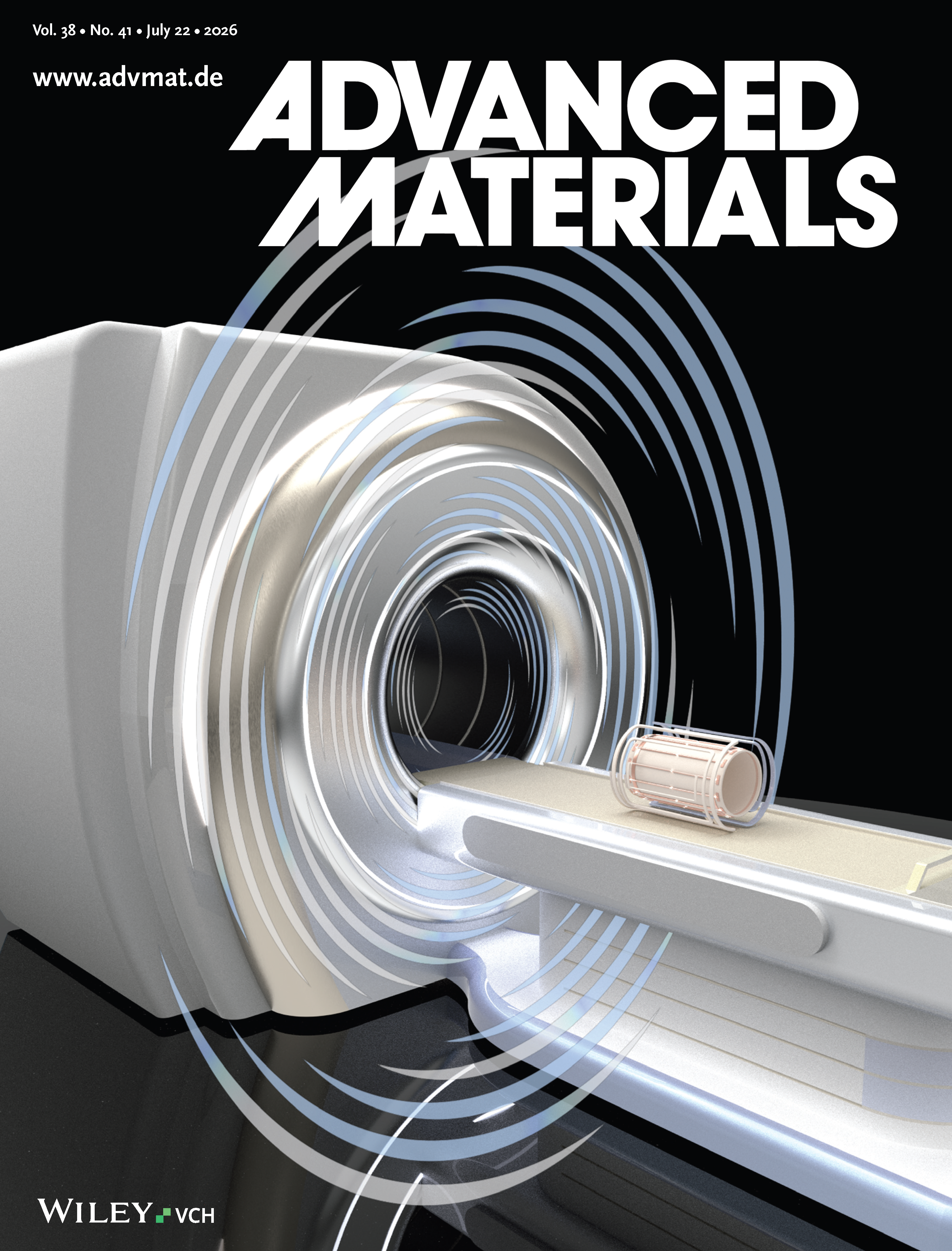
Circularly polarized metamaterial cage for homogeneous signal-to-noise ratio enhancement in magnetic resonance imaging
Y. Liu#, X. Zhu#, K. Wu#, S.W. Anderson, and X. Zhang* Advanced Materials, 2026, 38(41): e16569 +AbstractThe signal-to-noise ratio (SNR) in magnetic resonance imaging (MRI) governs the quality of signal detection and directly impacts the clarity and reliability of the acquired images. Recent advances in metamaterials have enabled lightweight solutions with selective magnetic responses, offering a route to locally boost SNR in targeted anatomical regions but often with compromised field homogeneity. Here, a wireless metamaterial cage constructed from coaxial cables is engineered for homogeneous SNR enhancement at 3.0 T. With its cylindrical geometry and electromagnetic architecture, the device supports circularly polarized resonance through engineered phase-shifted currents, enabling selective and omnidirectional interaction with the rotating B1– field to achieve a uniform magnetic field distribution. Integrated with the Birdcage coil (BC), the device yields a 31.45-fold SNR enhancement while maintaining comparable homogeneity to the BC alone, exhibiting only 12.07% variation within the region of interest (ROI). Benchmarking against a state-of-the-art 16-channel extremity coil further shows that the metacage achieves at least 1.94-fold and 2.24-fold higher SNR in axial and coronal planes, respectively, and exhibits substantially lower SNR variation (12.07% compared to 54.83% for the extremity coil). The results establish the metacage as a compelling platform for next-generation wireless MRI technologies.
|
|
Metamaterial-enabled hybrid receive coil for enhanced magnetic resonance imaging capabilities
X. Zhu#, K. Wu#, S.W. Anderson, and X. Zhang* Advanced Science, 2025, 12(3): 2410907 +AbstractMagnetic resonance imaging (MRI) relies on high-performance receive coils to achieve optimal signal-to-noise ratio (SNR), but conventional designs are often bulky and complex. Recent advancements in metamaterial technology have led to the development of metamaterial-inspired receive coils that enhance imaging capabilities and offer design flexibility. However, these configurations typically face challenges related to reduced adaptability and increased physical footprint. This study introduces a hybrid receive coil design that integrates an array of capacitively-loaded ring resonators directly onto the same plane as the coil, preserving its 2D layout without increasing its size. Both the coil and metamaterial are individually non-resonant at the targeted Larmor frequency, but their mutual coupling induces a resonance shift, achieving a frequency match and forming a hybrid structure with enhanced SNR. Experimental validation on a 3.0 T MRI platform shows that this design allows for adjustable trade-offs between peak SNR and penetration depth, making it adaptable for various clinical imaging scenarios.
|
|
Conformal metamaterials with active tunability and self-adaptivity for magnetic resonance imaging
K. Wu#, X. Zhu#, X. Zhao#, S.W. Anderson, and X. Zhang* Research, 2024, 7: 0560 +AbstractMetamaterials hold great potential to enhance the imaging performance of magnetic resonance imaging (MRI) as auxiliary devices, due to their unique ability to confine and enhance electromagnetic fields. Despite their promise, the current implementation of metamaterials faces obstacles for practical clinical adoption due to several notable limitations, including their bulky and rigid structures, deviations from optimal resonance frequency, and inevitable interference with the radiofrequency (RF) transmission field in MRI. Herein, we address these restrictions by introducing a flexible and smart metamaterial that enhances sensitivity by conforming to patient anatomies while ensuring comfort during MRI procedures. The proposed metamaterial selectively amplifies the magnetic field during the RF reception phase by passively sensing the excitation signal strength, remaining "off" during the RF transmission phase. Additionally, the metamaterial can be readily tuned to achieve a precise frequency match with the MRI system through a controlling circuit. The metamaterial presented here paves the way for the widespread utilization of metamaterials in clinical MRI, thereby translating this promising technology to the MRI bedside.
|
|
A robust near-field body area network based on coaxially-shielded textile metamaterial
X. Zhu#, K. Wu#, X. Xie#, S.W. Anderson, and X. Zhang* Nature Communications, 2024, 15: 6589 +AbstractA body area network involving wearable sensors distributed around the human body can continuously monitor physiological signals, finding applications in personal healthcare and athletic evaluation. Existing solutions for near-field body area networks, while facilitating reliable and secure interconnection among battery-free sensors, face challenges including limited spectral stability against external interference. Here we demonstrate a textile metamaterial featuring a coaxially-shielded internal structure designed to mitigate interference from extraneous loadings. The metamaterial can be patterned onto clothing to form a scalable, customizable network, enabling communication between near-field reading devices and battery-free sensing nodes placed within the network. Proof of concept demonstration shows the metamaterial’s robustness against mechanical deformation and exposure to lossy, conductive saline solutions, underscoring its potential applications in wet environments, particularly in athletic activities involving water or significant perspiration, offering insights for the future development of radio frequency components for a robust body area network at a system level.
|
|
Wireless, customizable coaxially shielded coils for magnetic resonance imaging
K. Wu#, X. Zhu#, S.W. Anderson, and X. Zhang* Science Advances, 2024, 10(24): eadn5195 +AbstractAnatomy-specific radio frequency receive coil arrays routinely adopted in magnetic resonance imaging (MRI) for signal acquisition are commonly burdened by their bulky, fixed, and rigid configurations, which may impose patient discomfort, bothersome positioning, and suboptimal sensitivity in certain situations. Herein, leveraging coaxial cables’ inherent flexibility and electric field confining property, we present wireless, ultralightweight, coaxially shielded, passive detuning MRI coils achieving a signal-to-noise ratio comparable to or surpassing that of commercially available cutting-edge receive coil arrays with the potential for improved patient comfort, ease of implementation, and substantially reduced costs. The proposed coils demonstrate versatility by functioning both independently in form-fitting configurations, closely adapting to relatively small anatomical sites, and collectively by inductively coupling together as metamaterials, allowing for extension of the field of view of their coverage to encompass larger anatomical regions without compromising coil sensitivity. The wireless, coaxially shielded MRI coils reported herein pave the way toward next-generation MRI coils.
|
|
Wearable coaxially-shielded metamaterial for magnetic resonance imaging
X. Zhu#, K. Wu#, S.W. Anderson, and X. Zhang* Advanced Materials, 2024, 36(31): 2313692 +AbstractRecent advancements in metamaterials have yielded the possibility of a wireless solution to improve signal-to-noise ratio (SNR) in magnetic resonance imaging (MRI). Unlike traditional closely packed local coil arrays with rigid designs and numerous components, these lightweight, cost-effective metamaterials eliminate the need for radio frequency cabling, baluns, adapters, and interfaces. However, their clinical adoption is limited by their low sensitivity, bulky physical footprint, and limited, specific use cases. Herein, a wearable metamaterial developed using commercially available coaxial cable, designed for a 3.0 T MRI system is introduced. This metamaterial inherits the coaxially-shielded structure of its constituent cable, confining the electric field within and mitigating coupling to its surroundings. This ensures safer clinical adoption, lower signal loss, and resistance to frequency shifts. Weighing only 50 g, the metamaterial maximizes its sensitivity by conforming to the anatomical region of interest. MRI images acquired using this metamaterial with various pulse sequences achieve an SNR comparable or even surpass that of a state-of-the-art 16-channel knee coil. This work introduces a novel paradigm for constructing metamaterials in the MRI environment, paving the way for the development of next-generation wireless MRI technology.
|
|
Computational-design enabled wearable and tunable metamaterials via freeform auxetics for magnetic resonance imaging
K. Wu#, X. Zhu#, T.G. Bifano, S.W. Anderson, and X. Zhang* Advanced Science, 2024, 11(26): 2400261 +AbstractMetamaterials hold significant promise for enhancing the imaging capabilities of magnetic resonance imaging (MRI) machines as an additive technology, due to their unique ability to enhance local magnetic fields. However, despite their potential, the metamaterials reported in the context of MRI applications have often been impractical. This impracticality arises from their predominantly flat configurations and their susceptibility to shifts in resonance frequencies, preventing them from realizing their optimal performance. Here, a computational method for designing wearable and tunable metamaterials via freeform auxetics is introduced. The proposed computational-design tools yield an approach to solving the complex circle packing problems in an interactive and efficient manner, thus facilitating the development of deployable metamaterials configured in freeform shapes. With such tools, the developed metamaterials may readily conform to a patient’s knee, ankle, head, or any part of the body in need of imaging, and while ensuring an optimal resonance frequency, thereby paving the way for the widespread adoption of metamaterials in clinical MRI applications.
|
|
Helmholtz coil-inspired volumetric wireless resonator for magnetic resonance imaging
X. Zhu#, K. Wu#, S.W. Anderson, and X. Zhang* Advanced Materials Technologies, 2023, 8(22): 2301053 +AbstractSignal-to-noise ratio (SNR) is one of the most common metrics in assessing the image quality of magnetic resonance imaging (MRI). Among a host of technological developments, various wireless devices, including metamaterials and volumetric wireless resonators have been reported to enhance SNR by redistributing the radio frequency magnetic field in the near field region. While theoretically feasible, their widespread clinical adoption has been limited by their field inhomogeneity, limited spatial coverage and challenges in their applications to higher field (≥3.0T) MRI systems. In this study, a Helmholtz coil-inspired volumetric wireless resonator (HVWR) featuring a uniform magnetic field enhancement within the resonator volume is reported. The HVWR is free from cables, adapters and interface boxes, allowing for ease of fabrication and straightforward installation. The resonator allows for resonance frequency tunability and adaptivity, enabling for passive detuning during the MRI transmission phase. Experimental validation using a 3.0T MRI system demonstrate a substantial SNR boost (5× or higher) being achieved in a region covering the average size of the human knee. This study offers an efficient and practical wireless solution for improved MRI image quality that may be applicable across a range of imaging applications.
|
|
Auxetics-inspired tunable metamaterials for magnetic resonance imaging
K. Wu#, X. Zhao#, T.G. Bifano, S.W. Anderson, and X. Zhang* Advanced Materials, 2022, 34(6): 2109032 +AbstractAuxetics refers to structures or materials with a negative Poisson’s ratio, thereby capable of exhibiting counterintuitive behaviors. Herein, auxetic structures are exploited to design mechanically tunable metamaterials in both planar and hemispherical configurations operating at megahertz (MHz) frequencies, optimized for their application to magnetic resonance imaging (MRI). Specially, the reported tunable metamaterials are composed of arrays of interjointed unit cells featuring metallic helices, enabling auxetic patterns with a negative Poisson’s ratio. The deployable deformation of the metamaterials yields an added degree of freedom with respect to frequency tunability through the resultant modification of the electromagnetic interactions between unit cells. The metamaterials are fabricated using 3D printing technology and an ≈20 MHz frequency shift of the resonance mode is enabled during deformation. Experimental validation is performed in a clinical (3.0 T) MRI system, demonstrating that the metamaterials enable a marked boost in radiofrequency field strength under resonance-matched conditions, ultimately yielding a dramatic increase in the signal-to-noise ratio (≈4.5×) of MRI. The tunable metamaterials presented herein offer a novel pathway toward the practical utilization of metamaterials in MRI, as well as a range of other emerging applications.
|
|
Nonreciprocal magnetic coupling using nonlinear meta-atoms
X. Zhao#, K. Wu#, C. Chen#, T.G. Bifano, S.W. Anderson, and X. Zhang* Advanced Science, 2020, 7(19): 2001443 +AbstractBreaking Lorentz reciprocity is fundamental to an array of functional radiofrequency (RF) and optical devices, such as isolators and circulators. The application of external excitation, such as magnetic fields and spatial–temporal modulation, has been employed to achieve nonreciprocal responses. Alternatively, nonlinear effects may also be employed to break reciprocity in a completely passive fashion. Herein, a coupled system comprised of linear and nonlinear meta-atoms that achieves nonreciprocity based on the coupling and frequency detuning of its constituent meta-atoms is presented. An analytical model is developed based on the coupled mode theory (CMT) in order to design and optimize the nonreciprocal meta-atoms in this coupled system. Experimental demonstration of an RF isolator is performed, and the contrast between forward and backward propagation approximates 20 dB. Importantly, the use of the CMT model developed herein enables a generalizable capacity to predict the limitations of nonlinearity-based nonreciprocity, thereby facilitating the development of novel approaches to breaking Lorentz reciprocity. The CMT model and implementation scheme presented in this work may be deployed in a wide range of applications, including integrated photonic circuits, optical metamaterials, and metasurfaces, among others.
|
|
Intelligent metamaterials based on nonlinearity for magnetic resonance imaging
X. Zhao#, G. Duan#, K. Wu#, S.W. Anderson, and X. Zhang* Advanced Materials, 2019, 31(49): 1905461 +AbstractMetamaterials provide a powerful platform to probe and enhance nonlinear responses in physical systems toward myriad applications. Herein, the development of a coupled nonlinear metamaterial (NLMM) featuring a self-adaptive response that selectively amplifies the magnetic field is reported. The resonance of the NLMM is suppressed in response to higher degrees of radio-frequency excitation strength and recovers during a subsequent low excitation strength phase, thereby exhibiting an intelligent, or nonlinear, behavior by passively sensing excitation signal strength and responding accordingly. The nonlinear response of the NLMM enables us to boost the signal-to-noise ratio during magnetic resonance imaging to an unprecedented degree. These results provide insights into a new paradigm to construct NLMMs consisting of coupled resonators and pave the way toward the utilization of NLMMs to address a host of practical technological applications.
|
|
Boosting magnetic resonance imaging signal-to-noise ratio using magnetic metamaterials
G. Duan#, X. Zhao#, S.W. Anderson, and X. Zhang* Communications Physics — Nature, 2019, 2: 35 +AbstractMagnetic resonance imaging (MRI) represents a mainstay among the diagnostic imaging tools in modern healthcare. Signal-to-noise ratio (SNR) represents a fundamental performance metric of MRI, the improvement of which may be translated into increased image resolution or decreased scan time. Recently, efforts towards the application of metamaterials in MRI have reported improvements in SNR through their capacity to interact with electromagnetic radiation. While promising, the reported applications of metamaterials to MRI remain impractical and fail to realize the full potential of these unique materials. Here, we report the development of a magnetic metamaterial enabling a marked boost in radio frequency field strength, ultimately yielding a dramatic increase in the SNR (~ 4.2×) of MRI. The application of the reported magnetic metamaterials in MRI has the potential for rapid clinical translation, offering marked enhancements in SNR, image resolution, and scan efficiency, thereby leading to an evolution of this diagnostic tool.
|
| Ph.D. Dissertation |
| Metamaterial-enabled near-field engineering for magnetic resonance imaging Xia Zhu, Ph.D. Dissertation, Boston University (Advisor: Xin Zhang; March 2026) |
| Magnetic field enhancement in metamaterials Ke Wu, Ph.D. Dissertation, Boston University (Advisor: Xin Zhang; March 2023) |
| Major Media Features & Global Coverage |
| Magnetic Metamaterial Can “Turn Up the Volume” of MRI Speeding Up MRI Scans to Save Lives This Bizarre Looking Helmet Can Create Better Brain Scans Unleashing the Power of Metamaterials to Improve MRI Imaging American Scientist: Custom-Tuned Materials Making MRI More Globally Accessible: How Metamaterials Offer Affordable, High-Impact Solutions |
| YouTubes |
| How Magnetic Metamaterial Improves MRI Intelligent Metamaterials for Enhanced MRI New Metamaterial Improves MRI Imaging |


