REVIEW: Phoebe Bridgers @ TD Garden 10/7
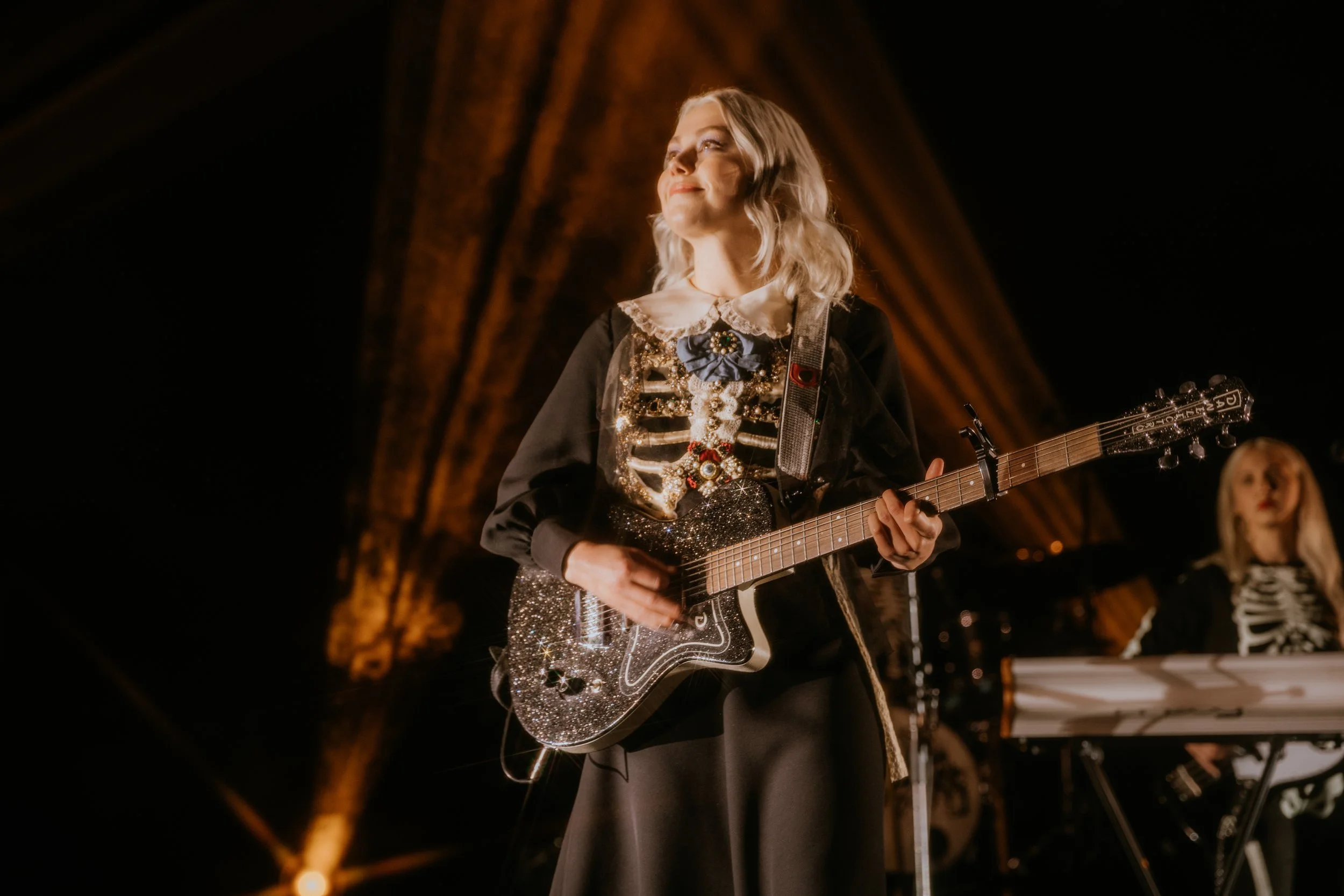
Photo Credit: Nicole Busch
Review by Kathy Doan
American singer-songwriter Phoebe Bridgers, known for her melancholic indie rock, took over TD Garden for the second night of her sold-out Boston shows on her first arena tour. The Lost Weekend Tour centered on her third album, released last August. This introspective record ruminates on public relationships and breakups, grief and the healing that follows. For fans of Bridgers, the album and tour marked a momentous announcement following a six-year hiatus since the release of her sophomore album, “Punisher,” in 2020. In 2023, Bridgers lost her father and spent time afterward focusing on her band, boygenius.
Prior to the tour, Bridgers held pop-up shows across the United States. She implemented a strict no-phone policy and kept the same regulations for the tour.
I arrived around 7:30 p.m., knowing Bridgers would take the stage at 9 p.m. I was worried that the no-phones policy would make the process of storing everyone’s phones time-consuming. Surprisingly, the line moved quickly, as it would at any other show. I handed my phone to a staff member to lock up in a Yondr pouch, and I kept the pouch with me until the end of the show, when staff used a special device to unlock it. Designated phone-use areas were also available for fans.
As I headed toward my seat, I noticed fans dressed in astronaut and skeleton costumes that reflected Bridger’s branding and flair. Looking around, I was also struck by the set design featuring a planetarium dome with bright teal lighting and backdrop. Across from the main stage was the B stage with a much smaller orbit suspended overhead.
Her opener, Alex G, had already started his set. His performance was electrifying as he took over the B stage with special light sticks and his full band. I have never seen an opener command the B stage quite like he did. The performance felt a little more intimate on that smaller stage.
I noticed that I could see everyone’s faces so clearly, even across the arena, because no one had a phone up against their face to record. I didn’t expect to feel such a dystopian sensation, seeing everyone else in the building so clearly. Like many concertgoers, I was so used to having phones blocking my peripheral view.
Without my phone, I couldn’t keep track of the time, but the intermission between Alex G’s set and Bridgers felt like 30 minutes until suddenly, the lights turned off, and sharp, blinding multicolored lasers from the orbit above B stage shot into the crowd. Within minutes, the dome from the main stage opened, revealing Bridgers and her band.
Dressed in black from head to toe, Bridgers started the night with “Motion Sickness.” The crowd immediately recognized the opening chords. Her band featured a cello, violin, viola and mandolin, in addition to the usual guitar, drums and bass.
Bridgers illuminated the big screen with glittery makeup beneath her eyes that resembled teardrops, reflecting the album’s overarching theme. To me, the look served as a metaphor for how internal pain can be curated into glorious art.
A few songs into the set, Bridgers talked about her 2018 performance at the Great Scott, a music venue in Allston that closed in 2024 for a relocation. The venue was reportedly expected to reopen in 2026.
“Was anyone at the show?” Bridgers asked. “They kicked us out at 7 for a DJ set at 8.”
More than a few hands went up, prompting a visibly shocked reaction from Bridgers.
“Moon Song” followed. A moon was brightly projected onto the hollow section of the raised dome, creating a lifelike effect.
Bridgers eventually moved to the B stage, where she sat on its flat surface and gracefully played her keyboard during “Lost Weekend,” a song performed in remembrance of her late father.
“Is anyone else’s dad dead?” Bridgers asked.
I didn’t realize how much death surrounds me until this night when nearly half of the audience raised their hands.
“I felt like I was just floating for a couple [of] years,” Bridgers said.
She explained how the no-phones policy was in place because she didn’t want recordings of her discussing her complicated relationship with her father to become another clip circulating the internet.
“Thank you for putting your phones away and making this easier for me,” she continued.
On her way back to the main stage, Bridgers slowly made her way through the crowd to greet her fans, softly touching every hand that reached toward her.
Then she played “Waiting Room,” and the crowd settled into a calmer mood. Audience members held their loved ones and swayed back and forth to the slow melody.
Bridgers brought out her little brother, Jackson Bridgers, to sing “I Can’t Wait.”
A fan favorite, “Kyoto” started playing, and the crowd brought the energy. It was one of the final songs on the setlist before her encore on the B stage.
After a brief intermission, Bridgers reappeared onstage again dressed entirely in white. Even her socks changed from black to white. The transformation felt cathartic to see right after she performed “I Know the End,” a song about acceptance and peace at the end of a relationship. By wearing white that glowed in the light, Bridgers seemed to symbolize shedding the weight of a breakup and the rediscovery of a former self.
“Scott Street” began, and nostalgia rushed over me. It was one of my favorite songs. The lights came on, revealing the entire audience waving to one another across the arena. The song, written about running into someone you used to be close to, felt like a metaphor for the fans who had waited together for Bridger’s comeback. It took six years, but at last, they were all under one roof again, waving to one another.