Review: of Montreal @ Royale 3/25
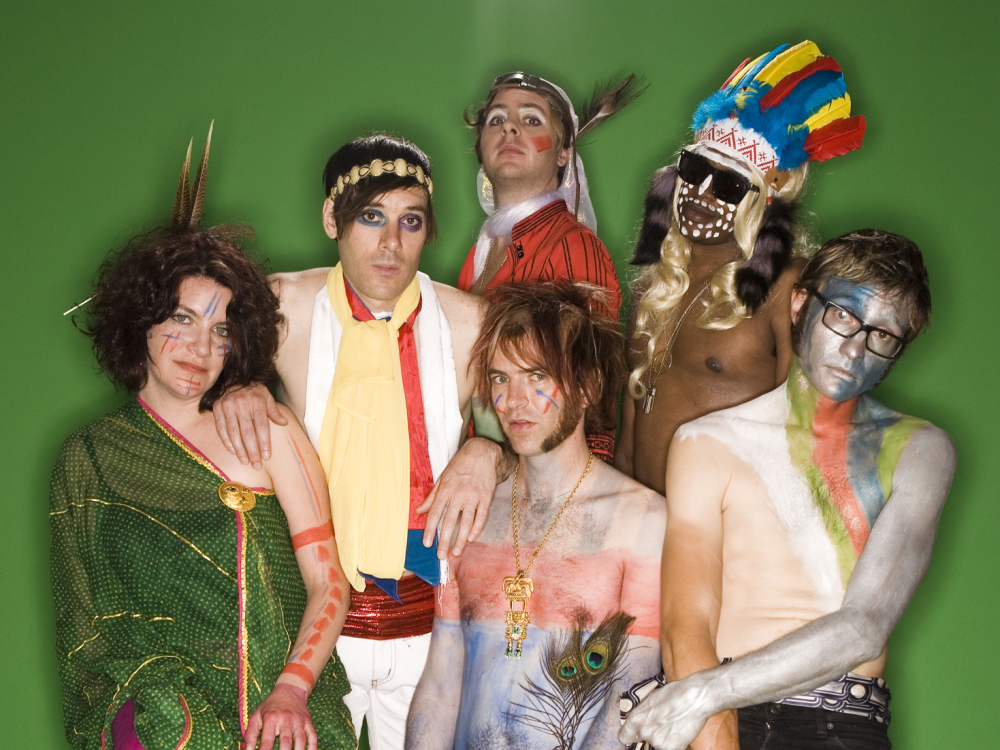
Photo credits: Courtesy of the artist
Review by: Owen Butler
What will the world look like in 5 billion years, as Earth is on the brink of devastation as the sun begins to engulf the planet? My guess: a little like an of Montreal show. For the night, the Royale became the epicenter of lead singer Kevin Barnes’ sonic and tectonic disruption. Despite the show’s dystopian focus, of Montreal is on tour celebrating the 20th anniversary of their seventh studio album, The Sunlandic Twins. Earlier this year, the band released a four-disc, 53-track 20th Anniversary Edition of the album, steeped in remastered tracks, outtakes, live performances, remixes, and de-mixes.
As the lead singer and indie-pop icon, Kevin Barnes, dressed in a silken pink suit, scurried on stage, the venue travelled both forwards and backwards in time to a 2005 conception of the distant future. On stage, keyboardist Dojo Glidewell, drummer Clayton Rychlik, and bassist Ross Brand were accompanied (in presence and outfit) by a troop of outlandish dancers, dressed as burlesque ravens, a martial skeleton god, and the Sunlandic Twins. The show innovatively utilized projection lighting, blank props, and costumes to transform the simple set into characters and settings from an astro-steam-punk Alice in Wonderland. Unafraid of what lies within the grooves of reality, the band can craft alternate realities on stage, a sonic and visual playpen for your imagination to run loose. Of Montreal’s images lit up the venue’s many screens, both on the walls and ceiling, with macro photography images of fly eyes, kittens, and flowers flashing between waves of 2005 Microsoft Paint illustrations.
On an album anniversary tour, the setlist is rather predictable; if it’s not performed in sequential order, the range of songs rarely strays further than the album’s track list. Accordingly, the crowd’s energy was irreplicable, sustained over 20 years to hear their favorites from Twins given prime spotlight among of Montreal’s dense and prolific discography. Despite this, that night, not much else in the music hall was predictable, save for the crowd’s rangily, wacky-inflatable-flailing-arm-tube-man dance moves. During the crowd favorite “The Party’s Crashing Us,” only a few heads were stationary in a sea of bobbing counterparts. Barnes’ absurdist-yet-universal lyrics and undeniably groovy synth lines had women in corporate clothing dancing alongside college-aged kids in thrifted Hunter boots.
Searching for meaning in the show’s absurdity, I blurred my eyes to the show’s eccentricities, to its thematically unintelligible animations and dancers. I couldn’t explain what was happening in front of me on stage, but maybe it could explain itself to me. What I was left with was an odyssey following a nameless character Barnes assumed for the night as they navigated post-post-modern love, twisted humanity, and their mortal coil in a world where the sun is not too far from engulfing all we know. In the face of utter destruction, the show illustrated that we today should be less concerned about the sun in 5 billion years and instead discover the sun within ourselves, as illustrated on the album’s cover.
For the last few songs and the encore, Barnes was joined by long-time collaborator and friend of the band, Elizabeth Wheeler, in wig and costume. Donning an audience member’s Transgender flag as an over-the-shoulder scarf, Wheeler acted as Barnes’s sunlandic twin, singing beautiful harmonies over his tenor warbling. The encore included B-sides to the album that were never performed live, including the heartwarming “Family Nouveau.”
Throughout the show, I was debating with myself just how similar a Bowie show might have been in the 70s, with its unforgiving colors and abrasive optimism. I feared I was being too young and naïve, drawing too heavily a connection between two eccentric, gender-bending, guitar-slinging glam-rock figures. However, I was given passing validation as Barnes and Wheeler began the final encore song, a cover of “Suffragette City” by the one and only Bowie. As he did at the end of every song, Barnes gave his final shy but well-rehearsed “thank you.”