Building Student Career Pathways: A Public Health Professional’s Toolkit
Welcome to the Student Pathways Toolkit!
This toolkit was developed to help organizations create and implement effective student pathways into public health careers. It outlines various types of career pathway programs, highlights key components and characteristics, and shares best practices for implementation. It includes a variety of peer-generated tools and templates which users can adapt to meet their specific needs.
The toolkit is designed to reduce the burden on individual organizations developing new pathway programs, support preceptors mentoring students, support the evaluation and improvement of existing initiatives, and ultimately contribute to a stronger, more resilient local public health workforce.
This toolkit was created for the New England Public Health Training Center (NEPHTC) and was funded by a grant from the National Network of Public Health Institutes (NNPHI).
If you have any questions about the content or suggestions for future versions, please contact Tali Schiller at natalia.schiller@gmail.com.
What’s in this toolkit?
This toolkit is guided by two key questions:
- What makes a high-quality pathway program experience for both students and preceptors?
- What support do preceptors need to effectively host students and provide meaningful public health training?
The best practices and resources included here are applicable to a wide range of student pathway models, including internships, fellowships, training programs, and other entry points into public health careers.
This toolkit is split into four sections:
Who is this toolkit for?
- Public health professionals who want to create or strengthen student pathways into public health careers.
- Public health professionals who want to expand their capacity to act as supervisors and mentors for students.
Student Pathway Programs: an Overview
This section is a brief introduction to student pathway programs: the definition of a pathway program; the different types of programs; and why they’re useful.
What is a student pathway program?
Long held as an essential component of education and workforce preparedness, student pathway programs engage students through experiential learning and opportunities to work in their field of interest. The literature supports these programs as critical to promoting interest in local public health careers and strengthening the local public health workforce.
A student pathway program allows for Work-Based Learning (WBL), which is defined by the Center for Apprenticeship and Work-Based Learning as “an approach to training in which a student or worker completes meaningful tasks in a workplace.”
What are the different types of pathway programs?
There are many other names for pathway programs, including pipeline program, experiential learning, work education, and work-based learning. There are also many forms of pathway programs; the most common are internship, practicum, service-learning, field work, fellowship, and training program.
Each of these have different structures and outcomes, but they share a common objective: to provide students or recent graduates with work experiences outside the traditional classroom setting.
- Internship: A form of experiential learning that integrates knowledge and theory learned in the classroom with practical application and skills development in a professional setting.
- Fellowship: A merit-based, funded opportunity sponsored by associations, organizations, institutions, or government which sets eligibility requirements for the advanced study of an academic subject.
- Practicum: A work-education experience that links theory with practice by providing regular structured and supervised opportunities for students to apply and test knowledge, skills, and attitudes. Practicums may be designed around a specific research question.
- Service-learning: An experiential learning model involving the incorporation of community engagement into course curriculum to enhance student learning outcome and advance community efforts. Service- learning is differentiated from other types of service by its equal focus on the service being provided and the learning that occurs as a result.
- Field-based learning: An extension of teaching outside the classroom into real-world settings. Most commonly associated with environmental and ecological domains.
- Field work: Placements in authentic settings where students gain hands-on experience, often under direct supervision. Field placements may be highly specific, related to professional or occupational skill development.
- Project-based learning: A student-based pedagogy that involves students designing, developing and constructing hands-on solutions to a problem.
- Training program: Formalized programs that guide students toward a particular profession but can include an internship, service-learning, or field placement as part of the overarching objectives of the program.
What are the core elements of a pathway program?
Career pathway programs, despite varying definitions across federal law and major initiatives, share these common themes:
- Industry Alignment: Pathway programs design their training to match the specific skills that local employers actually need in growing job sectors.
- Accessibility and Progression: Programs offer multiple ways to enter at different skill levels and multiple stopping points where students can exit with credentials for jobs or continue to higher levels.
- Wraparound Support: Students receive career counseling, skills assessments, and support services to help them overcome obstacles and successfully complete their training.
- Intentional Design: Programs create clear sequences of courses and credentials that build on each other, with basic skills taught within the context of actual job training.
- Systemic Coordination: Multiple organizations—schools, workforce agencies, employers, and community services—work together and share resources to create complete pathways for students.
Why are pathway programs useful? Why do we need them?
In 2022, the Public Health Accreditation Board (PHAB) added a new measure to their standards and measures: to “recruit a qualified and diverse health department workforce”. However, a recent analysis of the content of Workforce Development Plans submitted by 201 accredited health departments found that these workplans rarely discussed recruitment strategies in detail or included specific recruitment strategies.
For public health employers, pathway programs offer three key benefits:
- They build the public health workforce, both in size and skills.
- They strengthen the public health workforce by increasing individuals with varied backgrounds and experiences.
- They lower recruitment barriers into public health careers.
For students, there are five core benefits to work-based learning:
- They expose participants to the world of work.
- They expose participants to a career field.
- They offer opportunities to apply academic learning.
- They enhance professional and/or career-track skills.
- They can provide a temporary or permanent job.
Research finds that student pathway programs may increase employment and earnings more than traditional workforce development programs such as job fairs, mentorship programs, on-the-job training, etc., across all ages and types of programs.
Career pathway programs have their challenges. According to a study conducted by the Department of Labor, the largest obstacles these programs face are funding and sustainability. This is often due to the temporary nature of grant programs and the difficulty of maintaining cross-organizational partnerships over time.
How can I create and improve my pathway program?
This toolkit contains tools and resources collected in direct response to the needs of practitioners. It includes 40+ downloadable templates for job descriptions, interview guides, learning agreements, and evaluation forms. Step-by-step guides walk users through topics such as developing student projects, inclusive recruiting, managing interns effectively, and compensation. All resources are grounded in evidence-based best practices for pathway program design.
Tools and Templates
In this section, you’ll find tools and resources collected in direct response to the needs of practitioners. All resources are grounded in evidence-based best practices for pathway program design.
For simplicity, we are using the term intern, but the principles and practices can be used to guide to any student pathway program.
1. Getting Started
Tools
- Start here: Why do you want an intern? A brainstorming exercise and readiness checklist
- Step-by-Step: Developing Student Projects in a Public Health Workplace
- Training Resources for Student Intern Supervisors
- What do students want from an internship?
Templates
Additional Resources
- Designing effective internships: A mixed-methods exploration of the sociocultural aspects of intern satisfaction and development, Center for Research on College-Workforce Transitions
- Work-Based Learning Framework, Jobs for the Future
- INTERNSHIPS: Creating high impact experiences, University of Washington Career & Internship Center
2. Funding
The resources in this section will help you identify and secure funding for student interns.
Tools
- Start here: How to Pay Students
- Student payment models
Additional Resources
3. Recruitment, Hiring, and Onboarding
The resources in this section will help you ensure you’re recruiting interns that are a good match with the project.
Tools
- Start here: How to Recruit and Hire Students with the Right Skills and Background
- Best Times to Recruit & Host Student Interns
- Hiring International Students as Interns
- Hiring a Range of Student Interns, Inclusively and Legally
Templates
- Acceptance Letter
- Internship Application
- Internship Application Form
- Internship Job Description
- Internship Job Interview Guide
- Internship Position Description Template
- Marketing and Outreach Plan
- Mentoring Students and Early Career Professionals
- Sample Student Internship Interview Questions
- Standard Operating Procedure for Hiring Interns
- Standard Operating Procedure for Onboarding
Additional Resources
- Retention and Recruitment Toolkit, Public Health Foundation
- Recruitment and Retention in Public Health Workshop Series, Region 2 Public Health Training Center
- Resources for Hiring, The Management Center
- Recruiting New Talent for Public Health Jobs With Evidence-Based Job Descriptions and Attractive Job Postings, Journal of Public Health Management and Practice
4. Creating Shared Goals
The resources in this section will help you ensure that you and your interns are on the same page about goals and desired outcomes.
Tools
Templates
- Learning Agreement Template #1
- Learning Agreement Template #2
- Learning Agreement Template #3 (pages 11-14)
- Learning Plan Template #4
- Project Charter
Additional Resources
5. Supervision & Management
The resources in this section will help you navigate how to supervise and manage student interns.
Tools
Templates
- Endpoint Performance Review
- Final Evaluation of Products Completed and Overall Student Performance
- Final Intern Evaluation
- Intern Orientation Plan
- Internship Final Reflection
- Internship Preceptor Handbook
- Key Tips to Hosting an MPH Intern
- Mid-point Check-in Survey Tool
- Midpoint Evaluation, Self-Review
- Midway Progress Report
- Midway Progress Report
- Supervision Checklist
- Time Log
Additional Resources
- Resources for Giving Feedback and Evaluating Performance, The Management Center
- Resources for Addressing Performance Problems, The Management Center
- Exit Interview Tips (and a Template!), The Management Center
- 7 Tips for Making the Most of Your Check-ins, The Management Center
- 14 Tips for Managing Interns, Indeed
- Managing Interns, University of Washington Career & Internship Center
- How To Be An Awesome Intern Manager, University of Washington
- Internship Supervisor Best Practices, Go Government
- Internship Work Plan, Go Government
6. Navigating Administrative Processes
The resources in this section will help you navigate administrative processes, such as partnership agreements and committee structures.
Resources
- The Public Health Foundation’s Academic Health Department Partnerships Toolkit has examples of committee structures, scopes of work, and workplans.
- The Public Health Foundation has also collected partnership agreements (e.g., MOUs) for a variety of different situations.
7. Professional Development
The tools in this section will help you support student professional development and networking.
Tools
- Start here: Supporting Professional Development in Public Health Internships
- Training Resources for Public Health Student Interns
Templates
Additional Resources
- Retention and Recruitment Toolkit, Public Health Foundation
- Public Health Mentoring Program Guide, New Hampshire Public Health Association
Research and Best Practices
This section includes additional research on student pathways and best practices to consider as you create or strengthen your own program. Integrating all of these best practices is likely not feasible for every program. We recommend reviewing these resources and applying what is possible in your particular situation. This toolkit has suggestions on how to do so.
Are career pathway programs effective in increasing employment and earnings?
According to the What Works for Health evidence clearinghouse, assessments of career pathway programs are considered “Expert Opinion”. This means that the practice is recommended by credible, impartial experts but there is limited research documenting effects. Further research, often with stronger designs, is needed to confirm effects.
What does existing research say about the effectiveness of career pathway programs?
“Career pathways programs are a suggested strategy to increase employment and earnings for low-skilled individuals, out of school youth, and hard-to-employ adults. However, additional evidence is needed to confirm effects.”
“Available evidence indicates that career pathways programs may increase employment and earnings more than traditional workforce development in some instances, though program effects may fade over time. Gains in earnings may be greater for participants in programs with longer durations; shorter programs may increase employment but not wages.”
“Participation in programs that incorporate career pathways can increase educational attainment and vocational credential receipt for workers with low incomes.”
“Experts suggest partnering with high-demand sectors and engaging with employers to create or replicate successful programs. Difficulty developing necessary partnerships, lack of basic skills among some participants, and a dynamic labor market that may eliminate occupations can be challenges to establishing career pathways programs.”
What are the core elements of a pathway program?
There are many different definitions of pathway programs and their core elements. Here are three sources that define the core elements of a pathway program.
FEDERAL LAW: Three federal laws include a shared definition of career pathways:
- The Strengthening Career and Technical Education for the 21st Century Act (Perkins V)
- The Workforce Innovation and Opportunity Act (WIOA)
- The Higher Education Act (HEA)
According to these laws, career pathways are a “combination of rigorous and high-quality education, training, and other services” that:
- Align with the skills needs of industries in a state or regional economy;
- Prepare an individual to be successful in a full range of secondary or postsecondary education, including Registered Apprenticeships;
- Include counselling to help individuals achieve their education and career goals;
- Include, as appropriate, education offered concurrently with and in the same context as workforce preparation activities and training for a specific occupation or occupational cluster;
- Organize education, training, and other services to meet the particular needs of an individual in a manner that helps accelerate their educational and career advancement;
- Enable an individual to attain a secondary school diploma or equivalent, and at least one recognized postsecondary credential; and
- Help an individual enter into or advance within a specific occupation or occupational cluster.
The ALLIANCE FOR QUALITY CAREER PATHWAYS is an initiative whose goal is to help state and local/regional partnerships strengthen their career pathway systems. In 2014, Alliance partners jointly developed and provided consensus support for the Alliance for Quality Career Pathways Framework 1.0, which establishes a common understanding of quality career pathways and systems.
According to the Alliance, the three essential features of a quality career pathway are:
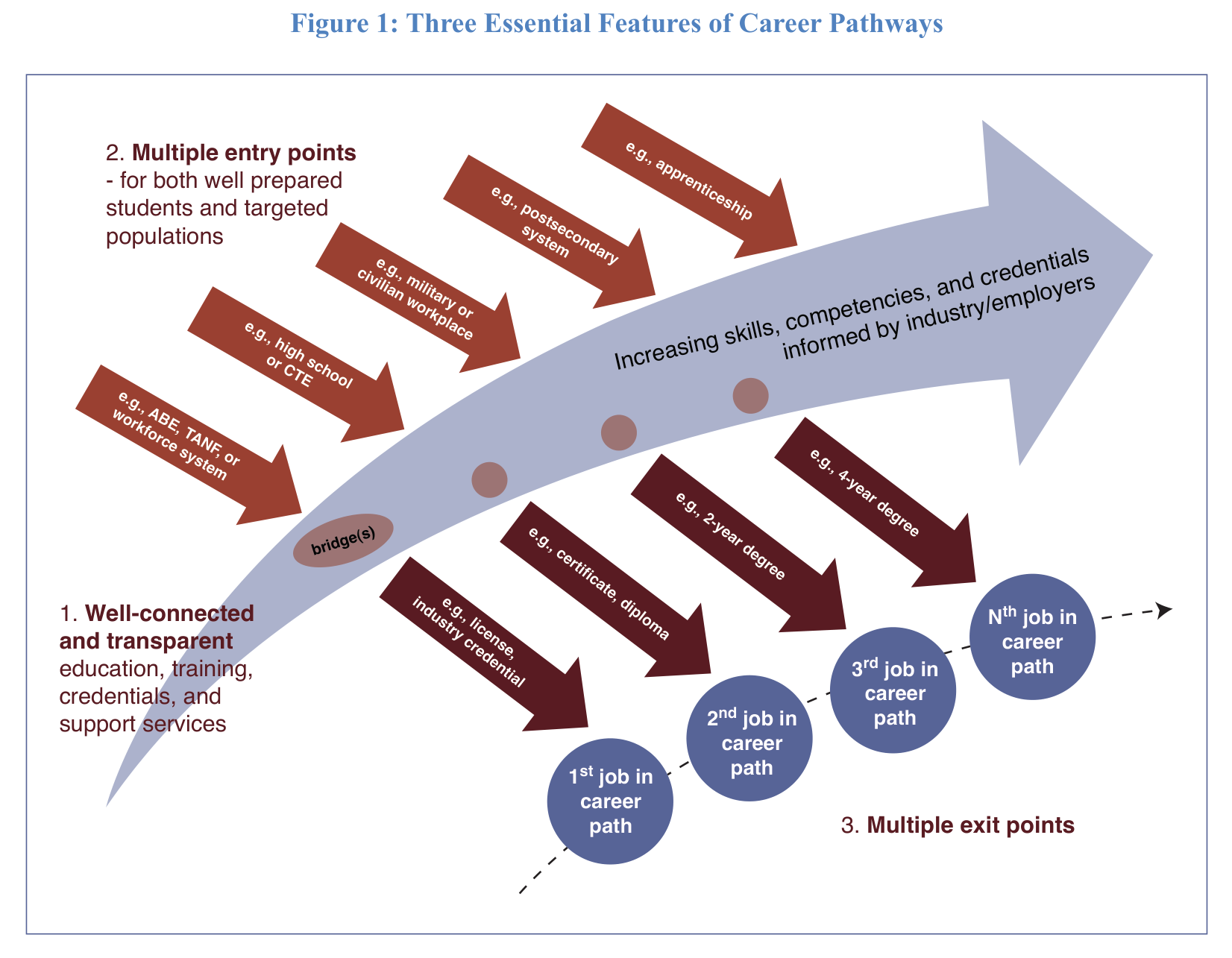
- Well-connected and transparent education, training, support services, and credentials within specific sectors or cross-sector occupations (often delivered via multiple linked and aligned programs).
- Multiple entry points that enable well-prepared students, as well as targeted populations with limited education, skills, English, and work experiences, to successfully enter the career pathway. Targeted populations served by career pathways may include adult education or other lower-skilled adult students, English Language learners, offenders or ex-offenders, high school students, disconnected or “opportunity” youth, some former military personnel, un- or under-employed adults, or others.
- Multiple exit points at successively higher levels that lead to self- or family-supporting employment and are aligned with subsequent entry points.
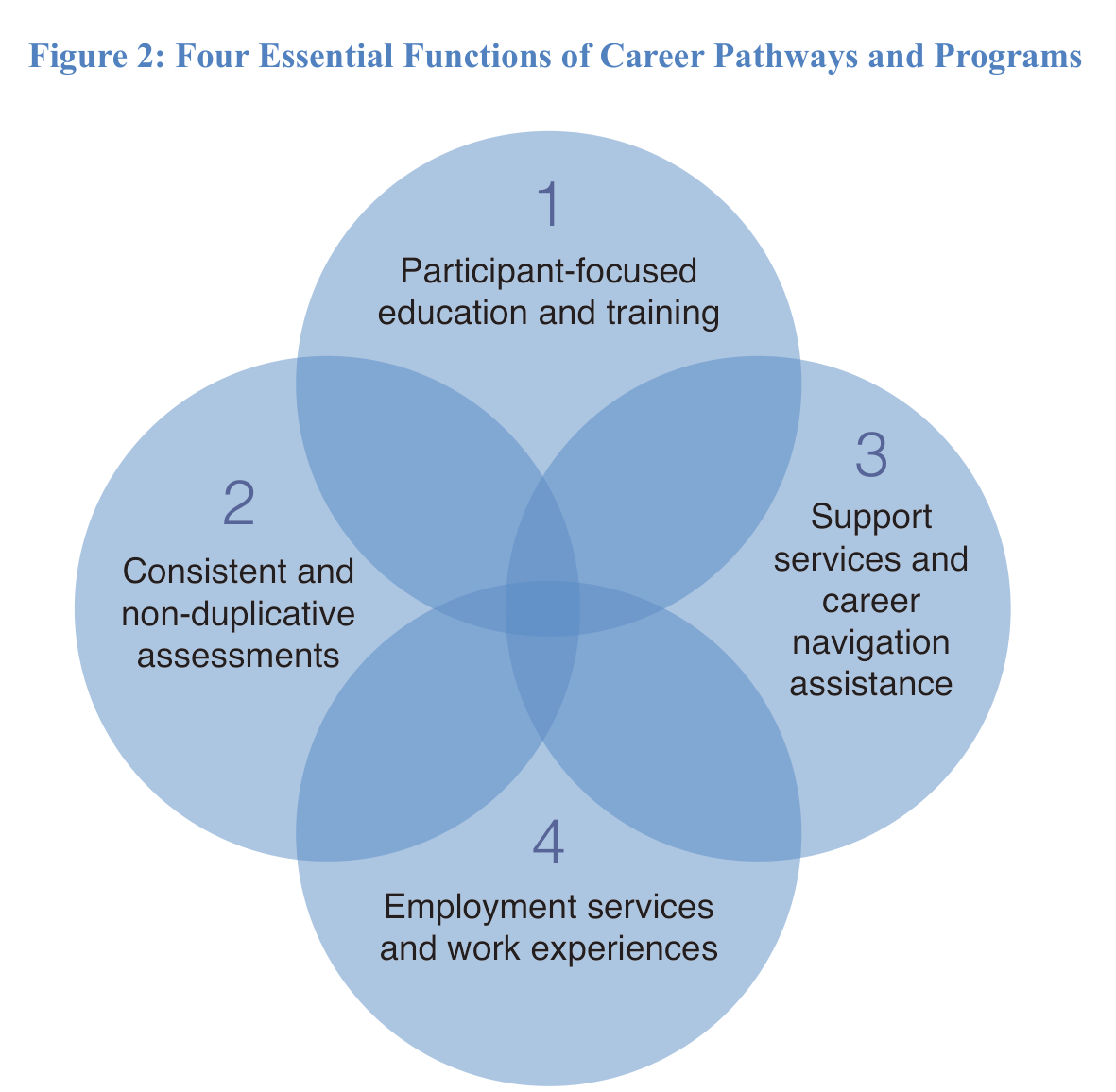
According to the Alliance, the four essential functions of a quality career pathway are:
- Participant-focused education and training;
- Consistent and non-duplicative assessments of participants’ education, skills, and assets/needs;
- Support services and career navigation assistance to facilitate transitions; and
- Employment services and work experiences.
In 2016, the DEPARTMENT OF LABOR identified these Six Key Elements of Career Pathways in their Career Pathways Toolkit: An Enhanced Guide and Workbook for System Development:
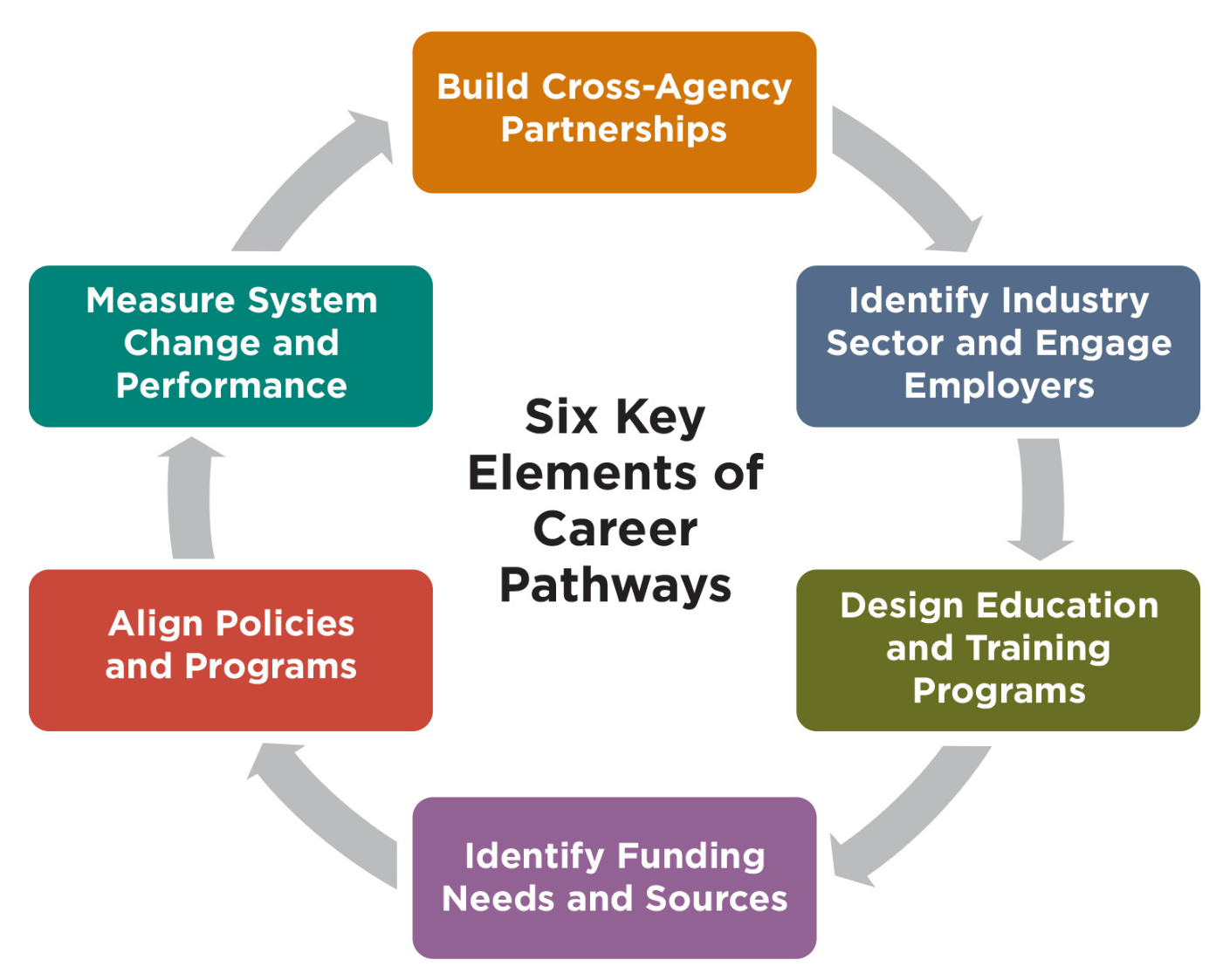
- Build cross-agency partnerships and clarify roles.
- Identify industry sectors and engage employers.
- Design education and training programs. Career pathways provide a clear sequence of education courses and credentials that meet the skill needs of high-demand industries. Key program design features include contextualized curricula, integrated basic education and occupational training, career counseling, support services, assessments and credit transfer agreements that ease entry and exit and promote credential attainment.
- Identify funding needs and sources. Because career pathways approaches blend and align services from different government agencies to support an individual’s successful completion, innovative funding strategies that braid funds from a variety of public and private sources are essential.
- Align policies and programs.
- Measure system change and performance.
What elements make a successful / effective pathway program? What are the best practices for a student pathway program?
There is no one definitive authority on best practices for a student pathway program. Here are some highly regarded sources with recommendations for how to create a successful pathway program.
JOBS FOR THE FUTURE (JFF) has defined 7 Principles for Effective Work-Based Learning. JFF identified these principles “based on more than three decades of experience in promoting and implementing education and workforce strategies that support youth and adults seeking to launch and advance in careers.”
The seven principles are:
- Support entry and advancement in a career track.
- Provide meaningful job tasks that build career skills and knowledge.
- Offer compensation.
- Identify target skills and how gains will be validated.
- Reward skill development.
- Support college entry, persistence, and completion.
- Provide comprehensive student supports.
To learn more about each of the seven principles and programs and initiatives that incorporate these principles, please refer to JFF’s article on the subject.
In 2019, JFF also published a systematic review of 16 career pathway program evaluations in their brief, What Works for Adult Learners? Lessons from Career Pathway Evaluations. The results show that “well-designed career pathways can improve academic, employment, and income outcomes for adults”.
The brief also defines three core elements of a career pathway program: pathway entry, integrated training, and career progression.
- Pathway entry. Some career pathway programs offer basic education and training, like bridge programs, to help students go from beginner-level classes (even ones that don’t give college credit) to college-level courses and jobs.
- Integrated training focuses on building job skills, offers college credit, and is connected to good-paying, middle-skill jobs. It works because of strong partnerships between employers, job training programs, adult education, colleges, and other groups. These programs help people earn recognized credentials in high-demand fields that can lead to stable jobs and long-term careers.
- Career progression focuses on helping adult learners move beyond beginner-level education and training. It includes plans that support them in earning several credentials—like certificates, licenses, and degrees—so they can grow in careers that offer financial stability.
The brief also recommends next steps to create and expand career pathways for adult learners (page 17).
The Center for Research on College-Workforce Transitions (CCWT) developed an Internship Scorecard that serves as a framework for evaluating college internships on the basis of purpose, quality and equitable access.
As stated in the Scorecard, “this new framework is based on theory and evidence from cultural anthropology, the learning sciences and work-based learning, and is designed for higher education professionals, funders, policymakers and employers so that they can – with more nuance and precision than is currently available – make distinctions between program types and begin to ‘score’ programs at the individual-level or in the aggregate for entire institutions.”
CCWT has many other resources on college internships, work-integrated learning, and career readiness on their website: https://ccwt.wisc.edu/internship-research/
What is “career pathway mapping”?
The Career Ladders Project created the Career Pathways Mapping Toolkit in 2019 to help community colleges, K-12 partners, and four-year institutions collaboratively map career pathways for students.
“Clear career pathways maps enable more students to advance through college, attain credentials with labor market value, and earn wages that sustain their families.”
The toolkit outlines a five-step process to create visual maps that clarify program alignment, identify gaps, and link education levels with employment opportunities. The mapping process brings together stakeholders to strengthen pathways and help students advance through credentials with labor market value.
The Career Ladders Project has map examples on their website, including a biosciences pathway map.
What are best practices for an internship?
According to work done at the Center for Research on College-Workforce Transitions (CCWT), internships with these six characteristics have the most impact.
- Paid position. Research shows unpaid internships are linked to lower job satisfaction, which can undermine long-term employee retention. More than any other metric, a wage or salary at or above local living wage standards makes internships more effective.
- Dedicated supervisor with regular check-ins. Interns benefit most when autonomy in their work is paired with regular feedback from trained mentors who are invested in their growth.
- Purposeful learning and development programs. Structured learning and development through courses, workshops, or training sessions can accelerate intern readiness and performance, according to experts.
- Clear connection to full-time opportunities. Designing internship experiences with conversion to full-time employment in mind – from training to mentorship – helps ensure that successful interns are ready to step into long-term roles and reduces future hiring and onboarding costs.
- Structured opportunities to build professional relationships. By building structured networking opportunities – particularly with near-peers – into internship programs, companies can help interns develop valuable social capital.
- Real projects with measurable impact. Assigning interns to real projects or team-based work not only builds their capabilities but also demonstrates trust and value, which is essential preparation for potential full-time roles.
The National Association of Colleges and Employers (NACE) has a lot of excellent information about internships on their website, including a position statement on why all internships should be paid.
NACE has defined 20 best practices for internships that can be summarized in the following six principles:
- Align your internship program with your organization’s overall goals for a diverse, inclusive workforce.
- Approach your internship program (recruiting, hiring, and compensation) as you would your full-time hiring.
- Hold orientations for all involved.
- Provide interns with a handbook and/or website.
- Stay connected with your interns after they return to school.
- Compensate interns with wages, relocation assistance, scholarships, or other forms of payment.
- Design the internship as a learning experience that will professionally develop the intern by providing them with real work assignments, networking opportunities, and new-hire panels.
- Encourage team involvement.
- Invite career center staff and faculty to visit interns on site.
- Hold new-hire panels.
- Bring in speakers from your company’s executive ranks.
- Offer training/encourage outside classes.
- Showcase intern work through presentations/expo.
- Set interns up for success through effective personnel management, including onboarding, supervision, final showcase, and exit interviews.
- Consider work arrangements that will work for your interns and your organization.
- Have an intern manager.
- Collect and analyze data about intern experience and whether you are meeting your goals for the internship program.
- Conduct focus groups/surveys.
- Collect, track, and analyze your program’s statistics.
- Conduct exit interviews.
What are the different potential components of a public health pathway program?
Karen White et al have created a resource to describe three categories and ten characteristics of different public health pathway programs. This “typology” of pathway programs can help newer programs consider including all ten characteristics, and more established programs consider whether they have addressed all ten.
The three categories of pathway programs are:
- Programs That Expose Students to Public Health
- Programs That Guide Students to Specific Public Health Professions
- Programs That Connect Students With Organizations for Public Health Practice
The ten characteristics of pathway programs are:
- Student participants: Participants’ program and education level requirements, identified as undergraduate, graduate, or doctoral.
- Eligibility & Recruitment: The conditions of program participation.
- Type of work-education program: Internship, practicum, service-learning, field work, fellowship, or training program.
- Student choice of assignment: The student’s ability to choose their work-education experience that includes the area of focus and the setting.
- Program Components: Components that were included and if there were any theoretical underpinnings used to support various aspects of the program.
- Supervision: Type of supervisor and supervision.
- Primary setting: The program’s physical location.
- Program Funding: Funding sources.
- Length: Program Length.
- Payment to students: Compensation offered in exchange for the work students perform for their host organizations.
These elements are recommended/should be considered:
- Designing the program based on an established learning theory, such as Social Cognitive Theory, the Transtheoretical Model (stages of change), or the Health Belief Model.
- Using established competencies to define educational goals and desired outcomes. This CDC site has a selection of public health competency frameworks: https://www.cdc.gov/public-health-gateway/php/our-work/public-health-professionals-competencies.html
- A framework for measuring student skill progression.
- Breadth and depth of applied practice experiences.
- Partnerships with academic institutions and community-based organizations. Strong partnerships between academic institutions, community organizations, and health departments were documented as a key success factor with each study, across all three program categories. Studies referenced shared funding, goals between community partners, and a well-established communication cadence as critical for ensuring success. In the case of academic health departments, the memorandum of understanding helped to articulate roles and responsibilities and advanced planning allowed for the execution of mutually beneficial projects.
- Mentorship. Core components of experiential learning includes mentorship and student reflection as part of the program curriculum. Mentorship with work-education programs helps the student understand the application of skills in a practice-settings and connects them to the workforce. Our research identified the importance of mentorship, either by faculty or peers, for reflection, trainee skill development and career guidance. However, some of the programs we assessed reported challenges of lack of mentor skill, time, and availability. We recommend that program implementers prioritize the role of mentors, through funding and additional research to understand the unique ways mentorship can be achieved, such as peer mentoring, mentoring circles, and one-on-one mentoring. Programs that may be shorter in length do not typically include components such as career advising and formal mentorship.
- Professional development and networking.
How can I apply the public health pathway typology to my student pathway program?
- If you are starting a new pathway program:
- Decide which category best suits your situation.
- Read the literature about programs in that category.
- Review each characteristic and choose the structure and features that best suit your situation.
- Read literature about programs with similar characteristics as yours.
- Apply recommendations to your program design and delivery.
- If you want to improve an existing pathway program:
- Determine the category and characteristics of your program.
- Determine if any characteristics need to be defined or clarified.
- Read literature about programs with similar characteristics as yours.
- Apply recommendations to your program design and delivery.
Stories From The Field
The Connecticut Public Health Fellowship Program (PHFP) is a CT Department of Public Health (CT DPH) career pathway program for students to gain critical experience, build professional networks, and launch their career in public health service.
The PHFP aims to build interest in public health careers by helping students find high-quality public health fellowship placements in CT, and by providing $3,500 stipends. The program is open to 3rd or 4th-year undergraduate or graduate-level students enrolled at any accredited academic institution in any degree program relevant to public health.
Eligible placement sites include CT DPH, local health departments, and community-based public health agencies that work with state or local health agencies in Connecticut.
What did PHFP fellows want from a pathway program?
Based on surveys (n=92) and interviews (n=13) with CT Public Health Fellowship Program Fellows, the top three things that students wanted from a public health pathway program were:
- Meaningful and measurable. Students want to work on projects that are challenging, meaningful, and valuable.
“And this was just kind of the perfect fit. And I really liked that the program also had multiple… check-ins, actual measurable goals…this wasn’t kind of just a general internship…So that was kind of my initial, what drew me to apply….I think having clear learning objectives and clear areas of focus before, and it wasn’t just like I wrote them down. Like the preceptor had to also work on them..And I think being able to kind of set that expectation ahead of time was very efficient.”
- Program Accessibility and Modality. Students want programs that are flexible, provide compensation, balance both in-person and remote work, and have a clear application process.
” ..the way the program was structured I like it because it gave us the chance to select our own public health competencies with Yeah. In addition with our preceptor… And also that will reflected my goal. So that flexibility really helped me. And then I worked towards what I’ve selected. So yeah, the program is not strict..they give you the chance to really explore based on your professional goal and interest. “
- Culture and Support. Students want to work in a supportive environment that values growth and professional development.
“I felt very supported there, there was people that looked like me there and you know, listened to my goals and my thoughts and we had a lot of similar perspectives and you know, and then, then I learned for things that may have been differing perspectives. Everyone was very respectful..it was just learning from each other. It was an excellent environment for that.”
What were PHFP fellows’ recommendations for pathway programs?
Based on surveys (n=92) and interviews (n=13) with CT Public Health Fellowship Program Fellows, students’ recommendations for pathway programs were:
- Increased Collaboration and Promotion
- Collaborate with partners to promote the program.
- Enhance marketing and outreach efforts, specifically targeting diverse communities.
- Preparation and Resources
- Provide guidance specific to working in local/state health prior to placement.
- Share webinars and trainings broadly.
- Networking and Community Building
- Organize social gatherings or volunteer activities.
- Implement a ‘buddy system’ or peer groups for additional support.
- Administrative and Structural
- Maintain hybrid placement options.
- Extend internship length to one year for better job placement.
- Financial and Logistical
- Offer an adequate stipend.
- Allow repeat participation.
- Expand fellowship slots and mentors for geographic diversity.
What did PHFP preceptors want from a pathway program?
Based on surveys (n=62), CT Public Health Fellowship Program Preceptors wanted the following from a pathway program:
- Clear and Supportive Processes. Preceptors wanted streamlined access to application documents and prompt staff responses which facilitated smooth student onboarding and engagement. They also wanted pre-vetted fellows, stipend provision, clear work plans, orientation, and flexible hourly and work arrangements.
“The structure of the program was excellent. The up-front requirement to identify domain-related competencies worked really well, and I appreciated the requirement that the fellow and the preceptor were expected to collaborate on this; it also mandated that the fellow think clearly about how this work experience tied to his academic experience.”
- Mutual Program Benefits and Workforce Enhancement. Preceptors thought the PHFP fostered valuable networking and mentorship, enriching both preceptors and fellows. They also appreciated the opportunity to mentor students and connect with the next generation of public health professionals, and they thought the bidirectional learning environment brought fresh perspectives and renewed enthusiasm to their work.
“It is always helpful to have public health students helping us to achieve our goals. They bring new ideas and insights to our work.”
- Addressing Logistical and Resource Needs. Preceptors wanted additional support to offset organizational burdens and enhance fellowship experiences. They recommended the program offer funding for necessary resources at the placement sites, support remote work options, and provide structured training/networking events.
“The biggest challenge is scheduling and space. We are at full capacity in our space so scheduling became an issue for the rotation of interns/fellows.”
Bibliography and Suggested Reading
- About work-based learning. Jobs for the Future (JFF). https://www.jff.org/about-work-based-learning/
- White KM, Drainoni ML, Elliott P, Hurley M, Cunnington S, Greece J. A typology of US public health work-education programs. Journal of Public Health Management & Practice. 2025;31(3):E134–E143. doi:10.1097/PHH.0000000000002079
- Work-based learning can advance equity and opportunity for America’s young people. Brookings. https://www.brookings.edu/articles/work-based-learning-can-advance-equity-and-opportunity-for-americas-young-people/
- PHAB Standards & Measures Version 2022. PHAB. https://phaboard.org/accreditation-recognition/version-2022
- Yeager VA, Burns AB, Lang B, et al. What are public health agencies planning for workforce development? A content analysis of workforce development plans of accredited public health departments. Journal of Public Health Management & Practice. 2023;29(6):762-774. doi:10.1097/PHH.0000000000001805
- Career pathways programs | county health rankings & roadmaps. https://www.countyhealthrankings.org/strategies-and-solutions/what-works-for-health/strategies/career-pathways-programs. Published May 17, 2022.
- Cielinski A. Career Pathways in Career and Technical Education. January 2019. https://www.clasp.org/wp-content/uploads/2022/01/2019_careerpathwaysincte.pdf
- Shared Vision, Strong Systems: The Alliance for Quality Career Pathways Framework Version 1.0. June 2014. https://www.clasp.org/wp-content/uploads/2022/04/AQCP-Executive-Summary-FINAL.pdf
- Workforcegps – career pathways toolkit: an enhanced guide and workbook for system development. WorkforceGPS. https://youthbuild.workforcegps.org/resources/2019/11/07/19/20/Career-Pathways-Toolkit-An-Enhanced-Guide-and-Workbook-for-System-Development
- Cahill C. Making Work-Based Learning Work. July 2016. https://www.jff.org/wp-content/uploads/2023/09/WBL_Principles_Paper_062416.pdf
- What Works for Adult Learners: Lessons from Career Pathway Evaluations. July 2019. https://www.jff.org/wp-content/uploads/2023/09/SPUB-Adult-Learners-070219.pdf
- The Internship Scorecard: A new framework for evaluating college internships on the basis of purpose, quality and equitable access. Research Brief #11. CCWT. https://ccwt.wisc.edu/publication/the-internship-scorecard-a-new-framework-for-evaluating-college-internships-on-the-basis-of-purpose-quality-and-equitable-access-research-brief-11/. Published July 21, 2020.
- From Transactional to Transformational: Closing the Gap Between Worker Expectations and Experience for Internships and Apprenticeships. August 2025. https://justcapital.com/wp-content/uploads/2025/08/Strada.pdf
- Best practices for internship programs. https://www.naceweb.org/talent-acquisition/internships/2bad225d-2977-476a-99dd-d8b7638ade1a
- Internship meaning and definition: a nace guide. Default. https://www.naceweb.org/internships
- Nappi S, Allen N, Hill K, et al. An approach to building a strong public health workforce: the connecticut public health fellowship program. Journal of Public Health Management & Practice. 2026;32(1):34–43. doi:10.1097/PHH.0000000000002275
- The Green Jobs and Health Care Impact Evaluation: Findings from the Impact Study of Four Training Programs for Unemployed and Disadvantaged Workers. https://www.dol.gov/agencies/eta/research/publications/green-jobs-and-health-care-impact-evaluation-findings-impact
- Career Pathways Design Study . February 2018. https://www.dol.gov/sites/dolgov/files/OASP/legacy/files/3-Career-Pathways-Implementation-Synthesis.pdf