
Climate Stories & Shared Futures:
MISI Launches with Landmark Summit
Boston University’s newest hub for interdisciplinary collaboration kicks off with a day of dialogue, creativity, and connection.
The Center for Media Innovation & Social Impact (MISI) officially opened its doors with the Communicating Climate summit – a full-day event that brought together leading thinkers, journalists, artists, and policymakers to explore how storytelling and media can drive meaningful action in the climate crisis.
With speakers flying in from across the country and local leaders lending their voices to the conversation, attendees witnessed a rare blend of disciplines and perspectives. The Center’s Director, Eric Gordon, opened the summit by challenging us not just to think about solutions, but also to work together to identify the right questions.
The event opened with a keynote conversation between Harvard Law Professor Cass Sunstein and journalist Michael Grunwald. The two discussed the intersection of climate policy, behavioral science, and public communication. Their discussion ranged from Sunstein’s experiences inside the White House to Grunwald’s recent book, The Earth is Eating Itself, emphasizing how important it is to meet people where they are.
The momentum continued with a panel called Policy, Science, and Public Engagement in an Age of Skepticism, featuring Massachusetts Climate Chief Melissa Hoffer, Carol Gregory of the Conservation Law Foundation, and BU Environmental Science Professor Nathan Phillips. Together, they explored how trust, transparency, and collaboration can bridge the gap between data and public understanding.
“Whose voice is telling the story, who is the audience, and how are they receiving the story?”— Nathan Phillips
The next discussion turned the spotlight on community-based responses to climate misinformation. Kenneth Bailey, co-founder of the Design Studio for Social Intervention, joined Pulitzer Reporting Fellow Barbara Espinosa Barrera and BU Professor of Environmental Health Patrica Fabian to emphasize the value of local voices and grassroots action in shaping global narratives. “Be present and do the best that you can to contribute to the community,” urged Fabian.
One way to do that is through art. According to Bailey, “Art creates opportunities for people who feel like the current forms of protest and engagement aren’t scratching the itch that they feel they need scratched.”
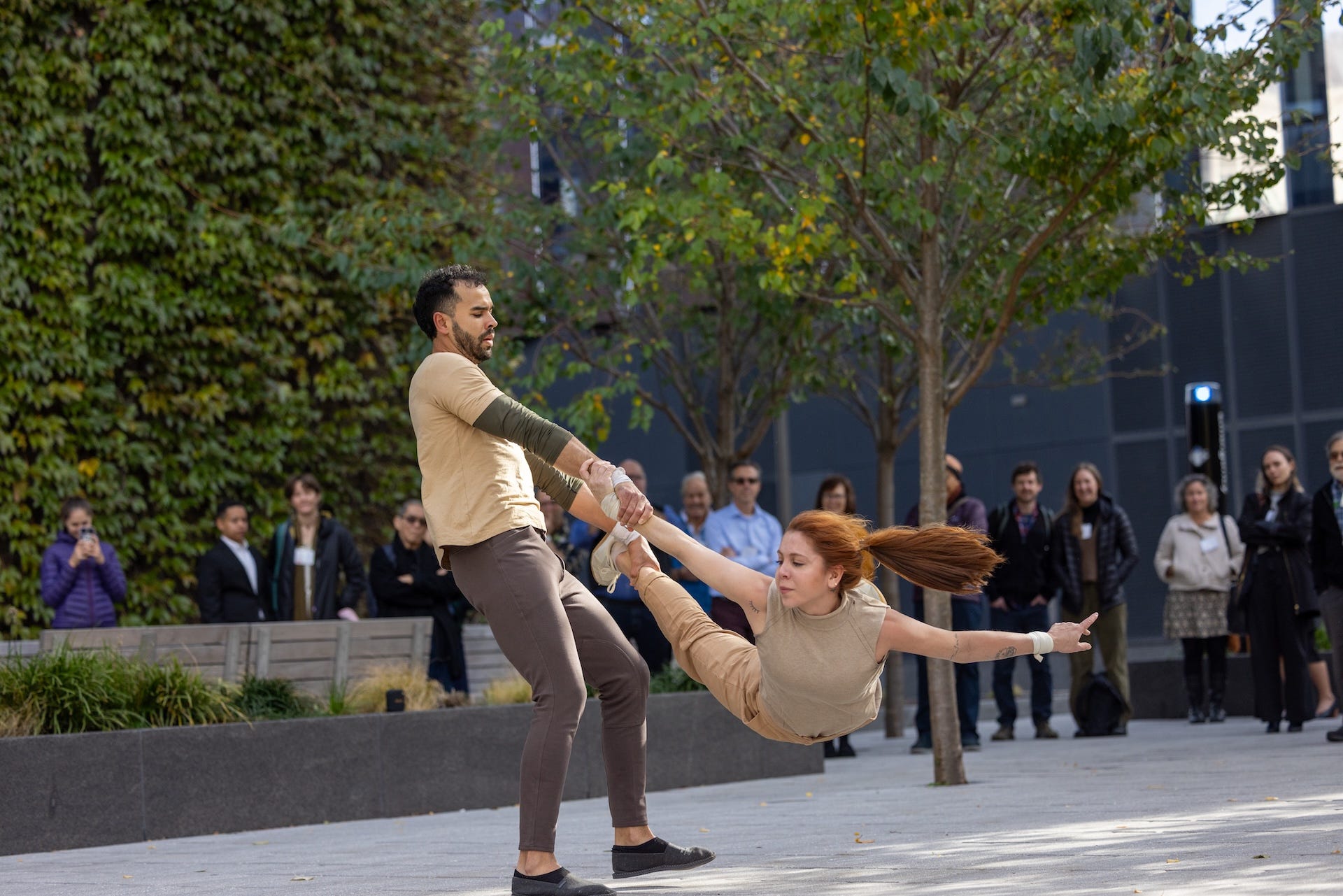
Following the panel, attendees were guided outdoors for an interactive circus performance and workshop led by Pedro Mello e Cruz. Performers Edio Silvio Neto and Isadora Bello Silveira captivated the audience with their daring balance and trust-based acrobatics – an artful metaphor for risk, collaboration, and resilience. After the performance, Mello e Cruz invited attendees to engage in a workshop that introduced basic circus techniques, like mutual balance and trust falls, to demonstrate the value of non-verbal communication, trust, and shared risk in responding to the climate crisis.
Re-energized by the workshop, the day moved into a lively conversation called Journalism, Trust, and Cultural Relevance in a Time of Climate Crisis. The panel – featuring Emmy-nominated documentarian Ian Cheney, the “dean of Climate Journalism” Andrew Revkin, and Journalist and BU Community Impact Fellow Meera Subramanian – examined how journalists can connect more deeply with audiences inundated by information and misinformation alike. They emphasized the need for authenticity, empathy, and depth over spectacle.
“To invite people to go out and inspect, and observe, and explore, and think critically, and be skeptical of the world around them. That creates a great unknown. It’s an open invitation, a generosity that hopefully empowers them to see themselves as storytellers and observers in the world.” — Ian Cheney
Next, chair of BU’s Journalism Department and former editor-in-chief of the Boston Globe Brian McGrory, WBUR Executive Editor Dan Mauzy, and University of Wisconsin, Madison Professor Sue Robinson engaged in the panel: Audience Trust and the Future of Science and Climate Policy Journalism. The group reflected on how newsroom structures and storytelling strategies must evolve to meet public expectations and rebuild confidence in media institutions As Mauzy noted, “It’s critical that we do everything we can to reflect the community we aspire to serve.”
The day concluded with a forward-looking conversation on the panel Emerging Media, AI, and the Climate Crisis. Professor of Media Studies Joan Donovan, Boston’s Chief Innovation Officer Santaigo Garces, materials scientist and author Ainissa Ramirez, and UMass Amherst Professor Ethan Zuckerman explored how new technologies can both support and complicate climate communication. The discussion wrestled with the real environmental and human harms of AI and how the widely available technology might be harnessed for social good.
“These tools are politically important. They are shaping the public sphere, and the public sphere shapes democracy.”— Ethan Zuckerman
As the event came to a close, attendees carried forward with the central message of the day: meaningful climate action depends not only on good science and policy, but on how we communicate to a diverse audience.
The MISI team looks forward to building on the ideas sparked at Communicating Climate, continuing to connect creators, researchers, and communities to shape trustworthy communication about our shared climate and environment.
Participants
- David Abel
- Kenneth Bailey
- Isadora Bello Silveira
- Ian Cheney
- Mariette DiChristina
- Joan Donovan
- Barbara Espinosa Barrera
- Patricia Fabian
- Santiago Garces
- Amy Geller
- Eric Gordon
- Carol Gregory
- Michael Grunwald
- Melissa Hoffer
- Meghan Irons
- Dan Mauzy
- Brian McGrory
- Pedro Mello e Cruz
- Janot Mendler de Suarez
- Nathan Phillips
- Ainissa Ramirez
- Andrew Revkin
- Sue Robinson
- Edio Silvio Neto
- Meera Subramanian
- Cass Sunstein
- Kannan Thiruvengadam
- Chris Wells
- Ethan Zuckerman
Organizations
- MISI
- CAS
- COM
- IGS
- SPH
- City of Boston
- Conservation Law Foundation
- Design Studio for Social Intervention
- GreenRoots
- Harvard University’s Harvard Law School
- The State of Massachusetts
- The Boston Globe
- University of Massachusetts Amherst
- University of Wisconsin Madison
- WBUR
- Wicked Delicate