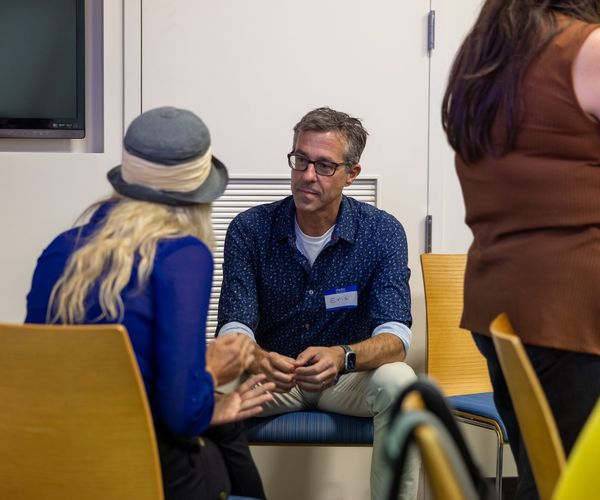
Inside the new Center for Media Innovation & Social Impact, which is exploring approaches for involving communities in storytelling.
By Sofia Sanchez (SWIP Summer Writing Intern, summer 2025)
Banner photo by Derek Palmer.

Public confidence in once-respected institutions is deteriorating. With the proliferation of misinformation fueled by AI, political polarization, and social media, people are less likely to trust public outreach from news organizations, government entities, universities, and other historically trusted sources of information.
Communication is foundational to a healthy and productive democracy. As conversations about crises like climate change become increasingly fraught, a team of Boston University communication experts is bringing together local storytellers and BU faculty to explore how to restore trust and communication.
“We’re in this ecosystem where all these institutions are churning out messages, but everyone’s like, ‘Nope, I don’t trust what you’re churning out. What I’m going to trust is the thing that my friend on Instagram is posting.’ So what do we do with that?” asks Eric Gordon, a professor of the practice of journalism at Boston University’s College of Communication (COM) and an affiliated faculty member at BU’s Institute for Global Sustainability (IGS).
Gordon recently joined BU to lead its new Center for Media Innovation & Social Impact (MISI). He will work alongside COM’s David Abel, a professor of the practice of journalism, Chris Wells, a professor of emerging media studies, both also IGS faculty affiliates, and Amy Geller, an assistant professor of film & television. We spoke with Gordon to learn about MISI, diminishing levels of trust, community perspectives on storytelling, and the Communicating Climate event planned for this fall.
Q&A with Eric Gordon
What are some of the core issues the Center for Media Innovation & Social Impact (MISI) aims to address?
The reality is, if we look at our information landscape and our media landscape, even the best reporting is sometimes not trusted. When we assess that reality, do we say: ‘It’s not trusted because it’s bad reporting?’ Or do we say: ‘It’s not trusted because of the way the story gets socialized within the community that is meant to trust it?’ Our team is working to understand and support how stories gain trust and legitimacy.
When you’re operating in a context of reduced or absent trust, it may be necessary to bring the people central to that story closer to the storytelling. The problem is news organizations tend to draw a hard line between journalism and community storytelling. But in order to reinvigorate the relevance of journalism and the organizations that do it, we need to diversify the kinds of methods and goals that we use.
Our team is working to understand and support how stories gain trust and legitimacy.
– Eric Gordon
The Center will experiment with participatory methods where we bring people into the act of storytelling to create more authentic and trustworthy stories. We’ll also explore traditional storytelling methods with novel media forms. Our goal is not to say ‘This is the only way to tell trustworthy stories.’ Instead, we’re asking, ‘What kinds of stories, and what kinds of technologies and methods are most effective for information to be trusted by the communities who need it. ’
What are the benefits of focusing on local storytelling?
Focusing on the local area is important for a number of reasons. We want to establish the Center and BU as a trustworthy partner within Boston’s environmental justice community. Our goal is to have a place-based community and an in-person culture to build relationships and to understand impact within the community of local activists, media makers, and artists. We want to have national and international influence, but we do that by actually understanding how this work can change a local ecosystem.
A value for me, and the Center, is to directly support individuals and the communities they’re coming from when we collaborate or add affiliates. That’s how a university like BU can have a substantial impact on the city that surrounds it. And at this particular moment, cities and localities matter more than ever.
Can you tell us more about the Transforming Narratives for Environmental Justice (TNEJ) project, as one of MISI’s first initiatives?
What we’re doing with Transforming Narratives for Environmental Justice is focusing on communities that are most impacted by climate change. With a generous grant from the Mellon Foundation, we recruited two separate cohorts: One is a cohort of five humanities scholars from across BU who are coming to the Center to explore how their specific expertise might apply to environmental justice in contemporary New England. The other cohort is our Community Impact Fellows, who are climate artists, activists, and advocates from the Boston area.
One of our goals is to create a context where we can have discussions across disciplines and levels of expertise and work across those divides. These Fellows can create a trusted and collaborative community to understand a space that is not yet defined — to ask important questions, cultivate new collaborations or partnerships, and generate new research ideas or projects within the context of environmental or climate justice. That’s how we’re getting this off the ground.
What makes BU the right place for MISI and TNEJ to thrive?
I’m encouraged by messages from President Gilliam that BU should be Boston’s university. That’s something that I’m really leaning into at MISI. I’m also encouraged by messages from other university leaders looking for collaborative endeavors and interdisciplinarity in all its forms. The Center we’re starting is nothing if not collaborative, and nothing if not focused on local impact. In that sense, I feel like BU is the exact right place to be doing this right now.
Additionally, the scope of the expertise at BU is extraordinary and unique. It gives us an opportunity to work alongside the existing expertise at the University and figure out ways to catalyze it toward real-world impact.
The Center we’re starting is nothing if not collaborative, and nothing if not focused on local impact. In that sense, I feel like BU is the exact right place to be doing this right now.
– Eric Gordon
How can people get involved with MISI’s work?
One way would be to attend our upcoming event. On November 7, on the 17th floor of the CDS building, we’re hosting our Communicating Climate event, which is our first annual Media and Social Impact Summit. This year’s event will involve a range of speakers, including government leaders, journalists, and researchers, as well as artists and performers. We’ll set out to address a wicked problem: ‘How do people come to trust climate science and facts about the local impacts of climate change? And what is the role of technology and storytelling in creating legitimacy?
Content has been edited for length and clarity.