INTERVIEW: BRONCHO
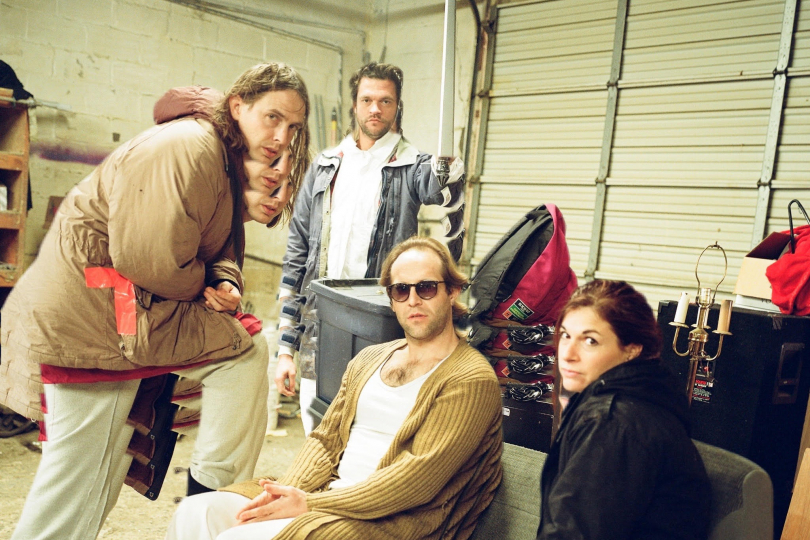
Photo Credit: Pooneh Ghana
I had the opportunity to speak with Ryan Lindsey, frontman of the Oklahoma-native band BRONCHO. We discussed the creative process behind the band’s albums, his past in the boys’ choir, and how his brothers helped him become a natural performer.
Brianna Benitez (BB)BB: I would like to hear about your timeline with the band, from when you started up until now.
Ryan Lindsey (RL) It’s interesting right now because we’re doing the “Double Vanity” tour and then also some shows where we’re playing “Just Enough Hip to Be Woman.” It’s like I’m giving glimpses into the time capsule that is ten years ago, or “Just Enough Hip to Be Woman” going further back, 12 to 13 years ago, when we were recording that record. But “Double Vanity” we recorded in 2015. I had just moved to Tulsa from Norman, and I immediately drove back to Norman to record. That’s a moment in time that I can remember pretty well. But it’s all foggy… That’s part of the mystery of memory. It’s all becoming more clear as I listen back to the records with the intention to play them. It is an interesting time capsule to have a record and have that moment recorded. I think it’s pretty special to be able to go back and remember things about that time, or tour, or whatever. There’s all kinds of things popping back up.
BB: With the concept of this tour you guys are going on right now, you’ll have some shows where you fully dip into this world that you had a while ago. Then, the next show, you’ll exclusively have the newer stuff. Do you ever feel like you get detached from a certain project with this tour style? Is there a strategy you use to get back into certain projects?
RL: There’s no [strategy], but there’s a little of the jumping in the water and shock that happens with going back and listening to the older stuff. Something will be totally different from what I remember it being. You have to just relax in the environment, and it all gets real familiar pretty quick. That has happened a few times where I’m like, “What?” But then I’m like, “Oh, this feels totally normal.” It takes some sitting in the water to get that place.
BB: It’s like a meditational practice that you have to do.
RL: Yeah. It can be scary sometimes. I naturally move onto the next thing, and I’m thinking about some other songs that are bouncing around in my head that I want to record. Then, all of [a] sudden, going back and hearing stuff from even a year ago can sometimes be funny to me.
BB: It’s this subconscious thing that comes right at you.
RL: That’s right.
BB: You have to compose yourself, but you also have your band members to help with this. Regarding touring and playing with them live, and with making these projects, can you talk about how they’ve helped you compose yourself?
RL: For me, I always liked being in a band because we’ve got our little crew. In the first band, I was with my two older brothers. I immediately felt comfortable–I liked being with them. However, many years later, I’m still in that mindset where it feels good to have some people that I consider friends and that I like being around to be a part of something like creating music, and creating videos, or art. It’s cool to do that with people who are also fun to hang out with and have a good time and make me laugh, or maybe I make them laugh. You go through things with everybody. Everybody is always going through something different. We’ve been together long enough that we’re quick to be there for each other and figure things out.
BB: Although you have these friends, sometimes you have to have that balance of friends, but also your coworkers or colleagues. You know that saying that goes like, “Having too many heads in the kitchen,” and it becomes too much? Creative minds are always awesome to have in the kitchen, but sometimes there’s too much of that. Are there any struggles you might face in that sense?
RL: The way everything gets created for us usually ends up being a process of me having something in my head, maybe I’ve demoed it, maybe I haven’t, and maybe somebody hears me playing through something or in sound check. Everything happens so differently that I think we’re always floating in zero gravity. Being open to anyone having the answer to any math problem at any moment is as vital as anything because I’m open to anyone’s take being better than the version that’s been in my head. As we start to work on it, someone’s interpretation of wherever I was coming from can open a whole new world that I would have never dreamed of, and make something feel so good that if I had been completely tied to my initial idea, we never would’ve found something so beautiful from someone else. Stuff like that will happen. There’s no room to be super sacred about anything unless you know for sure that someone feels great through all that. It’s more like, “This feels good to me,” and someone else’s take will either feel better or be like, “I don’t know, I still like this version.” It all just shakes out, and that’s part of the whole process of making a song or the whole record. “Natural Pleasure” was different because I did a lot of that by myself through COVID. There were times where we did get together and work on a song. We would take it that far, and then sometimes it was just like, “Oh, yeah, I forgot about this thing I did. This feels good; it fits with that. Let’s use it.” You know, is Mod Podge still a thing?
BB: It sure is.
RL: Like [Mod Podge], I take it however it comes. Whatever feels best to me is what I try to lean into.
BB: That’s the way to do it. I would also say that your guys’ style is pretty defined. Even with the music videos, there’s some cohesion that has been built, and I assume a lot of that foundation comes from gripping onto one idea rather than floating everywhere. It’s interesting that you talk about the fact that there’s no room to not accept other advice. Can you tap into how you keep the original voice while still accepting those other ideas?
RL: Part of keeping the voice there and getting other input is when we’re all in the same room, because that voice can shift with who’s in there… There’s been tons of times where it’s just me, and even by myself, [I] will be pulling from inspiration from moments with anybody else that was there before. Whether it be Nathan, Kenny, Ben, and our buddy Brennan. He’s been playing guitar for us because Ben had a baby in the… summer? Time is crazy.
BB: Time is going by.
RL: Yeah! So Ben was like, “I’m gonna stay home.” It made total sense to be with the family. We had Brennan tour with us last year, and he’s playing on these shows, too. He’s a part of the band. It gives us another voice when we start talking about ideas. It’s been seamless having him there with us.
BB: There’s a bunch of puzzle pieces with you guys, and how he comes in to take over for a little while, but Brennan still fits in.
RL: It was so natural. It all happened very naturally. Everybody’s always still a part, so it’s nice to still talk with him about ideas, and Brennan, having ideas, and Nathan, and Penny. It all floats in this cloud.
BB: That haze. That fog.
RL: We have our own “uploadable” cloud, maybe, that we all are a little bit subconsciously connected to at all times. And we’ve done every record with our buddy Chad. He’s definitely always been part of that as well. He’s just as important as any of us… [With making] “Double Vanity,” I moved to Tulsa and then drove straight back to Norman. We had a month and a half blocked at the studio. We spent probably two weeks getting our RV set up and making all the rooms feel good. Then it started to feel like, “How long has it been already? Two weeks? Well, it feels great out here, but we haven’t recorded anything.” As we got closer and closer to that end of the month it started ramping up and stuff became more clear and song ideas started to get fully formed, and there started to be lyrics. When I typically think about the romantic version of making a record, “Double Vanity” was that because it was a chunk of time that we had and we locked ourselves in there and finished a record. Other records have been spread out and we have little chunks of time [to make them].
BB: But “Double Vanity” was this condensed time frame.
RL: Everything happened and got sewn up quickly within what seems like a normal period of time. And I like the other processes, too, because they give you time. With “Natural Pleasure,” I started those songs in 2020 or 2021. Time seemed infinite then…I had all the time in the world, and, interestingly enough, those songs did not change much from [when they were written]. Starting to demo those songs to that five-year period of time until it was like, “Here it is. Let’s turn it in and put it out.” It was a lot of sitting around with the songs for a while. Forgetting about them and coming back and being like, “This feels good to me still. Let’s use this.” With “Save Time,” we had a different working version of that. It felt great, but at one point I fell out of love with it. I was thinking there was this other version of it, and then there was like a couple day period where Nathan and I drove to Norman and it just happened, and the version on the record just happened. I knew at that point that this was the version that felt the best. Just being open to whatever the mission calls for. You never know what that mission is until you’re right there in it. Every song has its own [mission]. You just gotta be fluid with wherever it might steer you, or drag you, or push you, or whatever.
BB: Whether it’s “Double Vanity,” where you’re locked into it, versus “Natural Pleasure,” where it’s spread out, regardless of that, it’s a process that requires you to be present and understanding right now. Even with all that freedom you may have had, you just have to look at, “What am I hearing? What am I listening to? What do I like right now?”
RL: It’s a mix of having those moments where you have to make a decision and those moments lots of times come after a lot of moments where you’re free, like not thinking about much and just going with it, and you can come back and be like, “Oh, this is the way. This is the version.” [With] “Double Vanity,” we did have a little bit of that because we had some time between like, “Okay, I think the record’s done, but is it?” Chad got this reverb tank, and he started running everything through that and it was like, “Oh, that’s the way!”
BB: It all started with Chad’s reverb tank!
RL: It did this magic trick on all the songs. It was those songs, compared to all our previous records and tracks in general, [that] were slow. “Double Vanity” was this slow record that needed ‘verb and needed something to put a blanket over these blocks of time between kick and snare that wasn’t there. When we get to “Natural Pleasure,” “Double Vanity” is fast. When we originally were touring on “Double Vanity,” it was hard because I didn’t know how to go slow after being a fast and wild BRONCHO for a few years. Now that we’ve done a few more records and did an even slower record, I’m coming back playing “Double Vanity,” and it is way easier. The tempos feel natural compared to when we first did it. I remember we played a few shows where we played “Double Vanity” all the way through, and one of them was in San Diego at Casbah and this guy came up to me after the show, and he was so mad we played the record all the way through.
BB: Wow.
RL: I think of him every so often when we’re about to do something real slow. “Natural Pleasure” was a good exercise and relaxation.
BB: A necessary record to make.
RL: Yeah, it can be whatever it is, doesn’t have to be fast or slow, but what feels best with this idea.
BB: It’s cool that you have that one guy you think about constantly.
RL: I remember kind of agreeing with him. Like, “Yeah, I don’t know man!”
BB: You guys have been doing this for a while now, and especially with you going at constantly even during COVID. It’s a never-ending process. I read somewhere that you did choir in junior high, and you mentioned that you didn’t care about it much back then. However, you said that when you look back, it’s important for who you are today. Considering that and anything else that you’ve done, maybe you looked down on it while it happened versus now. What are things that you appreciate that have happened to you?
RL: My mom put me and my brothers in the boys’ choir when we were in elementary school. I hated going because I was so young, I just wanted to be outside playing. All of a sudden, every Tuesday night I’m being driven to go to this choir rehearsal that I thought was crazy. Now, I’m so glad I did it because it taught me proper breathing. I mean, we were doing some real-life stuff in second grade. They were teaching us how to breathe from our diaphragm. It seemed strict in a weird way, but it wasn’t strict at all. It was more like, “Here’s how to do it. It’s an honor that you’re in the choir.” It wasn’t like getting slapped on the wrist with rulers. It was professional in a weird way, and I’m only thinking about it now looking back on it. We were expected to be well-behaved and there wasn’t time for anything other than learning how to use your voice.
BB: I mean, you’re putting your kid into this professional space, and you demand all these things. It’s a strenuous thing to ask for a kid.
RL: They knew how to work with kids. It wasn’t anybody involved, and it was more in my mind I’m like, “Why do I have to leave this backyard to get in the car to go to choir practice.” That sounded crazy to me. But you get there and the director, I loved him, he was great. But then I was also doing Oklahoma State University, the college in the town that I grew up in. There were a few university productions that I played kid parts in. I had these early life moments where I’m with people who are serious about doing something, and I’m just as serious about it. I love performing. And I’m the youngest [child], so performing was something I have always done.
BB: Natural performer.
RL: Yeah. You’re the youngest. You’re the night’s entertainment.
BB: That’s true.
RL: I was always OK with that. It somehow morphed into, “Oh, my brothers have a band,” and I was all in on that stuff. They asked me to play, and all that stuff I had [learned] as a kid already had some hours clocked with being in front of a crowd, [which] made me feel extremely comfortable with being in a band. There was nothing scary about the stage to me. I felt like I had already been there before. But, the boys’ choir was a period until my voice changed. You could only be in a boys’ choir until your voice changed. So that was until elementary school and a minute in middle school.
BB: Everything changes in middle school.
RL: Yeah. The junior high choir was great. Our teacher, Mrs. Smith, was awesome. She made it fun. Then I was in choir for a second in high school, but I think I felt like I’d already done choir stuff. I was starting to play in bands.
BB: It’s different.
RL: Yeah, I was like, “I’m not in choir, I’m in a band, man!”
BB: Almost sounds rebellious.
RL: Yeah. That was where I really started to cruise down the world that would eventually lead to BRONCHO.
BB: Beautiful. Could you give me three words that describe BRONCHO right now?
RL: That’s funny because there are times where I think of funny and simple words that are good for moments like this. Then I find myself in moments where I’m like, “I don’t know,” and way later I’m like, “Ah, I remembered!”
BB: That eureka moment.
RL: Yeah. I think physical is a word that makes me think of BRONCHO because I think there’s something physical about the whole process, and there’s something physical about our show, and about the art that we try to put on. There’s something grainy. I think there’s something that looks touchable and maybe sounds a little physical and touchable when you listen to our recordings.
BB: Nice. Two words right there, which are physical and touchable.
RL: Yeah. Physical, touchable, and sensible. We’re sensible people. We’re lovable.
BB: I feel all those. Especially the physical part. Hearing that excites me for your show and how it’s gonna look. I’m looking forward to that!
This interview was edited for clarity.