Interview: Becca Hannah
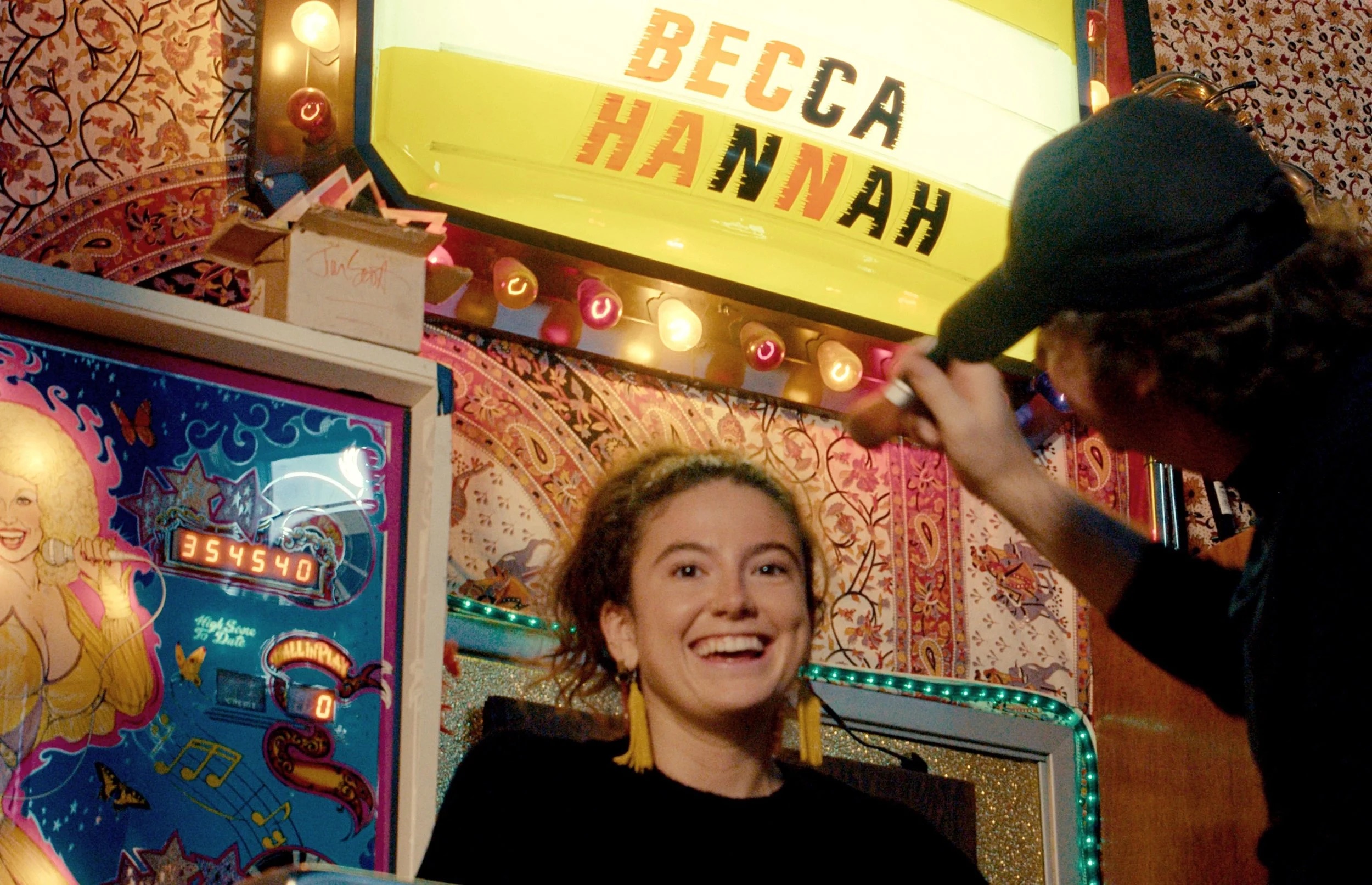
Photo Courtesy of Becca Hannah
Interview by: Brianna Benitez
I recently spoke with Becca Hannah shortly after the release of her latest record, “Tonight In My Dreams.” We discuss collaborative processes, musical inspiration, and living on the West Coast.
Brianna Benitez (BB): I’m curious about your whole post-release process with your new album. It’s been out for a couple of weeks now.
Becca Hannah (BH): It’s been almost three weeks. It feels so good to be able to just listen to the album for the sake of enjoying it rather than listening to the mix or for a tweak that needs to be done. It expands my perspective on songwriting, too. I was in the thick of the nitpickiness, the crafting, and trying to make it as good as possible. Now I’m sitting back, listening, and I’m like, “Wow, this just exceeds what my expectations were.” I was in the fog of being a perfectionist. Now that I’m able to take a step back, I realize there is no perfect, but the album is also so much better than I realized.
BB: You know what they say about being our own worst self-critics. You talk about perfectionism with your art. Would you say that you try to be more intuition-focused or are you more technical?
BH: I’m definitely more intuition-focused. I work with a lot of people who are a lot more technical. Well, no, it’s a mix of both, actually. But there are a lot of people who are more technical, and it’s nice because we’re able to balance each other out with our approaches and point out each other’s blind spots. Just reminding each other, “It could go this way, or what if we try this?” Just expanding our sense of curiosity.
BB: That’s always important with a team. Is there maybe someone, or a few people, that have been important, that you wouldn’t have been able to do this project without?
BH: I would say my two close friends, who are part of my band and recorded the album with me, along with other musicians. My two close friends: Tristan Jantz, who co-wrote and co-produced the album with me; and Pàppa D, who is the pianist on the album. We’ve had so much fun exploring different methods of how we want to perform the music live and other choices. They both went to Berklee College of Music, so they have the technical training, too. It grounds me and my ability to make those intuitive choices, and I think we’ve made a great team. I would not be the artist I am today without them at all. I’m really grateful for them. I’m grateful for everyone on the project, but those two in particular, I see them the most, and they’re in my day-to-day world out here in [Los Angeles].
BB: The way you’re describing it almost sounds like they know you also outside of the professional world.
BH: Totally. They’re some of my good friends here. That makes it easier. When people understand you on a personal level, it’s important.
BB: Things can go unsaid, but that’s only possible because they know you so well. About your collaborators, Tristan Jantz and Pàppa D, how did you meet them?
BH: Tristan and I met in Boston five years ago through a Boston’s musicians Facebook group. We started gigging at corporate events and weddings. Then we started writing together. He moved to [Los Angeles] in 2023, and I moved there in 2024. When I got here, he introduced me to some of his circle and we built on it together from there. He’s challenged me and encouraged me in ways that I am so eternally grateful for. I truly would not be [at this point in my career] without him. Pàppa D, I love him. He and Tristan met out here. They both went to Berklee, but they met out here. His style is unmatched—he dresses like he’s in the 70s, he’s Greek, and has this whole persona. He’s the kind of guy who walks in the room and everyone is like “Who is that?” Everyone just wants to talk to him and get to know him. We make great strides as a collective and individuals because we support, lift each other up, challenge, and inspire one another.
BB: The way you speak about them is so endearing, too. But before we talk more about Tristan, I want to hear more about your timeline. Where exactly do you come from in Boston?
BH: I grew up in Newton.
BB: I’m from California. We swapped!
BH: We swapped states! I’m in East Hollywood, right on the border of Silver Lake. I love it a lot. It’s so cool to be immersed in this creative culture where the arts are honored. It’s just in the air. Sometimes it can be overwhelming and intimidating. Sometimes I fall into this trap of comparison and feeling like I need to be doing more than I’m doing. When I have these moments, but I’m in a really grounded headspace, I can take a step back and be like, “Look at all this progress you’ve made. Look at all these things you’ve done. Look at all these people you’ve met,” and reflect on this journey because it’s not a linear, overnight process, being an artist or creative in any capacity.
BB: And your whole transition from being on the East Coast to the West Coast. How has the cultural switch inspired you?
BH: I’ve been able to see the art and the inspiration and everything around me more so than ever. That directly translates to the way I write my music. I’ve been writing new stuff with other people. My artistic vision and ability to break barriers once subconsciously put on creative work, I’ve been able to break through them since being out here. Seeing all these artists and creatives, the molds that they’re creating for themselves and their imprint on the artist world is unique. There’s no conventional way to do it and I feel like I’m able to think outside of the box more. I’m consistently surprised by that. Even in the moments where I feel less inspired, I still trust that inspiration will come back, and it always does. The arts are celebrated more here. They are celebrated on the East Coast, in Boston, but it’s a different kind of vibe.
BB: Has [Los Angeles] matched your vibe?
BH: It has totally matched my vibe. But it’s funny because everyone I meet out always knows [that] I’m from the East Coast. I kind of love that. All of my people out here are from the East Coast. It’s funny that we find each other. I do feel like the East Coast will forever be my home. [Los Angeles] is a long-term adventure for me. I love both for different reasons.
BB: Home versus work. But work is also this beautiful thing.
BH: For sure. I like the pace of the East Coast. The “go, go, go” vibe. I hate it and I love it. Part of me is kind of addicted to it; it’s ingrained in my being. But when I’m in [Los Angeles] or California in general, I love the “go with the flow,” laid-back, less punctual vibe. I feel I naturally move more towards that, but there’s these two conflicted parts in myself that I see [reflected] in the East and West Coasts.
BB: With that last bit that you just mentioned, your music is kind of like that. It’s this fusion of pop, but also some R&B, and some jazz. You could name a few artists that are doing these unconventional combinations, but yours is a unique approach amongst those. Your voice is also unique—I see it as the lighthouse of your music. Especially with this new project, you were trying a lot of new textures and colors. It can be difficult for people to [be] open to new adventures, but maybe that’s natural for you. I’m interested in hearing how you opened up to these new ideas.
BH: I love that question. The process is ever-unfolding. I’m never going to emphasize just one genre. I am super inspired by jazz, R&B, soul, funk, pop, and all of it. It depends on the mood I’m in or the message I’m conveying. Having connected with such incredibly talented musicians and instrumentalists out here, I’ve been able to really expand my vision and the sound I want to evoke. When it’s just me and my acoustic guitar, or me and my keyboard, I can play, but I can’t play like them. They have more training obviously, but because of that broader training or more in-depth training and skillset, they’re able to explore the bending of genres and different core progressions. That’s a goal I have. I’ve done that, but I’ve always only scratched the surface. I want to continue delving into working on my chops, like my guitar, my keyboard, and writing more intricate core progressions that strike chords, but there really aren’t words to fully articulate.
BB: And that’s the reason we make art, to express what we can’t put into words. Your voice reminds me of Amy Winehouse first of all. Erykah Badu as well with what she tries in her music. One of your songs specifically really reminded me of her.
BH: Thank you! I get the whole Amy Winehouse comparison a lot and I love it, but Erykah Badu I’ve only gotten that once or twice. That’s a huge compliment.
BB: I could see you as their love child.
BH: I feel like it’s [as] if Erykah Badu, Amy Winehouse, and Norah Jones had a baby.
BB: There you go. That’s perfect. Going from artists that you’re compared to, could you give me three artists that inspire your work, whether they’re similar [to your sound] or not?
BH: I listen to such a broad range of genres. I love Eloise. She’s UK-based. She’s soul and R&B and jazz, but a little more on the jazz end of the spectrum.
BB: Is she contemporary?
BH: Yeah, she’s contemporary, but some of her core progressions have this Billy Holiday-esque thing going that I’m like, “Oh, my God, I need to write something like that.” I think it’s cool that when we try to write songs that, when compared to the inspirations, they end up sounding different, but it brings us one step closer to our authentic sound. I love Daniel Caesar so much. He’s more R&B, but he takes you on a journey—an emotional, in-depth story that fills, no, it envelopes you, like every song of his. Ugh, I love him.
BB: What’s your favorite song of his?
BH: He came out with a new album last year. There’s a couple of songs in there that I love, like this one song called “Who Knows.” It’s acoustic… [maybe not] acoustic, but it starts kind of acoustic guitar-esque. Ugh, it’s so beautiful. I’m literally going to listen to it after this. It really pulled me in and it’s cool because I don’t hear as much acoustic guitar vibes from him. But he still has the soul, the depth, and the R&B.
BB: The voice is the soul of it.
BH: Yeah. Carole King has always inspired me, too. Her songwriting is world-class. It’s remarkable, the stories she’s able to convey, and the core progressions. She has the soulful-meets-folk sound that feels like home to me. I grew up listening to her and there’s this sense of home and warmth and familiarity.
BB: These are all such good choices. All these combined feels like the sun. They’re fiery. I’d love to go back to Tristan, though. You’ve mentioned before that when you write on your own you’re able to speak in a private language that only you understand. That’s interesting to say because, it’s so true, but you said it in such perfect words. It’s different when you have a collaborator. I would love for you to talk more about how it was working with Tristan in that sense.
BH: I started writing some of the songs alone a few years ago and I was stuck. Then Tristan, a couple years later, helped me finish them. He gave his interpretation, set an idea of what direction to move in, and it got the ball rolling. I needed that time to sit with it and then come back to it and hear his ideas and combine my new ideas with his, then tie the ribbon on top. Then the other songs we started writing last year together. Those are the kind of songs [where] I feel they needed both of us. Both of our unique quirks and ideas and styles combined to make these songs. I don’t think I could’ve written them like that without him. You know, I wrote a song the other day that was super personal and vulnerable, sort of like a diary? Some of my songs read like a diary, but not to the point where I wouldn’t want to release them because I want to do something with it eventually. But I thought I was able to tap into my stream of consciousness without someone else interpreting and going, “Oh, what if you did that, or what if you did that?” There’s beauty in both processes of co-writing and independent writing. Both are great for different reasons. Both are, in my opinion, somewhat necessary for artists and writers to continue evolving, too.
BB: This song you brought up sounds interesting. I hope you release it at some point.
BH: I will! And I’ll let you know which one it is.
BB: Oh, please do. A little secret! How open are you to receiving feedback from any other collaborators or musicians?
BH: I’m pretty open. It brings me out of my head because I’m like, “OK, this person says this thing, but they want to challenge this thing,” and, you know what, whenever that’s happened, I listen back and I’m like, “Oh, wait. That was a good call.” It sounds like it exceeds my expectations of what I thought I could do.
BB: On that note of working with collaborators, but also people outside like family or friends who are not necessarily musicians—outsiders from the music world—goes back to one of your songs, “Empathy.” It’s about prioritizing what you need. Obviously, you have people who are next to you and there’s this mutual, constant support, but you always come first. That’s a special thing to acknowledge. Connecting it to you as an artist, how would you say you maintain your voice? Like I said, you have a unique voice, but people have expectations. Do you choose to meet people’s expectations? Do you want to completely do something that is true to you? How do you mesh those two things together?
BH: That’s a great question. I’m still figuring that out myself. I think every circumstance that evokes that question is different. Therefore, I’m going to talk about it [in] a different way each time. It’s an in the moment, game-time decision as to how I want to use my voice. “What am I trying to do? What’s my goal here?” I mean, I don’t really think that much of my goals before the night or show starts. I just go in and hope for the best possible outcome for everyone involved. I’m very good at improvising and troubleshooting in the moment, knowing how to appease other people, but also to appease the crowd and whatnot. It’s something I can’t fully plan.
BB: That makes sense. It correlates to what we spoke about earlier with the “go-with-the-flow” feeling that you enjoy. You were also talking about coming up and your experience evolving, learning how to become an artist. From what you’ve learned through your process, what would be your advice to aspiring musicians?
BH: I always want to say trust the process. I know that’s overdone, but it really is true. Trust the process even if you feel uninspired or down on yourself. It’s okay! You don’t have to have it figured out all the time. You shouldn’t have it figured out all the time. Lean into the moments of discomfort in whichever way that makes sense for you, in whatever capacity you have to do so. Take moments to celebrate your accomplishments.
BB: That’s amazing. One last thing before we head out: What’s a note you’d give to your future self?
BH: Thank you for trusting me and knowing that you’re more capable than you might initially think you are.
This interview was edited for clarity.