Impressions from the first SysteMPC workshop
On Thursday, July 10th, 2025, we hosted the first Workshop on Systems for Secure Multiparty Computation (SysteMPC’25) at Boston University to bring together the cryptography and systems communities around building systems for secure MPC. We had an excellent set of talks from academia and industry, including two keynote speakers, six long talks, and thirteen lightning talks. In total, we had 54 attendees from academia (BU, Brown, MIT, CMU, Berkeley, Stony Brook, UConn, UBuffalo, Yale) and industry (JPMorgan Chase, Google, VISA Research).

The field of secure computation began almost half a century ago, and a long line of theoretical and systems breakthroughs has made it a practical tool in many real-world scenarios. Nevertheless, important work remains to bring the frontier of secure computation closer to the state-of-the-art plaintext systems that now process vast amounts of data. This workshop seeks to foster collaboration between the research communities that exist at this intersection to help the field take the next step.
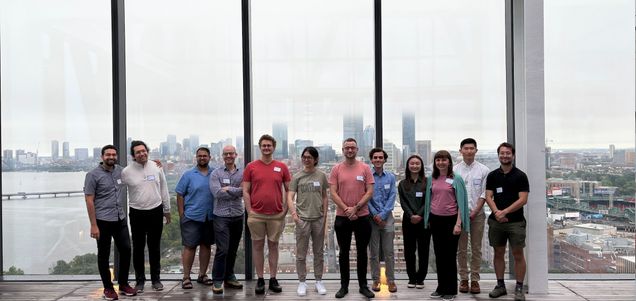
Marcel Keller from CSIRO’s Data61 delivered the first keynote on the MP-SPDZ project, a versatile library for secure multiparty computation. He highlighted how MP-SPDZ supports a wide range of protocols and security models, and described recent features like function-dependent preprocessing and secure shuffling. After the talk, we took a picture with Marcel and all the many MP-SPDZ users in the audience.
Peter Rindal from Visa Research gave the second keynote on pseudorandom correlation generators (PCGs), a tool that has dramatically improved the efficiency of two-party computation. He explained how PCGs allow parties to generate large amounts of correlated randomness from a short seed to achieve sublinear communication and highlighted their impact on designing scalable, high-performance secure computation protocols.
We also heard six excellent full-length talks:
Kert Tali from Cybernetica presented the “MPC Engine” abstraction as a unifying layer for integrating MPC into real-world platforms. He highlighted lessons from Sharemind, Carbyne, and the JOCONDE project in the EU, and raised the key question of what building blocks best support practical MPC deployments.
Mariana Raykova from Google presented Willow, a secure aggregation framework designed for real-world deployments of private analytics. Drawing on experience from federated learning and COVID exposure notification systems, she showed how Willow enables seamless transitions across different trust architectures to make large-scale secure aggregation more practical.
Antigoni Polychroniadou from J.P. Morgan discussed real-world deployments of secure computation in finance, focusing on privacy-preserving analytics for trading and pricing. She highlighted practical challenges such as continual data releases with differential privacy and improving profit while maintaining strong privacy guarantees.
Marina Blanton from the University at Buffalo discussed lessons from designing and experimenting with the PICCO compiler, an early tool for transforming general-purpose programs into secure multi-party computation protocols. She highlighted challenges in supporting general-purpose programs, providing intuitive abstractions, and enabling PICCO’s use for research, teaching, and deployable MPC applications.
John Liagouris from Boston University presented the BU Secure Analytics Stack, a unified software architecture for secure collaborative data analysis in the cloud. He showed how careful system design and cross-layer optimizations enable complex MPC-based analytics on large datasets, achieving strong security without relying on trusted hardware or leaking information.
Peihan Miao from Brown University discussed recent advances in private set intersection (PSI) to broaden its practical applications. She focused on new techniques for supporting fuzzy or noisy matching and handling large-scale, dynamic, and streaming datasets, addressing limitations of standard PSI protocols in functionality and scalability.
We also heard over a dozen lightning talks from graduate students and researchers across the country. Talk abstracts and slides can be found on the workshop webpage. The feedback from attendees was overwhelmingly positive, with many people suggesting that we make SysteMPC a recurring event!
We thank the U.S. National Science Foundation (award #2209194), the BU Computer Science Department, and the BU Center for Reliable Information Systems & Cyber Security (RISCS) for their generous support. More information is available in the Workshop Report.