BU-SHARP News and Research Blog
AI’s Growing Role in the Fight Against Alzheimer’s
post by BU-SHARP Writing Fellow Lindsay Griesman
From decoding DNA to designing drugs, artificial intelligence is changing both how fast Alzheimer’s discoveries happen and how scientists make them.
For decades, scavenging human DNA for markers of Alzheimer’s has been like reading a book one letter at a time. Researchers at USC are now using a “genomic language model” that can detect subtler influences across thousands of genes at once, which could guide new drugs aimed at preventing or treating the disease. Paul Thompson, director of the ENIGMA Consortium, compares AI to a “new telescope to survey the universe” (Levin, 2026)
That shift reflects a broader trend. The use of AI in medical diagnostics has grown significantly from image analysis to treatment planning to drug development and disease prediction (Zhang et al.). It is a fast moving field in dementia research.
Listening for early warning signs
 Some of the most promising work is happening here at Boston University. In 2024, BU researchers developed an easy-to-use AI tool that identifies people with mild cognitive impairment (MCI) who are likely to develop Alzheimer’s disease within six years. The model works from speech instead of relying on scans or lab tests. The team used recorded neuropsychological test interviews from the Framingham Heart Study, transcribed them with automated speech recognition, and trained models to predict who would develop the disease. The model analyzes what people say, such as word choice and sentence structure, rather than how they say it, such as enunciation or speed.
The results were encouraging. The best models, which combined speech-derived features with age, sex, and education level, reached 78.5% accuracy and 81.1% sensitivity in predicting MCI-to-Alzheimer’s progression within six years. In an interview with Andrew Thurston, Ioannis Paschalidis, lead researcher and director of BU’s Hariri Institute for Computing, says that early detection gives scientists more opportunities to study the disease and its progression. They also highlight the practicality of a development like this: a fully automated procedure could become an inexpensive and widely accessible screening tool that supports remote assessment.
Care and Prevention
Outside the lab, Alzheimer’s Society says AI will never replace person-to-person care but could help people with dementia live at home longer. Vanderbilt’s Timothy Hohman adds that apps and wearables could track modifiable risk factors like hearing loss, cardiovascular health, and sleep.
A tool, not a shortcut
Experts stress that human judgment still matters. Hohman warns that biased training data produced biased models, which could worsen health disparities. Ultimately, although an incredibly innovative tool, AI cannot fully replace the training, expertise, and experience of healthcare professionals, but this marks a major step forward in the journey to end Alzheimer's.
We Must Take a Stand Against Time-Travel! (in Data Analysis)
September notes from MPI Maria Glymour
For this month’s BU-SHARP blog post, I want to write something warm and inviting - diving into a topic that everyone will find exciting and enjoyable.
So, I have selected the issue of time-travel in data analysis. Time-travel: until we figure out how to do this in the real world, we must be vigilant to avoid it in data analysis too! What do I mean by time-travel? I mean using information about one time point to inform the classification of a variable at an earlier time point. For example, my medication use next year does not change my medication use this year (although the reverse might be true). Likewise, when analyzing data, I shouldn’t use information on a person’s medication use in say the year 2020 to categorize that person’s medication use in 2019 or before.
When I describe it like that you may say “of course not! Who would ever do that?” But, I fear that this approach, or various flavors of it, is very common in research. It is especially pervasive in aging and lifecourse research, where we are typically interested in characterizing exposure over a long-period of time. The intuition that leads to this mistake is that we want to use everything we know about a person — their entire follow-up period — to classify their exposure status. For example, when studying duration of drug use as a predictor of dementia onset from 2010 to 2020, we might classify someone as never using the drug, using the drug for 1-3 years, 4-7 years, or >7 years. But if we then apply those classifications beginning in 2010, we are using the future — information from 2011-2020 — to classify the past. Nobody who got dementia at say 3 years into follow-up (and was thus censored) will be classified as having the maximum duration of medication use. This also applies for the “never-user” group: you cannot know in 2010 that someone never used the drug, so using the entire follow-up period to identify “never users” and feeding that exposure category back to predict outcomes beginning in 2010 is flawed.
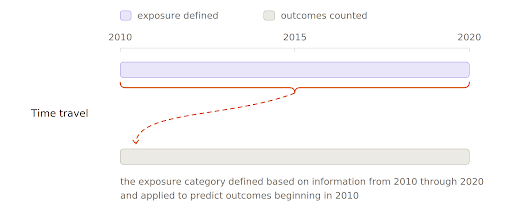
Other examples relate to extracting a trajectory of exposure over the follow-up period, e.g. the slope or sequence of exposures, and then using these trajectory values to predict outcomes starting from the beginning of the follow-up period. I consider these immortal time bias (some cases may just be cousins of immortal time bias) and the bias can be very large. This is not your run of the mill confounding or selection — this bias can deliver a seriously incorrect estimate. In the simple version of this, the bias is obvious, but it is shockingly seductive. This bias has some type of siren song that calls to researchers with longitudinal data. Even knowing it, I often find myself falling into some version of this mistake. Recently there is a lot of enthusiasm for ‘target trial emulation’. One of the best things about target trial emulation is that it helps avoid this type of analytic mistake- it’s not a panacea for all the things that threaten causal inference in observational data analysis, but it helps innocent analysts avoid this major unforced error.
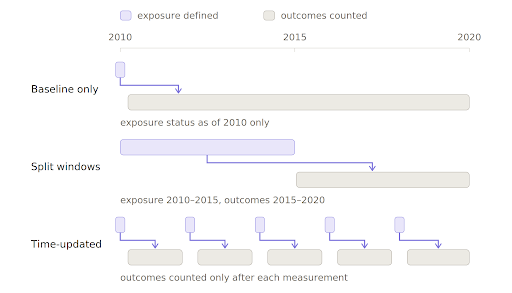
Fortunately, there are alternatives to time-travel! We can classify at baseline only — this is often pretty useful because it predicts much of the future trajectory. Initiating a medication is likely strongly associated with subsequent use. You can also separate the exposure definition period from the outcome definition period. For example, characterize exposure from ages 50-60 and outcome beginning at age 60. And finally, you can define a time-updated exposure value. Each of these entails some complexities (most notably, interpreting the baseline estimate, dealing with people who do not persist in the sample, and addressing time-varying confounding, respectively). But they are all viable options and avoid the major biases of time-traveling data classification. So before committing to your longitudinal analysis, ask yourself: am I using any information from the future to define a variable in the past? If so, please stop, step away from the time-traveling data analysis, and redefine your time-specific variables using only information that would have been known by that time.
That is it for the September BU-SHARP blog! Comments, citations, and examples are very welcome. And let us know if there are other topics you’d be interested in hearing our opinions about! Probably next month we’ll aim for a little less geek.
Some pertinent references:
- Suissa S. Immortal time bias in pharmacoepidemiology. American journal of epidemiology. 2008 Feb 15;167(4):492.
- Hernán MA, Sauer BC, Hernández-Díaz S, Platt R, Shrier I. Specifying a target trial prevents immortal time bias and other self-inflicted injuries in observational analyses. Journal of clinical epidemiology. 2016 Nov 1;79:70-5.
- Hernán MA. How to estimate the effect of treatment duration on survival outcomes using observational data. Bmj. 2018 Feb 1;360.
- Platt RW, Hutcheon JA, Suissa S. Immortal time bias in epidemiology. Current Epidemiology Reports. 2019 Mar 15;6(1):23-7.
- Fu EL, Harhay MO, Schneeweiss S, Desai RJ, Hernán MA. Starting right: aligning eligibility and treatment assignment at time zero when emulating a target trial. bmj. 2026 Jan 12;392.
September is World Alzheimer’s Month
post by BU-SHARP Writing Fellow Lindsay Griesman
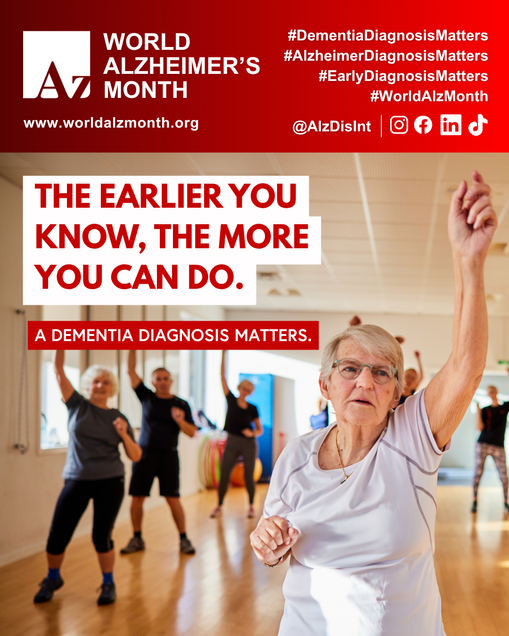 September is World Alzheimer’s Month, an international campaign dedicated to raising awareness about Alzheimer’s disease and related dementias. Each year, people and organizations around the world come together to learn more about dementia and support those affected by encouraging conversations about diagnosis, care, and research. This year’s campaign highlights the importance of early diagnosis with the theme “The Earlier You Know, The More You Can Do: A Dementia Diagnosis Matters.”
September 21 marked World Alzheimer’s Day, which takes place annually during World Alzheimer’s Month. The day is an opportunity to bring even greater attention to Alzheimer’s and related dementias and to recognize how it affects more than 55 million people worldwide. Globally, organizations mark the day through fundraisers, walks, and other community events.
Alzheimer’s is a progressive disease that accounts for nearly 60-80% of dementias. According to the Alzheimer’s Association, dementia is a general term for memory loss and other changes in cognitive abilities severe enough to interfere with daily life. It is important to note, though, that Alzheimer’s is not a normal part of aging.
While September provides an important opportunity to learn about this disease, awareness does not have to end when the month does. In the United States, one way to continue that momentum is by participating in the Walk to End Alzheimer's, a yearly event organized by the Alzheimer’s Association.
Get Involved: Walk to End Alzheimer's
This fall, the Boston Walk to End Alzheimer’s is on October 25th. For students and members of the Boston University community and beyond, participating in this walk can be a meaningful way to turn awareness into action. Whether by walking, volunteering, or fundraising, community participation helps keep conversations about Alzheimer’s alive beyond September.
To stay up to date on local research on healthy aging, follow BU-SHARP's work. Follow us on LinkedIn and Bluesky @busharp.bsky.social. Click here to sign up for our newsletter.
Parental Longevity and the Science Behind Healthy Aging
post by BU-SHARP Writing Fellow Lindsay Griesman
As life expectancies increase and people live longer, researchers are increasingly interested in not just how we live, but how long we can do so in good health. People who live to 100 years or older are known as centenarians, and they offer researchers a unique opportunity to better understand the factors that may contribute to healthy aging and extreme longevity. Despite life expectancies rebounding to higher years, centenarians remain remarkably rare, making up just 0.03% of the US population in 2024.
One strategy researchers can use to learn more about healthy aging is to study the children of centenarians. If having a parent who lives to be 100 is associated with living longer or developing age-related diseases later, researchers can investigate which biological and environmental factors might contribute to this pattern, and relate their findings to actionable change to reduce the incidence of disease or delay the onset of age-related diseases.
A recent study published in JAMA Network Open examined this question, using three longitudinal studies: the LonGenity Study, the New England Centenarian Study (NECS), and the UK Biobank. Researchers compared people who had at least one parent who lived to age 100 with control participants whose parents had shorter lifespans. Across the three studies, researchers examined mortality and four age-related health conditions: cardiovascular disease (CVD), cancer, hypertension, and stroke.
The researchers found that offspring of centenarians had lower risk of death, CVD, and hypertension compared with controls. Their risk of death was 42% lower, while their risks of CVD and hypertension were 33% and 32% lower, respectively. The age at death was delayed by about three years, while the onset of hypertension was delayed by approximately five years. No significant association was found between parental longevity and cancer.
BU Researchers Studying Exceptional Longevity

The New England Centenarian Study (NECS), one of the data sets featured in this study, has tracked centenarians and their families since 1995 and has been based at Boston University since 2002. Stacy L. Andersen, PhD, and Thomas T. Perls, MD, MPH, of Boston University’s Chobanian & Avedisian School of Medicine are co-directors.
The NECS is one of the largest studies of centenarians and their families, having recruited and assessed over 4,000 individuals to date. Through this research, Andersen, Perls, and their collaborators investigate why some people are able to live exceptionally long lives while delaying or avoiding many of the diseases commonly associated with aging.
So far, the team has determined that exceptional longevity runs in families and that there is a genetic influence upon survival which increases with ages of survival beyond ages 90-99. This genetic influence likely consists of a plethora of genetic variations with insignificant individual effects but as a group, have a strong effect.
Help BU Recruit Centenarians for the Study
If you know a centenarian, Please contact the NECS toll-free at 1-888-333-6327 or by email at agewell@bu.edu. You can also reach the Principal Investigator, Tom Perls MD, MPH at thperls@bu.edu.
Meet Lindsay Griesman, BU-SHARP’s Social Science Writing Fellow
BU-SHARP welcomes Lindsay Griesman to the team! Lindsay joins us as our first Social Science Writing Fellow. She'll be working with us on blog posts, social media, and assorted content creation.
Staff Spotlight:

Lindsay Griesman is a senior at Boston University majoring in Anthropology, Health & Medicine (CAS’27), and minoring in Biology (CAS) and Public Health (SAR). Born and raised in Manhattan, New York, she has grown up surrounded by urban environments and public health efforts, motivating her to pursue a Master of Public Health after graduation and to continue pursuing the intersections of research, advocacy, and patient care fields.
In Summer 2026, Lindsay interned at Boston University's Center for Innovation in Social Science (CISS) and conducted research on the use of GLP-1s, how social dynamics shape their use and access, and the growing influence of self-optimization and enhancement in today’s society. Her paper, “For Health or Enhancement: GLP-1 Use in the Era of Molecular Biopolitics,” pushed her to think more critically about the ways we define health, wellness, and the body.
At BU-SHARP, Lindsay is particularly interested in understanding how socioeconomic factors shape the aging process, health outcomes, and access to care. Her interest in aging research is also personal, as her connection to Alzheimer’s disease has motivated her to better understand the social and structural factors that influence cognitive health and quality of life as people age.
Stay tuned for her first piece coming out this Friday, which examines the recently published JAMA article, "Exceptional Parental Longevity and Onset of Morbidity and Mortality Across Cohorts".
BU-SHARP Network, Community, and Priorities
August notes from MPI Maria Glymour
It’s back to school season here at BU-SHARP and the MPI team is excited to welcome the community. We have several upcoming events planned—an (online) 'meet and greet' open house (9/10, 3-4 pm); research accelerator meetings offering help on conference preparation, skills-building, and problem solving (9/14, 1045-1145 am); a data analysis “hackathon” focused on data from the Health and Aging in Africa: Longitudinal Studies in South Africa (HAALSA) cohort; and many other activities we hope the BU-SHARP community will find useful.
Overall, our goal is to foster interdisciplinary research on social, economic, and demographic factors and Alzheimer’s Disease and Alzheimer’s Disease Related Dementias (AD/ADRD). I realize that to newcomers this is a bizarrely clunky acronym, but please know that every letter is precious.
BU-SHARP is part of a nationwide network of NIA-sponsored centers, coordinated by a terrific team at the University of Minnesota. We are a new center, just launched in the summer of 2026.
Our specific points of focus include understanding why some groups of people persistently have a higher risk of AD/ADRD than others, and what we could do about that. We are also interested in fostering high quality of life for people affected by AD/ADRD and their loved ones. With growing emphasis on early diagnosis, many people will live for decades after being diagnosed with some condition on the AD/ADRD continuum. We believe it is critical to ensure those individuals continue to thrive and engage in our society, but evidence will be needed to understand what strategies work to achieve that. Our center aims to elevate concerns in particular of people with disabilities and rural communities, incorporating consideration of life course factors and modifiable factors.
As we launch BU-SHARP, we are trying to find the ways to be the most supportive and generative for the research and practice communities. Please don’t hesitate to drop us a line and let us know what you’d like to see here in the blog and in BU-SHARP sponsored activities—for yourself or for your students and mentees.
Announcing BU-SHARP, a P30 Center on the Demography and Economics of Aging
Maria Glymour, Andrew Stokes, and Deborah Carr will lead the Boston University-Quantitative Population Science and Healthy Cognitive Aging Research Program (BU-SHARP) to foster national research collaboration on preventing and ameliorating the consequences of Alzheimer’s disease and related dementias in disproportionately affected populations.
In the United States, sociodemographic groups have distinct experiences with Alzheimer’s Disease and Related Dementias (ADRD) onset, progression, and consequences. These experiences are shaped by potentially modifiable social and contextual risk factors across the life course. Research on ADRD involving these populations and studying risk factors, however, is often impeded by methodological challenges, insufficient data, and research teams that lack the appropriate, interdisciplinary expertise to study specific populations and contexts.
To fill this gap, Maria Glymour, chair and professor of epidemiology at the School of Public Health, Andrew Stokes, associate professor of global health, and Deborah Carr, A&S distinguished professor of sociology, have received a $2.7 million grant from the National Institute on Aging to establish a Center on the Demography and Economics (D&E) of Aging at Boston University, the eighteenth such D&E Center nationally.
This six-year award will support the establishment of the Boston University-Quantitative Population Science and Healthy Cognitive Aging Research Program (BU-SHARP) center. The BU-SHARP center will work to foster interdisciplinary connections between research initiatives across and beyond Boston University focused on demography, sociology, economics, and epidemiology and which hold relevance to ADRD and cognitive aging research, provide pilot funding and technical assistance, and enhance access to underutilized datasets and methodological resources. The center will support research examining between and within group patterning of AD/ADRD onset, progression, and consequences in disproportionately affected populations, investigating social resources and mechanisms affecting risk, and identifying modifiable contextual, policy, and other structural influences that may serve as strategies to reduce the incidence and burden of AD/ADRD across the country.
Some of the planned activities for the center include a meeting series that will provide an opportunity for researchers across the country to workshop and receive constructive feedback on ADRD research projects, office hours providing data and analytic support to ADRD researchers, a research translation program that includes partnerships with the Public Health Post and Social Science Summer Writing Internship Program, a pilot funding and mentorship program for innovative, small-scale research projects led by early-stage investigators, and the development of numerous data and methodological resources to benefit the ADRD research community.
The premise of BU-SHARP is that advancements in ADRD research can be accelerated by bringing the right people to the table, giving those people the best available tools to address problems, creating a dynamic community that kindles new ideas and approaches, and highlighting research progress for other researchers, the public, and decision-makers to leverage. It is rare for a single research team to have expertise in advanced quantitative methods, experience with ADRD research and datasets, relevant contextual and community-based experience, and training on how to disseminate and translate research. BU-SHARP seeks to bring together stakeholders across disciplines, including those who have not previously studied ADRD, to forge interdisciplinary collaborations that will advance the state of the science and its public health impacts.
SPH researcher Jennifer Weuve, professor of epidemiology, is a co-investigator on this project, along with Tal Gross, professor in the Questrom School of Business and Christopher Robertson in the School of Law. Programming and other opportunities organized by BU-SHARP open to the SPH and BU communities will be shared on the center’s website, where a sign-up is available to receive email updates about the center’s upcoming activities.