Exploring How Environmental Exposures Shape Alzheimer’s Disease Risk
How do our surroundings influence brain health as we age?
On October 19, 2026, the BU PopSci Seminar Series welcomed Dr. Marcia Pescador Jimenez, PhD, Associate Professor of Epidemiology at the Boston University School of Public Health (BUSPH), for a presentation titled “Challenges and Opportunities in Exposome Studies of Alzheimer’s Disease and Related Dementias” (co-presented by BU-SHARP). Her talk explored how different combinations of environmental exposures may influence Alzheimer’s disease and related dementia (ADRD), in addition to the challenges researchers face when examining these complex relationships.
An estimated 7.2 million older adults in the United States were living with ADRD in 2025, with that number projected to reach approximately 14 million by 2060. Existing research often examines individual risk factors like diabetes, hypertension, and depression, but Dr. Pescador Jimenez emphasizes the importance of understanding the environments in which people live.
Her research uses an exposome approach, which considers the range of environmental exposures people experience throughout their lives. This includes air pollution, green space, ambient temperature, neighborhood accessibility, noise, and socioeconomic disadvantage. Instead of studying each factor individually, her team examines the factors’ intersectionality and how their combined effects influence brain health.
Dr. Pescador Jimenez’s work, and that of the fellow BU researchers she spotlights, highlights how systemic racism can shape environmental conditions and perpetuate health disparities. Differences in neighborhood resources and pollution exposure, for example, may influence risk factors such as diabetes, which are already associated with dementia. Identifying potentially modifiable environmental factors could help researchers better understand and address disparities in improving or maintaining cognitive health.
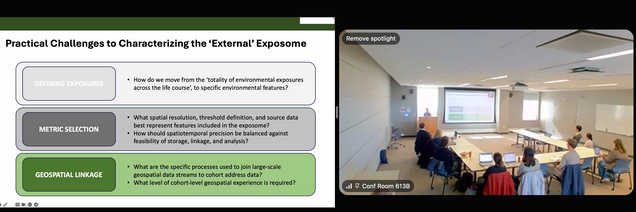
She also discussed the methodological challenges of exposome research. Managing large datasets, selecting appropriate statistical models, and interpreting multifaceted findings require balance, attention, and a collaborative team. Her team’s studies have analyzed how multiple environmental exposures relate to brain MRI biomarkers and depressive symptoms. Although some findings suggest associations between harmful environmental conditions and health outcomes, some associations weakened after additional statistical adjustments. Further investigation is needed to produce more conclusive evidence.
During the session, Maria Glymour, SD, BUSPH, asked “To what extent do you think the components that you’re putting in are themselves causal versus their correlates of something else that’s happening?” The question highlighted a central challenge in environmental health research; exposures might be interconnected, making it difficult to determine which factors directly affect health and which reflect broader underlying conditions.
Dr. Pescador Jimenez acknowledged these limitations, explaining that researchers can draw on existing literature and potential biological or social mechanisms to guide their work, but studying exposures measured simultaneously makes it difficult to establish a sequence of cause and effect. More research and adjustment for confounding variables is important for clarifying and classifying these relationships.
The impactful presentation reminds us of the value of looking at the big picture. By bringing together environmental epidemiology, life-course analysis, and existing research on health disparities and aging, her work will help researchers better understand the connection between environmental conditions and dementia risk.
See BU PopSci 2026-27 Seminar Schedule
Visit the BU PopSci Seminar Series to see additional population science seminars coming up. The seminar series is co-directed by BU-SHARP MPIs Dr. Deborah Carr and Dr. Andrew Stokes. Seminars are offered in a hybrid format. Boston area academics and scholars are encouraged to attend in person. All are welcome to register via Zoom.
post by BU-SHARP Writing Fellow Lindsay Griesman