Ph.D. Program Requirements
All Ph.D. students within the Boston University Graduate Program in Urban Biogeoscience and Environmental Health must be enrolled in an associated degree-granting graduate program (such as Biology, Earth & Environment, Environmental Health, Mathematics & Statistics, Computing & Data Science, or Bioinformatics). In addition to the requirements of the home department, training elements for all BU URBAN Ph.D. trainees include:
- Introductory Workshop for new trainees
- Urban Governance Series
- Science Communication
 Professional Development
- Annual Symposium
- Colloquium (2 credits)
- One course in Biogeoscience (4 credits)
- One course in Environmental Health (4 credits)
- One course in Statistics or Data Analytics (4 credits)
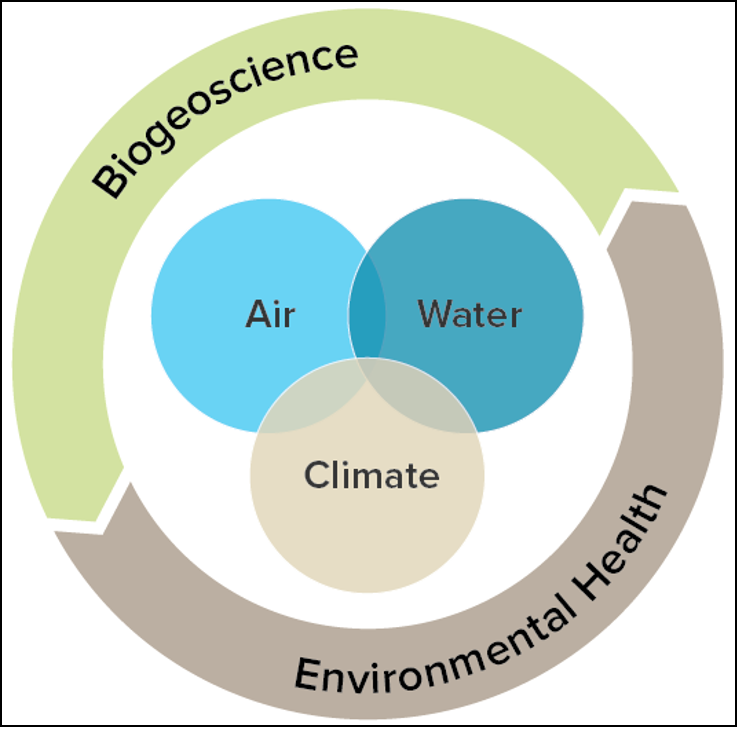
The courses are designed to provide trainees with a foundation in Biogeoscience, Environmental Health, and Statistics across topics that span air, water, and climate. The Colloquium, typically taught in the fall semester, includes presentations by participating faculty and speakers from outside Boston University followed by an intensive reading and discussion period. This course is a keystone in interdisciplinary training as it highlights the inter-departmental linkages and introduces new trainees to faculty research at Boston University and elsewhere.
Internship
Each student is required to carry out an internship for a minimum of 80 hours with a city government office, NGO, and/or the private sector. Trainees also enroll in a companion course (CDS DS 795). Trainees may use the internship experience to help formulate future scientific research activities to support these entities and to provide the foundation for some of the trainee’s dissertation research. The goals for trainees are to learn how policies are made and to develop collaborations with partner organizations that are focused on local, “real-world” environmental problems that have environmental policy implications.
Ph.D. Dissertation Research
Trainees fulfill dissertation research requirements of the department they are enrolled in and are required to form an interdisciplinary dissertation committee. Trainees in the Departments of Biology, Earth & Environment, and Environmental Health must form a dissertation committee with at least one faculty member from Environmental health and one faculty member from either BU URBAN with a Biology or Earth & Environment affiliation or the Biogeoscience Program. Trainees in the Department of Mathematics & Statistics and the Faculty of Computing & Data Sciences must form a dissertation committee with at least one faculty member from either Environmental Health, BU URBAN with a Biology or Earth & Environment affiliation, or the Biogeoscience Program. If a trainee would like additional support with meeting the URBAN dissertation committee requirement, they are encouraged to reach out to the URBAN leadership team by sending the Program Manager (urban@bu.edu) a 1-page summary of the focus of their dissertation. Students for whom this structure is not viable should submit a written petition explaining how they will fulfill the interdisciplinary objectives of an URBAN-affiliated dissertation in the absence of this faculty committee structure. Additional committee members may be chosen from other faculty at Boston University (including the Department of Mathematics & Statistics and the Faculty of Computing & Data Sciences), faculty from other universities, representatives from the City of Boston or other cities, or representatives from the private sector. Discussions at committee meetings and with individual committee members help trainees develop a specific line of research. Expectations for the work provided by faculty on PhD committees varies by department, so please check in with your advisor to learn about these expectations and explicitly discuss work and time expectations for faculty from participating departments at your first committee meeting.
NSF Acknowledgments and Reporting
All presentations and publications generated by students enrolled in the URBAN program must acknowledge funding support from NSF with the following statement: “This work was initiated with support from a National Science Foundation Research Traineeship (NRT) grant to Boston University (DGE 1735087) and has also been supported by institutional funds from Boston University.”
In addition, we expect trainees to complete a bi-annual self-report survey to aid in the documentation of the program’s progress and outcomes.
Hear from trainee Beth Haley about how BU URBAN program elements support research at the nexus of community, environment, and health.