Home
“The Effects of Untreated Trauma” Live from a Hospital Bed.
Trauma that goes untreated, festers like an undiagnosed infection.

Trauma goes unseen to the naked eye, unlike the common misconception in which mental illnesses are aligned with a physical disability, trauma can appear deep within the societal presentation of "normal". The American Psychological Association defines trauma as an emotional response to a terrible event like a car accident, sexual assault, abuse, or victim to a mass occurrence of violence. Immediately following the initial event, shock and denial are typical. Longer term reactions include unpredictable emotions, flashbacks, strained relationships and even physical symptoms like headaches or nausea. While these feelings are normal, some people have difficulty moving on with their lives.
Untreated trauma can serve as the foundation for excessive amounts of stress throughout an individual's life course. Without proper redirection of how to healthily manage the stress, it effects on the body can result in physical illness. Stress is the automatic response to harmful situations body's, whether they’re real or perceived. In an attempt to prevent injury, a chemical reaction occurs in the body to prevent injury. This reaction is known as "fight-or-flight,” or the stress response. During stress response, your heart rate increases, breathing quickens, muscles tighten, and rise of blood pressure. Despite the body's stress response, there is no immuno-feedback to prevent the effects over time. Stress can affect an individuals emotional stability, behaviors, process functioning, and physical health.
Emotional symptoms of stress include:
- Becoming easily agitated, frustrated, and moody
- Feeling overwhelmed, like you are losing control or need to take control
- Having difficulty relaxing and quieting your mind
- Feeling bad about yourself (low self-esteem), lonely, worthless, and depressed
- Avoiding others
Physical symptoms of stress include:
- Low energy
- Headaches
- Upset stomach, including diarrhea, constipation, and nausea
- Aches, pains, and tense muscles
- Chest pain and rapid heartbeat
- Insomnia
- Frequent colds and infections
- Loss of sexual desire and/or ability
- Nervousness and shaking, ringing in the ear, cold or sweaty hands and feet
- Dry mouth and difficulty swallowing
- Clenched jaw and grinding teeth
Cognitive symptoms of stress include:
- Constant worrying
- Racing thoughts
- Forgetfulness and disorganization
- Inability to focus
- Poor judgment
- Being pessimistic or seeing only the negative side
Behavioral symptoms of stress include:
- Changes in appetite -- either not eating or eating too much
- Procrastinating and avoiding responsibilities
- Increased use of alcohol, drugs, or cigarettes
- Exhibiting more nervous behaviors, such as nail biting, fidgeting, and pacing
Occasional fits of stress are normal for everyone. Working over time, heightened stress due to finals week, or maybe you are giving a public presentation for the first time at your new job. Sweaty palms and a sigh of relief once it's over is a normal recovery response but chronic stress can exacerbate serious health conditions. The prolonged effects of chronic stress can increase the facilitation of many symptoms including; depression and anxiety, cardiovascular disease; heart attacks, abnormal heart rhythm, skin and hair loss; acne, eczema, gastrointestinal problems; GERD, ulcerative colitis, and irritable colon.
Stress is normal, but how you handle it is the tell-tale predictor in ensuring you can effectively reduce or prevent it before the physical repercussions it will enact on your body. Before you are lying in the back of an ambulance, seek professional help if you feel as though your confines of stress have become unmanageable.
Sources
Mayo Clinic. (2021) Symptoms of Stress, Mayo Clinic.
American Psychological Association. (2021)
Delinquency Due to the Foster Care System
This semester we discussed a lot about child development, and risk factors that can lead to psychological problems, and may result in crime activity. I wanted to focus however, on children in the foster care system, and some of the psychological, and behavioral problems that may be developed due to their vulnerable circumstances. It is said that about 70% of people in state prisons have at one point in their life been in the foster care system. Before being placed in the system many children have been in high risk situations such as, “neglect (50%–60%), physical abuse (20%–25%), and sexual abuse (10%–15%; U.S. Department of Health & Human Services, U.S. Department of Education, & U.S. Department of Jus- tice, 2000)...Other traumatic exposures that may result in foster care placement are a lack of medical care, poverty, homeless- ness, violence in the home, parental substance abuse, and parental mental illness” (Hornor,pp.160-162). Even while being in the system they may also be at risk for dealing with similar trauma. Children may deal with biological issues such as drug uses, prematurity, obesity, or anemia. These issues may increase if there are multiple children in a household because of the lack of attention.
Due to the high amount of risk in foster homes children seem to struggle in, and outside the home. Children in the foster care system are more susceptible to developing psychiatric disorders that might be long term. These psychiatric disorders may include; depressive disorder, conduct disorder, Oppositional Defiant Disorder (ODD), PTSD, antisocial personality, and intermittent explosive disorder. “Travis Hirschi introduced his theory of Social Bonding in his 1969 book ‘Causes of Delinquency.’ His major focus was to contribute to an understanding of the causes of juvenile delinquency. For Hirschi, the ‘bond’ resides in the child and involves four factors or systems: Attachment, Commitment, Involvement, and Belief” (Adoption in Child Time). Without these four stable bonds in a child's life they find it hard to create meaningful relationships,and have good morals, due to lack of attention. Many children thus tend to act out of resentment and form aggressive, or even violent behavior. It is important for Forensic Nurses, CPS workers, or the overall foster care system to make sure they do thorough health evaluations and screenings to find the best possible treatment for these adolescents or young adults. In many cases the most effective treatment plan involves the entire family actively participating in treatment, to help combat some of the issues within the household.
Striking Back in Anger: Delinquency and Crime in Foster Children. Adoption in Child Time. (2019). Retrieved December 13, 2021, from https://adoptioninchildtime.org/bondingbook/striking-back-in-anger-delinquency-and-crime-in-foster-children.
Hornor, G. (2014). Children in foster care: What forensic ... - ceconnection. https://nursing.ceconnection.com. Retrieved December 13, 2021, from https://nursing.ceconnection.com/ovidfiles/01263942-201407000-00008.pdf.
Leading Amongst Corporate Psychopaths
When you hear the word psychopath what do you think of? Most people typically think of some of the more famous serial killers like Ted Bundy or John Wayne Gacy, or maybe a Hollywood depiction like American Psycho or Texas Chainsaw Massacre. But what about the psychopaths that live normal lives amongst the population? They could be your neighbor, your cousin, your coworker or even your significant other. According to the Law Enforcement Bulletin, it is estimated that approximately 1 percent of the general male population are psychopaths alluding that most people already know or will meet a psychopath during their lives (Babiak & O’Toole, 2012). Psychopaths are master manipulators and are skilled in portraying a version of themselves they want their victims to see. This is especially true for a subset of successful psychopaths that Babiak, Neumann, and Hare studied called corporate psychopaths. “Using a sample of 203 corporate professionals from seven companies scattered across the United States, the researchers reviewed records, conducted interviews, and administered the PCL-R, discovering that the prevalence of psychopathic traits was higher than that found in community samples (C & A Bartol, 2021, p. 221).” This research demonstrated what psychologists knew to be true; not all psychopaths commit crime or acts of violence. Hare was famously quoted saying that, “not all psychopaths were in prison, some were in the boardroom (C & A Bartol, 2021, p. 221).”
Since psychopathy is on a continuum and not an identical from person to person, the corporate psychopath may appear differently in each instance. “This personality disorder is a continuous variable, not a classification or distinct category, which means that not all corporate psychopaths exhibit the same behaviors (Babiak & O’Toole, 2012).” Psychopathy is sometimes difficult to identify for even the most skilled law enforcement officer and even psychologists, how is the average citizen going to be expected to recognize this in someone in their lives or their workplace? “According to Drs. Robert Hare and Paul Babiak, corporate executives are about three and a half times more likely to be psychopathic than members of the general public. Positions of power attract a disproportionate number of pathological individuals (not just psychopaths) (Hartley, 2016).”
The concept of corporate psychopaths making their way to the top of businesses has become a common theme in many mainstream media shows and movies. Some that came to mind were The Devil Wears Prada, Office Space, and Horrible Bosses. In each of these movies, it is portrayed in a comical or relatable manner that these highly manipulative and selfish individuals climbed their way to positions of power. Although these movies make light of the situation, this is a very plausible scenario since psychopaths can be highly successful in their professional lives. It is critical that others in leadership positions are able to identify these types of callous and deceptive individuals in order to ensure they do not continue to gain validation or influence.
In my professional career I have almost certainly met individuals that exhibited psychopathic characteristics. As a leader it is your job to protect your team, subordinates, and organization from toxic behavior regardless of how it presents itself. Most psychopaths will initially come off as powerful, smart, charming, and almost too good to be true. An experienced leader may be able to see through the façade, but most people will likely be under their spell initially. Although many of their skills like boldness, quick wit, and charm may initially impress those in a workplace, immediate supervisors, peers, and subordinates will likely see through the mask a psychopath is wearing. Therefore, as a leader it is critical to consider how subordinate and peers view others in your organization.
Sources:
Bartol, C. R., & Bartol, A. M. (2021). Criminal behavior: a psychological approach (12th ed.). Pearson.
Paul Babiak, PhD., and Mary O’Toole, PhD. (2012). Law Enforcement Bulletin: The Corporate Psychopath, https://leb.fbi.gov/articles/featured-articles/the-corporate-psychopath
Dale Hartley, MBA, PhD. (2016), Psychology Today: 5 Ways of the Corporate Psychopath, https://www.psychologytoday.com/us/blog/machiavellians-gulling-the-rubes/201609/5-ways-the-corporate-psychopath
Preventing School Shootings: How Do We Keep Kids Safe at School?
Preventing School Shootings: How Do We Keep Kids Safe at School?
In today's world, parents fear sending their children to school. In the middle of algebra classes, and band rehearsals, students must practice lockdown drills in case a shooter ever enters their school. This is not something any parent wants to imagine. So, how do we keep kids safe? How do we prevent another Columbine, or Sandy Hook, or Oxford from happening?
As of September 2020, the Center for Homeland Defense and Security found that there had been 68 school shootings since Columbine in 1999 (Melgar 2020). School shootings in the United States happen an average of once every 77 days. This number is show to be increasing over the years (Melgar 2020). Having 68 school shootings in eleven years is such a high number, and to have that number growing is startling. From 1999 to 2014, the average number of days between shootings was 124 days. From 2015 to 2018, the average was 77 days (Melgar 2020). That’s a drastic change. The idea of school shootings becoming even more frequent should be upsetting for everyone.
The Everytown for Gun Safety fund has created a plan to help keep children safe at school, and to stop school shootings from being a normal occurrence. The plan lists eight targets to stop gun attacks in schools. The targets are: 1. Pass Extreme Risk Laws 2. Encourage Secure Firearm Storage 3. Raise the Age to Purchase Semi Automatic Firearms 4. Require Background Checks on All Firearm Sales 5. Create Threat Assessments in Schools 6. Put in School Security Upgrades 7. Create Trauma-Informed Emergency Planning 8. Create Safe and Equitable Schools (Everytown Research & Policy 2021).
While Everytown’s plan is thorough, and hits many key points, it would be extremely hard to pass. The United States is so polarized that passing gun laws or any legislation to prevent school shootings will face a lot of backlash. Because of this, I think Everytown’s plan will be viewed as too extreme. We have so many school shootings in the United States, but school shootings have become a political issue, and that makes it nearly impossible to do anything to stop them. Schools can work on promoting mental health awareness, they can do research-baked risk assessments, and can do more to prevent bullying. This certainly won’t prevent all school shootings, but it could be away to stop the number of school shootings from increasing.
Sources:
Everytown Research & Policy (2021). In Everytown for Gun Safety Support Fund. Retrieved from https://everytownresearch.org/report/preventing-gun-violence-in-american-schools/
Melgar, L. (2020, September 17). ARE SCHOOL SHOOTINGS BECOMING MORE FREQUENT? WE RAN THE NUMBERS. In Center for Homeland Defense and Security. Retrieved from https://www.chds.us/ssdb/are-school-shootings-becoming-more-frequent-we-ran-the-numbers/
In Search of the Successful Psychopath
What is a successful psychopath?
To study a successful psychopath, we must identify what it is to succeed as a psychopath. In a sense, the psychopath that behaves in whatever way they choose and is never caught has succeeded. That behavior may be the classic serial killer but, recognizing that psychopaths may not always be set apart from society, it may also be embezzlement, fraud, identity theft, or just being a nasty coworker. But the goal of studying the successful psychopath is to explore the phenomenon of psychopaths who succeed within the boundaries of normative culture, not those whose transgressions go unnoticed. Further, as Welsh and Lenzenweger observed, defining the successful psychopath as the one who is never apprehended fails to consider the perspective of the individual in question, defining them by their relationship to criminal justice rather than their own experience (2021). What about classic metrics of success in a capitalist society - income, acclaim, and power?
Moving past psychopathy as a monolith
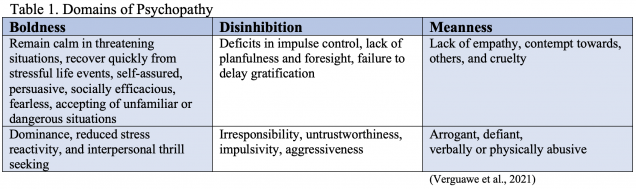
While scores to such as PCL-R can be used to determine the presence and degree of psychopathy - useful for formulating an approach to treatment - the individual components of those scores may become lost once the label is applied. But to facilitate the exploration of an anomaly such as the successful psychopath, researchers have adopted the triarchic approach, allowing characterization of in terms of boldness, meanness, and disinhibition (Table 1) rather than only a total score. In particular, the domain of "boldness" has been hypothesized to be a fulcrum around which the successful psychopath may pivot from the Hollywood serial killer to the hero of the boardroom.
Bold Belgian bosses
Vergauwe, Hofmans, Wille, Decuyper, and De Fruyt recruited psychology students to evaluate their bosses' effectiveness as leaders (Table 2), and recruited those bosses to complete the Dutch version of the psychopath exam: The Psychopathic Personality Inventory-Revised (Table 3). This study was performed twice, to assess for reproducibility, the second with a much larger sample size.
Vergauwe et al. offered three hypotheses. The Differential Severity model suggested a curvilinear relationship between psychopathic characteristics and business success. Psychopathy would increase success until a point of diminishing returns, at which point higher scores would lead to worse performance. This hypothesis did not examine the relationship between specific domains of psychopathy, rather it interpreted the total score. The results from the first and second studies refuted this, showing a linear relationship rather than curvilinear.
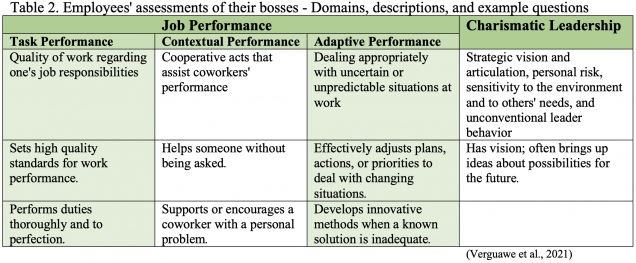
The Moderated Expression model added an additional criterion: Conscientiousness, as measured by the self-reported Dutch NEO Five-Factor Inventory (eg. I have a clear set of goals and work toward then in an orderly fashion). It posited that characteristics of psychopaths that might otherwise be maladaptive could be tempered and even made beneficial in the presence of certain qualities (others are noted below). This theory bore fruit in Study #1, showing that Task Performance worsened in individuals with low Conscientiousness as Self-Centered Impulsivity increased. In the presence of high Conscientiousness, Task Performance improved as Self-Centered Impulsivity went up. However, Study #2 did not replicate this result, and the presence of Conscientiousness actually correlated with a steeper drop in Contextual Performance and Charismatic Leadership as Cold-Heartedness increased. Of note, other research has suggested that qualities such as Executive Functioning, Intelligence, or even good parenting techniques may provide the moderating effects that turn increasing psychopathic domain scores into success (Welsh & Lezenwegere, 2021).
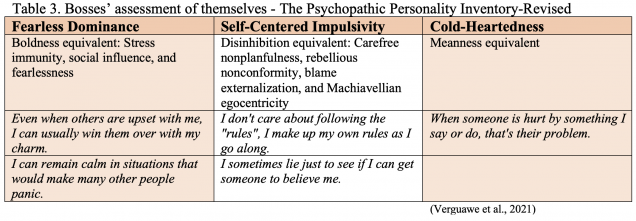
It was the Differential Configuration model that provided Vergauwe et al. with the most reproducible results. This hypothesis proposed that increases in certain domains of psychopathy would lead to greater success while increases in others would lead to worsening dysfunction. This was the hypothesis that assumed the least covariance between domains - an increase in boldness need not be accompanied by an increase in disinhibition or meanness, and a lower score in one might not portend lower scores in another. In Differential Configuration, Boldness (Fearless Dominance, in the Dutch model) showed positive, linear relationships with effectiveness, statistically significant in the arenas of Adaptive Performance and Charismatic Leadership. In contrast, Disinhibition was significantly associated with decreasing Task Performance, and Meanness was negatively associated with all leadership qualities. It seems Boldness may be the difference between the successful and unsuccessful psychopath, at least in the business world.
Successful psychopath in the streets - and in the sheets?
Boldness may have cemented its value in the work of Pilch, Lipka, and Gnielczyk when they looked at the role of psychopathic traits and social status as they related to romantic and sexual relationships (2021). In contrast to the other studies, their work left the evaluation of psychopathic characteristics to another individual, not the one being assessed for psychopathy. In further contrast, the research focused on women, a largely neglected population in the world of psychopathy research. The individuals in question were still men, and the study was limited by a heteronormative structure, but it provided women the opportunity to assess their partners’ psychopathic qualities, which were then analyzed in terms of self-reported satisfaction with both romantic and sexual relationships. Boldness won the day once more, identified as the quality most likely to increase women’s satisfaction rather than damage it. Increasing Meanness and Disinhibition scores had a deleterious effect.
What makes a successful psychopath is not yet well-characterized. Even the definition of a successful psychopath is unclear. But research to this point has suggested that Boldness, associated with resilience and social efficacy, may be the key to what makes one psychopath a secretive, perhaps murderous societal aberration, and another the leader of a Fortune 500 company - or perhaps the president of the United States.
Pilch, I., Lipka, J., & Gnielczyk, J. (2022). When your beloved is a psychopath. Psychopathic traits and social status of men and women’s relationship and sexual satisfaction. Personality and Individual Differences, 184, 111175. https://doi.org/10.1016/j.paid.2021.111175
Vergauwe, J., Hofmans, J., Wille, B., Decuyper, M., & de Fruyt, F. (2021). Psychopathy and leadership effectiveness: Conceptualizing and testing three models of successful psychopathy. The Leadership Quarterly, 32(6). https://doi.org/10.1016/j.leaqua.2021.101536
Welsh, E. C. O., & Lenzenweger, M. F. (2021). Psychopathy, charisma, and success: A moderation modeling approach to successful psychopathy. Journal of Research in Personality, 95, 104146. https://doi.org/10.1016/j.jrp.2021.104146
Trigger Warnings: Necessary or Trivial?
Throughout the past almost two years of the pandemic, mental health awareness has become extremely widespread through the use of social media and due to the depressing nature of the pandemic. In online communities, individuals are making large strives towards being politically correct, enhancing emotional intelligence, and attempting to be sensitive to others, specifically through what are known as “trigger warnings”. Previously, I had only ever seen them used as joke or “meme” material, but with the increasing awareness of mental health, I realized that I should properly educate myself. So what exactly are trigger warnings? Why are they used?
Trigger warnings are warnings that “flag material that might cause distress or discomfort, or possibly trigger a panic attack in students with post-traumatic stress disorder” (3). Originally used online for topics that primarily included sexual assault, the term has now been coined for use with topics that include race, sexual orientation, disability, colonialism, torture, and other intense subjects (1). In classroom settings, students are encouraged to speak up about triggering topics, but do they even help with preventing stress responses?
On one end of the spectrum, trigger warnings can be seen as keeping others’ best interests in mind, and on the other end, it can be seen as something that does not “give them the freedom to develop their antifragility.” (1). For some students, this might be the case, as some trigger warnings have been shown to increase anxiety and stress responses as opposed to not including one. The most effective treatment for individuals with PTSD is a cognitive behavioral therapy that is trauma-focused. One of the main components of trauma-focused cognitive behavior therapy is called exposure therapy, where the individual is exposed to the traumatic event in some capacity to help the individual cope with their trauma and desensitize them to the traumatic event (4). The avoidance of these potentially triggering topics actually can make the stress response worse when the individual is exposed to it and can make intrusive thoughts about the trauma worse (1).
The true nature of trigger warnings, however, is that they are not supposed to prevent students from developing their antifragility by avoidance, but rather strengthen and fine-tune it, with warnings that say to regulate their emotions more with this unpleasant topic that is about to be discussed (1). The adverse of those intended effects have been shown in individuals who are not able to emotionally regulate their stress responses well. In a study in 2019 led by Mevagh Sanson, it was found that individuals who received a trigger warning before reading triggering material had no reduction in stress response compared to those who did not receive a trigger warning before reading the material (2).
While trigger warnings seem to be considerate and emotionally aware, they could be doing more harm than good for those who struggle with PTSD. Even though not every individual is the same and has the same experience, letting people figure out their triggers, and how to handle them is essential to healing from trauma. Putting censors on every potentially triggering topic is not going to expedite that.
Citations:
1. Kaufman, S. B. (2019, April 5). Are trigger warnings actually helpful? Scientific American Blog Network.
2. Mevagh Sanson, D. S. (n.d.). Trigger warnings are trivially helpful at reducing negative affect, intrusive thoughts, and avoidance. SAGE Journals.
3. NCAC report: What's all this about trigger warnings? National Coalition Against Censorship. (2020, January 2).
4. PTSD Facts & Treatment: Anxiety and Depression Association of America, ADAA. PTSD Facts & Treatment | Anxiety and Depression Association of America, ADAA. (n.d.). Retrieved December 10, 2021, from https://adaa.org/understanding-anxiety/posttraumatic-stress-disorder-ptsd/treatment-facts.
Denial, the Harmful Resilience
Humans are very resilient, in many different ways. Some of those ways are not necessarily the healthiest. We have this “Keep on trucking” attitude that usually contributes to us overlooking major issues. Therefore we can easily underestimate the individual or generational effects that trauma has on us. “Regardless of how trauma is introduced, the direct and indirect exposure can alter how the brain process information and facilitate behavior (Dr. Rousseau 2021).” The effects of trauma are apparent when looking at our weakest links; our children and unborn children. “Trauma in pregnancy has dramatically increased in the past 25 years and is now the number one cause of non-obstetrical maternal death in the United States. With major trauma, there is a 40 to 50% risk of fetal death.” (D. M. Krywko, F. K. Toy, M. E. Mahan, J. Kiel. 2021)
The unhealthy resilience in adults can cause them to band-aid their harm rather than heal it, therefore continuing to ignore the severe effects of trauma, subsequently causing more harm. It seems we are stuck on a Merry-go-round of trauma, fuelled by denial. Comparable to infants, adults usually do not die physically from trauma, but the effects are dire. More than 17,000 people in the US have died as of May 28, 2021, from gun-related violence. There were 44,834 total deaths by suicide in 2020 according to the CDC and exedra.
The same occurrences that cause adult trauma can cause trauma to an unborn baby “in utero.” and the same deadly effects can occur to both yet we choose to continue ignoring them. One would argue we need to prevent in utero trauma, another will argue that crime rates need to decrease. One will state that poverty needs to be addressed in order to lessen the trauma, and another will argue for a budget increase to police training. All of them would be correct. Writing this blog, I am realizing there is no one topic I could possibly bring to your attention that hasn’t been spoken of to death. There are many brilliant individuals who have thought of trauma prevention, healing trauma, bringing our judicial and mental health systems closer together in order to both prevent and heal trauma, exedra. Yet we find ourselves in the same place asking the same questions years later. So I end this blog without presenting more data to support a topic I may or may not actually have knowledge of. I will not distract you with insignificance. I leave you with a question. What are we missing in order for actual change to happen?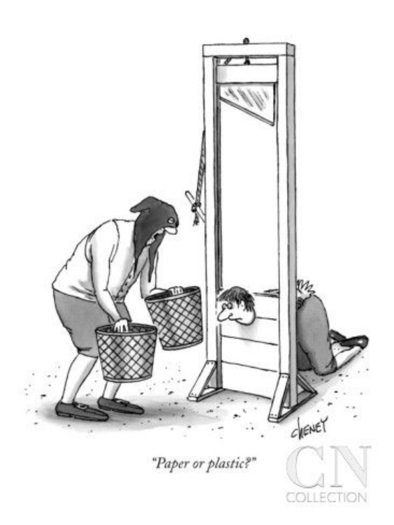
Paper or Plastic?
References:
Pregnancy Trauma
https://www.ncbi.nlm.nih.gov/books/NBK430926/
Rousseau, D. (2021). Module 3: Neurobiology of Trauma. Boston University Metropolitan College: Blackboard.
Suicides fell in 2020, early CDC data shows
https://www.beckershospitalreview.com/public-health/suicides-fell-in-2020-early-cdc-data-shows.html
THE IN UTERO EXPERIENCE TRAUMA BEFORE BIRTH
The US has had 225 mass shootings in 2021 so far. Here's the full list.
https://www.insider.com/number-of-mass-shootings-in-america-this-year-2021-3
Van der Kolk, B. 2014. The Body Keeps Score: Brain, Mind, and Body in the Healing of Trauma. Penguin Random House. New York.
Blog post
ABSTRACT
Adverse Childhood Experiences are traumatic, but prevention and self-care can make it much better for the surviving individuals. ACE test correlates individuals with their childhood traumas seem wrong as we see it in the context of the Juvenile Justice system. the ACE test is conducted with a positive intention as part of the law in the criminal justice system. We cannot stop the ACE test from being conducted by the legal system, but we can fight ACEs in the longer run by taking certain steps. Self-care strategies practiced by the victims would also strengthen their mental health. Physical activities and meditation can play an important role in dealing with anxiety, abnormal and violent behavior following trauma. It is highly desirable to unearth the factors which are responsible for a violent behavior of an individual. ACE test, for that matter, becomes a necessity, especially for those who exhibit characteristics of violent nature. It should be optional for those who want to take it with their own will.
Keywords: Adverse Childhood Experience, ACE test, Past trauma
Criminal Justice Blog Entry
All across the world, several children are identified with Adverse Childhood Experiences (ACEs). These experiences are in the form of verbal abuse, physical abuse, sexual abuse, etc., comprising personal experiences, and external affairs comprising of an alcoholic, abused, divorced, or jailed parent can also affect a child's mental health. The test is conducted on legal practitioners and staff members and stands as an important test in the criminal justice system. However, this is a brutal act in the name of law as it triggers victims' traumas which he has long forgotten. The ACE test would complement the practitioners in carrying out their job. The Test will help them understand the trauma. Also, the ACE test demonstrates the deep reasons behind an employee’s violent behavior. This test makes the victims relive their traumatic experiences of childhood to give something to the legal system. (Starecheksi, 2015). The test administered on the legal practitioners to a good extent helps in unearthing the reason behind the productivity.
The ACE test cannot be stopped from being taken as it is part of the solution to a particular case study. One thing that can be done is the practice of giving remedy to the individuals who suffered from Adverse Childhood Experiences in the past or not letting ACEs propel in the first place. Dr. Nadine Burke-Harris, a Californian Surgeon, is working hard to create awareness against Adverse Childhood Experiences, concluding that someone’s adversity is not their destiny. Moreover, specific ways can be used to determine a family’s internal conditions without interfering with any of them. One of them includes the FLAT (Family Law Adversity Test) scan, which will administer a screening survey that provides insight that could help the generations refrain from ACEs (Chroman, 2020).
While dealing with ACE test-taking individuals, cultural competencies must be taken into account. The in-house counselors or psychologists must be aware of the diverse culture of patients; otherwise, issues related to cultural competencies intervene with the test results. Likewise, the judiciary, litigation, and collaborative communities need to build an inter-disciplinary approach at an early level to fight ACEs. One measure can be making collaboration and mediation standard policies to help fight children with ACEs. The families who are scanned positive in the FLAT scans must be engaged with regular check-ups. The Centre proposed some strategies to fight ACEs for Disease Control and Prevention. These include giving economic support to families, promoting violence-free norms in society, engaging youth with trusted adults, intervene to cure long-term traumas. (National Center for Injury Prevention and Control, 2020) All these strategies need to be taken in order to fight the perceived issue.
As a measure of self-care and treatment approach, specific tools used by the victims themselves can prove to be effective in preventing the after-effects of Adverse Childhood Experiences in the longer run. These include building a healthy relationship by spending quality time with your loved ones. Meditation and exercise can help significantly to let go of past traumas acting as a form of catharsis. Better nutrition and sleep patterns would help maintain health and keep your mental health and subjective well-being healthy. For self-care, communication is the key. Building fit and effective communications with your loved ones keep you in good mental proportions. Likewise, being mindful of your surroundings emotionally and physically strengthens oneself. All these measures, if taken effectively by the ACE diagnosed individual, can improve his mental health.
References
Chroman, K. (2020). Making The Case for ACEs: How the Legal System Can Further Help Children and Take Meaningful Steps to Address Adverse Childhood Experiences (ACEs) . LACBA, 1-9.
National Center for Injury Prevention and Control. (2020, September). Adverse Childhood Experiences. Retrieved from Centre for Disease Control and Prevention: https://www.cdc.gov/injury/pdfs/priority/ACEs-Strategic-Plan_Final_508.pdf
Starecheksi, L. (2015, March 2). Take The ACE Quiz — And Learn What It Does And Doesn't Mean. Retrieved from NPR: https://www.npr.org/sections/health-shots/2015/03/02/387007941/take-the-ace-quiz-and-learn-what-it-does-and-doesnt-mean
Self-Care
Self-care is sometimes completely overlooked by everyone. We are so centered on our every day lives that we forget to take a moment to breath and to focus on ourselves. It is so important to focus on our mental health and our physical health but it is very easily overlooked and forgotten about. Self-care is very different for every individual it can sometimes be anywhere from "getting enough sleep, or filling up a bottle of water before heading out to work in order to stay hydrated throughout the day. Simple little things that keep our physical health taken care of can make a significant, positive impact on our mental health as well" (Crisis Center of Tampa Bay, 2018). A majority of people believe that drastically changing something in their routine is going to cause an impact on their mental health and while that might be true, little things as preparing your clothing for the next working the night before could improve our mental health.
Mental health is so important and it truly can shape our future. The way that we look at ourselves, the way that we create relationships and the way that we interact with people all stems from our mental health. If someone is upset, has had a bad day, they are more likely to snap at people, be angry at themselves and continue to put themselves under stressful situations which will eventually lead the individual to burn out. I know that meditation is incredibly helpful to people, reading, exercising, going to bed earlier or later, cooking, baking and even taking a walk will improve someone's mental health. Every individual has a special niche where they can sit and focus on other things, a hobby or even a book that calms one mind can be incredibly beneficial.
Crisis center of tampa bay. (2018). The importance of self-care is maintaining positive mental health.
Family Acceptance Project
In honor of Pride month, I wanted to highlight a policy initiative to help prevent physical and mental health risks for LGBTQ+ youth, such as suicide, homelessness, drug use, and HIV/AIDs: Family Acceptance Project. The Family Acceptance Project's goals are to address these risks through research-based and "culturally-grounded approach to help ethnically, racially and religiously diverse families learn to support their LGBTQ children" (Family Acceptance Project). This project is based at the San Francisco State University, but offers training to any agency, institution, congregation, or community. Cultural and ethnic differences affect how a family may approach their LGBTQ+ child's coming out and determine the initial responses (Bhugra, 2016). It is incredibly important to try to meet families where they are culturally and find a way, within their home culture, of integrating the new knowledge to help minimize the harm a harsh familial response could cause a child. This project is important, but also relies on organizations coming to them for training. A nationwide initiative based on this model would be ideal so families have access to counselors, as often family rejection is the first step to negative outcomes (Katz-Wise, Rosario & Tsappis, 2016).
Bhugra, D. 2016. Cultural variations in LGBT issues. World Psychiatric Association, London. https://doi.org/10.1016/j.eurpsy.2016.01.982
Family Acceptance Project. Family Acceptance Project ® | (sfsu.edu)
Katz-Wise, S., Rosario, M., & Tsappis, M. 2016. LGBT Youth and Family Acceptance. Pediatric Clinic North America. 2016;63(6):1011-1025. https://doi: 10.1016/j.pcl.2016.07.005.