Home
Mental Health In The Middle East
Throughout the course we have discovered the impacts and effects of trauma in a multitude of sectors and communities. We have focused on trauma in children, trauma in those who have experienced significant traumatic events both personally and professionally, and the necessary implementation of mental health interventions and the removal of stigma for those who are struggling.
Though, I want to make the assertion that the whole concept, trend, and awareness of “mental health issues” is predominantly a western phenomenon and something that is not widely accepted in other regions of the world. Today, I want to focus on the emergence of the mental health field in the Gulf-Arab states, where I am from (Dubai, United Arab Emirates) from both an anecdotal perspective, as well as a research perspective.
A study conducted in 2021 by a group of Gulf-Arab researchers focused on understanding the awareness of the general public by asking what they know about mental health. This inquiry was labeled as MHL, or mental health literacy. This study analyzed over 27 studies conducted in the region engaging over 16,000 people. They concluded that the majority of people, including health professionals (doctors, nurses, etc.) know little to nothing about mental health or even acknowledge it as being a real diagnosable problem. As well, a general negative attitude about the topic was uncovered which relates directly to my anecdotal experience.
Culture: In the Gulf-Arab states, we come from a region which is heavily rooted in religion and tradition. We come into this life following the Islamic path, which clearly outlines our responsibilities in this life. Marry, have children, take care of yourself and your family, die and inshAllah go to heaven if you have been good in this Dunya (lifetime). We also tend to be quite a judgmental group of people. This is linked to many things including our small local communities. In the United Arab Emirates actual locals, Emiratis are only 11% of the population- which makes us a close-tight knit community involved in everyone's business.
Though, the mental health stigma comes from religion. Some people believe that if you are depressed or anxious- you are not praying enough to god. Prayer is often a suggested solution for those who are deeply struggling. We also hold beliefs about the evil eye… the idea that somebody can envy you from afar, and that this leads to downfalls in your individual life- which require prayer to protect you. Some people also believe in the presence of Jinn (shapeshifters and entities that look and function like humans, but have freewill and can obey or disobey god leading to consequences for the people around them)... like being possessed or mentally controlled by Jinn.
These concepts may sound crazy to some, but this is the society we grew up in. Furthermore, we have strong traditional gender roles and in particular for men- the stigma surrounding mental health is enormous. So enormous that the emergence of this field didn’t even occur in our nation until recently with the influx of expats (foreign workers living here).
The thing is, just because we don’t acknowledge a problem doesn't mean it doesn’t exist. Absolutely and undeniably we have people suffering here from a wide variety of mental health issues, and I am thankful that overtime this field is gaining prominence because religion doesn’t solve every problem. True chemical imbalances exist, true traumatic experiences have affected people and stunted their development, etc.
I think that there is a direct conflict between traditional islamic values and the field of mental health but that is something to be dealt with culturally and internally as opposed to removing access to those who are struggling because of religious beliefs.
Overall, I want to reaffirm that the mental health field is strong and actively existing in the United States, but in many other cultures it isn't acknowledged or even prevalent.
Sources:
https://www.globalmediainsight.com/blog/uae-population-statistics/
Is Social Media Traumatizing Us?
On a rainy morning, I was getting ready to go on a tour in Dublin, Ireland. The older guide approached us and appeared to be very upset. He asked if we were okay, and if we needed some time before our tour started. Confused, we asked what was wrong. “Did you hear? A mass shooting happened this morning in America.” He was met with a few shrugs and “Yeah, that happens.” Shocked, he replied “If that happened here, we would probably shut down the city for weeks.”
It was in that moment, I began to think about why this group of American’s reacted this way. Besides the lack of action from political leaders, I thought about social media. For years, we have been exposed to violence and tragedy (virtually) right in front of us. In the live classroom this week, it was brought up about social media and having this information right at our fingertips. We have access to more information than ever, and it is quite overwhelming. Even this morning, I woke up to several news notifications involving death and tragedy with pictures attached.
Grace Dowd, a psychotherapist, says “Since we don’t always have enough time to digest one story before another breaks, we can sometimes end up feeling emotionally numb, helpless and immobile. This typically happens when our survival mechanisms are triggered.” Grace then adds, “Our constant access to social media and the news plays into this by continuing to provide access to information to the point where it no longer becomes shocking, and also by taking our attention away with the next crisis.” (Barnes, 2021) Mary Joye, a licensed mental health counselor, says “Repetition of [bad news and images] does damage to us through vicarious trauma.” (Barnes, 2021) Vicarious trauma was also discussed in our live classroom this week. Vicarious trauma is when the trauma does not directly happen to you, but you are affected by it.
Sites created to share memories and watch funny videos have slowly turned dark over time. On apps such as TikTok, you can watch a cooking tutorial and the next video is a house exploding. How do we protect ourselves?
Limiting time on social media has been a great tool for me. I have seen a major decrease in anxiety. It allows me to process anything I have seen and reflect. As bad as it sounds, I have had to adopt the “ignorance is bliss” stance with trends on social media. Most of these “trends” have turned into a rabbit hole of anxiety inducing videos, such as “top 10 household products that will give you cancer”. I even have friends that set time limits on their phones, or have deleted social media all together. I strongly believe that if we decrease our social media use, society will greatly benefit from it.
References:
Barnes, S. (2021, Feb 21). "Social Media is Traumatizing Us More Than We Realize" https://www.huffpost.com/entry/social-media-traumatizing_l_602d2c88c5b673b19b654d88.
Self-Care: The light at the end of the tunnel after trauma
The effects of trauma can reverberate for a long time after the incident has ended. Healing frequently involves a winding path filled with emotional struggles and self-discovery. Throughout this journey, the idea of self-care develops as a guiding principle that provides comfort and empowerment in the face of difficulty. Trauma creates a complicated narrative that is difficult to decipher. We are called to stop and consider the depths of trauma and the devastating effects it has on our mental, emotional, and physical health. Here, we take cues from research that highlights the interconnection of trauma's aftereffects and exhorts us to approach self-care with empathy and a critical mind.
Self-care goes beyond simple pleasure and involves a fundamental act of self-compassion and resilience. By digging deeper, we redefine self-care as a complete endeavor that encompasses not just pampering and relaxation but also nurturing on a psychological, emotional, and spiritual level. By deepening our understanding of self-care, we create a full toolkit that aids in the healing of trauma's wounds.
Am I a psychopath?
The short answer: most likely no. While individuals can exhibit certain traits of psychopathy, there is more to the clinical assessment of this diagnosis. The term "psychopath" has become colloquial in its use. It is thrown around when a friend does something out of the norm, when a character on TV displays particular traits, and when describing actions that are atypical. These instances have made it seem that psychopathy is more common than it actually is. People can certainly fall under the umbrella of "psychopathy" but genuine, diagnosed psychopaths must meet specific criteria in order to be diagnosed as such.
Psychopathy, as noted by Rousseau (2023), can be caused by genetics, neurobiology, and abuse. It is defined by three major characteristics which include callousness, a fearless personality type, and impulse control issues (Marsh, 2022). Approximately 30% of the population demonstrate a degree of these traits, but only about 1.2% are classified as "severe psychopaths," Marsh (2022) adds. In order to test for psychopathy, Robert Hare created the PCL-R
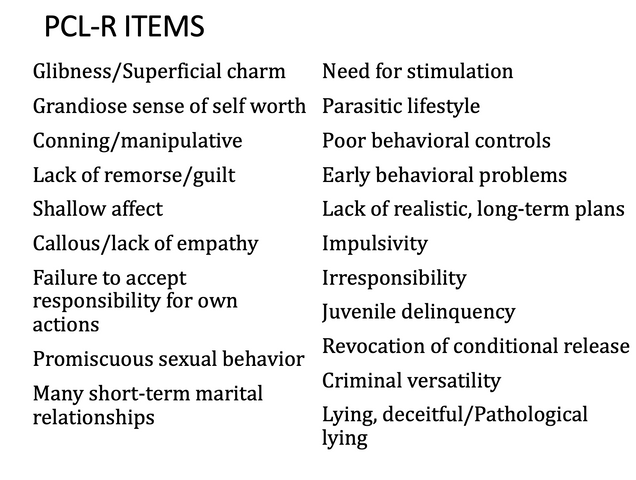
(Psychopathy Checklist-Revised) to measure the "extent to which [an] individual matches [a] prototypical psychopath" (Rousseau, 2023). This checklist consists of 20 items that are scored on a scale from 0-2; 0 means the item is not present and 2 means the item is definitely present. Rating each item a 0, 1, or 2, a score up to 40 can be obtained. Any score greater than 30 indicates severe psychopathy, which can only be "diagnosed" when administered by a professional with an advanced degree (Rousseau, 2023). While you can self-administer this test to get a general idea of where you stand, an accurate "diagnosis" can only come from a professional. "Diagnosis" is in air quotes here because psychopathy is not an official DSM diagnosis. Typically ASPD (Anti-Social Personality Disorder) is diagnosed, and in combination with a high PCL-R score, an individual is labeled to have psychopathic tendencies (Marsh, 2022).
Psychopathy can be viewed as a spectrum. Many individuals show psychopathic tendencies at one point or another and whether you have scored a 0, are in the early 20s, or maybe up in the 30s range, falling anywhere on the scale is not necessarily a bad thing. While yes, those with higher scores have an increased risk for criminal behavior due to the lack of empathy and guilt, psychopaths are not inherently bad individuals. Many are successful professionals who use their traits to their advantage. Being labeled a psychopath does not automatically lead to crime and violence; it all depends on how the traits are utilized in one's life.
Treatments for psychopathy are extremely limited. Successfully curing psychopathy is not possible, but there are methods to manage symptoms and improve one's quality of life. Treatments may include things like behavioral skills therapies, medications, and psychotherapy (Psychopathy Is, 2022). There tend to be additional challenges in treating psychopaths due to their lack of motivation, poor response to treatments, and resistance to any kind of change. These can stem from a psychopath's lack of ownership of problems and responsibilities as well as their separation from emotions, empathy, and guilt. While psychopathy can be managed, it is more stringent to do so than with other kinds of diagnoses.
So, the question still stands: are you a psychopath? The probability of falling into that 1.2% is very low but never 0. You may exhibit several of the PCL-R items at either level 1 or even level 2, but the best way to get to the bottom of it is to see a licensed professional. This can start you on your path to figuring out why your brain may work differently than others and why you act and respond the way you do in certain situations. Either way, it's all about how you use your personality and traits to your advantage while creating little to no destruction in your path. Change is not impossible and neither is living a successful, rewarding life.
References
Marsh, A. (2022, March). Why psychopathy is more common than you think, with Abigail Marsh, Phd. American Psychological Association. https://www.apa.org/news/podcasts/speaking-of-psychology/psychopathy#:~:text=Although%20severe%20psychopathy%20affects%20just,fall%20under%20this%20broad%20umbrella.
Psychopathy Is. (2022, December 21). Psychopathy Treatment Options. https://psychopathyis.org/treatment/#:~:text=The%20most%20successful%20approaches%20to,They%20may%20also%20incorporate%20medication.
Rousseau, D. (2023). Presentation files: Psychopathy. Boston University.
Is being a Cop ok today?
Hi, my name is Officer Wynter and I decided to become a Cop in today's world. Law enforcement today is not looked at the same as it used to be. Back in the day, being a Cop was one of the most well-respected careers someone could get into. The job demands someone to risk their lives after all and be a hero. However, today if you want to risk your life and be a hero, its recommended that you become a firefighter or soldier. Due to some bad eggs in the field of law enforcement, the job on a global level has had to suffer. The disconnect that has developed between the community and the police has grown over the past few years. Due to this, the question arises, is being a Cop ok today?
In my opinion, I think when you become a cop today, you are taking not only a great job; but also, the baggage that has been left before. The job itself is very stressful with all the cons within it. Then you add the baggage, and you are now in an environment that some may classify as unhealthy. Due to these things is it recommended to take up the mantel. Today if you go to a group of officers, there is a high chance if you ask them advice on joining the field; they would talk you out of it or have you second guess yourself. This is not because of the danger but due to the fact that the job is hated now by the police and the community. I won't get into the known details on why we are where we are, but to summarize; the job as a whole is suffering due to bad officers making bad decisions. This has caused an image issue that is hard to be fixed due to the struggle of regaining trust between the community and the police. With the lack of trust this has made the job even harder. It is known how often officers commit suicide due to the stress of the job. An article on US Today stated "In 2020, 116 police officers died by suicide and 113 died in the line of duty, according to researchers. While the number of suicides dropped from 140 in 2017, study co-author Hanna Shaul Bar Nissim noted that 2020 numbers are likely an undercount due to stigma and shame, lack of reporting and people needing time to come forward." (Stanton, 2022)
https://abcnews.go.com/US/video/record-number-police-died-suicide-2019-68046762
(News, 2020)
These numbers are due to what the job entails and due to how much harder it has become. Lexipol, which is a policy management software for public safety, has come up with a list of many ways that we can see police officers getting stressed or burned out. Some of these examples include:"
- Isolation and withdrawal
- Being disengaged or unmotivated
- Physical exhaustion
- Nightmares and flashbacks
- Poor hygiene or apathy about one’s physical appearance
- Loss of empathy or compassion
- Relationship issues, including divorce
- Substance misuse and abuse
- Recurrent sadness or depression
- Resistance to feedback
- Resistance to change
- Reduction in meaningful work product
- Reduced job satisfaction
- Increase in citizen complaints” (Fish, 2018)
In the end, this post is not to scare people away from the job of being a cop however it is to shine a light on the reality of what it has become. I still believe though time and hard work, the disconnect can be fixed. The job gives you the ability to help, protect, and impact people's lives in many ways. This gives me the hope that it is still a good job to be in. To prevent the high suicide rates and the low moral from within, Self-care is essential in my opinion. Finding a suitable coping method or some way to decompress is essential in the field of law enforcement. The three things one should do is:
1. Cultivate a life outside law enforcement.
2. Develop good physical health habits.
3. Practice meditation and mindfulness.
By striving to incorporate these things into your life, a form of joy and good health will start to cultivate itself. Giving yourself the ability to be mindful and meditate can help you understand and handle stress. Taking care of your body physically can promote good health. Finally, having hobbies and a life outside of work will help you decompress. Through good self-care and building a better community relationship, the job of being a cop can be the well-respected job it used to be.
Resources
Stanton, C. (2022, June 10). Police, firefighters die by suicide more often than in line of duty. why rates remain high. USA Today. https://www.usatoday.com/story/news/nation/2022/06/10/high-suicide-rate-police-firefighters-mental-health/7470846001/
News, A. B. C. (2020, January 2). Record number of US police officers died by suicide in 2019, advocacy group says. ABC News. https://abcnews.go.com/Politics/record-number-us-police-officers-died-suicide-2019/story?id=68031484
Fish, D. (2018, February 14). How Self-Care Can Reduce Police Officer Stress. Lexipol. https://www.lexipol.com/resources/blog/how-self-care-can-reduce-police-officer-stress/
Should I Be Worried About Meeting a Psychopath?
The short answer is no. Less than 2% of the population can be diagnosed as a psychopath (Iken, 2023). Even less than that will do physical harm. Of course, emotional damage is just as significant. If you work in politics or business, you most likely know a psychopath already. Business, along with temp jobs, is where many psychopaths choose to work. For temp jobs, this difference is that they can stay in one place for a short time. It is a short-term job where they are not expected to be the best in their field. So they can cause as much harm as they want and will not have to stay there very long (Raine, 2013).
If you are concerned that you could end up being friends with or dating someone who is a psychopath, you can learn the signs. You can not ideally prevent yourself from avoiding psychopaths because the functioning ones could be working alongside you. An example from 2016 was when within a business group, one member named Bob would always say he could take on new projects. The rest of the group knew they would end up doing all the work because Bob did not do it. It might seem to higher-ups or supervisors that he is getting the job done because he is at all the meetings and might even be running them. However, he will pass on all the work to someone else (Myron Beard, 2022).
As frustrating and stressful as this is, it could happen to you even if there is not a psychopath around. Some people do not want to put the work in. And if you know the signs you are looking for, you can mostly avoid them. The percentage is low, and once you know the signs you are looking for, you should not worry too much about running into a psychopath.
References:
Iken, H. (2023, May 2). 20 ways to spot the psychopath in your life. Ayo and Iken. Retrieved May 5, 2023, from https://www.myfloridalaw.com/twenty-ways-to-spot-the-psychopath-in-your-life/
Myron Beard, P. D. (2022, September 7). High-functioning psychopaths in the workplace. Myron Beard Executive Consulting. Retrieved May 5, 2023, from http://www.beardexecutiveconsulting.com/beware-the-charming-psychopath/
Raine, A. (2013). The Anatomy of Violence: The Biological Roots of Crime. Random House LLC.
Webb, C. H. (2022). The problem of psychopathy. Psychology Today. Retrieved May 5, 2023, from https://www.psychologytoday.com/us/blog/drawing-the-curtains-back/202203/the-problem-psychopathy
A pandemic inside a pandemic
Gender violence against women is one of the clearest manifestations of the subordination, inequality and power relations of men over women; this violence is caused by the difference between the two genders; in other words, women suffer violence simply because they are women, regardless of their social status, economic or cultural level.
Some types of this type of violence are the following:
- Psychological: this type of violence has as its main contexts the home, partner or family, however, it does not have to reach harassment or humiliation, but can manifest itself as restriction, manipulation or isolation, which causes emotional and psychological damage, harming the development of a woman.
- Physical: is any type of action that causes suffering or physical harm, affecting integrity. For example, a blow, a push, etcetera.
- Sexual: refers to any action that violates or threatens a woman's right to decide about her sexuality and includes any type of sexual contact without consent.
- Economic: corresponds to actions (direct or through the law) that seek a loss of patrimonial/economic resources through limitation. An example of this is that women cannot own property or use their money or property rights.
- Work: women's access to positions of responsibility in the workplace is hindered, or their development or stability in a company is complicated by the fact that they are women.
- Institutional: authorities or officials complicate, delay or prevent access to public life, adherence to certain policies or even the possibility for women to exercise their rights.
Unfortunately, nationally it is estimated that "approximately 94 percent of crimes committed against women go unreported" (Mata, 2019). Of the total number of women who were assaulted, only 4% filed a complaint or filed a report with an authority and 2% only sought help from an institution. Among the reasons why women do not report their aggressors are the following:
- They considered that it was something unimportant that did not affect them.
- Shame
- Fear of threats or consequences
- She thought they would not believe her or that they would say it was her fault.
- Did not know how and where to report
- The aggressor was someone influential or with a certain amount of power
Gender violence in Mexico has been invisibilized for many years and only about 5 years ago began to have the visibility it deserves, all thanks to the participation of feminist collectives and various non-governmental groups which focus on supporting the population at risk.
However, with the arrival of the COVID-19 pandemic in all parts of the world, women were indirectly forced by the government to remain locked in quarantine with their aggressor, which raised the levels of gender violence that were already high. COVID-19 highlighted the lack of government action and inefficiency in terms of health and protection for women suffering violence in any sphere.
Data show that the confinement derived from covid-19 led to the records of violence against women in the home to increase 60% in Mexico, according to figures from the United Nations (UN).
From January to May 2020, data given from the Executive Secretariat of the National Public Security System, showed that during the confinement there was 375 alleged victims of femicide and 1,233 female victims of intentional homicide were registered, giving a total of 1,608; that is, 6% more than in the same period of 2019.
Likewise, during the same year, 23,460 alleged female victims of intentional injuries were counted and 108,778 emergency calls to the 911 number, related to incidents of violence against women had been attended.
The COVID-19 emergency is deepening gender gaps and inequalities that already existed and were ignored, as well as increasing the risk of violence for millions of women in Mexico. Latin America is considered the most violent region worldwide, this is largely due to the prevailing patriarchal culture that governs all customs and practices of daily life, leading to the naturalization of violence against women, the production of stereotypes, and the perpetuation and reproduction of discrimination (Moreno and Pardo, 2018).
Emotional abuse, such as insults, humiliation, and threats, are also a widespread phenomenon in Latin American countries. Many women reported that their last or current partner used three or more controlling behaviors, including isolating them from their families and/or friends, insisting on knowing their location at all times, and limiting their contact with family and/or friends (Bott, et al. 2012).
In Mexico, a large proportion of violent deaths of women are femicide murders where the victims are attacked because of the social condition of their gender. This terrible trend is on the rise: from seven violent murders of women per day two years ago, there are currently 10, according to the UN Women Office in Mexico (Villegas and Malkin, 2019). These data refer only to the most serious type of gender-based violence; however, other dimensions of this phenomenon are also highly present in the country, among which one of the most worrisome is domestic violence.
In response to the announcement of the Jornada Nacional de Sana Distancia, several civil organizations declared that measures should be adopted to guarantee women's access to a life free of violence during the current health crisis, and also demanded to ensure that policies aimed at combating gender violence are not neglected as a result of the readjustment of priorities. In particular, Amnesty International, the National Network of Shelters and X Justicia for Women highlighted the need to:
- ensure the provision of resources to shelters,
- guarantee the functioning of the justice centers,
- guarantee access to justice for this sector of the population.
In this context, domestic violence has proven to be one of the most worrisome issues. Almost two months after the first case of COVID-19 was confirmed in Mexico, the Shelter Network observed an increase of 5% in women's admissions and 60% in cases of counseling via telephone, social networks and email. In addition, the integrated National Refugee Red centers are already at 80% or 110% of their capacity, especially in entities such as Guanajuato, State of Mexico and Chiapas (Castellanos, 2020).
It must be recognized that Mexico faces a double contingency consisting of a crisis due to gender violence and the expansion of COVID-19, and that both require the same level of attention. As of April 21, 100 women have died from the coronavirus since it entered Mexico on February 28, while in the same period 367 women have been killed (Global Health 5050, 2020; Castellanos, 2020).
The normalization of violence against women, as well as other gender-based inequalities, is unfortunately a persistent phenomenon. If we want to make this problem visible in the context of a pandemic, it is essential to take optimal and strategic measures immediately.
As a result, I began to develop an app to provide support to women who need help and receive it in an effective and efficient way without putting them at risk and at the same time eliminate the black number of complaints.
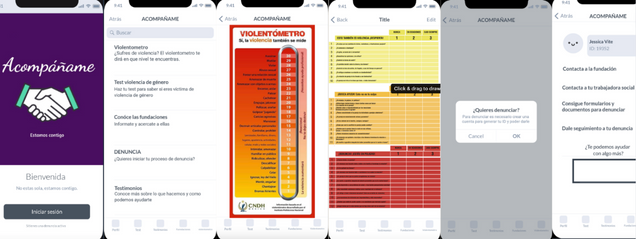
In collaboration with Casa Luna, a network of shelters in the Cuauhtémoc district of Mexico City, X Justicia and a network of colleagues from the university, I created the ACOMPÁÑAME application, which is a tool that facilitates women to receive psychological and physical help, as well as legal assistance and if necessary the opportunity to settle in a shelter, always taking into account their welfare in a comprehensive manner.
The app consists of first taking a test to find out if they are suffering violence and identify what type of violence it is in order to proceed in a better way. After that, women will have the option to contact specialized doctors to receive either physical or psychological treatment and as a final point they will be able to contact a network of lawyers to proceed legally against their aggressor.
This last point and the medical one are extremely sensitive points because of the information that is collected at the moment of contacting the victim, that is why all the data is treated with the utmost confidentiality giving the victim a folio number which also serves to prevent her aggressor from suspecting that something is going on. Both legal and medical actions being taken are given a film name so as not to raise suspicions and so that the victim is not at risk of further violence.
The pandemic created by COVID-19 came to an end, with the arrival of vaccines and movements of the different governments around the world; however, the pandemic of gender violence is far from coming to an end. It is necessary for each and every one of us to take action on this issue because, although it sounds cliché, the next woman who may suffer violence could be your mother, your sister or your daughter.
Initial layout of the app
References:
Mata, M. (2019). Cifra negra, 94% de delitos contra mujeres: JAPEM [Sitio web]. Retrieved may 2nd, 2023, from https://www.milenio.com/policia/cifra-negra-94-delitos-mujeres-japem
Inmujer. (2016). Definición de violencia de género [Sitio web]. Retrieved may 2nd, 2023, from http://www.inmujer.gob.es/servRecursos/formacion/Pymes/docs/Introduccion/02_Definicion_de_violencia_de_genero.pdf
Foreign affairs. (2020).La violencia contra las mujeres en Latinoamérica. Retrieved May 2nd, 2023. https://revistafal.com/la-violencia-contra-las-mujeres-en-latinoamerica/
New york times. (2019). ‘Not My Fault’: Women in Mexico Fight Back Against Violence. Retrieved May 2nd, 2023.
https://www.nytimes.com/2019/12/26/world/americas/mexico-women-domestic-violence-femicide.html
Organización Panamericana de la Salud. (2020). Violencia contra las mujeres. Retrieved May 2nd, 2023.
International Center for Research on Women. (N/D). The Sex, Gender and COVID-19 Project. Retrieved May 2nd, 2023.
https://globalhealth5050.org/the-sex-gender-and-covid-19-project/
Can there be successful reform to our criminal justice system?
I am incredibly passionate about reforming our justice system and I think focusing on prevention, or an upstream model, to tackle crime is a great solution. To begin the process of prevention work, the roots of the problem needs to be uncovered. Knowing the histories and contexts of our justice system unlocks understanding on how foundational beliefs shape the experience and outcome of individuals involved. When evaluating the process and results of the US system it is clear that the concept of justice is defined in a unique way. Who decides how a community measures justice? Digging for the truth reveals what this system is effective in achieving. Unfortunately, in the US, the origins explain an intentional pattern of harm: a system born out of oppression, control, and racism. This punitive system was merely a method to destroy communities of color and establish a nation based on individualism and capitalism. Now we see how those national values stand in opposition of true justice.
The article “The Foundational Lawlessness of the Law Itself: Racial Criminalization & the Punitive Roots of Punishment in America”, tackles the topic of US Justice System reform. The topics discussed helped me recognize how the origins of our system make it almost impossible for reform. The author, Kahil Muhammad looks back at American history to discover how this society came to define the criminal and how a criminal was dealt with. This examination revealed that the US strategically criminalized certain identities: “As generation after generation of White colonists and later citizens moved West, the choice to define Native populations and Mexicans as savages or criminals by law, custom, and practice rationalized the eventual creation of the nation” (p. 109). The criminal system was created to punish communities of color for merely existing and to gain control. White settlers perpetuated the idea that “An individual's deviance was a result of ‘cultural pathologies’ and bad parenting ensured delinquency and crime, to which policing and incarceration were the most appropriate responses” (Muhammad, p. 117). When looking back, “Criminal anthropologists assessed female deviance, in part, by subjects’ proximity, or distance from, Western ideals of femininity, morality, and virtue” (Muhammad, p. 112). These racist perspectives still remain to this day, as the justice system has failed to evolve, rather we see that “crime and punishment, in other words, emerged as the platform for the racial inequities established during the colonial era to flourish” (Muhammad, p. 109-110). Even outside of the adult justice system, we often see for Black youths that “The denial of the special protections of the juvenile court … reflected a pervasive view that Black youth were ‘presumed criminal’” (Muhammad, p. 113-114). The criminal justice system was created to enforce and uphold racist ideals. The system conceptualized the criminal as any person of color, and this stereotype persists. There is no justice for all in a system made to maintain white supremacy.
Included in the article is a quote from the Union Major General Carl Schurz, “But although the freedman is no longer considered the property of the individual master, he is considered the slave of society, and all the independent state legislation will share the tendency to make him such.” He pointed out that although slavery was now illegal, the US found a way to legalize a new form of slavery. Years later this still remains the truth. Black men make up the majority of incarcerated individuals. The system that existed back then still exists now and because the intentions were to criminalize Black men this problem is very much alive and well. I found it interesting that “incarcerated White men saw themselves as Black-adjacent. ‘Some even identify themselves as marked by that history of racial discrimination in recognizing that anti-black lawmaking is behind the sweeping legislative changes that widened the net of the criminal justice system, eventually catching them”(Muhammad, p.111). It makes you question what it truly means to be “Black-adjacent”. It seems that in this context being Black is to be ‘unwanted’ in society or ‘deviant’. By existing in a Black body the US feeds you this message. And when White individuals feel this way, to them it is synonymous with Blackness.
In the book Changing Lenses: Restorative Justice for Our Times, the author is “convinced that much crime and violence is a way of asserting personal identity and power” and that the violence perpetrated by offenders “feeds on low self-confidence and fractured self-esteem”(Zehr, ch. 3). Similarly, the article “An Abolitionist View of Restorative Justice”, describes crime as a “communicative act, expressive conduct, ‘a clumsy attempt to say something’”(Ruggiero). If you are a part of a society that places negative labels on members of your race, they raise you to hate who you are.
If we follow the logic established by these authors, there is no question as to why crimes will be committed. There is also no question as to why people will reoffend. If the current solution further instills self hatred, the problem is perpetuated. Instead of searching for the root cause of the violence or crime in our society, the criminal justice system locks away the symptoms to the “failings of economic, political, or social systems, which consequently deters the reform of these systems'' (Ruggiero).
This same article discusses Durkheim's theories on social order and presents three “Unity Patterns''. In my opinion, the most utopian patter is the Organic Unity Pattern which “is enacted when individuals develop feelings of reciprocity due to the role and social rewards they enjoy in relation to similarly satisfied individuals”(Ruggiero). If we strive for a society of community and social order, this is one healthy way to achieve it. Currently, we do not have this. Although it is a goal that may never be attained, it's one I think we should strive for. There is no reciprocity and this seems like the true root cause of criminal behavior. The US Justice System fails to function because it perpetuates, instead of addressing the problem.
Works Cited
Howard Zehr. (1995). Changing Lenses : Restorative Justice for Our Times. Herald Press.
Muhammad, K. G. (2022). The Foundational Lawlessness of the Law Itself: Racial
Criminalization & the Punitive Roots of Punishment in America. Daedalus, 151(1), 107–120. https://www.jstor.org/stable/48638133
Vincenzo Ruggiero, An abolitionist view of restorative justice, International Journal of Law,
Crime and Justice, Volume 39, Issue 2, 2011, Pages 100-110, ISSN 1756-0616, https://doi.org/10.1016/j.ijlcj.2011.03.001. (https://www.sciencedirect.com/science/ article/pii/S1756061611000279)
Treatment Alternatives to Incarceration for Individuals Suffering from Mental Health Conditions
According to the Department of Justice, approximately half of individuals who experience incarceration as well as over ⅓ of the United States prison populations are simultaneously suffering from a mental illness (DOJ, 2022). Additionally, the American Psychological Association reports that 64% of individuals experiencing incarceration within jails, 54% of individuals experiencing incarceration with state prisons, and 45% of individuals experiencing incarceration within federal prisons have reported to have mental health concerns (DOJ, 2022). Research has also found that within this population of individuals who suffer from various mental health conditions, 64% of them recidivate and are arrested again within 18 months of being released (Lurigio et al., 2004, p.5). These overwhelming statistics support the need for an alternative treatment plan to incarceration, as punitive approaches without the proper mental health treatment have clearly been ineffective in preventing re-entry for this population of individuals.
In many correctional facilities, the cost of incarceration for individuals living with severe mental illnesses is very high. For example, it was found that in the state of Massachusetts, the overall cost of incarceration for individuals living with severe mental health conditions reached about $300 million each year (Johnson et al., 2017, p.23). As a result of this high cost of living, oftentimes these individuals do not receive the proper treatment. More specifically, about 63% of individuals who have suffered from or are currently suffering from mental illness do not receive treatment while experiencing incarceration (National Alliance on Mental Illness). In the instance that correctional facilities do provide mental healthcare, it is often not adequate to meet the needs of the suffering individuals and therefore, do not support re-entry into society following their sentence.
The population of individuals who are experiencing incarceration and also suffering from mental health conditions are deserving of receiving the proper treatment. Several previous studies have supported this idea by providing suggestions of treatment alternatives. Vera Institute of Justice suggests four effective ways of instituting health and justice into the procedures within the criminal justice system when addressing individuals who have engaged in criminal behavior and suffer from serious mental illness. These include but are not limited to: specialized policing responses (SPR’s), jail diversion, specialized courts, and community reentry planning for individuals who did experience incarceration (Cloud & Davis, 2013).
- Specialized police responses include teams that assist individuals who live with severe mental illness in times of crisis and provide them with treatment without an arrest. These teams include crisis intervention teams and police- mental health co-responder teams, which are suggested to relieve correctional facilities from catering to crisis situations (which many are not equipped to properly do), and decrease stigmatization of their condition by providing treatment instead of incarceration (Cloud & Davis, 2013, p.2).
- Jail diversion is a cost effective alternative to incarceration, providing programs that assist with behavioral health treatment. One example of these programs is the Forensic Assertive Community Treatment (FACT) program, which is a justice based- health partnership that has been proven to yield high cost savings and fewer jail bookings (Cloud & Davis, 2013, p.2).
- Specialized courts such as drug courts, mental health courts, and veteran courts are a great alternative procedural system to assist in the court procedures of individuals who suffer from severe mental illness. The purpose of these courts are to provide the option to individuals who have engaged in criminal behavior and struggle with severe mental health conditions with the option to participate in rehabilitative treatment alternatives to incarcerations. For example, many individuals who suffer from post-traumatic stress syndrome and engage in criminal behavior may be given the option to participate in physical treatment programs, such as yoga. A specific organization that provides a mindful treatment alternative through a trauma based approach to individuals court-ordered to participate in an alternative program include Yoga4Change. The mission of this organization is “to achieve lasting, demonstrative change for veterans, individuals who are experiencing incarceration, youth, and people living with mental health conditions through a purpose-driven yoga curriculum”(Yoga4Change, 2014) . This program does not exclude any population, for they provide alternative treatment to individuals who are actively experiencing incarceration and those who are not.
- Lastly, Vera Institute of Justice suggests community reentry planning for individuals who did experience incarceration. Although this service is not an alternative to incarceration, it does provide the proper resources for individuals suffering with severe mental illness to prevent reentry and crisis situations post-release. It was found that “transitional planning to coordinate services for people with substance use and mental health treatment needs in their communities upon release from a correctional facility reduces recidivism and improves health outcomes” (Cloud & Davis, 2013, p.3).
All in all, these services are few of the many suggested alternatives to incarceration as well as further treatment care for individuals who engage or have engaged in criminal behavior and live with severe mental health conditions. If these practices continue, we would have done our due diligence as a society to build a strong rehabilitative procedural practice for individuals who are system impacted and experience life with mental illness. It is extremely important to support these individuals with treatment alternatives to incarceration with trauma informed approaches, to decrease recidivism and also provide behavioral care to improve their mental health.
Cloud, D., & Davis, C. (2013). Treatment alternatives to incarceration for people with mental health needs in the criminal justice system: The cost-savings implications. Vera Institute of Justice.
DOJ. (2022, May). Mental Health and Reentry: How Court Services Offender Agency Meets the Challenge of Mental Health Community Supervision. Dispatch. Retrieved May 2, 2023, from https://cops.usdoj.gov/html/dispatch/05-2022/mental_health_reentry.html#:~:text=Approximately%20half%20the%20people%20in,path%20for%20prisoners%20returning%20home.
Hern-Johnson, H., Menchine, M., Goldman, D., & Seabury, S. (2017, September). The cost of mental illness: Massachusetts facts and figures. The Cost of Mental Illness: Massachusetts Facts and Figures. Retrieved May 2, 2023, from https://healthpolicy.usc.edu/wp-content/uploads/2018/07/MA-Facts-and-Figures.pdf
Home. Yoga 4 Change. (2014). Retrieved May 2, 2023, from https://www.y4c.org/
Lurigio, A. J., Rollins, A., & Fallon, J. (2004). The effects of serious mental illness on offender reentry. Fed. Probation, 68, 45.
Mental health treatment while incarcerated. NAMI. (n.d.). Retrieved May 2, 2023, from https://www.nami.org/Advocacy/Policy-Priorities/Improving-Health/Mental-Health-Treatment-While-Incarcerated#:~:text=About%20three%20in%20five%20people,in%20state%20and%20federal%20prisons.
Trauma and Suicide within Law Enforcement
Trauma is a serious thing that needs to be taken a closer look at, it is the third largest cause of death worldwide for males and fourth largest death worldwide for females, it was estimated to have caused 10% of all deaths in 1990 (Bourbeau, 1993; Girolami et al., 1999; Murray and Lopez, 1996). “Trauma is defined as one or more events perceived to the individual as harmful or life-threatening, usually causing adverse effects to the individual’s well-being” (Substance Abuse and Mental Health Services Administration, 2019).
Law enforcement officers are at great risk of being exposed to trauma during their work, and the officers are also at a greater risk of developing post-traumatic stress disorder (PTSD), increased suicidal risk, and increased substance use (Collazo, 2022). Police officers are at great risk of being exposed to multiple traumas throughout their careers, it has been estimated that they witness anywhere from 10 to 900 traumatic events throughout their career (Papazogulou & Tuttle, 2018; Rudofossi & Lund, 2009). It is estimated that 15% of male and 18% of female law enforcement officers develop PTSD compared to 1.3% to 5.5% of the general population (Berger et al., 2012, Frans et al., 2005, Hartley et al., 2013).
1.216 first responders ended their own life from January 1st, 2017 to February 27th, 2023, 811 of these individuals were law enforcement officers who majority were active officers at the time (Blue help, 2023). As of February 27th, 2023 16 law enforcement officers have committed suicide, 12 of those were active officers (Blue help, n.d). The trauma that these officers have been exposed to throughout their careers is the leading cause of their suicide and it is important that all officers have access to receive the help that they need without being judged for it. In 2020 there was a discussion on the topic in Dr.Phil who talked to the families of some of these officers and explained that there is a lack of help for them within the police department and that most officers do not seek help out of fear of being judged. In 2019 180 male and 16 female officers lost their lives because they were unable to seek help to the trauma that they were exposed to in their workplace, total of 197 law enforcement officers lost their lives that year which is unacceptable. It is important that not only law enforcement officers but all first responders have access to mental health services that can help them to deal with the trauma that they are exposed to while they are on duty because they are the ones who are responding to situations that most would run away as quickly as they possibly could.
In 2018 the Law Enforcement Mental Health and Wellness Act 2017 was signed into law, this act recognizes that law enforcement officers need support with their mental health. This act ignores the old way of thinking about mental health where only “crazy” people need help and it is taboo to seek help from a mental health professional. The act is a huge step in the right direction however, there are still approximately 150 law enforcement officers ending their own lives every year and it is clear that the stigmatization of mental health is still a problem and it needs to be changed. It is extremely important to understand that it is okay to talk about your problems and not to judge others who do because it should be encouraged especially for first responders who are often the first people on a scene that is traumatizing.
References
Becker, C. B., Meyer, G., Price, J. S., Graham, M. M., Arsena, A., & Armstrong, D. A. (n.d.). Law enforcement preferences for PTSD treatment and crisis management alternatives. Behaviour Research and Therapy, 47(3), 245-253. https://doi-org.ezproxy.bu.edu/10.1016/j.brat.2009.01.001
Bourbeau, R. (1993). Analyse comparative de la mortalite violente dansles pays developpes et dans quelques pays en developpe-ment durant la periode 1985-1989. World Health Stat Quart, 46, 4-32.
Collazo, J. (2022). Adapting Trauma-Focused Cognitive Behavioral Therapy to Treat Complex Trauma in Police Officers. Clini Soc Work, 50, 160-169. https://doi-org.ezproxy.bu.edu/10.1007/s10615-020-00770-z
Congress. (2017). S.867 - 115th Congress (2017-2018): Law Enforcement Mental Health and Wellness Act of 2017. Congress.gov. https://www.congress.gov/bill/115th-congress/senate-bill/867
Frans, Ö., Rimmö, P., Åberg, L., & Fredrikson, M. (n.d.). Trauma exposure and post-traumatic stress disorder in the general population. Acta Psychiatrica Scandinavica, 111(4), 290-291. https://doi-org.ezproxy.bu.edu/10.1111/j.1600-0447.2004.00463.x.
Girolami, A., Foex, B. A., & Little, R. A. (1999). Changes in the causes in the last 20 years. Trauma, 3-11. https://doi-org.ezproxy.bu.edu/10.1177/146040869900100101
Hartley, T. A., Violanti, J. M., Sarkisian, K., Andrew, M. E., & Burchfiel, C. M. (2013). PTSD symptoms among police officers: Associations with frequency, recency, and types of traumatic events. International journal of emergency mental health, 15(4), 241-253. https://www.ncbi.nlm.nih.gov/pmc/articles/PMC4734407/
McGraw, P. C. (2020, September 11). Behind The Badge: Is 'Code Of Silence' Leading More Law Enforcement To Take Their Own Lives? Dr. Phil. https://www.drphil.com/videos/behind-the-badge-is-code-of-silence-leading-more-law-enforcement-to-take-their-own-lives-alt/
Murray, C. J.L., & Lopez, A. D. (1996). The global burden of disease. The Harvard School of Public Health.
The Numbers. (n.d). Blue H.E.L.P. Retrieved February 27, 2023, from https://bluehelp.org/the-numbers/
Papazoglou, K., & Tuttle, B. M. (2018). Fighting police trauma: Practical approaches to addressing psychological needs of officers. SAGE Open. https://doi-org.ezproxy.bu.edu/10.1177/2158244018794794.
Rudofossi, D., & Lund, D. A. (2017). A Cop Doc's Guide to Public Safety Complex Trauma Syndrome: Using Five Police Personality Styles. Taylor & Francis Group. https://doi.org/10.4324/9781315225142
Substance Abuse and Mental Health Services Administartion. (2022, September 27). Trauma and Violence - What is Trauma and the Effects? SAMHSA. https://www.samhsa.gov/trauma-violence