Home
Why Massachusetts Should Not Build Any New Women’s Prisons
This post serves as a review of the Baker Administration’s proposal of a trauma-informed new women’s prison, an initiative that is vastly under researched, misinformed, and fiscally irresponsible. While the national rate of women’s incarceration has risen dramatically in the past two decades, the opposite is true for Massachusetts (Rousseau, 2021; Massachusetts Department of Corrections, 2019). Yet despite housing such a low prison population for women, the Baker Administration is pushing on for the creation of a new women’s prison. In its plans, the Administration touts a robust trauma-informed facility based on questionable and irrelevant research (Sered et al, 2021); however, the notion of a trauma-informed incarceral state is not only misinformed but harmful to both the women incarcerated and their impacted communities. Rather than spending well over $50,000,000 on the further incarceration and degradation of women (Sered et al, 2021), the Baker Administration has an invaluable opportunity to re-evaluate it’s criminal justice priorities and listen to the true experts and advocates fighting for decarceration. This post seeks to expand on the downfalls of a trauma-informed prison and offer alternatives to incarceration that would better address the unique challenges associated with crime faced by women.
The key issue with the Administration's, perhaps well-intended plan, is that it will not sufficiently address the inherent trauma associated with incarceration and serve to only further practices of mass incarceration. It is impossible to separate trauma from prison; the implementation of incarceration alone creates trauma and exasperates already present symptoms of trauma. First, incarceration separates families. This is especially concerning in regard to women’s incarceration because incarcerated women are more likely to be the primary caregiver of a young child (Rousseau, 2021; Bloom et al, 2003: 16). Not only does this create obvious trauma for children of incarcerated mothers (Lee et al, 2013), but the mothers themselves face serious mental repercussions from this separation, especially if they recently gave birth (Chambers, 2009). Once released, the damaging effects of incarceration on the family continue to manifest in ways that also impact rehabilitation. As noted by Bloom et al, “Many women released from prison have lost touch with their families and thus face greater adjustment problems in reintegrating into the community” (2003: 16). Without close ties to the family or community, individuals are more likely to recidivate (Mooney and Bala, 2018). Not only does this impact the outlook for the original offender, but the trauma and disruption transferred to the children of incarcerated women is also significantly disturbing and harmful (Lee et al, 2013).
Second, incarcerated women suffer from Post Traumatic Stress Disorder (PTSD), depression, and anxiety, at a higher rate than their male counterparts (Rousseau, 2021). Furthermore, many of these women were victims of crime themselves, with up to 70% reporting a history of abuse (Rousseau, 2021). When placed in a prison setting, underlying trauma and mental illness will suffer (Owen, 2020; Rousseau, 2021). Even when provided treatment during incarceration, it is impossible to avoid the daily harms of one's mental health while behind bars because of the way in which incarceration is structured; inherent in the current carceral state is isolation, high risk of physical and sexual abuse, and lack of bodily autonomy (Bloom et al, 2003: 25; Sered et al, 2021). Even with trauma-informed policies, these risks are simply not worth continuously suppressing incarcerated women when better alternatives to incarceration exist.
Finally, “the most common pathways into crime [for women] are based on ... poverty and substance abuse” (Rousseau, 2021). Incarceration does not solve these problems, it does not get to the root of poverty or substance abuse. Instead, it exasperates these pathways and leaves women with little support post-incarceration to later overcome these challenges. For example, while incarcerated many women are not provided adequate research-based treatment. Alarmingly, “[t]he opioid overdose death rate is 120 times higher for those recently released from incarceration compared to the rest of the adult population” (ACLU Massachusetts, 2021). Moreover, women are not provided adequate opportunities to address poverty while incarcerated, which leaves the problem unaddressed once reintegrated into their communities. Women are typically offered less compensation than male counterparts for work-assignments and are provided a smaller range of vocational programs to assist them post-incarceration (Bloom et al, 2003: 23). These major discrepancies allow the most common pathways into crime for women to fester and worsen upon release, which creates a cycle of criminal behavior that could have been interrupted if the proper resources were originally provided.
While well intentioned programs, such as yoga therapy and trauma-informed practices in the prison setting have been implemented in places such as MCI-Framingham, a thorough review of scientific literature “found no evidence for the effectiveness of prison-based therapeutic programs, including ones designed to be gender-responsive and trauma-sensitive” in the long term (Sered et al, 2021). This is because trauma-informed services are incompatible with incarceration. Trauma informed services must be composed of four key fundamentals: (1) “take trauma into account; (2) avoid triggering trauma reactions and/or traumatizing the individual; (3) adjust the behavior of counselors, staff and the organization to support the individual's coping capacity; and, (4) allow survivors to manage their trauma symptoms successfully so that they are able to access, retain, and benefit from these services” (Rousseau, 2021). These four fundamentals cannot be effectively carried out in a prison where the “[l]oss of custody of children, lack of bodily privacy, absence of control over whom one does or does not interact with, and limited freedom of movement, control over time, and personal space may in and of themselves cause trauma” (Sered et al, 2021). Thus, in application, the carceral state does not leave room for the avoidance of traumatizing or retraumatizing an individual. Further, the constraints and environment of a prison does not allow survivors to effectively manage their symptoms of trauma. Counselors, staff, and organization can work to support the individual’s treatment, as advocated and explained by Tonier Cain, a national trainer on trauma-informed services in prisons (Rousseau, 2021); however, “barked orders, pat-downs, strip searches, and looming threats of punishment” at the hands of the prison staff work against this (Sered et al, 2021). Despite attempts to alleviate the trauma endured behind bars, a trauma-informed prison will not prevent the inevitable long term harms of incarceration.
The greatest hurdle to both legislators and the general public, it seems, is what do we do without a prison? What about those who have committed so-called violent crimes? These questions cannot be ignored, but they cannot be solved by simply building a new prison. Rather than imprisoning women, thereby disrupting families and exasperating mental health issues, alternatives to incarceration are wide and plenty, many of which offer far more promising results in rehabilitation than incarceration provides (Sered et al, 2021). These alternatives should take into consideration the pathways leading to the alleged crime and find ways to divert the individual from incarceration. In practice, for example, a woman suffering from substance abuse disorder could greatly benefit from voluntary treatment outside of prison -- this concept is supported by evidence finding that recurrent substance abuse needs treatment not punishment (ACLU Massachusetts, 2021). Alternatives to incarceration are not simply alternatives to the physical imprisonment of an individual, but also include updating criminal justice policies to reduce incarceration and better serve the needs of communities. As an example, some criminal justice advocates suggest decriminalizing various degrees of drugs and sex work and focusing instead of providing resources to work against substance abuse and poverty. By placing the emphasis on support and rehabilitation rather than punishment and incarceration, the Commonwealth can more effectively reduce crime.
Building a new women’s prison is not necessary to promote rehabilitation, reduce recidivism, and support the community. Instead, I argue that building a new prison will only further suppress and degrade women deserving help, support, and encouragement. As aptly put by Dr. Danielle Rousseau, “Not all populations within the criminal justice system are the same, and in order to foster effective policy and programing, it is important to recognize this fact” (2021). Thus, moving forward, the Baker Administration should take seriously the advocacy of women who have been put down by the very system the Administration intends to promote, such as the formerly incarcerated advocates and experts leading the way with Families for Justice as Healing (FJAH). As a concluding thought, I leave the following statement, “[Women] need families that are not divided by public policy, streets and homes that are safe from violence and abuse, and health and mental health services that are accessible. The challenges women face must be met with expanded opportunity and a more thoughtful criminal justice policy” (Bloom et al, 2013: 21); the Commonwealth has a unique opportunity to support the rehabilitation and empowerment of women through the implementation of alternatives to incarceration as opposed to a formidable new prison.
*This post does not speak for or on behalf of any advocacy group and was written solely for academic purposes.
Works Cited
ACLU Massachusetts. (2021). Treatment Not Imprisonment: Aligning Probation Orders With Addiction Science.
Bloom, B. E., Owen, B., & Covington, S. S. (2003). Gender-Responsive Strategies: Research, Practice, and Guiding Principles for Women Offenders. National Institute of Corrections. https://nicic.gov/gender-responsive-strategies-research-practice-and-guiding-principles-women-offenders
Chambers A. N. (2009). Impact of forced separation policy on incarcerated postpartum mothers. Policy, politics & nursing practice, 10(3), 204–211. https://doi.org/10.1177/1527154409351592
Lee, R. D., Fang, X., & Luo, F. (2013). The impact of parental incarceration on the physical and mental health of young adults. Pediatrics, 131(4), e1188–e1195. https://doi.org/10.1542/peds.2012-0627
Massachusetts Department of Correction. (2020, April). Prison Population Trends 2019. Mass.gov. https://www.mass.gov/doc/prison-population-trends-2019/download
Money, E. & Bala, N. (2018, October). The Importance Of Supporting Family Connections To Ensure Successful Re-entry. R Street Shorts. https://www.rstreet.org/wp-content/uploads/2018/10/Final-Short-No.-63-1.pdf
Owen, B. (2020). Women face unique harms from solitary confinement. Vera Institute of Justice. https://www.vera.org/blog/addressing-the-overuse-of-segregation-in-u-s-prisons-and-jails/women-face-unique-harms-from-solitary-confinement
Rousseau, D. (2021). Module 4: Implementing Psychology in the Criminal Justice System. Boston University Metropolitan College.
Sered, S. S., Tafte, E., & Russell, C. (2021, January). Ineffectiveness of prison-based therapy: The case for community-based alternatives. Susan Sered, PhD. http://susan.sered.name/blog/debunking-the-myth-of-gender-responsive-treatment-in-prison/
Sered, S. S., Tafte, E., & Russell, C. (2021, March). Alternatives to Incarceration for Women in Massachusetts: An Opportunity and a Challenge. Susan Sered, PhD. http://susan.sered.name/blog/
Invisible Scars from Racism
Social stigma and discrimination have been a nationwide concern that has motivated many social movements and organizations to forefront changes. Despite these efforts, it is still a recognized problem with a prevalence varying in different cities and neighborhoods. As a result, a lack of awareness and recognition on how racism can be easily imposed on one and another makes this issue so impactful on the mental health.
In Experiencing Racism May Damage Memory Cognition, scholar Kat McAlpine exploits a longitudinal study on African American women and their lifelong health risks imposed by discrimination to shed light on such health and wellness concerns. Conveyed as the main point, McAlpine reiterated the connection between “exposure to racism and lower cognitive functions later in life” (2020). According to the Centers for Disease Control and Prevention (CDC) and its collaboration with a systematic review in 2015, racism is associated with higher rates of stress, increasing the risk of high blood pressure and a weakened immune system (2021). Further studies suggest that a constant exposure to racism can provide gateways to unhealthy coping behaviors, such as smoking, alcohol use, drug use, and excessive eating habits (Frellick, 2021).
These behaviors, psychologically, suggest that people who experience race-based stress and trauma frequently have similar experiences to people who have post-traumatic stress disorder (PTSD) (Kleinman & Russ, 2020). While the psychiatric disorder commonly occurs in people who have experienced or witnessed traumatic events, typically seen in disasters, war, and sexual violence, the rising experience of both direct and indirect systematic racism has left serious impacts to the mental and physical health of victims.
Beyond the community initiatives to combat against questionable policing and outbreaks of racially motivated physical and verbal attacks, systematic racism has made racial displacement, exclusion, and segregation an ongoing issue in all communities. The reason for this likely falls on transmitted traumatic stressors, a stressor that is transferred from one generation to the next—coming from historically racist sources or may be personal traumas passed down through families and communities (Mental Health America, 2021). This becomes an important concept highlighted by the social bond theory in which theorist Travis Hirschi argued that elements of social bonding includes the attachments to families and commitments to social norms and institutions (1969). How can understanding this systematic issue help victims of racism?
Like many topics in the field of criminal justice, racism, is also a complex phenomenon. Racism stems from individual experiences, systematic faults, direct traumatic stressors, vicarious traumatic stressors, and transmitted stressors (Mental Health America, 2021). The following statistics are a few examples of some of the prevalent nature of racism:
- In 2018, approximately 38% of the Hispanic community were verbally attacked simply for speaking Spanish. They were told to “go back to their countries,” called a racial slur, and/or treated unfairly by others (Lopez et al., 2020).
- The lack of cultural competency in resources for Native American communities have resulted rates of suicide to be 3.5 times higher than ethnic groups with the lowest rates of suicide (Leavitt et al., 2018).
- African Americans make up around 33% of the total prison population; this highlights an overrepresentation of racist arrests, policing, and sentencing in the criminal justice system (FBI Uniform Crime Report, 2019).
While communities have already and continued their efforts to address racism on many platforms, it is important to remember to maintain the awareness and recognition that racism is more than the definition of prejudice and discrimination against a person, it is a physical, emotional, and mental health issue, and allowing such racial trauma to control a victim’s life should be enough evidence for every level of government to intervene in their highest capabilities.
References
Frellick, M. (2021). CDC declares racism a serious public health threat. CDC. https://www.webmd.com/lung/news/20210412/cdc-declares-racism-a-serious-public-health-threat
Hirschi, T. (1969). Causes of delinquency. Berkeley: University of California Press. https://criminology.fandom.com/wiki/Social_Bond_Theory#:~:text=The%20four%20basic%20elements%20of,an%20individual%20holds%20in%20society
Kleinman, B., & Russ, E. (2020). Systematic racism can leave black people suffering from symptoms similar to PTSD. Courier Journal. https://www.courier-journal.com/story/opinion/2020/06/12/racial-trauma-can-leave-black-people-ptsd-symptoms/3160232001/
Leavitt, R. A., Ertl, A., Sheats, K., Petrosky, E., Ivey-Stephenson, A., & Fowler, K. A. (2018) Suicide among American Indian/Alask Natives – National violent death reporting system. MMWR. doi: 10.15585/mmwr.mm6708a1
Lopez, M. H., Gonzalez-Barrera, A., & Krogstad, J. M. (2020). Latinos’ experiences with discriminations. https://www.pewresearch.org/hispanic/2018/10/25/latinos-and-discrimination/
McAlpine, K. (2020). Experiencing racism may damage memory, cognition. Boston University: The Brink. https://www.bu.edu/articles/2020/experiencing-racism-may-damage-memory-cognition/
Mental Health America. (2021). Racial trauma. https://www.mhanational.org/racial-trauma
Uniform Crime Report. (2019). Table 43. https://www.ucr.fbi.gov/crime-in-the-u.s/2018/crime-in-the-u.s.-2018/tables/tables-43
CJ 725
Trauma refers to the human reaction to a troubling or distressing happening that devastates a person’s coping abilities; it causes feelings of helplessness, reduces their sense of self, and ability to feel various experiences and emotions. Trauma affects people of all races and ages; hence it is significant concern around the world. There are multiple forms of trauma, including acute, chronic, and complex. According to Gawęda et al. (2020), almost 60% of adults experience abuse or challenging family situations in their childhood. Additionally, the studies indicate that nearly 26% of children in America will encounter traumatic events before three years while one in ten kids has experienced various forms of sexual abuse.
However, various therapies could help mitigate the effects of trauma, including Cognitive Behavioral Therapy. This is a form of treatment that helps victims of trauma learn how to recognize and alter disturbing or destructive thought patterns that negatively impact emotions and behavior. Cognitive Behavioral therapy majors on transforming automatic negative thoughts that could enhance anxiety, emotional difficulties, and depression. Among the major concerns is whether Cognitive Behavioral Therapy is more effective compared to other forms of therapy? Hence there is a need for further research about the topic. Various studies indicate that Cognitive Behavioral Therapy is effective since it entails multiple approaches and techniques that focus on behaviors, emotions, and thoughts (Cohen et al., 2018).
Mainstream psychology often ignores the essence of trauma concerning cultural psychology. Even though clinical trauma psychology acknowledges the significance of the ethical value of variations in trauma treatment, there are minimal studies on how culture is related to trauma's human emotional and cognitive responses. There are various self-care strategies that people with trauma could implement. (Salloum et al., 2019). For instance, talking to people more regularly, doing activities that make an individual relax, allowing oneself to experience emotions such as crying, and avoiding major life decisions.
References
Cohen, J. A., Deblinger, E., & Mannarino, A. P. (2018). Trauma-focused cognitive behavioral therapy for children and families. Psychotherapy Research, 28(1), 47-57.
Gawęda, Ł., Pionke, R., Krężołek, M., Frydecka, D., Nelson, B., & Cechnicki, A. (2020). The interplay between childhood trauma, cognitive biases, psychotic-like experiences and depression and their additive impact on predicting lifetime suicidal behavior in young adults. Psychological medicine, 50(1), 116-124.
Salloum, A., Choi, M. J., & Stover, C. S. (2019). Exploratory study on the role of trauma-informed self-care on child welfare workers' mental health. Children and Youth Services Review, 101, 299-306.
Domestic Violence: Easy to See, Hard to Discuss
Spousal abuse is one of the most common types of abuse that society sees but is also one that society often turns their nose at. Family abuse, domestic abuse more specifically, is estimated to affect about “10 million people every year” and also affects “one in four women” and “one in nine men” showing that it is no longer stereotypically a man abusing his wife (Huecker, 2021). One would think that with how common spousal or even intimate partner abuse is, is that it would be one of the most reported crimes. Sadly enough, statistics show that about “20,000 phone calls are made” to domestic violence hotlines but police reports do not show nearly as many (NCADV). Those who are victims of intimate partner abuse usually stem from a history of abuse already. Although it is a well-known cycle within the criminal justice system, the Cycle of Abuse may not be common knowledge for society. Having exposed and abused children continue on in life to find themselves in an abusive relationship is more common that I’d like to see. Although I myself have not been a victim of domestic abuse, I have been a witness to abusive relationships. I wasn’t a witness in a physical abuse altercation, but I have had friends be in an abusive and toxic relationship.
Abuse does not have to be strictly physical and violent, but it includes “emotional and psychological” abuse and that is the abuse that I saw my friends engaging in, unknowingly (Huecker, 2021). I would be in the college cafeteria area, and I would be sitting with my friends, X and Y who were in a long-term relationship. However, they would argue more times than I would have seen them be affectionate with each other. A lot of the words that were thrown around in these arguments would be “stupid”, “pathetic”, “idiot”, and X would often degrade Y by just referring to her as “woman” rather than her name. They made no effort to make these fights private, as they would shout at each other across the café and have no worries about it. When they broke up, it was a relief to all of our friends because perhaps they could see how bad their relationship was and would also try not to repeat the cycle. As far as I know, they are still broken up.
This relationship, although not physical abuse, ticked off a lot of the qualifications for what deems intimate partner/spousal abuse, what it is:
- Psychological aggression by a current partner
- Resulted in both X and Y having:
- Anger management issues
- Low self-esteem
- Feelings of being inferior;
(Huecker, 2021).
And so on. It is hard to help victims of spousal abuse because it’s often a hard situation to bring up. You do not want to intrude, embarrass the victim, or even be wrong about the situation. I can say that went for our friend group for X and Y, we always just let them argue and then hope that they would be over it soon. That was definitely the wrong way to go about it, but I’m hoping (but absolutely not hoping!) that if I am ever in a situation of witnessing any type of intimate partner or spousal abuse, that I can bring myself to help the victim in the best way that the victim needs.

DOMESTIC VIOLENCE IN GEORGIA
- 37.4% of Georgia women and 30.4% of Georgia men experience intimate partner physical violence, sexual violence and/or stalking in their lifetimes.1
- In 2019, Georgia domestic violence programs answered 52,282 crisis calls.2
- Georgia domestic violence shelters provided shelter to 7,214 victims of domestic violence in FY 2019. Anadditional 4,176 were turned away due to lack of bed space.3
- In 2017, there were 149 domestic violence-related fatalities. 70% of those involved firearms.4
- In 2017, Georgia had the 10th highest rate in the US of women murdered by men.5
- As of December 31, 2019, Georgia had submitted one misdemeanor domestic violence and no activeprotective order records to the NICS Index.6
(NCADV)
My wish is that with resources like this available, victims can get the support and help that they need, along with the hope of lowering those statistics.
Reference:
Huecker, M. (2021, February 17). Domestic violence. Retrieved April 14, 2021, from https://www.ncbi.nlm.nih.gov/books/NBK499891/
NCADV: National coalition against domestic violence. (n.d.). Retrieved April 14, 2021, from https://ncadv.org/STATISTICS
Are We Well and Good?
Correctional professionals have an inherently stressful job. But what is all this stress doing to their bodies and minds? In 2013, the U.S. Department of Justice commissioned a literature review to shine a light on this very topic. Dr. Jamie Brower, Psy.D., took to looking at all the areas that Correctional Officers encounter stress in their daily jobs. The review was aptly named: Correctional Officer Wellness and Safety Literature Review. The review draws attention to these areas: Inmate-Related Stressors, Occupational Stressors, Organizational and Administrative Stressors, Psycho-Social Stressors (Brower, 2013).
So basically, there are very few aspects of the job that do not affect the stress and safety of a correctional officer. That’s the bad news. The Good news is there are things that can help. Specifically, a program/ training called: Creating Regulation and Resilience– CR/2 for short. This training is a “staff communication model designed to foster productive interactions with justice-involved clients’’. (ORBIS, 2020) Within the CR/2 model there are 2 phase- first staff are encouraged to use strategies (grounding, breathing, etc.) to build their regulation (calm & balance). Second, is to create resilience- meaning, engaging in effective action (ORBIS, 2020). An example of this would be successfully getting a non-compliant inmate to lock in because of your calm and direct approach, instead of it becoming a screaming match and possibly needing to go hands-on.
You can clearly see how the two approaches – the clam vs. the screaming, would have completely different affects on the human body. One of the biggest components to the CR/2 model is Staff self-care. The review stated that the average life span of correctional officers, at 59 years of age, is 16 years lower than the national average (Brower, 2013). That’s almost unbelievable. They also found that 31% of CO’s reported having serious psychological distress, that’s twice the national average (Brower, 2013)!
According to the U.S. Bureau of Labor Statistics, there were approximately 424,000 Correctional Officers in the United States as of May, 2019 (www.bls.gov). So with that said- 31% of that is 131,440 with serious psychological disorders- that are job related only! My hope is now that there is literature and the stress and all that comes with working in that kind of environment, is being acknowledge- more programs like CR/2 will become more widely accepted and used in both Jail and Correctional environments. The outcomes not only effect the officers, but the clients they serve.
References:
Brower, Jamie, Psy.D., ABPP. National Institute of Corrections: Correctional Officer Wellness and Safety Literature Review (2013). Retrieved 6/2020 from: https://www.ncjrs.gov/App/Publications/abstract.aspx?ID=266912
ORBIS partners. Creating Regulation and Resilience, CR/2. Retrieved 6/2020 from : https://www.orbispartners.com/corrections-staff-training-cr2United States Bureau of Labor Statistics.
Occupational Employment and Wages, May 2019. Correctional Officers and Jailers. Retrieved 6/2020 from: https://www.bls.gov/oes/current/oes333012.htm
From Prison to PhD: Post Traumatic Growth after Incarceration
Prison inspires a culture of its own. To be given a new name, rather a number, that you are to be called upon and to be stripped of your previous identity. To be stripped naked and given standardized attire to be worn day in and day out. To be surrounded by uniformed personnel with metal handcuffs and weapons around their belt. To be beaten, humiliated, degraded, pent up in the dark like an animal, and to constantly fear for your life with gruesome images that may linger in your mind for the rest of your life. How can anybody be expected to return from prison and released back into their community as if their life, their mind, and experience of the world has been unaltered? How can anyone expect to move forward and grow after what many may call to be a traumatic incarceration? Mika’il DeVeaux, a former incarcerated young man and current PhD student and director of nonprofit organization aimed to help explore the idea and meaning of success as defined by seventeen men who had three years to try and survive a post-incarceration life successfully. Among his interview with men, he explored the social support that allowed them to reach that success. “The most important you know [is] family.” Family allowed the formerly incarcerated men to be surrounded by a positive influence that created a sense of yearning of success while preventing them from gravitating to the former negative influences that may have led them to reincarceration. Charles, one of the participants in the study stated, “relationships play a key role…I am talking about support relationships…about making sure that we are accountable.” Keeping in touch with “professional change agents” were also attributed to post-prison success. Among all of the other variables that the men used to define their success such as housing, employment, education, and building a family, the theme that surrounded each individual’s concept of success incorporated the idea of a strength behind social support.
As Mika’il DeVeaux explained about his own life experience, “Prisons are institutions that have a life of their own, but the life is an abnormal one. It is a life filled with deprivations, with isolation, with fantasy and imagination, and with hanging on to what was, despite little preparation for what is to come…with little reason to ponder what life could be like after prison.” It is easy to become trapped in your own mind while your physical body is trapped in a cell. Having voices from loved ones to remind you that there is more than bars and concrete is overwhelmingly helpful for inmates.
Although not everybody experiences prison in the same way, it seems to be that it is beyond a coincidence that these men found success after prison with the aid of social supports from positive influences. “Upon my release, I was helped by the support network I maintained during my incarceration.” Mika’il explains that his family provided the support that he needed to imagine what life after prison might be like. Having maintained connections with people he knew from his previous life, such as his childhood friend, and persons that would introduce him to his new life such as his professors,e helped to establish a sense of a future and reintegration into society. A sense of hope, renewal, and growth after a traumatic experience has been strengthened by the social support that has allowed many men like Mika’il and those he welcomed into his study to come out stronger from the traumatic experience of incarceration.
References:
DeVeaux, M. (2013). The Trauma of the Incarceration Experience. Harvard Civil Rights – Civil Liberties Law Review, 48, 257-277. Retrieved from https://heinonline-org.ezproxy.bu.edu/HOL/Page?collection=newyork&handle=hein.journals/hcrcl48&id=261&men_tab=srchresults
DeVeaux, Mika'il, "Fitting-in: How Formerly Incarcerated New York City Black Men Define Success Post-Prison" (2017). CUNY Academic Works.
https://academicworks.cuny.edu/gc_etds/1822
Traumatic Divide
St. Louis city has a terrible reputation as being a dangerous city overrun by crime. Most of the crime is centered in two districts of northern St. Louis City. “There is this conception of the city as crime-ridden throughout,” says University of Missouri–St. Louis criminology professor Richard Rosenfeld. Looking at the homicide rate, which ranks at or near the top among U.S. cities each year, it appears that the violent crime risk is the same everywhere throughout the city. Rosenfeld’s research says otherwise: “It’s very high in a few neighborhoods on the north side, and in and around Dutchtown, and hardly anywhere else.” (Woytus, 2019).
Working for the Federal Public Defender’s Office in St. Louis, MO, I represent people accused of federal crimes. Most are young, African-American men, indigent, with at least one mental health diagnosis. Regardless of the type of crime they are accused of committing, their personal stories of trauma incurred as children, events they have witnessed, or violence they have committed to simply survive is a recurring theme. Many of them grew up in the aforementioned districts.
Delmar Boulevard is referred to as a “divide” in the city. South of this divide, you will find $500,000 homes and wine bars. This southern neighborhood, according to U.S. Census data, is 70 percent white. To the north of the divide: collapsing houses, gang signs spray painted on every corner, trash in the streets, and neglected infrastructure. The neighborhood is 99 percent black. “You have a division between the haves and have-nots,” explained Carol Camp Yeakey, founding director of the Center on Urban Research & Public Policy and Interdisciplinary Program in Urban Studies at Washington University in St. Louis. “People on one side are prospering, and the people on the other side are not” (Harlan, 2014). The north city has a poverty rate around 40%. Around 25% of residents have not finished high school. There are distinct socioeconomic, cultural, and public policy differences to the north and south of the divide.
According to Elijah Anderson, “The inclination to violence springs from the circumstances of life among the ghetto poor—the lack of jobs that pay a living wage, the stigma of race, the fallout from rampant drug use and drug trafficking, and the resulting alienation and lack of hope for the future” (Cullen, Agnew, & Wilcox, 2018). These conditions create a subculture of violence that can be found in these neighborhoods. In “The Code of the Streets,” Anderson describes the formation of the code among those who experience “a profound sense of alienation from mainstream society and its institutions, who see no positive place for themselves in dominant culture, yet sense a need for dignity on some grounds, some clear sense of personal ‘respect’” (Cullen, Agnew, & Wilcox, 2018).
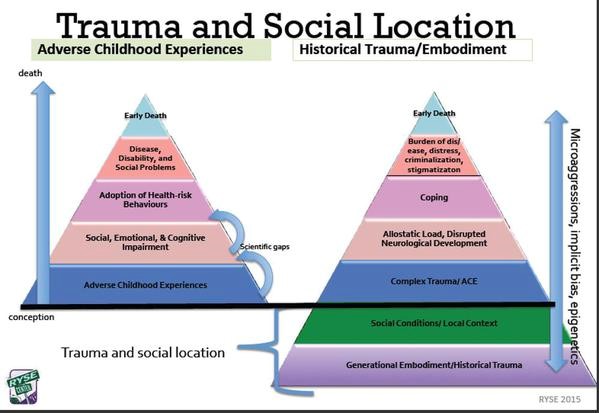
Many researchers have focused their studies on biological and environmental causes of trauma. A cultural divide and lack of protective factors affect an individual’s response to trauma. A poor family environment, with social factors such as poverty and abuse, adversely affect a person’s natural state.
(Advocate, n.d.).
In comparison to Caucasians, ALANAS (African/Black Americans, Latina/Latino Americans, Asian/Pacific Islander Americans, and Native Americans) are more likely to develop PTSD after experiencing a traditionally defined traumatic event (Helms, Nicholas & Green, 2010). The men I work with describe seeing family members shot in the streets, friends gunned down in drive-by shootings, experienced sexual assaults by family members, and have no safe space to call home. Much like the veterans that Van Der Kolb spoke about, these men’s only support system are those that live the same life and have had experienced the same traumas.
I focus on this population of people to demonstrate how two different sets of life experiences, different skill sets, and how the lack of support systems contributes to PTSD. People fortunate enough to receive early intervention within a safe place are able to better understand the negative feelings they are having and how to put them into perspective. A trauma victim heals within strong family environments and positive peer relationships. The way a person makes sense of life events contributes to their recovery. Post traumatic growth occurs for those that are resilient and are able to gain an increased sense of personal strength and greater appreciation for life in general (Rousseau, 2020). It is imperative that mental health professionals and trauma researchers work toward developing more comprehensive understandings of the experiences of traumas for people growing up in poverty or unsafe neighborhood environments. In doing so, we can help trauma victims that do not have a safe place or positive support structures begin to heal and experience their own post traumatic growth.
References
Advocate. (n.d.). Retrieved from http://www.peace4gainesville.org/advocate.html.
Cullen, F. T., Agnew, R., & Wilcox, P. (2018). Criminological theory: Past to present: Essential readings. New York: Oxford University Press.
Harlan, C. (2014). In St. Louis, Delmar Boulevard is the line that divides a city by race and perspective. Retrieved from https://www.washingtonpost.com/national/in-st-louis-delmar-boulevard-is-the-line-that-divides-a-city-by-race-and-perspective/2014/08/22/de692962-a2ba-4f53-8bc3-54f88f848fdb_story.html?utm_term=.2bb00a09b6b1.
Helms, J., Nicolas, G., & Green, C. (January 01, 2010). Racism and Ethnoviolence as Trauma: Enhancing Professional Training. Traumatology, 16, 4, 53-62.
Rousseau, D. (2020). Module 1. Retrieved from https://learn.bu.edu/webapps/blackboard/execute/displayLearningUnit?course_id=_65989_1&content_id=_7783430_1&framesetWrapped=true.
Woytus, A. (2019). These are the St. Louis neighborhoods with the most crime-and this is what the police and residents are doing about it. Retrieved from https://www.stlmag.com/news/crime-data/.
Trauma and Genocide – Thoughts after reading Night
I have read Night several times and found that each time I read it, different things stuck with me. I had never read it while looking through the lens of trauma. So, this time, a particular quote stood out to me early in the novel, that colored the way I read the rest of the narrative. "The ghetto was ruled by neither German nor Jew; it was ruled by delusion" (Wiesel, 2006, p. 12).
Wiesel is careful to detail his thoughts or misconceptions throughout the novel, giving the reader an inside look at the trauma he had experienced. The quote mentioned above really stood out to me because it described one of the most common coping mechanisms or symptoms experienced during the traumatic event. The "delusion" Wiesel notes in the beginning of the novel, describes the way many people disassociate with trauma in order to cope with and survive the experience. I found it helpful to remember the quote throughout my reading in order to tie that idea of dissociation with Wiesel's reaction to events as they unfolded.
In the same chapter, an effort by a police officer to warn the family was unsuccessful. Wiesel seemed to appreciate the officer’s attempt but, as a reader, I wondered why he had not tried to do more. It is similar to the events unfolding at the southern border, where human rights are being violated, thousands are being exposed to traumatic situations, and millions of Americans are silent. Even those that try to voice outrage have been unable to make any meaningful changes.
In this course, we learned that it is necessary to be able to identify trauma early on and try to prevent it; it is not enough to treat the symptoms but must also understand and treat the cause. Why, then, do we sit back in the face of genocide and not seek to address the trauma experienced by those affected? Is it because we too are traumatized by what we see? Do we hide in willful ignorance to avoid secondary trauma or compassion fatigue? These questions have been central to my reading of Night and even more important when reviewing the information about trauma and genocide.
Healthy Mind During Pandemic
The past 6 months have been a roller coaster between the death of Kobe Bryant which impacted me greatly since I grew up watching him. To the start of COVID-19 and being in quarantine for a little over 3 months. Now many would say, how do you keep your mind straight and not lose your mind while working from home all day to then logging into class on the same laptop you were just working on. My answer may vary from yours, it all depends on how you deal with stress. My escape from it is just getting into my car and aimlessly driving around town. Yours might be exercising or reading a book.
There are two components of self care and they are physical and mental. The Mayo Clinic Health System provides tips in how to practice physical healthy," eating healthy, sleep 7-8 hours a night, stretch, spend time outside." But the one that take more strength and determination in my opinion is mental health. They Mayo Clinic recommends "set and maintain a routine at home, focus on things you can control, maintain social connections with your loved ones" The one that sticks out the most is focusing on the things you can control. Many people love to be in control of their lives but a lot of what happens is out of our hands and it is important to not get lost in trying to figure out why things happen but instead learning how to control the things that are able to be tamed.
But I think it is important to highlight the importance the individuals who have been on the front lines during this pandemic who have experienced immense amounts of stress with little time to deal with it. According to the American Psychiatric Nurses Association a way to manage stress is to exercise self-compassion "almost everyone impacted by an emergency will experience psychological distress"... "It is easy to play up the importance of self-care to our patients while downplaying it to ourselves...give yourself permission to schedule even a few moments for self-care each day." This reminds of what Van Der Kolk states in The Body Keeps the Score "When chronically stressed, tension builds up within the body." ( pg.266) which is why nurses and people who work in public health should definitely not feel guilty for wanting some alone time to keep a healthy mind.
References:
Managing Stress & Self-Care During COVID-19: Information for Nurses. (n.d.). Retrieved June 22, 2020, from https://www.apna.org/m/pages.cfm?pageID=6685
Self-care tips during the COVID-19 pandemic. (n.d.). Retrieved June 22, 2020, from https://www.mayoclinichealthsystem.org/hometown-health/speaking-of-health/self-care-tips-during-the-covid-19-pandemic
Self-Care and Trauma
Many people do not realize the importance of self-care as it relates to trauma. van der Kolk states that, “Nobody can ‘treat’ a war, or abuse, rape, molestation, or any other horrendous event, for that matter; what has happened cannot be undone, but what can be dealt with are the imprints of the trauma on the body, mind, and soul” (2015, p. 205).
The effects that trauma has on our bodies can be mentally, emotionally and physically debilitating. It can cause a crushing sensation in your chest that you may label as anxiety or depression; a fear of losing control; always being on alert for danger or rejection; self-loathing; nightmares and flashbacks; a fog that keeps you from staying on task and from fully engaging in what you are doing; being unable to fully open your heart to another human being (van der Kolk, 2015, p. 205).
Trauma affects our entire being and affects how we relate and connect to others. When one suffers the effects of trauma, it is imperative to deal with the imprints it has left on our bodies, minds and souls to live a happy and healthy life.
Van der Kolk stated that, “the fundamental issue in resolving traumatic stress is to restore the proper balance between the rational and emotional brains, so that you can feel in charge of how you responds and how you conduct your life” (2015, p. 207). There are many methods one can use to deal with the effects of trauma.
Cognitive Behavioral Therapy (CBT) relies on the idea “that when patients are repeatedly exposed to the stimulus without bad things actually happening, they gradually will become less upset; the bad memories will have become associated with ’corrective’ information of being safe (van der Kolk, 2015, p. 222-223). It was originally used to treat phobias but has often been used to treat PTSD.
Van der Kolk explains that, “we may think we can control our grief, our terror, or our shame by remaining silent, but naming offers the possibility of a different kind of control” (2015, p. 234). Communication with one’s self is key to awareness. This communication can be writing, art, talking, music or dancing. Talking with yourself and sharing it with others makes one feel like a member of society again. Once a person begins to share, they are able to open themselves up to loved ones and begin to mend and strengthen those relationships as well.
Eye movement desensitization and reprocessing (EMDR) is yet another effective method to deal with trauma. In EMDR, one goes back to the trauma and brings to mind the images of it, the sounds and thoughts that went along with it. Then, they follow the therapist’s finger as it is moved slowly back and forth about twelve inches from the right eye, stopping every few minutes to take a deep breath and pay attention to what is on their mind; and repeating the process numerous times (van der Kolk, 2015, p. 251).
“One of the ways the memory of helplessness is stored is as muscle tension or feelings of disintegration in the affected body areas: head, back and limbs in accident victims, vagina and rectum in victims of sexual abuse” (van der Kolk, 2015, p. 267). Yoga is an especially effective method to combat the muscle tension and feelings of disintegration. Yoga is a series of movements that is posture-based. It is also a form of meditation to relax and reconnect with oneself. It allows the parasympathetic nervous system work in tandem with the sympathetic nervous system to balance the body.
Trauma can be stressful, but it doesn’t have to stay that way. The first step to recovery is realizing there is trauma that needs to be dealt with and the want to deal with it. As van der Kolk notes, “silence about trauma also leads to death – the death of the soul (2015, p.234)."
Van der Kolk, B. A. (2015). The Body Keeps the Score: Brain, Mind, and Body in the Healing of Trauma. New York: Penguin Books.