News
Ready for First Pass (E. Atz, Sep. 25, 2021)
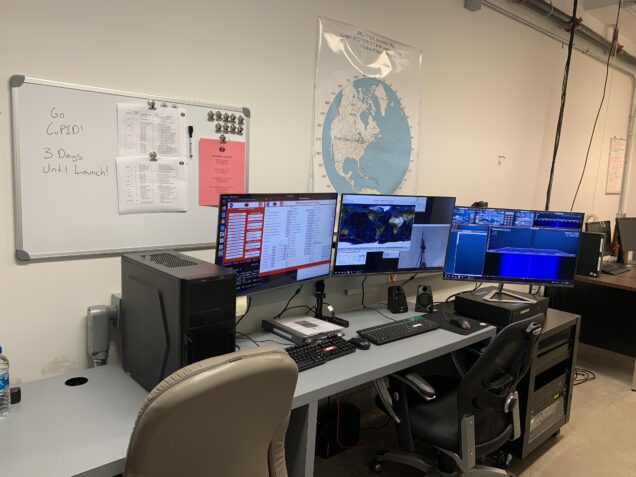
The CuPID team has gotten the ground station computers and accompanying software prepared for launch on Monday the 27th! After spending two days fighting with motors on the antenna, the ground station is fully functional and ready for PI Brian Walsh to establish contact as soon as we get orbit information!
Go CuPID!
Integration at Vandenberg Space Force Base! (E. Atz, Aug. 12, 2021)
Last week, CuPID was integrated into the flight deployer and ESPA ring at Vandenberg Space Force Base in Lompoc CA. The team hand carried CuPID over commercial airline to LA, and then via rental car to Lompoc. Integration went smoothly, there were no problems with cleanliness checks, travel, or the integration activity. CuPID now waits, inhibited, inside its deployer as the assembly is mated to Landsat-9 and mounted onto the rocket for launch!


Unfortunately, photos from the integration event are for not cleared for public release at this time.
CuPID Survives Vibe… Again! (E. Atz, Jul. 9, 2021)
Last week, requirements for the Cubesats riding on this launch changed unexpectedly. We were required to re-test the satellites to higher vibration levels to guarantee that our satellites will behave during launch, and will do no harm to the launch vehicle.
On Friday July 2nd, with incredible assistance from our co-workers at NASA, we performed a vibration test at Wallops Flight Facility. CuPID did phenomenally, and really proved itself on the vibe table that day!
Check out some of the cool stuff that came from that day of testing!
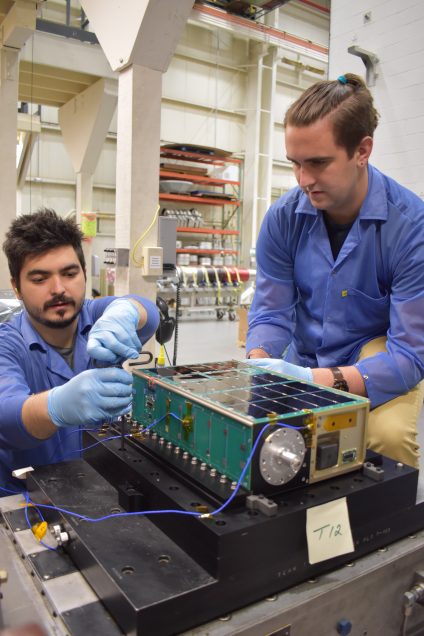
Video: CuPID tests the X-axis random vibe. We increase the power of the shake from -20dB to -9dB then -3dB and finally 0dB to observe if something would warrant the termination of the test. (0dB is the full power of the test). Listen to the sound of CuPID as it goes through the test! The video does not to the sound justice!
CuPID Survives Vibration Testing! (E. Atz, Apr. 6, 2021)
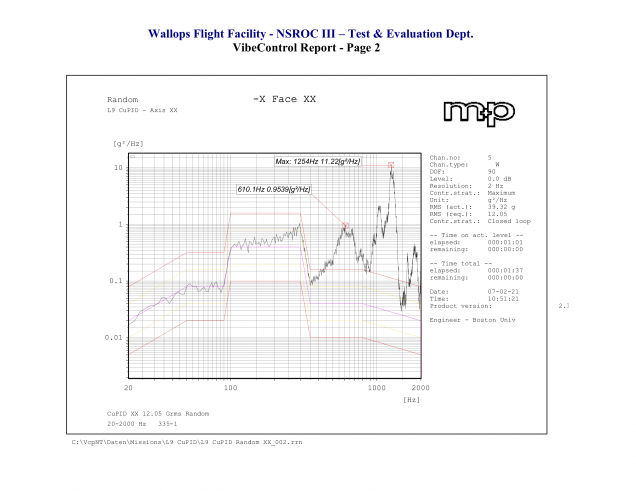
Last week, CuPID underwent vibration testing as part of its environmental test requirements from the launch provider. CuPID survived the extreme vibrations we gave it, and showed nominal operation after the test.

Accelerometers are mounted to the vibration plate to define the driving forces, as well as specific location on CuPID to characterize CuPID's response. CuPID was tested three times in each axis, a total of 9 vibration tests. The tests include a sine sweep, random vibe, and a second sine sweep.
- A sinusoidal frequency "sweep" is used to find CuPID's natural frequencies (Natural frequencies are where a system has a large response, such as when your car shakes at a specific speed on the highway, or when the washing machine vibrates excessively when the wet laundry is un-balanced inside.)
- A random vibration, lasting 1 minute, spanning frequencies from 20Hz to 2000Hz at various amplitudes, proves CuPID's robustness to extreme forcing.

Star Tracking in the Winter in Boston (R. Nutter, Jan. 13, 2021)
Like many spacecraft, CuPID uses a star tracker to identify its pointing or attitude. The star tracker uses a catalog of stars and compares with observations of measured star patterns to identify pointing at a given moment in time.
After a brief failed attempt at viewing through the light pollution from the top of the Photonics building on campus in the middle of Boston, we sought a new venue outside the city. The next stop was the dark backyard of a team member's home a few miles outside the city with a wide view of the sky.
Once we found a clear (but cold!) night the we packed up the spacecraft and test equipment then drove out to the new test site in Groveland, Mass.
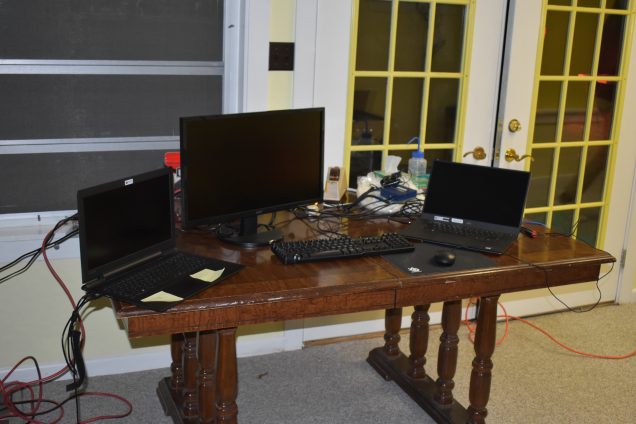
After setting up a living room test control room, the spacecraft was setup outside and CuPID was ready to go. A useful design feature of CuPID's custom transport case, is that the star tracker can view the sky without fully removing the spacecraft from the housing. As the sun dipped below the horizon and the stars came out shortly after 6pm, we began making measurements.
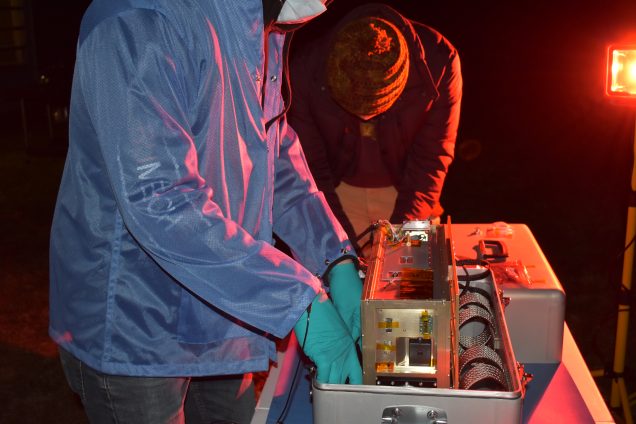
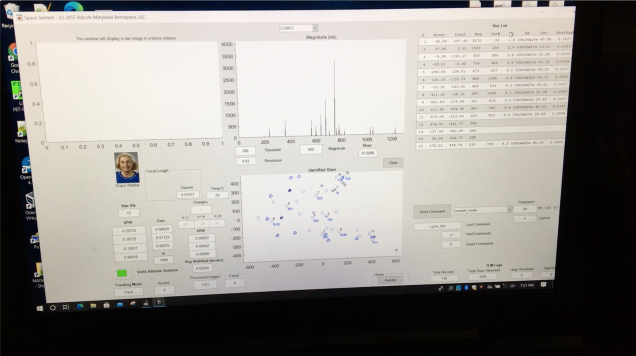
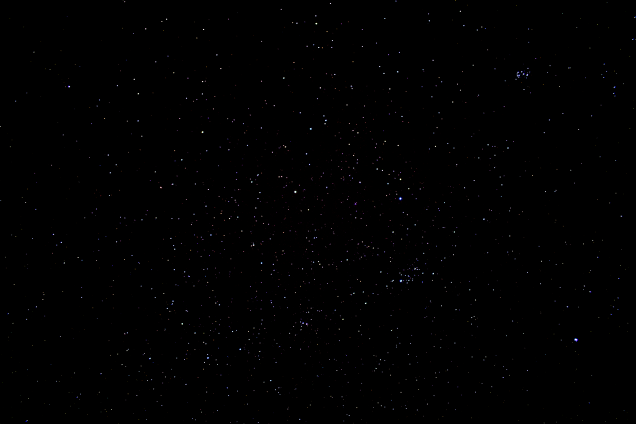
The goal for this initial test was to confirm CuPID could observe stars, track and reference with the star catalog, and provide a solution. With these components CuPID will be able to orient itself while in orbit. The test was a success!! CuPID both saw stars and provided pointing solutions through the flight computer rapidly as the spacecraft was articulated. The team continues to work through data collected in the testing to confirm the results. Also during the test we set up our DSLR camera to take a picture of one area of sky CuPID was pointed at. A beautiful night sky and evening for an experiment.
CuPID’s first time outside (R. Nutter, Jun. 2, 2020)
The past few weeks have been full of X-ray calibration testing. But this week we shifted to a test of CuPID’s ability to track GPS satellites. If successful, the ability to track GPS satellites will allow us to triangulate CuPID’s position at any given time. To best do this test we had to be outside with clear lines of sight. As this was CuPIDs first time outside and we are still in the midst of a pandemic, we spent a full day before the test preparing for transport of CuPID to the roof of the building and planning for safety measures needed to be maintained to keep all those involved safe and healthy.
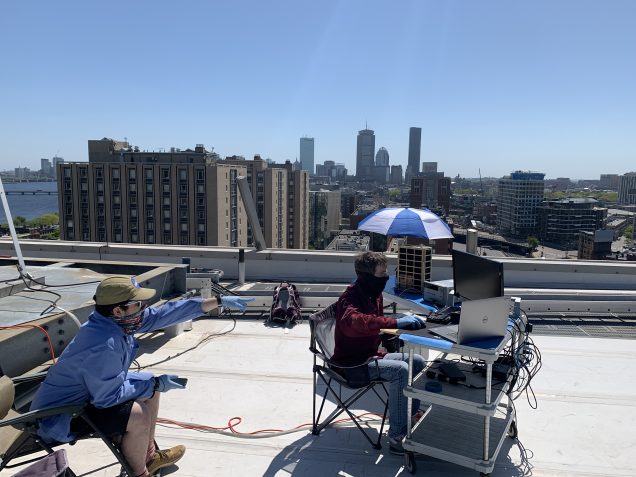
Once on the roof, and everything was set up, we began the test. Within seconds CuPID had recognized 6 GPS satellites! We let CuPID run for 10 minutes in a variety of variations and were holding a steading tracking of 9-10 satellites at any given time.
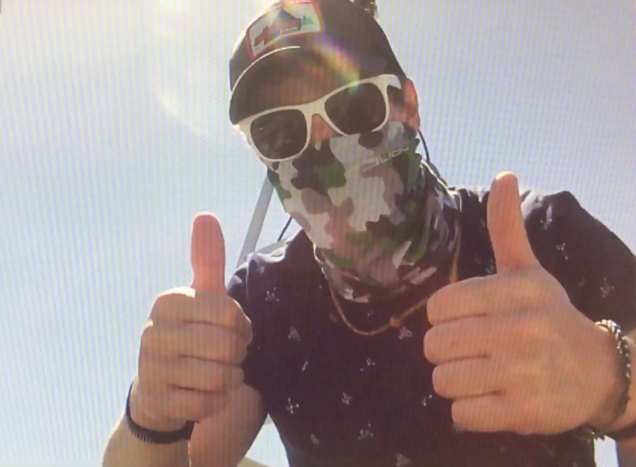
We concluded the test with great success and had some extra time to install a new camera pointed at our antenna array to be able to view the antenna without needing to access the roof. Emil was very excited to have a working camera again. After a successful day of testing, and some golden tans for all of us, CuPID was brought to the lab and put back in the vacuum chamber for further X-ray testing.
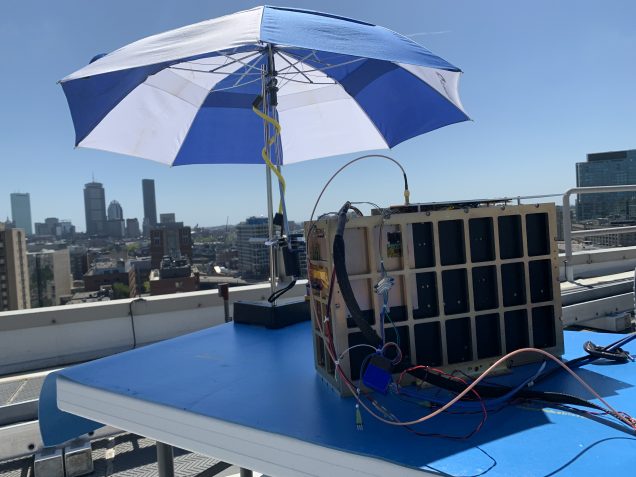
We are all very lucky and grateful to be able to be healthy and have the ability to continue to make progress during these trying times.
The testing must go on! (E. Atz, Apr. 26, 2020)
Individually, CuPID's structure and electrical components have been tested, but now integrated, we are requiring CuPID to go through many more tests to fully confident that CuPID will work as designed once in orbit. From just confirming functionality of all sub-systems to calibrating the instruments, CuPID has been spending a lot of time running.
Earlier this year, CuPID was at GSFC undergoing some X-ray calibration tests. A 2.5 meter long beam line was set up to calibrate the point spread function of the optic and detector.
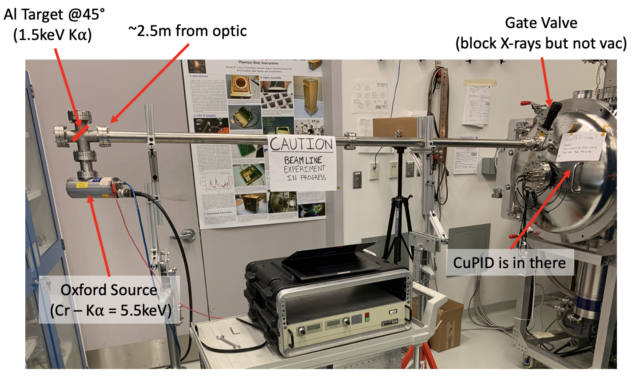
Then, just before the Covid-19 stay at home orders, CuPID was 'evacuated' out of the GSFC lab before a shutdown could have locked CuPID into long-term storage. CuPID and its drivers made a safe one day trip to the BU lab.
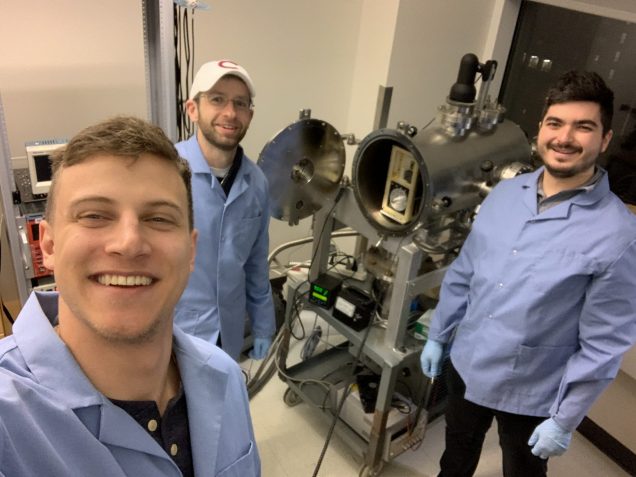
Under lab access restrictions, the BU team is allowed to continue to work on CuPID. CuPID is undergoing tests to calibrate the X-ray detector to a known image. These tests involve generating a known image, or mask to cover the Micro-Channel Plate (MCP) detector and processing the data to determine response and conversions from instrument results to physical measurements.
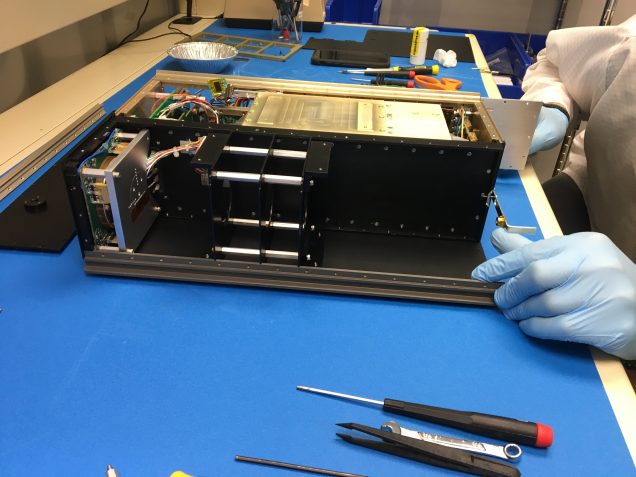
CuPID and the team working on it are safe and healthy during this unstable time.
Integration! (E. Atz, Feb. 17, 2020)
In the recent weeks, the CuPID chassis and avionics met for integration. This process involved mounting the avionics into the chassis and then wiring all the components together through the spacecraft. After many hours of work with screwdrivers, wire crimpers and lacing cord, we powered the spacecraft on. With much anticipation, everything checked out! Sun sensors, thermistors, and instruments (no high voltage yet, but soon) all powered on and operated nominally!
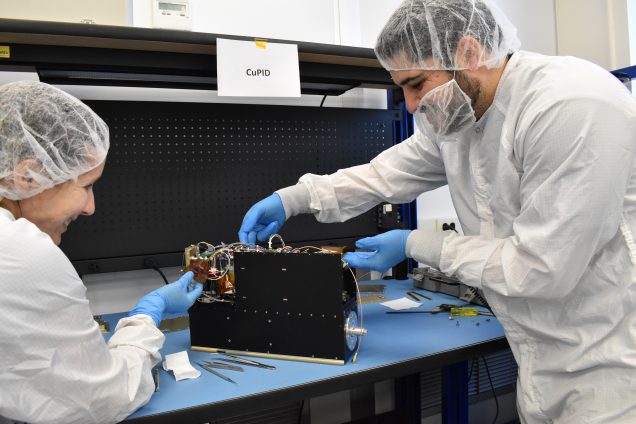
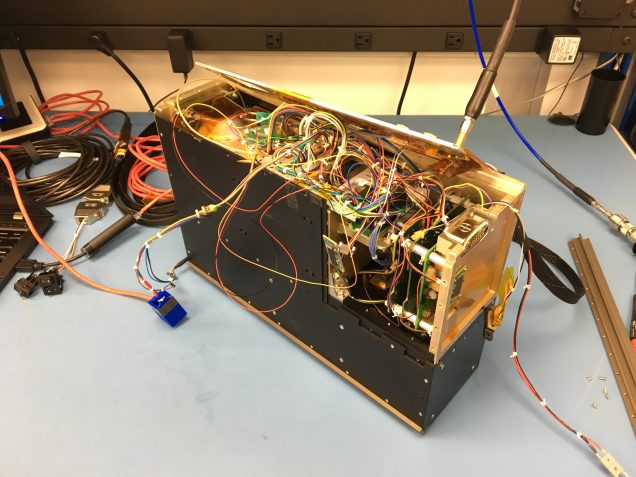
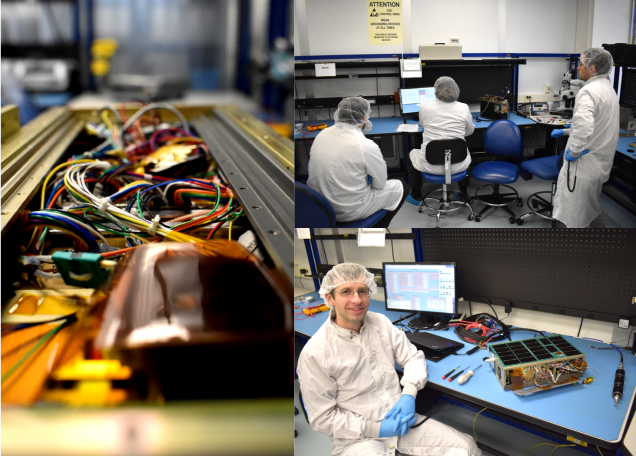
CuPID was transported from the clean room where integration took place, to the vacuum chamber in a building nearby. In this vacuum chamber, the CuPID X-ray telescope high voltage will be powered on under vacuum. A report on testing coming soon!
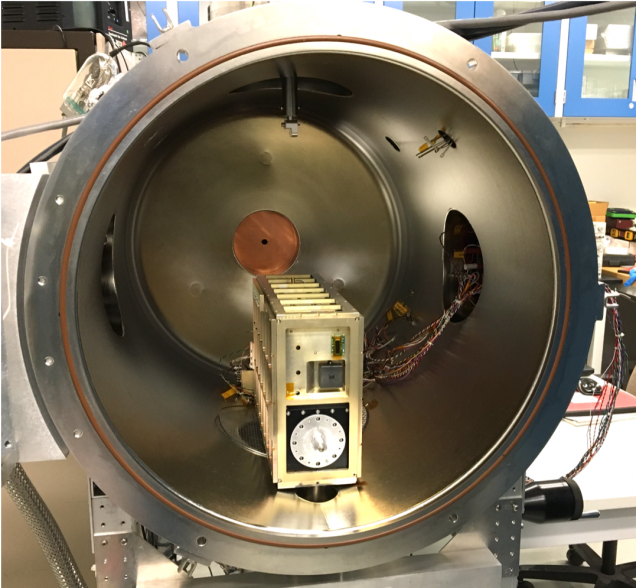
Let the marathon of spacecraft and instrument testing before launch begin!
Glasses for CuPID? (E. Atz, Oct. 15, 2019)
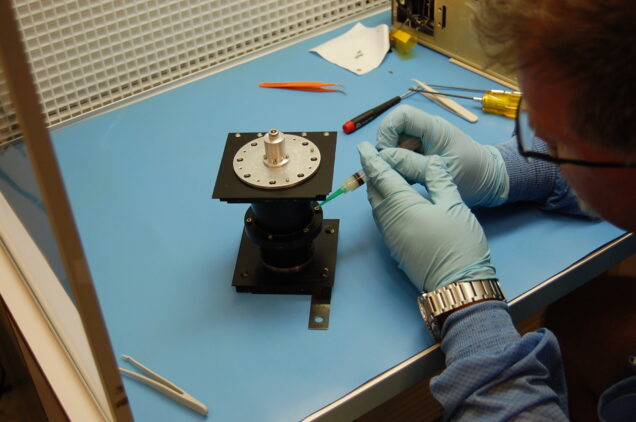
Optics in a telescope are just like glasses to improve someone's sight. In the case of visible light, the glass lens refracts the light to the desired pattern. With x-rays, the optics can only deflect the incoming light because the x-rays would pass right though! These optics, called slumped micro-pore optics, and are an array of lead-glass channels that are slumped over a spherical surface creating a grid of square channels that point radially outward from a sphere.
This type of optic is very delicate, so until now, assembly and testing of other flight components has been done without the optic. Though, recently it was installed into the CuPID Cubesat for the first time at Goddard Space Flight Center.
Below, Nick and Ken from GSFC assemble transfer the optic from its storage assembly to the flight chassis assembly. CuPID was given its glasses that day!

The Instruments Meet Each Other! (E. Atz, Aug. 30, 2019)
This week, Brian, Jef and I delivered the CuPID micro-dosimeter to Nick , Norm and Michael at Goddard Space Flight Center where the CuPID chassis and X-ray instrument currently reside. Until now, the instruments have been built and tested separately. After some individual testing that morning to document functionality, the instruments were integrated into the chassis and mounted inside a vacuum chamber.
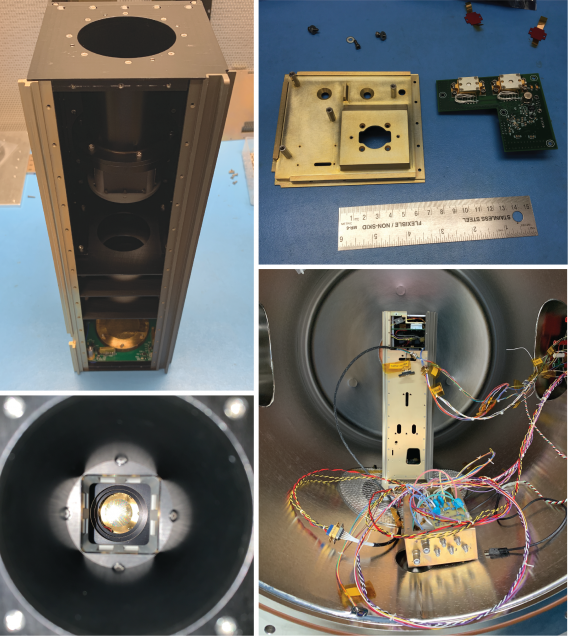
After being seated in the vacuum chamber, the instruments were powered on and data from each instrument were collected! The instruments both operated nominally and produced data to the spacecraft bus emulator which combined data into files that will one day be sent from orbit to ground!
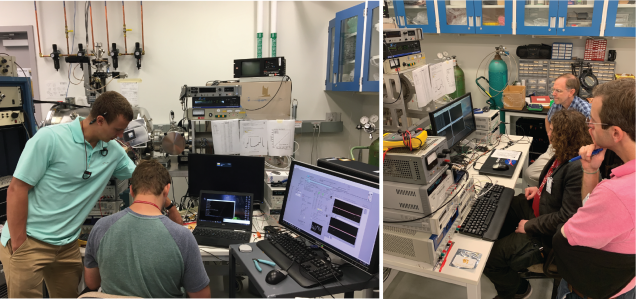
I like to joke that it was an instrument love story planned from the beginning and this was their first date! They behaved well!