Maria Giménez Cavallo

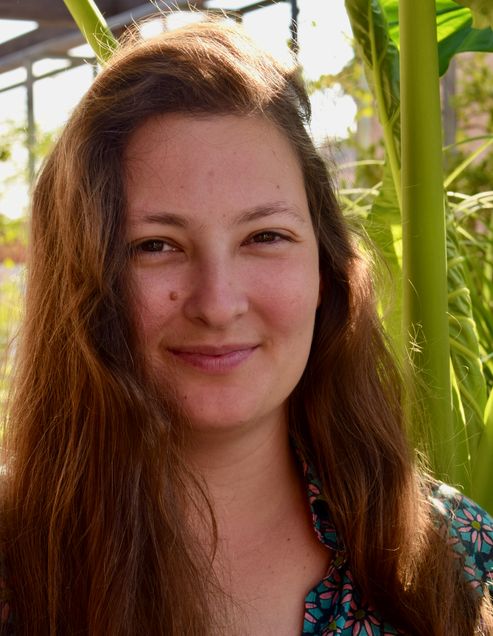


Maria Giménez Cavallo was born in New York in 1992 to an Italian-American mother and Spanish father. She got her B.A. from Columbia University in Film Studies, Italian Cultural Studies, and French Cultural Studies. After graduation, Maria moved to Paris to work with French-Tunisian director Abdellatif Kechiche as artistic collaborator, first assistant director, casting director, and editor for the Mektoub, My Love trilogy. She then moved to Rome to collaborate with Pietro Marcello, Alice Rohrwacher, and Francesco Munzi on set and in the editing room, for a documentary shot on 16mm throughout Italy: Futura, later followed Pietro back to Paris where she was artistic director on his French film L’Envol, and most recently accompanied him as assistant on Duse.
In 2020, Maria opened her own production company, Anima Films, with her mother, Renaissance and epic scholar Jo Ann Cavallo. Since then, she has made various short films with nature as the central theme, including La Visita (Locarno 2022), La Grande Quercia (Bellaria, FIFAM 2022), and Jeanne, petite bergère (Shortlist Quinzaine 2020). She has participated in various workshops, including Locarno Spring Academy, Armani Laboratorio, Itineranze Doc, and Milano Film Network In Progress. Her ethnographic hybrid fiction film Anime galleggianti, a reimagining of Ovid’s Metamorphoses filmed in Sardegna, had its premiere at the Alice nella città Festival in Rome 2024. In 2025, she participated in Venice’s Biennale College development program with her next feature film Bambino maialino.
In her work, she focuses on questions of humanity and animality, as well as breaking the boundaries between species. She searches for a poetic, transcendental, and post-humanist vision of the world through films that put the natural and animal realms in the foreground by way of a non-anthropocentric discourse. She gives as much agency to non-human characters as to human ones, so that animals, plants, and the elements can become protagonists in their own right. She believes that cinema should be transformative in that it can portray new points of view that then open new perspectives in the spectator. For her, cinema should not only portray a story per se, but make visible the invisible and reveal the spirit and essence through the idea of the soul.
Anime galleggianti
USA/ITALY Hybrid fiction, 71 mins
Synopsis: Anime galleggianti reinterprets the stories of the most intriguing characters of Ovid’s Metamorphoses, including Persephone, Arachne, Callisto, Europa, Daphne and Orpheus. The transformations of forms into new bodies are narrated by the Parca who cuts the thread of life, interpreted by the Ottana mask Sa Filonzana. These episodes are interwoven and tied together by the presence of the philosopher Pythagoras, who accompanies us on a journey from the origins of the world to the present day. The mythological tales are reinvented through Sardinian tradition and culture. An ethnographic hybrid experiment between reality and imagination, the film is also the result of a close collaboration with artisans, musicians and local inhabitants. The metamorphoses culminate in the carnival ritual, symbolized by the island’s archaic masks, neither human nor animal, but almost divine figures that visually transcend the boundaries of the natural world. Embracing a poetic, post-humanist and non-anthropocentric vision, the film places nature in the foreground. It aims to make the invisible visible, and reveal the eternal transmigration of souls.
Official website: https://animafilms.net/anime-galleggianti/