News
2019 Atmospheric Chemistry Gordon Research Conference
This week, Jeff is attending the Gordon Research Conference in Atmospheric Chemistry being held at the beautiful Grand Summit Hotel at Sunday River in Newry, Maine. He is presenting a poster called: "Biogenic ozone precursors in nonattainment regions of the US: Decreasing sensitivity to isoprene, increasing vulnerability to soil NOx".
TEMPO Science Team Meeting 2019
The TEMPO Science Team converged on Madison, Wisconsin this week for the annual Science Team Meeting. TEMPO is a geostationary satellite instrument dedicated to monitoring tropospheric pollution over North America from space every hour of the day. For updates on the TEMPO instrument, check out the website here. We anticipate to hear an announcement of a host for TEMPO this summer, and at that point should have an idea of when to expect lift-off!
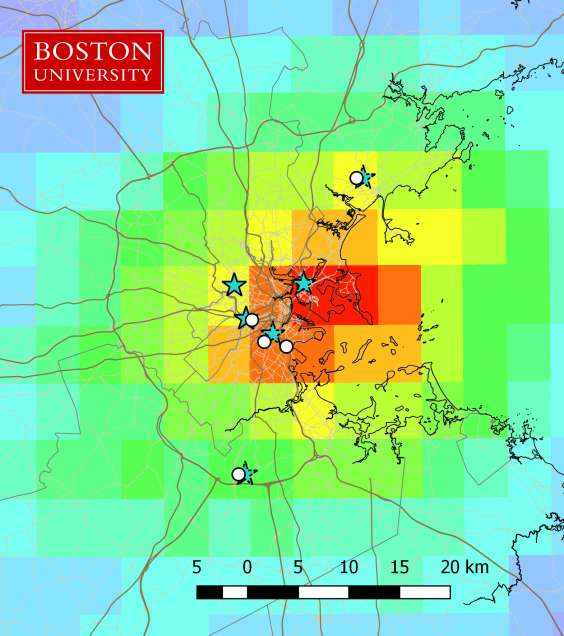
This year, Jeff was presenting his work on establishing an intra-urban network of ground-based remote sensing instruments in Boston for monitoring tropospheric trace gas column variability at the neighborhood-level. This work will help us link the latest satellite observations of atmospheric composition to air quality at the surface.
Congratulations Anthony!
We congratulate Ph.D. Candidate Anthony Wong for successfully passing his qualifying exam. The qualifying exam consists of a week of written questions, followed by an afternoon-long oral exam. Well done, Anthony!
International GEOS-Chem Meeting at Harvard
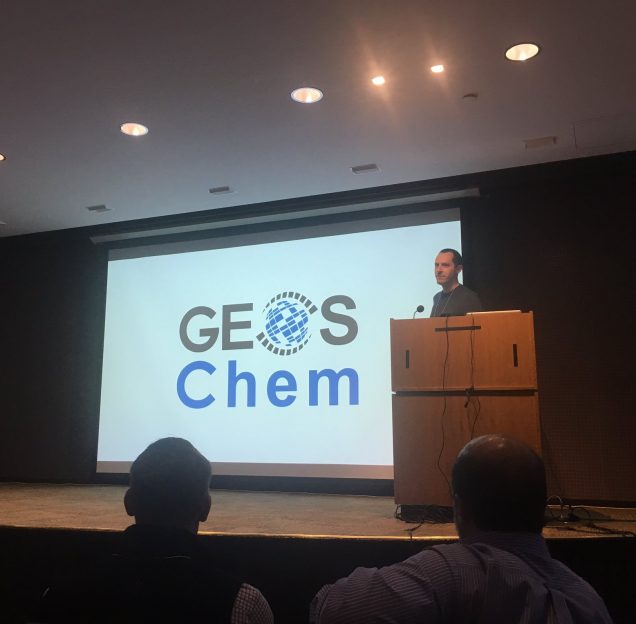 Last week was the 9th International GEOS-Chem Meeting at Harvard University. The meeting consists of rapid-fire presentations about model development and science, and break-out sessions to discuss priorities and future plans. The full program and webcast is available here.
You can jump to Anthony's presentation on improving dry deposition processes in the model here. (You can also see Jeff officially unveiling the new GEOS-Chem logo here!)
Past IGC presentations: Check out Jeff’s presentation at the 2017 meeting discussing long-term deposition of reactive nitrogen oxides here, and his presentation at the 2015 meting about the development of a new land cover module here.
Research Highlighted in Science Magazine
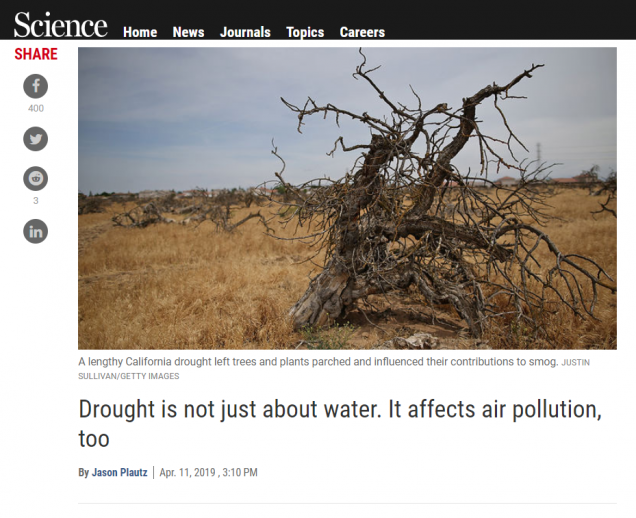 Research led by collaborators at the University of Virginia was recently highlighted in Science Magazine.
Jeff is a co-author on the original study, published in Environmental Science & Technology earlier this month, entitled "Observing Severe Drought Influences on Ozone Air Pollution in California". In this work, University of Virginia graduate student Angelique Demetillo and PI Sally Pusede describe their analysis that shows how the extended drought in California impacted surface ozone production by altering the natural emissions of biogenic hydrocarbons.
Talk at the BU Astronomical Society Meeting
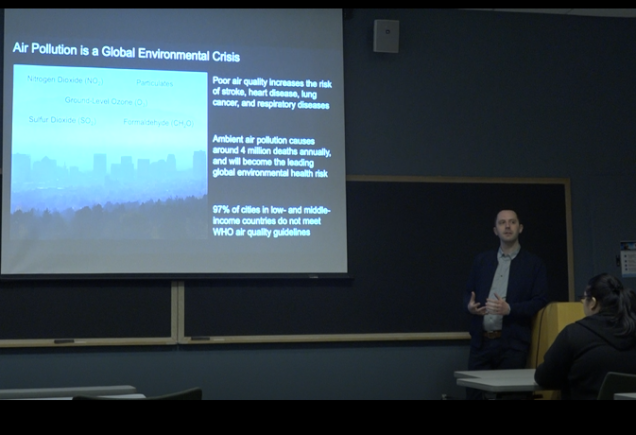
This weekend, Jeff spoke at the BU Astronomical Society's first annual weather balloon launch event. The afternoon consisted of talks from faculty and graduate students, as well as tours of the BU observatory, and scientific demonstrations, all organized by the BUAS students
WMO Expert Meeting on Global Total Atmospheric Deposition
 This week, Jeff is in Geneva participating in the latest Global Atmospheric Watch Expert Meeting on Measurement-Model Fusion for Global Total Atmospheric Deposition (MMF-GTAD) at the World Meteorological Organization in Geneva. The title of his talk is: "Update and Future Directions of Satellite/Remote Sensing Activities Related to MMF-GTAD".
Colloquium at the University of Washington
This week, Jeff is visiting the University of Washington to speak at their Department of Atmospheric Science colloquium about our group's research. The title of his talk is: "Checking Atmospheric Chemistry's Pulse: Modeling and Remote Sensing of Biosphere Interactions".
Geddes Group @ AGU
This week, two members of the Geddes group will be attending the Fall Meeting of the American Geophysical Union in Washington, DC.
Anthony will be presenting a poster called "Long-term Global Multi-physical Modelling of Ozone Dry Deposition Velocity - with Focus on Process Uncertainty and Implication on Air Quality Modelling" (see the abstract here).
Jeff will be presenting a talk called "Characterizing sea breeze effects on surface ozone concentrations in the Boston region, and implications for remote sensing of local air quality" (see the abstract here).
Follow along on social media using #AGU18!
Chemistry Seminar at BU
Today, Jeff will be giving the Department of Chemistry PChem Seminar in LSE 103 at 2pm. The title of his seminar is: "Keeping and Eye on the Atmosphere: Modeling and Remote Sensing of Atmospheric Chemistry". https://www.bu.edu/chemistry/seminars/p-chemseminars/