Julia Child Student Writing Award
The Gastronomy Department is proud to announce that Amy Phuong has been awarded this year’s Julia Child Student Writing Award. This award is given to matriculating MA students in Gastronomy and honors their outstanding academic work. Below is a Q&A with Amy on her award-winning work that uses food mapping— a technique that allows researchers to better make sense of their research through physical visualization.

How did you choose Lee’s Bakery as your research site?
Amy: Lee’s Bakery was not my original, intended research site. I found myself here after attending a book lecture by John T. Edge on his new memoir, The House of Smoke. In the conversation moderated by The Splendid Table’s host, Francis Lam, I became nostalgic for Edge’s memories of the global food options found along Buford Highway in Atlanta. Even then, I had planned to visit Northern China Eatery for my food observation visit. But when I typed the destination into GPS, I discovered it was closed. Rather than delay my observation visit, I decided to drive along Buford Highway, record my observations of the drive with a voice memo app, and see where the experience led me.
Buford Highway is home to various immigrant-owned restaurants and markets. For decades, it has served as a cultural bridge through food, where culinary traditions coexist along one of the city’s busiest thoroughfares. Buford Highway is a place I’ve visited a lot during my childhood. Growing up in Atlanta as the youngest of three children, I often tagged along with my parents during weekend shopping trips to Asian grocery stores and bakeries along the corridor. Those trips were less about food and shopping itself and more about being in a community, knowing where we belonged. In retrospect, choosing Lee’s Bakery wasn’t random at all. It reflected the pull of memory and familiarity that often shapes how we navigate food spaces.
In what ways did the food mapping process deepen or complicate your anthropological understanding of Lee’s Bakery?
Amy: Food mapping pushed me to think about space in a different way. During my initial ethnographic observations, I mostly analyzed interactions happening inside the restaurant. Mapping required me to zoom out and consider how Lee’s Bakery fits within a larger geography of daily life.
Drawing the memory map of Buford Highway made me realize how much of the corridor exists beyond restaurants. Auto repair shops, hair salons, tax offices, and convenience stores all operate alongside eateries. These places are rarely featured in glossy food destination narratives or articles about Buford Highway, but they are essential to the community that sustains those restaurants. The mapping process complicated my understanding because it showed that Lee’s Bakery is not just about Vietnamese cuisine. It represents a layered ecosystem of migration, adaptation, survival, and everyday coexistence.

What was the most challenging aspect of this project for you? How did you navigate it?
Amy: The most challenging part of the project was starting. I realized that this assignment wasn’t about creating a perfect map, it was about mapping the experience. Once I accepted that the maps could be interpretive rather than exact, the process became easier.
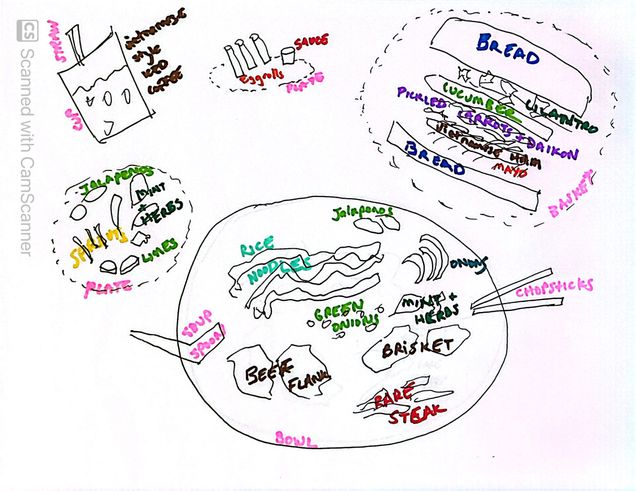
My favorite food map that I produced was of the Buford Highway corridor and of my plate map because it invoked many childhood memories.
How has completing this assignment contributed to your growth as a student and researcher?
Amy: This assignment challenged me to think beyond written observation and engage with visual methods of analysis.
As a student, I tend to approach research through writing detailed descriptions, analogies, and referenced citations. Food mapping forced me to interpret my observations spatially and visually. It also encouraged me to reflect more deeply on my own positionality—how my background and experiences shape what I notice and how I interpret it. I now see ethnography as not only as documentation but as a process of self-reflection and interpretation.
Why do you think food writing, especially ethnographic work, matters?
Amy: Food writing matters because food is one of the most accessible ways to understand culture and identity.
Ethnographic food writing goes beyond recipes or restaurant reviews. It examines the social relationships, histories, and emotions embedded as cultural texts in everyday meals and food practices. Through food, we can explore migration, adaptation, and belonging in ways that feel immediate and relatable.
Food ethnography also gives voice to ordinary spaces—small restaurants, markets, and community gathering places that might otherwise be overlooked.
Anything final thoughts you’d like to share or advice for other students?
Amy: From this project, I also learned that research doesn’t always begin with a carefully planned question. Sometimes, our best laid plans get sidetracked and by leaning into the journey and process of the work, I was able to produce one of my favorite projects so far through this Gastronomy program.
In my case, a closed restaurant led to a drive down Buford Highway, which led to Lee’s Bakery, and a deeper reflection about my memory and belonging.
In other words, just learn to go with the flow and you’ll surprise yourself!
This interview has been edited for length and clarity.