Institute-Funded Research Tackles Wildfire Smoke in Boston Schools
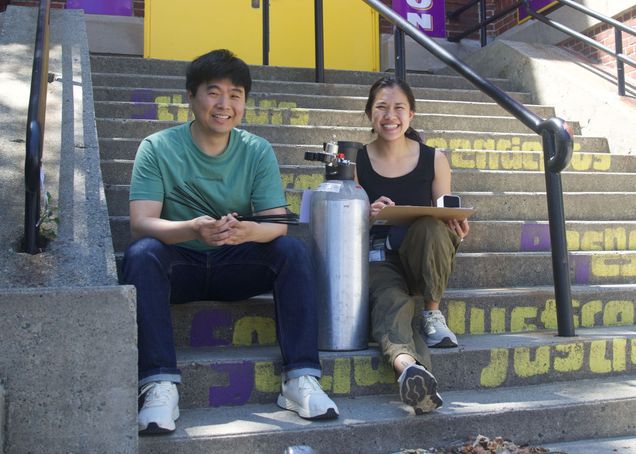
Dr. Pilar Botana Martínez and Patricia Fabian, ScD, Lead Co-Design Initiative to Empower Teachers
This summer, as wildfire smoke drifts into Boston, researchers at Boston University are conducting experiments to answer a critical question: How can schools protect students from severe outdoor air pollution?
The Institute for Early Childhood Well-Being is supporting this work through our pilot University-Community Partnership Research Award. Dr. Pilar Botana Martínez, Research Scientist in the Department of Environmental Health at Boston University School of Public Health, working with Patricia Fabian, ScD, Professor of Environmental Health at Boston University School of Public Health and Arunima Krishna, Associate Professor at the BU College of Communications, is leading the “Know it, Improve it” project, a co-design initiative centered on teacher voices.
Centering Teacher Knowledge
Building on four years of partnership between Boston University’s School of Public Health, Boston Public Schools, and the City of Boston, researchers identified a critical gap: teachers understand that air quality matters, but they lack clarity on what they can actually do in their classrooms.
Over the past weeks, Dr. Botana Martínez and Research Assistant Natascha Nussbaum interviewed approximately 15 teachers to understand their knowledge gaps, concerns, and practical barriers. In coming months, co-design workshops will bring teachers together to help craft educational materials grounded in classroom reality.
“If we provide accurate, actionable information to teachers, they will be willing to act on it to improve their classrooms. That’s why we need teachers’ perspectives,” says Dr. Botana Martínez.
Real-World Testing Underway
This summer, researchers are conducting controlled experiments at Boston Public Schools locations to test the effectiveness of air purifiers, ventilation systems, and closed windows. The team is also tracking actual air purifier usage patterns to measure the impact of future educational campaigns.
The broader research team is implementing a comprehensive approach: developing real-time pollution detection, co-designing teacher communications, testing interventions, and translating findings into school policy.
Why It Matters
“School time is such an important period for children,” reflects Dr. Botana Martínez. “If we count all the hours students spend inside schools, it could add up to four years of their lives. If the classroom environment is poor, their learning and health will be impacted during a very vulnerable period.”
Preliminary findings will inform Boston Public Schools’ air pollution response plan by spring 2027, providing a roadmap for school districts across the country facing similar challenges.
Learn more: Read the full research story
