Home
Gun control laws in the United States
What was so interesting for me this semester was chapter 10 in Bartol & Bartol (2016) that focused on Multiple Murder, School and Workplace Violence. Learning and speaking about public mass shootings and, in particular, school shootings is what stuck out to me the most this semester. According to the Washington Post, by February 15 of this year, there had already been seven school shootings in the United States. That makes for one school shooting per week, which is more than some countries have ever had.
Despite these high numbers, mass shootings actually make up a small percentage of overall deaths by firearm. “Over three recent decades (1983 to 2012), there have been approximately 78 public mass shootings in the United States, resulting in 547 deaths (not including the shooters)” (Bjelopera, Bagalman, Caldwell, Finlea, & McCallion 2013). Even if we add the more recent deaths not counted in those figures (e.g., Newtown and Aurora), the numbers do not approach 1,000 over three decades. While shocking, frightening, and tragic, public mass shootings account for a very small portion of the murders in any given year. In the year 2013 alone, for example, firearms were used to murder 8,454 persons (Federal Bureau of Investigation, 2014a, p. 306)
It is obvious that something needs to be done regarding gun violence and mass shootings, especially shootings that occur on school grounds, have brought it to the attention of the public. We need change in the United States in regard to stricter gun laws and more extensive background checks. With this being said, there should be certain rules regarding firearm ownership for individuals with mental illness as well as those who live in the household with them. A perfect example of this would be the Sandy Hook Elementary school shooting. Although the mother of the shooter, Nancy Lanza, owned her firearms legally, in my opinion, she should have not of held the firearms kept at home. Unfortunately, this mistake cost her life along with 20 innocent children and six adult staff members.
One major issue regarding to mass shootings in school is due to the easy availability of firearms. Erickson (2018) wrote: “Americans have a disproportionate number of guns at least 300 million, about one per person, especially handguns and semiautomatic weapons. A bullet from an AR-15 rifle, which the alleged shooter used in the Florida attack Wednesday, can penetrate a steel helmet from five hundred yards. As the New Yorker put it: when fired from a close range at civilians who aren’t wearing body armor, the bullets from an AR-15 don’t merely penetrate the human body – they tear it apart. It ‘looks like a grenade went off in there,’ Peter Rheem a trauma surgeon at the University of Arizona, told Wired.” With this being said, in my opinion, high powered AR-15 rifles should only be accessed by law enforcement or the military. Being able to willingly purchase an AR-15 is something that I find preposterous. It is clear that not only is school violence an issue that is unique to the United States, but the United States is also the only country that has an overall dilemma with firearm-related deaths. We as Americans are failing as a country, and our future unfortunately suffers.
With mass shootings happening at an alarming rate, we as a country must do something about it, rather than becoming so numb to it. One country that we can learn from is from Australia. On April 28, 1996, a 28-year-old Australian identified as Martin Bryant shot up a local tourist location using a semiautomatic rifle. The results of the shooting left 35 people deceased and 23 wounded resulting in the worst mass shooting in Australian history. After the shooting took place, the ruling center-right Liberal Party came together with groups across the political board to work together on legislation with the objective of ending easy access to guns. Calamur (2017) wrote: “Australian government banned automatic and semiautomatic firearms, adopted new licensing requirements, established a national firearms registry, and instituted a 28-day waiting period for gun purchases. It also destroyed more than 600,000 civilian-owned firearms, in a scheme that cost half a billion dollars and was funded by raising taxes.” The entire process took months to complete. The findings after the Australian government took action indicate that stricter guns laws do in fact work. Calamur (2017) shares the definition of a mass shooting in Australia is any incidents in which a gunman killed five or more people other than himself. This is a notably a higher casualty count than is generally applied for tallying mass shootings in the U.S. Mass shootings dropped from 13 in the 18-year period before 1996 to zero after the Port Author massacre (Calamur 2017). Between 1995 and 2006, gun related homicides and suicides in the country dropped by 59 percent and 65 percent, respectively, though these declines appear to have since leveled off.” It seems reasonable to aim to implement similar regulations in the United States, however the United States has more people, more guns per capita, and, the second amendment, which complicates the process.
Bartol, C. and Bartol, A. (2017). Criminal behavior: A psychological approach (Eleventh Edition). Upper Boston: Pearson.
Calamur, K. (2017, October 2). Australia’s lessons on gun control. The Atlantic. Retrieved from: https://www.theatlantic.com/international/archive/2017/10/australia-gun- control/541710/
Erickson, A. (2018, February 15). The one number that shows America’s problem with school shootings is unique. The Washington Post. Retrieved from: https://www.washingtonpost.com/news/worldviews/wp/2018/02/15/the-one- number-that-shows-americas-problem-with-school-shootings-is- unique/?noredirect=on&utm_term=.065d444660f4.
Does Justice Always Prevail?
In the recently political climate that has been brought about by the election of President Trump into office, many different facets of the justice system are being questioned. Along with these questions about how our system is functioning, questions have arisen regarding the morals and ethics of our current population. There has been recent uproar over the sentencing of Cyntoia Brown. At 16 years old, Cyntoia killed the man that solicited her for sex and who was known for being dangerous. For her actions, she was sentenced to at least 51 years in prison before even being eligible for release. This sentencing occurred over a decade ago and is just getting the attention that it deserves. Cyntoia’s situation recently gained the attention of several high profile celebrities, including Rihanna, whose Instagram post regarding her views on this topic is shown below (CNN, 2018).
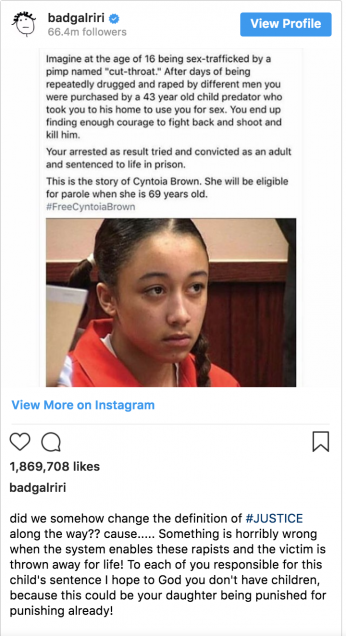
CNN, 2018
According to an article that CNN posted earlier this month, Brown was tried as an adult and was sentenced as such because they argued that she didn’t need to kill him out of self-defense and instead her intention was to rob him. However, this man had taken her to his house for sex, making this non-consented and essentially a premeditated rape. It would seem that in this situation, even her juvenile status did not earn her a reduced sentence. The outrage over her sentencing is exacerbated when it is coupled with all the articles about rapists getting away with not much of a sentence to serve.
Many have heard about the case against Brock Turner, who was a "former Stanford University swimmer who was sentenced to six months in jail in 2016 for sexually assaulting an unconscious woman” (Hauser, 2018). Many believed that his sentence was too lenient for the crime he was committing. Social media increased public awareness of this incident, further increasing public anger and disbelief. Most of what social media emphasized was the fact that Brock Turner did not look like what a typical rapist is usually assumed to look like, thereby earning him a more lenient sentence. However, in the case of Cyntoia Brown, her use of self-defense in which she murdered the man who was going to rape her earned her 51 years in prison. However, the man who could’ve committed the rape gets away with only six months in jail. The comparison between these two cases bring to light the difference in how justice is served, when one crime out of self-defense is penalized at a much greater or harsher rate than a more morally incorrect crime of rape.
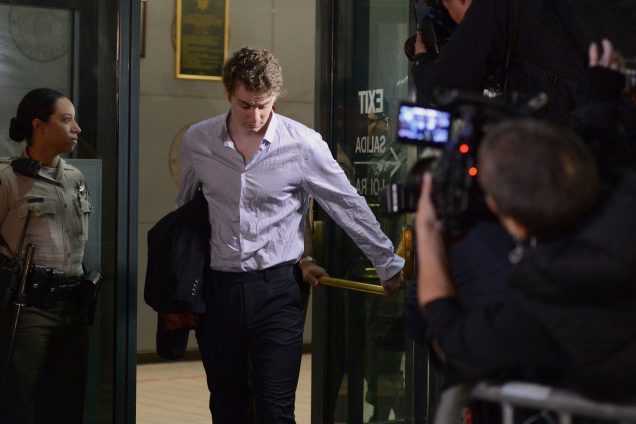
Dan Honda/Bay Area News Group, via Associated Press
Putting these two cases side to side really makes it seem as though justice is not being served adequately in our society. One would assume that a person who tried to commit rape would be penalized greater than a person who tried to act in self-defense. This also makes us question what type of image is being given to others. Rape victims will believe they will be ostracized if they come out to the public, and people in abusive relationships will fear to take action to remove themselves from the situation. If this is the message being given out, is justice really prevailing?
References:
CNN. (2018, December 09). Court: Cyntoia Brown must serve at least 51 yrs. Retrieved from https://www.nbc26.com/news/national/cyntoia-brown-life-sentence-decision-tennessee-supreme-court
Hauser, C. (2018, August 09). Brock Turner Loses Appeal to Overturn Sexual Assault Conviction. Retrieved from https://www.nytimes.com/2018/08/09/us/brock-turner-appeal.html
#ThisIsNotConsent
We encourage a lot of people to speak up and to report sexual violence but what happens if they do? We constantly hear about victim blaming but how ugly does it get? Most of us have heard about the #MeToo movement but how did this movement inspire others globally?
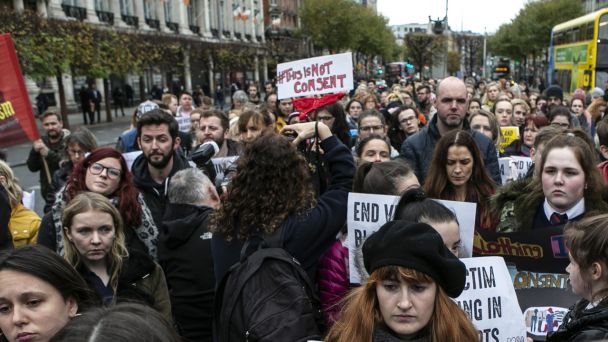
The #MeToo movement has inspired and empowered women of all ages to speak up against sexual violence globally. #ThisIsNotConsent movement was established in Ireland due to the admission of a victim’s underwear as evidence by the defense in a court trial regarding a rape case. The defense attorney argued that wearing nice underwear was consent and that the teenage girl shouldn’t have worn it in the first place (Norton, 2018). Further arguing, “You have to look at the way she was dressed. She was wearing a thong with a lace front” (George, 2018). The defendant was found not guilty of raping the 17-year old girl (Mezzofiore, 2018). This sparked multiple protests in Ireland and started the social media hash tag #ThisIsNotConsent.An Irish parliament member, Ruth Coppinger, held up underwear at one of the parliament house meetings to highlight the mistreatment of rape victims during trials and argued for a better legal approach to sexual violence (George, 2018). She further argued towards a male dominated assembly stating, “It might seem embarrassing to show a pair of thongs here in this incongruous setting, but… how do you think a rape victim or a woman feels at the incongruous setting of her underwear being shown in a court” (Norton, 2018). She further stated that the Rape Crisis Network Ireland statistics indicated, “only 10 percent of rapes are reported and just one in 40 gets an adequate conviction” (Norton, 2018). The low number of sexual violence allegations shows that many victims are hesitant to report such violence.
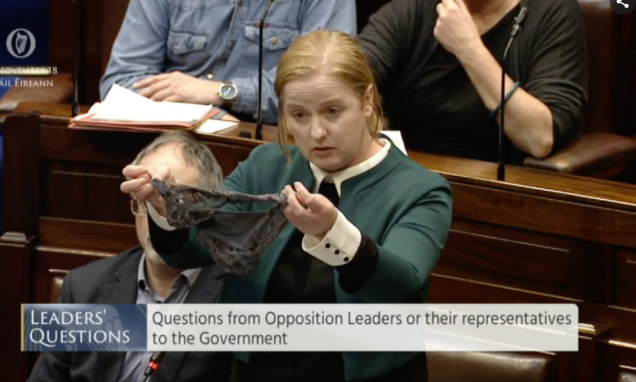
This demonstrates how victim blaming is a global issue, where if one had the courage to come forward, they might have to face such cruel condemnation. With such mistreatment of rape victims, it discourages many rape victims coming forward. Especially when showing off a victim’s personal garment by the defense legal team as evidence or a defense tactic against the victim in court. This truly affects whether or not a victim comes forward because they don’t or won’t be able to face such criticism or humiliation. This would also add emotional distress to the victims and re-traumatizes them. The problem here is the stigmatization the society has placed regarding this issue. Consequently, this can cause trauma to go untreated, causing it to develop into something more serious like seeking violence. Especially, when one feels hopeless with the world stacked against them.
Studies have shown that a direct correlation exists between trauma and violence (Saar, Epstein, Rosenthal, & Vafa, 2015). Where girls fall into the juvenile system rabbit hole, starting with smaller offenses and getting dragged into more serious offenses. I think this is due to the fact that the cause of the problem is not being addressed appropriately. Treating the trauma the girls have experienced and removing them from such toxic environment can improve this, showing them that there is hope or a way out.
The #MeToo movement has been very influential and has provided a platform for survivors. It encouraged many survivors to recognize the trauma they have experienced and also seek help to treat or heal from such trauma. This shows how important awareness is and how it can actually have a great impact on intervention. It is important for us to encourage victims to seek resources. It is our responsibility as a society to change.
Sources:
Saar, M., Epstein, R., Rosenthal, L., & Vafa, Y. (2015). The Sexual Abuse to Prison Pipeline: The Girls' Story. Washington, D.C.: George Town Law Center on Poverty and Inequality.
Mezzofiore, G. (2018, November 15). Use of underwear in Irish rape trial sparks outrage. Retrieved from https://www.cnn.com/2018/11/14/europe/ireland-underwear-rape-acquittal-scli-intl/index.html
Norton, S. (2018, November 19). 'This is not consent': How a thong prompted protests across Ireland over the handling of rape trials. Retrieved from https://inews.co.uk/news/long-reads/this-is-not-consent-thong-rape-case-ireland-protests/
George, K. (2018, November 21). Why Irish Women Are Showing Off Their Underwear To Denounce Victim-Blaming. Retrieved from https://www.bustle.com/p/irish-womens-this-is-not-consent-tweets-protest-the-shocking-way-this-rape-trial-was-decided-13147976
Self-Determination Theory
When selfceare is discussed often times we immediately correlate it to a persons physical wellbeing. People are affected by many lifestyle factors such as substance use, diet, and physical activity. These factors are ultimately controlled by a persons behavior. Any care outside of a hospital consist of being prescribed medications, self examinations, or refraining from a specific activity/habit. In my opinion the greatest problem with these implications is failure. The majority of individuals stick to a plan for a short amount of time before reverting to old habits. Lets be realistic here, habits are a life time in the making and are hard to break. Successful people remain self motivated by setting a goal and accomplishing it.
How do we revert our natural tendencies into positive healthy habits? Self-Determination Theory created by Edward L. Deci and Richard M. Ryan focuses on motivation and personality. Self-Determination Theory (SDT) is a theory of human motivation stating that individuals have innate tendencies towards personal growth and vitality that are either satisfied or thwarted by there immediate environment (Maraya, 2014). It is the ability for someone to take charge of their life and choices. Self-determination theory is comprised of two other sub theories including Cognitive Evaluation Theory and Organismic Integration Theory. Cognitive Evaluation Theory states we have a need to be good at something (competence), have control of our actions (autonomy) and are connected by positive relationships (relatedness). (Jones, 2014) Organismic Integration Theory states people just go through the motions (amotivation), motivation is simply to complete an external demand (external regulation), and motivation is enjoyable (intrinsic regulation). (Jones, 2014)
A strong goal oriented person sets their mind to what they want to achieve. I can't speak for most but for myself, I am happiest when I accomplish my goals. Self-determination is a vital component to our everyday lives including mine. We use it in the work place to feel more engaged and motivated, athletes use it to perform better and in personal relationships to provide support to one another. I have become successful in being realistic about my goals, owning my small accomplishments and mishaps, holding myself accountable, and taking pride in my small accomplishments. How can we help others become self dependent? Parents can encourage children to: self-awareness or self knowledge, goal setting, problem solving skills, decision building skills, ability to self advancement, and create goals and action plans. Teachers should nurture students interest, communicate using informal messages, explain the importance of different task, understand the students strength and weaknesses, provide positive feedback, and acknowledge students feelings. (Maraya, 2014). Self-determination theory provides positivity to heath, behavior, and well-being. Engaging in intervention methods for changing our life style improves longevity in each individual.
Home. (n.d.). Retrieved December 14, 2018, from http://selfdeterminationtheory.org/
Jones, B. D. (2014, January 06). Self-Determination Theory v1. Retrieved December 14, 2018, from https://www.youtube.com/watch?reload=9&v=v84XxJkqvbU
Maraya, J. (2014, August 24). Self determination theory. Retrieved December 14, 2018, from https://www.slideshare.net/jrmaraya/self-determination-theory
The Complexity of the Psychopathic Mind
The psychopath holds a special place in our society because of our fascination with the dark side of humanity. We are attracted by physical appearance that it trumps everything else about the individual and we evaluate this person by how he or she looks, dresses and talks.They are charming, which makes them easily misjudged or simply misunderstood instead of being considered dangerous. Psychopaths use their winning smile and captivating body language to play into our emotions, that make us weak and vulnerable, deceiving us from their true intentions.
These people are not your typical “psychopath” that conjures up images of famous serial killers or murderers. On the surface they can appear to be genuine and personable but just below the surface they are deceitful and manipulative. What makes them so captivating says, Dr. Raine, Professor of Criminology at the University of Pennsylvania, is, “their larger than life characteristics, they are charming, fun to talk to and they are the life of the party.” (Mallard 2018) Their charismatic behavior and hand gestures often distracts the listener from identifying their psychopathic nature says Dr. Woodworth. They have the ability to “perform convincingly in one – on – one setting which are all qualities that can help one get ahead” and into positions of power. (Forbes 2013) Robert Hare, Paul Babiak and Craig Neumann conducting a study on those who worked in corporate companies and found that 3% scored in the psychopathy range. This was disturbing to them as it is “well – above the incidence of 1% in the general population” but these results show; psychopathic behaviors are valued and at times commended. (The Conversation 2018)
The media has re – established the image of a psychopath by portraying them as the anti – hero. The “Hollywood psychopath” is someone with anti-social personality disorder or psychotic features and possess overdramatized traits that are common among psychopaths. (Perry 2014) Due to the lack of a diagnostic tool or a presence in the DSM V, it has led to the inaccurate media image of a psychopath. The psychopath on the big screens is seen as someone with high intelligence, charming, sophisticating and able to deceive the authorities by staying one step ahead. They are criminal masterminds who use their good looks to evoke empathy while lacking any themselves.
While the media does exaggerate psychopathic traits there is some truth in their behaviors. In terms of a successful psychopath, “we see a strong parallelism between what happens in our society and what happens in film.” (Perry 2014) While the prevalence of psychopathy in prisons is high but the majority of psychopaths are not criminals. The perception that psychotic and psychopathic are one in the same, simply is not accurate. They are not mentally ill rather masters at deception by appearing normal. They are not psychotic and have not lost touch with reality, they quickly weigh the risks and benefits but focusing mainly on the reward. They don’t feel emotion, they do what other people say is associated with a particular emotion and mimic those expressions, acting as if they do.
The psychopathic criminal makes up between 15 and 25 percent of the prison population. There is an alluring attraction in understanding how psychopaths think as our insight into neuroscience progresses. What makes psychopaths so dangerous is their ability to deceive the professionals whose jobs involve regular interactions with psychopaths. Their charm and deception have led to the misidentification by mental health professionals or their ability to coerce the criminal justice system. Psychopaths are very adept at imitating emotions such as remorse or guilt in the courtroom, the illusion of sincerity. As psychopathic behaviors continue to present themselves across our legal system will a neuroscientific defense become “my brain made me do it.” (New Atlas 2017) It has become evident that there are a variety of neurological mechanisms that affect thought process which influence our decisions. Research into the traits and neurology of psychopathology, brings us closer to explaining why they behave the way that they do and it has also given us insight into why we all do what we do.
Work Cited:
Haridy, R. (2017, July 07). Inside the brains of psychopaths. Retrieved from https://newatlas.com/psychopath-brain-mri-study/50365/
Lipman, V. (2018, December 03). The Disturbing Link Between Psychopathy And Leadership. Retrieved from https://www.forbes.com/sites/victorlipman/2013/04/25/the-disturbing-link-between-psychopathy-and-leadership/#687009974104
Lilienfeld, S. O., & Watts, A. (2018, September 19). Not all psychopaths are criminals – some psychopathic traits are actually linked to success. Retrieved from https://theconversation.com/not-all-psychopaths-are-criminals-some-psychopathic-traits-are-actually-linked-to-success-51282
Miller, A. (2014, February). The Criminal Mind. Retrieved from https://www.apa.org/monitor/2014/02/criminal-mind.aspx
Perry, S. (2014, January 17). Why psychopathic film villains are rarely realistic - and why it matters. Retrieved from https://www.minnpost.com/second-opinion/2014/01/why-psychopathic-film-villains-are-rarely-realistic-and-why-it-matters/
Woodworth, M. (2012, July 01). The Language of Psychopaths: New Findings and Implications for Law Enforcement. Retrieved from https://leb.fbi.gov/articles/featured-articles/the-language-of-psychopaths-new-findings-and-implications-for-law-enforcement
Solitary Confinement: A Sentence Within a Sentence
The UN Special Rapporteur on Torture has denounced the use of solitary confinement beyond fifteen days as a form of cruel and degrading treatment that rises to the level of torture, yet it is not uncommon for individuals to endure long-term isolation with no relief (Casella et al., 2018, p. 1). In 2016, William Blake entered into his twenty-ninth year of solitary confinement at the Special Housing Unit (SHU) at New York’s Great Meadow Correctional Facility (Casella et al., 2018, p. 26). Narrowly escaping the death penalty, despite the sentencing judge wanting to “pump six bucks’ worth of electricity into [Blake’s] body,” Blake reflected, “When the prison gate slammed behind me, on that very day I would begin suffering a punishment I am convinced beyond all doubt is far worse than any death sentence could possibly have been […] I cannot fathom how dying any death could be harder or more terrible than living through all that I have been forced to endure for the past quarter century” (Casella et al., 2018, p. 26-27). Similarly, Jesse Wilson, serving a life sentence at ADX Florence, described his experience in the government’s only remaining supermax as a “clean version of hell” (Casella et al., 2018, p. 81). Imploring that his humanity remain intact, Wilson wrote of himself: “Past these tattoos and this penitentiary pain, I remain, a son, a brother, a friend, and a human being. It sometimes feels that is forgotten” (Casella et al., 2018, p. 81). In addressing the inhumanity of solitary confinement, Wilson continued:
I refuse to embrace the solitude. This is not normal. I’m not a monster and do not deserve to live in a concrete box. I am a man who has made mistakes, true. But I do not deserve to spend the rest of my life locked in a cage– what purpose does that serve? Why even waste the money to feed me? If I’m a monster who must live alone in a cage, why not just kill me (Casella et al., 2018, p. 82)?
The adverse effects of solitary confinement appear to be related primarily to the length and conditions of imprisonment. Although it has not been conclusively established that short periods of isolation produce negative outcomes for the emotional well-being of inmates, long-term solitary confinement does, especially in relation to the psychological adjustment of prisoners (Arrigo & Bullock, 2008, p. 627). Serving as an expert witness for the plaintiff convicts in a class-action suit challenging the conditions of confinement in the SHU at Pelican Bay State Prison in California (Madrid v. Gomez, 1995), psychologist Craig Haney (2006) noted that the rigid conditions of solitary confinement and the absence of socialization encourages inmates to become “highly malleable, unnaturally sensitive, and vulnerable to the influence of those who control the environment around them” (p. 5). Ironically, long-term social isolation often leads to social withdrawal– individuals move from craving social contact to fearing it (628). Furthermore, prisoners housed under conditions of confinement grow to rely on the prison structure to limit and control their behavior. Consequentially, convicts are no longer able to manage their conduct when returned to the general prison population or when released back into the community (628).
It has been well documented that prisoners in long-term solitary confinement are at increased risk for developing symptoms of mental illness (Grassian, 1983; Haney, 2006). Specifically, social isolation is correlated with clinical depression and long-term impulse-control disorders (Arrigo & Bullock, 2008, p. 628). It has been amply demonstrated that the conditions of solitary confinement can produce symptoms of mental illness even in healthy prisoners. Convicts with preexisting mental illness are, however, especially susceptible to suffering damaging consequences from long periods of isolation, such as the development of psychiatric symptoms (632). In 1997, the Human Rights Watch estimated that five percent of the general prison population experienced some form of psychiatric illness, whereas more than half of the prisoners in segregation units suffered from psychiatric illnesses (Human Rights Watch, 1997). Psychosis, suicidal behavior, and self-mutilation are commonly seen among prisoners in long-term solitary confinement (Haney, 2006; 628). Considering this, it must be noted that suicide continues to be a leading cause of death in correctional facilities across the United States (Hayes, 2011, p. 1). In 2006, the National Center on Institutions and Alternatives (NCIA) entered into a cooperative agreement with the United States’ Justice Department’s National Institute of Corrections to conduct a national study on penitentiary suicides that would determine the extent of inmate suicides (Hayes, 2011, p. 1). The data indicated that the suicide rate in detention facilities during 2006 was thirty-eight deaths per one-hundred-thousand inmates, a rate approximately three times greater than that of the general population (Hayes, 2011, p. 3). One 2004 Austrian case control study, in an attempt to identify characteristics that distinguish prisoners who commit suicide from other prisoners, found five specific factors: (1) a history of attempted suicide or suicidal communications; (2) psychiatric diagnosis; (3) psychotropic medication prescribed during imprisonment; (4) a highly violent index offense; and (5) single-cell accommodation (Fruehwald et al., 2004) (note: it is unclear if these same factors are cross-culturally transferable).
With the complete isolation and austere conditions of solitary confinement having been shown to induce psychiatric symptoms in its recipients, solitary has proven to be a sentence within a sentence. “People,” begins Jean Casella, co-author of Hell Is a Very Small Place: Voices from Solitary Confinement, “are supposed to be sent to prison as punishment, not for punishment” (Casella et al., 2018, p. 10). According to the law, deprivation of freedom alone is supposed to be the price society demands for crimes committed. Additional suffering endured within prison at the hands of officers and administrators can then be seen as extrajudicial, and cruel and unusual. Former president Barack Obama, on the topic of long-term solitary confinement, said, “Do we really think it makes sense to lock so many people alone in tiny cells for twenty-three hours a day for months, sometimes for years at a time? That is not going to make us safer. It’s not going to make us stronger” (Obama, 2016). Therefore, solitary confinement as a punishment must be re-thought.
Works Cited
Arrigo, B., & Bullock, J. (2008). The Psychological Effects of Solitary Confinement on Prisoners in Supermax Units. International Journal of Offender Therapy and Comparative Criminology, 52 (6).
Casella, J., Ridgeway, J., & Shourd, S. (2018). Hell is a very small place: Voices from solitary confinement. New York: New Press.
Fruehwald S, Matschnig T, Koenig F, Bauer P, Frottier P. (2004) Suicide in custody: a case-control study. British Journal of Psychiatry, 185: 494-498.
Grassian, S. (1983). Psychopathological effects of solitary confinement. American Journal of Psychiatry, 140(11), 1450-1454.
Haney, C. (2006). Reforming punishment: Psychological limitations to the pains of
imprisonment. Washington, DC: American Psychological Association.
Hayes, L. 2011. National Study of Jail Suicide: 20 Years Later. National Jail Exchange.
Human Rights Watch. (2000). Out of sight: Super-maximum security confinement in the United States.
Madrid v. Gomez. (1995).
Obama, B. (2016). Why we must rethink solitary confinement. Retrieved from https://www.washingtonpost.com/opinions/barack-obama-why-we-must-rethink-solitary-confinement/2016/01/25/29a361f2-c384-11e5-8965-0607e0e265ce_story.html?utm_term=.49f6ef5c16b6
The Faces of Trauma: Migrant Children
The Faces of Trauma: Migrant Children
 Getty Images, 2018
Look at the face of this little boy. Does he look like a criminal or someone who wants to come to our country to stir up trouble? Look at his mother’s face the look of desperation as she must feel helpless not just for her plight but for her inability to calm her child down. The most recent caravan loaded with refugees coming from Central America are leaving their country plagued by violence and poverty. It is estimated that the caravan is loaded with approximately 9,300 refugees and 2,300 are children traveling towards the USA seeking asylum (Schlein, 2018). Our US present Donald Trump has referred to these groups of people as “Stone Cold Criminals” and has gone as far as deploying 15,000 troops to San Ysidro to secure the border which is the exit and entry from the Tijuana borderline. Our president has instructed the US troops to use all force necessary and even made threats to close the border permanently if necessary. The caravan immigrants have settled in the city of Tijuana, Mexico near the border. Only 100 applicants per day are being processed and with the long waits in line on top of the migrants that are expected to arrive, this lead to an act of desperation and violence between the US agents and the refuges that have made attempts to cross the border illegally last month. US agents fired tear gas at both adults and children and many were arrested trying to cross the border illegally. It may take months or even years for cases to get processed and heard. Some of the migrants are heading back home while others along with their children are still camping out in the city of Tijuana, Mexico clinging on to hope (Gomez & Jansen, 2018).
 Schlein, 2018
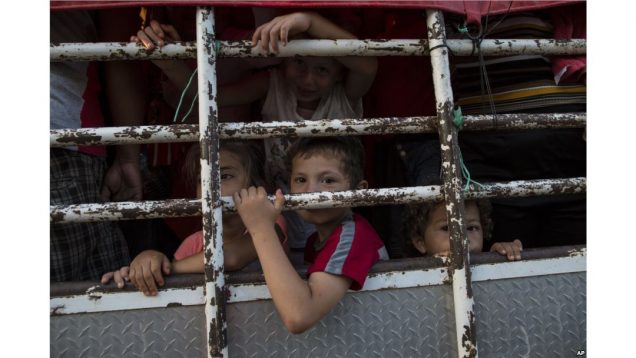
As the wait for asylum petitions continue, other children and families travel on cattle trucks (see above picture), cargo trains, or get a lift from kind people as they slowly make their way through Mexico towards the US border. This is a dangerous journey these families are making as they risk getting assaulted, robbed, raped, or even killed. Meanwhile what happens to these children as they embark on this journey initiated by their parents and caretakers? What goes on in their minds as they are faced with an unwelcoming government via excessive force? They are fleeing their homeland plagued by violence and poverty only to meet with an uncertain future and the possibility that they may have to return back home if their petitions for asylum are denied, that is if their petition is ever heard. Lynn Smithwick facilitator for METCJ 725 covered some valuable information on types of trauma during Module 5 live lecture. In this live lecture it was mentioned that children are “fragile” and witnessing any type of trauma can have an adverse effect in a child’s life. Smithwick addressed four types of vicarious trauma:
- Acute Trauma: a single even that is limited in time such as death or a shooting.
- Chronic Trauma: the experience of traumatic events over a long period of time such as poverty in inner city youth and witnessing violence.
- Complex Trauma: both exposure to chronic trauma as well as multiple and various forms of trauma.
- System Induced Trauma: the traumatic removal from home, admission to a detention center or residential facility, or multiple placements within a short period of time. For example when child protection services gets involve and removes the child, being placed in foster care, or being detained at a juvenile hall.
Smithwick stated that exposure to trauma can occur from events such as being in a car or other serious accident; having a significant health concern or hospitalization; sudden job loss; losing a loved one; being in a fire, hurricane, flood, earthquake, or other natural disaster; and experiencing emotional, physical, or sexual abuse (Smithwick, 2018: Module 5). What types of trauma do you think these children have been exposed to? All four! They are leaving their loved ones behind in their quest for a better future, their life has been a constant exposure to violence, their exposure has been a chronic one, and the system from where they come from and where they are going are not making things any better for them as they move from camp to camp waiting for their turn to have their case heard.
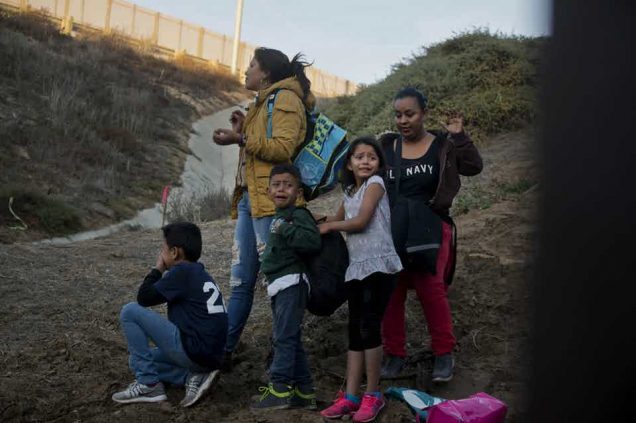 Hasan, 2018
Here a family surrenders to US Border Patrol after crossing the border wall into the US on December 2, 2018.
Syeda Javeria Hasan, a student from the University of Waterloo, wrote an analysis about the challenges a parent can face during this caravan journey. Hasan reports that the six week journey can hit children the “hardest” because of the physical requirements they are exposed to during this travel. This can impact parent and child relationship. Refugee parents and children often exhibit symptoms of PTSD, anxiety, and depression. This can leave parents feeling emotional worn out which can lead to “over-protectiveness, harsh discipline, and a reversal of parent/child roles”. Hasan reports that as the caravan migrants traveled the 4,000 kilometers from Honduras to Tijuana, Mexico, they are more prone to fevers, eye infections, lice infestations, respiratory illness, and dehydration. As the city of Tijuana makes efforts to provide shelter to the thousands of migrants as they arrive, the shelters are not in the most hygienic conditions and this only increases the health concerns of children since they are more vulnerable to diseases. Over time the strain this add to parenting can lead to low nurturance and low responsive to needs of the child. Hasan reports that when exposed to constant community violence, parents starts to feel “hopeless, powerless, emotionally overwhelmed”, leading to symptoms of anxiety, depression, and PTSD. Parents can also start to dissociate and have a decrease in understanding their child’s own psychological distress. This can result in a child developing emotional challengers, learn to disengage, and develop similar coping mechanisms as their parents (Hasan, 2018). Leaving behind their culture just to get away from the violence only to face a new form of uncertainty in a foreign country these migrants will have to adapt as they seek shelter and make their way towards the US border in hopes of obtaining political asylum, is troubling enough and not to mention what the children are being exposed to. Is there hope for these people as they await their fate at the border?
 Schlein, 2018
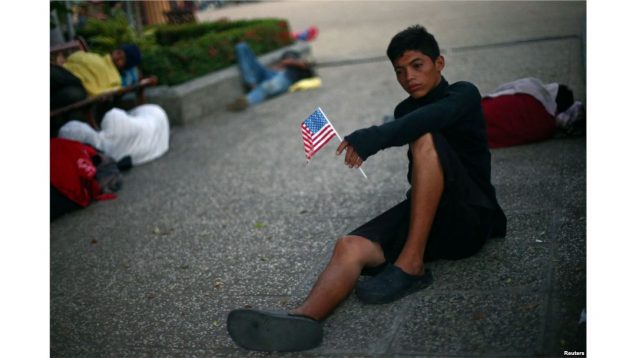
A youth from Honduras rests in a public area in Tecun Uman, Mexico enroute to USA as he waits to re-join with more migrants.
This picture breaks my heart just like the rest. This young man can be my son. Look closely at his face; he seems to have psychologically tuned out in order to endure the hardship that awaits him but prefers to risk it all in hopes of making it past the US border. President Trump is trying to make them go away and return them back to their homelands. One federal judge stated that our president can’t do that. US district judge Jon Tigar has suspended the administration’s new policy to cut off asylum to immigrants who enter this county by illegal means. The Immigration and Nationality Act of 1965, states that “any foreigner who arrives in the USA, whether or not at a designated port of arrival, may apply for asylum” (Gomez & Jansen, 2018). President Trump cannot overturn a law that was specifically made to give asylum from those who seek it. I understand that criminals may be on their way with the caravan but not everyone is a criminal. Instead of deploying thousands of troops to protect the US border why not increase the staff at the port of entry in order to thoroughly and swiftly process petition applications in order to alleviate some of the strain and chaos this whole event has caused. That way immigrants can decide based on their petition response, whether to make Mexico their new homeland, seek asylum at another county, or reunite with their loved here in the USA if entry access is approved. Anything is better than keeping them camping at the Mexican border, especially for the already vulnerable groups: the children.
Gomez, A. and Jansen, B. (2018). President Trump call caravan immigrants ‘stone cold criminals.’ Here’s what we know. Retrieved December 10, 2018, from https://amp.usatoday.com/amp/2112846002
Hasan, S. J. (2018). The challenges of parenting in a migrant caravan. Retrieved December 10, 2018, from https://theconversation.com/amp/the-challenge-of-parenting-in-a-migrant-caravan-107875
Schlein, L. (2018). UN: Migrant Caravan Children Suffering Extreme Hardships. Retrieved December 10, 2018, from https://www.voanews.com/amp/un-migrant-caravan-children-suffering-extreme-hardships/4630708.html
Smithwick, L. (2018). Module 5 live lecture: Best Practices-Juvenile Justice and Gender
Responsivity. Accessed online November 28, 2018. https://learn.bu.edu
Picture of child with mother copied November 29, 2018, from www.gettyimages.com
Enrique S. “Kiki” Camarena… The beginning of “Red Ribbon Week”
Enrique “Kiki” S. Camarena was a United States, DEA (Drug Enforcement Administration) Special Agent who was kidnapped, tortured, and killed in Mexico in 1985. The effects of this horrific tragedy shook the DEA, The United States, and Mexico. After Kiki went missing, while working in Mexico, the United States embarked on the most significant manhunt it had ever attempted until this time. The United States, especially the DEA, began hunting the person or people that had taken part in Special Agent Camarena’s kidnapping, torture, and murder.
Kiki was a decorated and valued DEA Special agent, but his story begins before he ever was employed by the DEA. In 1968 Kiki joined the United States Marine Corps. After serving in the Marine Corps for about two years, he joined the Calexico Police Department as a Criminal Investigator in 1970. In 1973, Kiki started working as a Narcotics Investigator with the El Centro Police Department (DEA.Gov). Kiki would stay with the El Centro police department until 1974. In June of 1974, Kiki joined the Drug Enforcement Administration (DEA).
Initially, Kiki would be assigned to some familiar territory in Calexico, California as a Special Agent with the DEA. Kiki had many resources with the local people as well as the local police department in Calexico, because of his prior service in the city. In 1977 he was assigned to the Fresno district office in northern California. Kiki had an unmatched work ethic and an overwhelming never quit attitude; this allowed him to make some great connections with the local people and with the state officials while working in the district office. His Strong work ethic, his never quit attitude, along with being fluent in Spanish, made him a prime candidate to be assigned to Mexico in 1981, where he would work out of the Guadalajara Resident Office (DEA.Gov).
Kiki and his family moved to Guadalajara, Mexico in 1981. For four and a half years, Kiki remained on the trail of Mexico’s most significant marijuana and cocaine traffickers. “In early 1985, he was extremely close to unlocking a multi-billion-dollar drug pipeline. However, before he was able to expose the drug trafficking operations to the public, he was kidnapped on February 7, 1985” (DEA.Gov).
According to redribboncoalition.com, "his efforts led to a tip that resulted in the discovery of a multi-million-dollar narcotics manufacturing operation in Chihuahua, Mexico. The successful eradication of this and other drug production operations angered leaders of several drug cartels who sought revenge.” Camarena was kidnapped on February 7th, 1985 by five armed men, driving a Volkswagen car, in the middle of the day while on his way to have lunch with his wife. Camarena's Mexican pilot, Alfredo Zavala-Avelars, was also kidnapped in a separate but related incident, according to redribbonweek.com (Flores)
“At almost the same hour, Alfredo Zavala Avelars, a professional pilot for the Mexican Ministry of Agriculture, was seized by cartel operatives as he drove into the city from Guadalajara's international airport, where he had just landed. Zavala was a close friend of Camarena and a DEA mole, regularly providing information about the comings and goings of regional drug lords who traveled in and out of the city aboard private aircraft, which he monitored and reported. Zavala, too, was forcibly carried to the house, for ‘interrogation.’” (The death house on Lope de Vega)
Kiki was kidnaped right in front of the Mexican Consulate’s office in Guadalajara. Five armed men grabbed him and threw him in a car. It is reported that they took him to a ranch that is known for drug activity and they kept him there for approximately three days. It was later discovered that Kiki was surrounded by Mexican intelligence officers from the DFS (a Mexican intelligence agency that no longer exists) while being kidnaped and tortured.
Kiki was held at 881 Lope de Vega in Guadalajara; this house was owned by Rafael Caro Quintero. Kiki was held against his will at this location for about three days. During this time Kiki was subjected to numerous torture techniques for over 30 hours. Quintero and others brutally assaulted Kiki over and over again. They crushed his skull, jaw, nose, and cheekbones by beating him with a combination of fists and a tire iron. They broke his ribs with numerous assaults to his mid-section. They were so brutal in their attack that they even drilled a hole in his head, and if that was not enough, they also tortured him with a cattle prod.
The torture that Kiki Camarena underwent was so intense that he passed out from the pain and almost died a few times during these torture sessions. Quintero was such a psychopath about the tortures that he ordered a cartel doctor to keep Kiki alive. "At that point, he administered lidocaine into his heart to keep him alert and awake during the torture," (Jeunesse). Due to his numerous wounds from the torture, eventually Kiki could no longer be kept alive, and he died on February 9th, 1985.
Kiki was kidnapped and murdered because he was smart enough to realize that in order to capture the cartel leaders, the DEA would need to chase the money and not the drugs. "We were seizing a huge amount of drugs. However, we were not disrupting the cartels. So he came up with the idea that we should set up a task force and target their monies." (Jeunesse)
Nobody in Mexico anticipated the reaction that the United States would have to this horrendous act. The Mexican Government seemed as though they were not doing what needed to be down in order to catch the people responsible for Kiki’s death. The United States kept the pressure on the Mexican Government to bring the responsible parties to justice. However, the Mexican government would consistently ignore requests from the United States. Frustration with the Mexican Government was growing stronger by the day. In an interview with FRONTLINE in 2000, Jack Lawn, the former Administrator of the DEA at the time of Kiki’s death, stated;
“The Mexican government knew what happened, and it became more clear to us that the government of Mexico indeed was covering up the assassination, the killing of Kiki Camarena. When we talked [to them about finding the body], they said, "Well, we have Mexican officers killed all the time. You may never get the body back." Moreover, our response was, "Just look how we feel about the MIAs." At that time, we had some 3000 MIAs missing from Vietnam. It continues to be a major issue.” (Drug Wars)
In February of 1985, the Customs Service Commissioner, William Von Raab, who was responding to an appeal from Francis M. Mullen Jr., the head of the Drug Enforcement Administration, ordered all U.S. Customs agents at every one of the 15 official crossings into and out of Mexico, to carry out an excruciating task of thoroughly inspecting every vehicle, looking for Kiki’s body. This operation came to be known as Operation Camarena.
“No one seriously believed that Camarena, an eleven-year DEA veteran, would turn up in the search. Instead, the border operation was the Reagan Administration's way of trying to force the Mexican government of President Miguel de la Madrid Hurtado to step up its hunt for the missing agent.”
“All along the 2,000-mile U.S.-Mexican border, everything on wheels was stopped and thoroughly inspected and searched. At the point known as the "world's busiest border crossing," between Tijuana and San Ysidro, Calif., the usual 20-minute delays on the 22-lane northbound approach plaza dragged on for as long as seven hours.” ("DD")
Many people criticized William Von Raab for his decision to “close the border.” However, within a week of the border being closed, Kiki’s body was recovered due to an “anonymous” letter that was sent to the police in Mexico with information about the location of Kiki’s body.
In March of 1985, the bodies of Enrique “Kiki” S. Camarena and Alfredo Zavala Avelars were found in Michoacán state which is located just southwest of Jalisco. The bodies were first buried in a wooded site in a metro area, and then later dug up and planted in the site that they were to be found at. Both of their bodies were badly decomposed when they were found by a farmer who was working his fields.
The United States authorities placed enormous pressure on the Mexican government to locate the people behind Kiki’s death. Due to this pressure, the Mexican government would eventually arrest, prosecuted and convicted Rafael Caro Quintero and others from the Guadalajara Cartel operations. Quintero was sentenced to 40 years in a Mexican prison. However, after serving only 28 of those years, a federal tribunal in Guadalajara ordered the drug lord's immediate release. The court's order was faxed to his place of incarceration and Quintero exited the Jalisco state prison 90 minutes later on August 9th, 2013.
“According to prison guards, Caro Quintero left with nothing but a small bundle of clothing, walking a kilometer up a dark and rain-slick road to the nearest highway, where unidentified persons waited for him in a car.” (The death house on Lope de Vega)
“Shortly after Kiki's death, Congressman Duncan Hunter and high school friend Henry Lozano launched Camarena Clubs in Kiki's hometown of Calexico, California. Hundreds of club members including Calexico High School teacher David Dhillon wore red ribbons and pledged to lead drug-free lives to honor the sacrifices made by Kiki Camarena and others on behalf of all Americans.”(DEA)
“Red Ribbon Week eventually gained momentum throughout California and later across the United States. In 1985, club members presented the "Camarena Club Proclamation" to then First Lady Nancy Reagan, bringing it national attention. Later that summer, parent groups in California, Illinois, and Virginia began promoting the wearing of red ribbons nationwide during late October. The campaign was then formalized in 1988 by the National Family Partnership, with President and Mrs. Reagan serving as honorary chairpersons. Today, the eight-day celebration is an annual catalyst to show intolerance for drugs in our schools, workplaces, and communities. Each year, on October 23-31, more than 80 million young people and adults show their commitment to a healthy, drug-free lifestyle by wearing or displaying the red ribbon.”(DEA)
Works Cited:
"DD." How Kiki Camarena's Murder Nearly Brought Down the Mexican Government and Economy. 10 August 2013. / 15 April 2015.
<http://www.borderlandbeat.com/2013/08/how-murder-of-kiki-camarena-nearly.html>.
DEA.Gov. Kiki and the History of Red Ribbon Week. 02 April 2015. / 14 April 2015.
<http://www.dea.gov/redribbon/RedRibbon_history.shtml>.
Drug Wars. Frontline. 10 October 2000. / 14 April 2015. <http://www.pbs.org/wgbh/pages/frontline/shows/drugs/etc/transcript2.html>.
Flores, Roman. A look into slain DEA agent Enrique Camarena's story during Red Ribbon Week. 27 October 2011. / 13 April 2015.
<http://articles.ivpressonline.com/2011-10-27/dea-agent_30330461>.
Jeunesse, William La. US intelligence assets in Mexico reportedly tied to murdered DEA agent. 13 October 2013. / 13 April 2015.
<http://www.foxnews.com/politics/2013/10/10/us-intelligence-assets-reportedly-played-role-in-capture-dea-agent-in-mexico/>.
The death house on Lope de Vega. MGR-The Mexico Gulf Reporter 17 August 2013. / 14 April 2015.
<http://www.mexicogulfreporter.com/2013/08/the-death-house-on-lope-de-vega.html>.
First, Do No Harm: False Positives in Forensic Psychology
One of the founding principles of any caring profession is to “do no harm.” Physically, we note the importance of a patient’s right to least restrictive treatment; mentally, we safeguard for adverse effects of whichever treatment option we choose to pursue; ethically, we hold the notion of doing no harm in high regard, alongside confidentiality and patient safety.
Despite all this, when mental illness and criminal activity coincide, the principle of doing no harm is often thrown to the wayside: the guiding principle is to first, incarcerate- harmful or not. Many mentally ill individuals are incarcerated without ever receiving serious treatment; as one 2014 study notes, “Approximately 20 percent of inmates in jails and 15 percent of inmates in state prisons have a serious mental illness. Based on the total number of inmates, this means that there are approximately 356,000 inmates with serious mental illness in jails and state prisons” (Torrey, Zdanowicz, Kennard et al.). In other cases, even acknowledging a patient’s mental health in a legal setting is seen as an “unwinnable” or risky tactic, one that could alienate them from juries (Reid, 2000). Most of us are familiar with these issues in forensic psychology.
And yet, there are also bizarre and troubling cases where mental illness isn’t ignored, but instead, invented as a result of treatment. Sometimes, this phenomenon can interact with the criminal justice system in unusual ways.
On page 234, our primary course text introduces a new term: iatrogenic, meaning “unintentionally caused by clinicians or practitioners themselves” (Bartol & Bartol, 2016). The term is generally used more broadly to describe any problem that arises as a result of a treatment. It was popularized in the field of biological sciences rather than behavioral ones, and stems from "Iatros" which means doctor or healer and "gennan,” which means "as a result” (Torrey, 2018). Therefore, the word literally means "as a result of a doctor." It is used to describe everything from intentional malpractice to honest errors: any instance in which the founding principle of doing no harm has been ignored or unachieved while a patient is receiving care.
In our textbook, iatrogenic is used in reference to cases of DID (dissociative identity disorder) that are illegitimate- encouraged, perhaps unintentionally, by clinicians who are too suggestive with their diagnostic tools. Mistakenly believing that a patient has DID (or simply being overly sensitive to signs of this particular syndrome), a clinician may in fact guide them toward actually exhibiting symptoms that were not present beforehand.
This isn’t the only way that “false positives” can interact with the criminal justice system. Have you ever seen a television show in which a character suddenly remembers being the victim of a crime when they were a child? This popular plot device- seen recently in The Sinner (2017), for example- hinges on ‘recovered’ or ‘repressed’ memories: namely, the notion that traumatic events can result in dissociative amnesia, but that situationally-accessible memories may resurface one day with the right triggers.
Unfortunately, real-life cases that involve repressed memories aren’t so straightforward. The “Memory Wars” of the 1990s refers to the heated controversy surrounding the recovery of old memories, and whether or not these memories can be considered real (Patihis, Ho & Tingen, 2013). While some clinicians maintained their validity, other studies showed that you can implant fake “memories” via the power of suggestive interview techniques. When done on purpose, practitioners caused study participants to “remember” things which objectively never happened. When done on accident, the criminal justice repercussions can be significant.
One reason that the Memory Wars debate happened in the 1990s was as a reaction to the so-called ‘Satanic Panic’ of the 1980s, in which scores of childcare providers were accused (and sometimes convicted) of participating in religious sex cults that ritually abused young children. Eventually, these cases were dismissed and the whole episode was looked at largely as something similar to the prior Salem Witch Trials. And yet, the lives and careers of so many in the childcare industry were forever tarnished and destroyed.
When we think about doing no harm in the world of forensic psychology, it’s not enough to simply look at the negatives: the situations in which care was denied, or mental health issues were ignored (as in the case of mentally ill individuals who are incarcerated without treatment). We must also consider the false positives, in which suggestive forensic techniques can create problems that were never there to begin with. A false positive can lead to a false accusation, which in turn can lead to wrongful conviction.
Bartol, C. & Bartol, A. (2016). Criminal Behavior A Psychological Approach (11th ed.). Pearson.
Patihis, L., Ho, L. & Tingen, I. (2013). Are the “Memory Wars” Over? A Scientist-Practitioner
Gap in Beliefs About Repressed Memory. Retrieved from
https://journals.sagepub.com/doi/abs/10.1177/0956797613510718
Rousseau, D. (2018) Module 2 Lecture: What is Mental Illness? Accessed online December 5, 2018. https://learn.bu.edu
Torrey E. F., Zdanowicz M. T., Kennard A. D., et al. (November, 2014). How many individuals
with serious mental illness are in jails and prisons? Treatment Advocacy Center.
Retrieved from
https://www.treatmentadvocacycenter.org/storage/documents/backgrounders/how%20ma
ny%20individuals%20with%20serious%20mental%20illness%20are%20in%20jails%20a
nd%20prisons%20final.pdf
Torrey, T. (October 3, 2018). Iatrogenic Events During Medical Treatments: When something
meant to help causes a new illness or injury. Retrieved from
https://www.verywellhealth.com/what-is-iatrogenic-2615180
When Bullying Leads to Violence
School shootings have been increasing recently, and while they are still rare, they cause massive devastation and tragedy when they do occur. While there has been much debate about the motivations behind school shootings, when the shootings occur in a high school by a student or students of that school, it is almost always revealed that the student was bullied and socially ostracized at that school. “‘School shooters are often students who have been bullied, picked on, and marginalized’” (Bartol and Bartol 2017). When the diaries of the two Columbine shooters were located after the massacre, one diary described the boy’s loneliness and how he believed he had no friends, while the other boy’s diary described how he was constantly being bullied at school by the other students (Bartol and Bartol 2017).
Anyone who has gone through high school knows that it can be a terrible place for some teens. Bullying can be a severely traumatic experience for anyone. Bartol and Bartol state that “in those schools where a shooting occurred, there was evidence of (1) an inflexible culture…[and] tolerance for disrespectful behavior” (2017). Furthermore, “the inflexible culture created among many students a sense of not belonging” and “tolerance for disrespectful behavior refers to ‘looking the other way’ when incidents of bullying, racism, and overt rudeness and aggressiveness happen in the school building and school grounds” (Bartol and Bartol 2017). I recall an incident in which I was standing in the high school lobby waiting to be picked up after a Regents exam and a student that I barely knew began making sexual movements against my body. I moved away three times, but each time he followed me, until I finally walked to the other lobby of the school. I recall a group of girls laughing at what was occurring. This shows not only a tolerance for disrespectful behavior, but an actual motivation for such behavior. The girls were encouraging this boy, who in hindsight was sexually harassing me, to continue his behavior. My mom reported this to the school, and we were very alarmed when the principal calmly assured us that the school had a strict three-strike policy when it came to sexual harassment, and this was the boy’s fourth strike, so he would be expelled. Come to find out, the boy received a “talk” from a guidance counselor and was allowed to stay in the high school. For a school, on paper, to state that they have a “strict three-strike policy against sexual harassment,” and then to disregard this statement when situations actually do occur is horrendous. First of all, as this was his fourth offense, it never would have even happened to me if they had expelled him after his third offense, as per the rules. Second, I am positive that he continued this behavior at the school, and the sexual harassment did not end with this fourth offense.
When schools make policies, they need to be followed. Obviously there is a high tolerance in our public school systems for bullying and harassment of any kind. Looking back, I should have been offered a counseling session, but was not. In a perfect world, this student would have been expelled and the girls who encouraged him would have been disciplined. Instead, they all considered this bit of bullying and sexual harassment a fun experience for themselves. This tolerance of bullying and harassment in public schools must end. Another time, a boy I did not know attempted to push me down a flight of stairs in the school on a dare; luckily, I caught myself and did not fall, but when I spoke to the counselor about it, I was told that this behavior was “harmless” and not something that they had time to look into. When school counselors, who are supposed to be looking out for the emotional and physical safety of the students, make excuses for bullying behaviors, it only serves to worsen the problem. Many parents would be alarmed to find out how their children treat others while they are in school, and how the guidance counselors react to this bullying, or rather, ignore this bullying. School guidance counselors can be our first line of defense in preventing school shootings by making sure that students who are expressing violent thoughts and being bullied everyday are made to understand that the bullying is unacceptable, that their lives are just as important as the lives of the other students in the school, and that the bullying will be stopped or someone will be severely punished. By letting children fall through the cracks like this, particularly adolescents, we are telling them that they do not matter, and that all of the terrible things that bullies say to and about them are true. Adolescents are going through enough emotionally without adding bullying on top of it. More strict rules against bullying, and actually following through on these rules, would be a step towards reducing the likelihood of school shootings occurring in high schools by students.
References:
Bartol, C. R., & Bartol, A. M. (2017). Criminal behavior: A psychological approach. (11th Ed.). Boston, MA: Pearson.