Home
Self-Care Strategies
Before we begin on strategies for Self-Care, it is important to define Self-Care.
Self-Care - the practice of taking action to preserve or improve one's own health. (Oxford English Dictionary).
Sounds simple enough right? Wrong. Many of us do not take the proper steps and time to take care of ourselves. We are often too busy with every day life, work, children, taking care of others, we don’t leave enough time to take care of the most important person in our lives – which is our own health and well-being.
There are many things we can do to take care of ourselves and self-care can mean different things to different people; however, there are some basic rules that can be applied to everyone. Self-care does not need to be complicated or too time consuming; however it needs to be actively planned rather than something that just happens every now and then.
Here are some basics to stick to when planning for self-care:
1. Get enough sleep
2. Develop healthy and nutritious eating habits
3. Exercise regularly (not obsessively)
4. Learn how to say NO
5. Do something that makes YOU happy
6. Pamper yourself without feeling guilty
7. Surround yourself with people that uplift you
It is important to note that you don’t have to do all of these activities all the time or at once, however picking a few that are important to you is a good way to make it a part of your daily routine.
For myself, the top three from the above-list are: sleep, exercise and doing something every day that makes ME happy. Although I think that some of these can be combined, but for the sake of simplicity, I will keep them separate.
I have battled with sleeping issues for a long time due to stress and injury and I must say not getting proper sleep is a slippery slope to many unhealthy choices that follow. If you don’t get enough sleep, it can truly mess up your immune system, make you irritable and the rest of your day is easily ruined. Some people need 8 hours of sleep, some people need 5, but it is important to get restful sleep. Meditation before bed or reading can help tremendously when having trouble sleeping.
Exercise for me is key to getting my day started on a positive note – it does not have to involve hours at the gym. It can be as simple as taking a 20 min walk followed by some yoga with light weights at home or just using your own body weight to get your blood flowing. Personally, I love to run and do Pilates – both combined is one of the biggest stress relievers for me. I love working out first thing in the morning as it sets the tone for the rest of my day. I have noticed if for whatever reason I am unable to exercise in the morning, my mood is not quite as good and I am more irritable and on edge. Not only does it make my body feel great and strong, but most importantly helps to keep my mind sharp. Furthermore, it increases serotonin levels and leads to good energy and good mood.
Last but not least, doing something every day that makes ME happy is very important. At times this may sound selfish to others, but to make others happy and be a good friend/partner/employee etc. you must take care of yourself first and be content before you can do that for others. This strategy sounds vague, but it can create a lot of positives for one’s well-being. It can be something so simple as walking to your favorite coffee shop to get coffee in the morning; to getting a massage or hanging out with a particular friend that day. The most important aspect of this is you are doing something that makes YOU happy. For me, each day it varies, but sometimes I just want to stay home and listen to music while other times I want to be surrounded by friends at a nice dinner and cocktail or going to a comedy show or spending time with my nephews – it all depends on what small or big thing I want to do that day. It is also important not to feel guilty when doing so. We often do things we don’t necessarily want to do or if we take time for ourselves, we feel guilty about it – that has to stop!
These are some simple steps we can take towards taking better care of ourselves.
Life is not perfect, and we are all busy, but we must take time for ourselves; it does not have to be complicated, time consuming or costly, even 20 minutes a day can have a great impact. When we don’t take time for self-care, our energy and motivation can decrease, making it even more challenging to stick with healthy lifestyle choices.
Michael R. 2018 – What self-care is and What it isn’t?
https://psychcentral.com/blog/what-self-care-is-and-what-it-isnt-2/
Post-Traumatic Stress in Animals
According to Rousseau (2019), trauma represents exposure to experiences or situations that are emotionally painful and distressing, that overwhelm a person’s ability to adapt or cope, and over which they feel powerless. One common anxiety disorder that results from trauma is Post-Traumatic Stress Syndrome. Symptoms of PTSD include: flashbacks, nightmares, hostility, difficulty sleeping, etc. Some people who get PTSD usually experienced trauma from child abuse, physical abuse, sexual abuse, an accident, a death of a loved one, or war. Since countless people experience PTSD, an interesting topic to examine would be the chance of animals also suffering PTSD. For many individuals, their pets are a member of their family. Many people adopt their pets from shelters, sometimes rescuing them from abusive owners. The trauma animals experience from physical abuse is similar to that of humans. So, can they develop Post-Traumatic Stress symptoms like humans as well?
Kumar (2017) discusses PTSD in her cat Lola. In May of 2017 in Afghanistan, a tanker truck was bombed. The attack claimed more than 150 lives and injured at least 700 others. The impact of the explosion was felt several miles away, breaking windows and cracking ceilings. 20 minutes after the explosion, Lola was hiding. For the next week, Lola was edgy. She was startled by small sounds and she would follow the author everywhere. Lola would wail when Kumar left the house and be clingy when she returned. She started eating less and losing weight. According to Kumar (2017), the U.S. military has seen this reaction to stress in its working dogs. About 5 percent of the dogs that have served in Afghanistan and Iraq suffer from “canine PTSD,” making some dogs aggressive, timid, or unable to do their jobs.
Romm (2016) discusses Elsom, a chimpanzee who experienced PTSD. Elsom’s mother died with he was 13. At age 15, he suffered a serious injury to his arm. He disappeared for a few months afterward and isolated himself from his community. Upon his return, he was different. He was easily agitated and angry. He was more fearful and had difficulty sleeping. Romm (2016) states that animal mental illness can be triggered by many of the same factors that unleash mental illness in humans, including the loss of family or companions, loss of freedom, stress, trauma, and abuse.
Post-Traumatic Stress Disorder is an awful illness that some people deal with. They are forced to relive whatever trauma they experienced through different psychological symptoms. It is evident, through many articles like the ones mentioned above, that animals can indeed suffer from Post-Traumatic Stress just like humans. Imagine a mental illness so powerful that it has the power to affect both humans and animals. That is the impact of Post-Traumatic Stress Syndrome.
References
Kumar, R. (2017, July 08). Can animals suffer from PTSD? Retrieved from https://www.washingtonpost.com/news/animalia/wp/2017/07/08/can-animals-suffer-from-ptsd/?noredirect=on&utm_term=.b4f2fadef2ef
Romm, C. (2016, May 05). Animals Can Get PTSD, Too. Retrieved from https://www.thecut.com/2016/05/animals-can-get-ptsd-too.html
Rousseau, Danielle, PhD (2019, April 28). [Module 4 Lecture]. Boston University
Self-Care through Resilience
Self-care is critical for all individuals in some form, but it is especially important for those in the criminal justice field. Self-care strategies are those things an individual does to reduce stress and ultimately rejuvenate ones self. This could be done through a combination of physical, mental, or even spiritual activities. Self-care could be as simple as drinking coffee while watching the sun rise; soaking in the quiet peace of the morning. It can also be as vigorous as playing recreational sports every week, or even a more spiritual approach of reflecting on the weeks sermon in church.
Self-care can be conducted in different ways but also includes making sure ones basic needs are met, such as maintaining a nutritional diet and ensuring one receives ample rest. These are all factors that can be done prior to the induction of stress to better prepare the body, physically, for the challenges to come. An individual can also prepare the mind for mentally challenging situations. Just as one exercises to build their physical stamina, one can also prepare the mind as a form of self-care. Building ones resilience is an effective approach to pre-conditioning the mind for difficult or stressful situations, which in the criminal justice field, is highly likely.
Resilience is the ability of an individual to bounce back in the face of adversity. Resilience skills and personal exposure and experiences all add to the response one might experience when faced with a stressful or traumatic event and can contribute to the level or existence of PTSD as a result of the event. Not every one experiences trauma the same way and not every event triggers a traumatic response from every individual. What we do know is that trauma can prompt a neurological effect in an individual, causing one’s emotional mind to react and essentially blocking the cognitive mind (Van Der Kolk, 2014). Yet, learning effective skills can boost an individual’s ability to cope with overwhelming amounts stress or lessen the physiological impacts.
In 2009, the Army took this concept and teamed up with the Positive Psychology Center at the University of Pennsylvania to develop a program specifically designed to teach resilience skills to Soldiers. The thought was that if Soldier’s learned specific skills designed to increase their resilience, they could better cope with the challenges of combat. These skills include methods that focus on the elimination of irrational thinking (i.e. giving in to the worst case scenario in a life threatening situation) to allow an individual to more clearly assess a situation (i.e. strategizing an escape or counter attack). Resilience skills can also improve personal connections, as connections are linked to an individual’s ability to overcome an event. This could also include skills designed to bring the body to the most optimal state for performance – mental, social, physical, and emotional skills. The idea is that a resilient individual is better equipped to cope with difficult situations and can further use these abilities for post-traumatic growth. Post-traumatic growth is the ability of an individual to experience positive change as a result of a difficult event. “Resilient people tend to take responsibility for their emotional well- being and use the traumatic experience as a basis for personal growth (Southwick & Charney, 2012, p. 13).
Although the concept of resilience and trauma is a fairly new area of study, research has already suggested that resilience does have neurological affects (Friedberg, 2018). Therefore, developing resilience-based skills can contribute to an individual’s wellbeing, their ability to overcome stress and trauma, and their ability to regain control of their mental state. Because these skills focus on improving an individual’s ability to coop with stress, mastering these skills can serve as a form of preventative self-care. In the moment, exercising these abilities can help an individual return to a more positive and constructive mental state, ultimately rejuvenating ones self when it is needed the most.
References:
Friedberg, Ahron & Malefakis, D. (2018). Resilience, Trauma, and Coping. Psychodynamic Psychiatry: Vol. 46, No. 1, pp. 81-113.
Positive Psychology Center. (2019). The University of Pennsylvania School of Arts & Sciences. Accessed online 22 March 2019. https://ppc.sas.upenn.edu/resilience-programs/resilience-research
Southwick, S. M., & Charney, D. S. (2012). Resilience: The science of mastering life’s greatest challenges. New York: Cambridge University Press. Accessed online 29 April 2019. https://doi.org/10.1017/CBO9781139013857
Van der Kolk, Bessel A. (2014). The Body Keeps the Score. New York, NY. Penguin Books.
Strategies for Self-Care
One would think after attending a Dr. Kevin M. Gilmartin presentation hosted by a local police department, I would have a better understanding of the importance of self-care. One would think after attending the previously mentioned presentation and later being assigned to read Dr. Kevin M. Gilmartin’sEmotional Survival for Law Enforcementin a work course, I would have an even better one two punch system for self-care. Guess what? Nope. Not at all. I listened to Dr. Gilmartin talk about being multi-dimensional and having more than just the title of “Krystal the Cop”; heck, I even read the book cover to cover! Here I sit, writing this blog post, after six weeks of discussions on trauma and crisis intervention realizing I am heading down a road of broken relationships, self loss, and walking right into being the victim of Post-Traumatic Stress Disorder caused by my job and those in it.
The emotional changes take place first: Anger can become a prevailing and ever present state in a police home. Then, as the years pass, physical changes can appear. The constant anger and the physical upheaval it causes, combined with years of shift-work-induced sleep deprivation, poor diet, and a sedentary lifestyle, can lead the now veteran officer to face physical changes in addition to emotional issues. (Gilmartin, PhD., 2002, pp. 4-5)
Yep, this is where my life is at. A ten-year veteran of a small town agency where the last five years were spent working a swing shift (1300 hours – 0100 hours), raising a now 7 year old boy, one failed marriage, working on trying to save a five year relationship with another man and his soon to be 7 year old son, looking around to realize I don’t have friends to call at any given moment in time. Clearly I am rocking this self-care! So what do I do? How do I change it? What steps do I need to take?
I have to get rid of the “I usta” responses. According to Dr. Gilmartin (2002), “It describes what they "used to” do before becoming police officers…the things that have been lost from the officer’s life, the things that are not work related…” (p. 69). Recognizing that I need to do things for myself outside of work, to include my family, and to not let the bitterness of my job continue to ruin my life.
Yoga for First Responders shows how implementing yoga for police and/or firefighters is important for emotional wellness and mental-resiliency (Yoga For First Responders, 2016). The benefits of yoga – stretching, meditation, breathing techniques – can be beneficial for me. Here is a “I usta” for me, I used to practice yoga long before I was a cop and I enjoyed it so very much but now with my schedule it is so hard to find the time. Physical fitness is another “I usta” for me, I used to go to the gym regularly but again my work schedule and having a child that cannot be home alone made it so difficult to maintain my gym schedule. A simple thing as going for drives, listening to music, putting my feet in the ocean and feeling the sand between my toes, all things that can help re-center my well-being and promote self-care.
But what it really comes down to is action. All the strategies in the world won’t mean a thing if I or another is not ready to make the move, to recognize the self-destruction that is occurring by not taking care of one’s self in this line of work. Going out to dinner with NON first responders, having friends that are not all first responders, doing activities that bring joy, being present in the moments with family and making the time to do things other than the job. I truly hope that everyone recognizes the importance of taking care of themselves, regardless of the job they do or regardless of their history.
Works Cited
Gilmartin, PhD., K. M. (2002). Emotional Survival for Law Enforcement.Tucson: E-S Press.
Yoga For First Responders. (2016). Yoga For First Responders. Retrieved from Yoga For First Responders: http://yogaforfirstresponders.org
Breaking the Stigma
Brothers and sisters in blue,
We aspire to protect and bring justice, but too often we neglect to protect and be fair to ourselves. From domestic violence cases, accidents, shootings, robberies, children in danger, we’ve seen it all! And let’s face it –it all takes a toll in our emotional, mental, social and physical wellbeing.
Suicide is the number one cause of death for law enforcement officers (Kulbarsh, 2016). Let that sit for a while…
We can no longer ignore the impact and the affects that experiencing constant crisis has on our mental health. Post-traumatic stress disorder is one of the common mental disorder experienced by many law enforcement officers. Post-traumatic stress disorder is classified by experiencing/witnessing a life threatening event. With PTSD, individuals experience intense disturbing thoughts, flashbacks, nightmares, fear, anger, sadness and avoidant behaviors (Parekh, 2017). Facing traumatic events is hard enough for anyone, especial law enforcements that are expose to multiple trauma in an ongoing basis; admitting that there is a problem related to that is even harder. Often officers worry about their jobs, their egos, their reputations. However, it is in the call of duty that the police profession break through the stigma of mental health within the profession so that our community of officers thrive both on the job and outside in their personal lives.
This is my hope, with this blog post. That the break-through starts with us. As a fellow law enforcement professional, I lived and witness the hardship that accompanies the job. There were sleepless nights and restless mornings. Too many days that I questioned why I was on the job. We are called to serve and if we are unable to adequately serve then we are not doing our duty.
That is why officers, I write this post to inform about the warning signs of PTSD, suicide ideations and distress impairments that can help in identifying if you or a team member are in need of mental health services. In order to build on coping skills to continue the great work you do.
Signs of change due to stress:
Physical changes
-Fatigue
-Muscle Tension
-Chest pain
-Shallow breathing
-Rapid heart beat
Cognitive and Emotional Changes
-Confusion
-Difficulties concentrating
-Heighten or lowered alertness
-Blaming others
-Irritability
-Feeling anxious, fear, guilt, grief
Behavioral Changes
-Lack of motivation
-Avoidance
-Emotional outburst
-Appetite changes
-Impairment in social functioning
Things that you can do to break the stigma and seek help
-Change your frame of thought!
-Don’t think getting help is taboo. Your mental health is as important as your physical health…. Can’t chase a robber with a twisted ankle!
-Seek a support system from family members, friends, co-workers.
-Seek relationships and participate in social functions outside of work.
-Get moving!
-Exercise, yoga, rock climbing, you name it!
-Exercise your mind!
-Read, meditate
-Build on your confidence mentally and physically- get into martial arts
-Watch your eating and sleep hygiene.
-Eat healthier
-Set a relaxing atmosphere to sleep
-Take time off from work.
-GET CONNECTED WITH A MENTAL HEALTH PROFESSIONAL NEAR YOU!
-Seek experts that will guide you in reinforcing your coping skills.
Kulbarsh, P. (2016, January). 2015 police suicide statistic. Retrieved from
https://www.officer.com/training-careers/article/12156622/2015-police-suicide-statistics
Parekh, R. (2017, January). What is posttraumatic stress disorder? Retrieved from
https://www.psychiatry.org/patients-families/ptsd/what-is-ptsd
Trauma, Kenya and Flying Kites Academy
The impact of early trauma and maltreatment is potentially profound and long lasting. Many early traumas faced in both rural and urban Kenyan communities are heightened by challenges related to poverty, such as residential instability, limited education, low income and earning potential, food scarcity, and limited access to healthcare (Shonkoff et al., 2012). A study by Karsberg and Elklit (2012) revealed that over 90% of rural Kenyan youth had been exposed to a potentially traumatic event (Appendix A). Thirty-four and a half percent of the studies total sample of 471 met criteria for post-traumatic stress disorder (PTSD), suggesting that more than a third of all Kenyan youths fulfill the symptom criteria for PTSD (Karsberg & Elklit, 2012).
Children who experience trauma are subject to chronic, toxic stress (Gronski et al., 2013; Ryan, Lane & Powers, 2017). Toxic stress is a continual activation of the physiological stress response system in the brain and can lead to negative physical and psychosocial consequences (Shonkoff et al., 2012). With a continually active stress response, children are unable to access self-regulatory capacities and ultimately unable to control the manner with which they process challenging experiences and stressors (Ryan, Lane & Powers, 2017). Furthermore, without the available support of a loving caregiver or a supportive environment, chronic toxic stress is potentially exacerbated (Gronski et al., 2013).
Flying Kites is an international 501(c)(3) non-profit organization based in Wellesley, Massachusetts and Njabini, Kenya. The mission of the organization is “to provide a competitive, Whole Child education and access to integrative services for vulnerable students in rural Kenya, inspiring lifelong learners who have the tools, skills, and growth mindset to positively impact their families, communities, and country as self-sufficient and productive citizens." Flying Kites Academy (FKA) was founded in 2007 to provide vulnerable students receive a competitive primary education and integrative, holistic services. FKA has adopted the ASCD’s Whole Child Approach to ensure that all students are healthy, safe, engaged, supported, and challenged.
As of January 2019, FKA educates 111 students ages 5-16. These students live in poverty and the majority have faced abuse, experienced neglect, lived without food, water, or safety. Research suggests that, more than any other type of child maltreatment, neglect is positively associated with poverty and both neglect and poverty are associated with negative outcomes for children across multiple domains of functioning (Nikulina & Widom, 2014). The head of FKA and Executive Director in Kenya, Warucu Kijuu, explained that neglect occurs frequently, and students may not have support at home and receive little parental feedback; in this community sometimes raising the children, often because of financial burdens, “is not a priority.”
At FKA, the children are the priority and all teachers and staff have a passion and love for the students in their community. By meeting the needs of the Whole Child, the integrative programs offered at Flying Kites Academy provide students with the support and tools required to pursue their ambitions and positively impact their families and communities.
Gronski, M. P., Bogan, K. E., Kloeckner, J., Russell-Thomas, D., Taff, S. D., Walker, K. A., & Berg, C. (2013). Childhood Toxic Stress: A Community Role in Health Promotion for Occupational Therapists. American Journal of Occupational Therapy, 67(6), e148–e153.
Jepkemboi, G., Jolly, P., Gillyard, K., & Lissanu, L. (2016). Educating Orphaned and Vulnerable Children in Elgeyo-Marakwet County, Kenya. Childhood Education, 92(5), 391–395.
Karsberg, S. H., & Elklit, A. (2012). Victimization and PTSD in A Rural Kenyan Youth Sample. Clinical Practice and Epidemiology in Mental Health : CP & EMH, 8, 91–101.
Nikulina, V., & Widom, C. S. (2014). Do race, neglect, and childhood poverty predict physical health in adulthood? A multilevel prospective analysis. Child Abuse & Neglect, 38(3), 414–424.
Ryan, K., Lane, S. J., & Powers, D. (2017). A multidisciplinary model for treating complex trauma in early childhood. International Journal of Play Therapy, 26(2), 111–123.
Self Care and Trauma
Stacy-Anne Parke ~ CJ720 ~ Trauma and Crisis ~ Blog Post
You deserve to enjoy life just as much as anyone else!
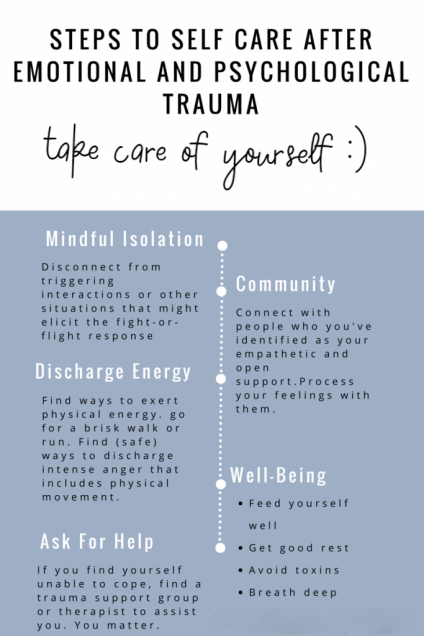
You may not know what good self-care looks like, but it forms the backbone of your physical and emotional well being. It encourages progress and healing. It is essential in the maintenance of a healthy relationship with yourself. Sometimes it’s as simple as getting enough sleep, waking up and getting out of bed, brushing your teeth, and providing your body with the right nutrients it needs. Other times self-care can manifest itself in taking walks, yoga (movement), hanging out with friends or not hanging out with friends, relaxing, expression, and listening to yourself.
How do you know you need to practice better self-care? Well, you may:
- Sleep too much!
- Or not sleep at all.
Retrieved from: Justjasmineblog.com Later modified by me. - Over-schedule.
- Have a poor relationship with food.
- Abuse alcohol and substances
- Feel constant stress.
- Feel Helpless
Trauma is overwhelming and often the relationships between your mind and surroundings are heightened- and maybe even painted a shade of grey. Trauma survivors often feel detached, ”the essence of trauma is feeling godforsaken, cut off from the human race” (Van der Kolk, 2014). However, your life deserves to be in color, full of turquoise, light lilac and ignited red. Taking care of yourself is life-saving, it isn’t a luxury but it sure does feel luxurious . Especially for trauma survivors, it is important to engage in “activities that lower the physiological adrenal surge from trauma” ( De Lorenzo, 2018). Engaging in the present reduces those surges.
The neuroplasticity of your brain continues to develop past childhood; at any age, you can re-heal, grow, and learn. How incredible and hopeful is that? This can be accomplished through safe relationships, improved adaptive thinking, self-regulation, learning, and social skills, all of which are facets of many self-care plans (Masten, 2014; Matto, Strolin-Goltzman, & Ballan, 2014). Emotions help us to engage in actions and behaviors. Love encourages us to love, fear encourages detachment, while anger can culminate into aggression, violence, and emotional harm. Trauma suspends those emotions and instead leaves the mind and body feeling paralyzed, absolutely stuck in time. With the incredible tool of plasticity it is still hard for our rational brains to take care of ourselves, "the rational mind, while able to organize feelings and impulses, is not well equipped to abolish emotions, thoughts, and impulses" (Van der Kolk, 2009). For example, individuals with PTSD are usually out of touch with their physical sensations; mindfulness can help mend that relationship by allowing the individual to become more aware.
Starting with children it’s important to equip them with the right tools for self-management. For traumatized and neglected children this can be established in schools. In fact, schools can be a gateway to creating resilience. Thus, it is imperative
“to receive a good education in schools where they are seen and known, where they learn to regulate themselves, and where they can develop a sense of agency. At their best, schools can function as islands of safety in a chaotic world. They can teach children how their bodies and brains work and how they can understand and deal with their emotions. Schools can play a significant role in instilling the resilience necessary to deal with the traumas of neighborhoods or families … to be the places where children are taught self-leadership and an internal locus of control" (Van der Kolk, 2014)
For traumatized adults, it is imperative that there are established dependable and healthy relationships and if not eliminating toxic ones are ideal. Addressing the dimensions of self-care through those relationships can then do wonders.
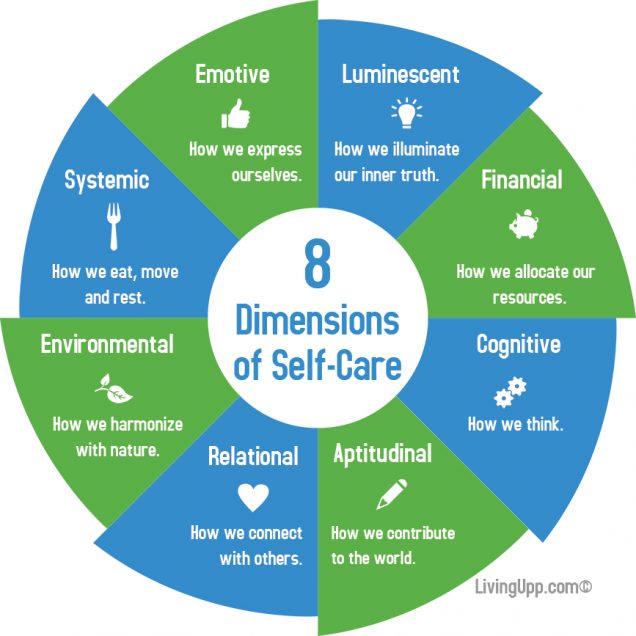
Self-care shouldn't fall solely on the individual either. Friends and family can encourage better stress-management practices; Clinicians have a responsibility of encouraging healthy practices with their clients and themselves (vicarious trauma). Small assignments that turn into habits throughout a course of therapy can lead to momentous changes in behavior and self-worth. Improvements are made in energy levels, productivity, fulfillment/satisfaction, along with overall well-being.
Balancing psychological needs and maintaining a sense of well-being requires effort, consistency, and patience. Not only is there an ethical need for self-care for therapists, but there is a paramount necessity for it in order to live wholly. We essentially have all of the parts to be effectively be present and manage stress; however, self-care keeps those parts in shape and running.
25 ways to practice self-care
- hydrate
- walk
- dance
- listen to music
- shower/bath
- sleep
- change your clothes
- yoga
- clean
- wash your face
- read a book
- write a poem
- journal
- light a candle
- talk to a friend
- talk to many friends
- feel- cry, smile, laugh
- color
- practice forgiveness
- practice acceptance
- set priorities
- therapy
- cook
- surround yourself with your favorite smells
- try something new
References
Masten, A. S. (2014). Ordinary magic: resilience in development. New York: Guilford Press.
Matto, H. C., Strolin-Goltzman, J., & Ballan, M. S. (2014). Neuroscience for social work: current research and practice. New York: Springer.
Van der Kolk, B. (2009). Yoga and Post-traumatic stress disorder [Interview]. Integral Yoga Magazine, 12-13.
Van der Kolk, B. (2014). The body keeps the score: Brain, mind, and body in the healing of trauma. New York: Viking.
Take Care of Yourself, You’re More Important than You Realize
The practice of self-care, although a necessity in life, is not used enough and many people don’t truly understand what self-care is. Many people attempt to eliminate a lot of things that they find stressful. But what happens when the stressors are unavoidable parts of life? Many people have children, a family, school or work that present unavoidable stressors. “Self-care is vital for building resilience toward those stressors in life that you can’t eliminate” (Scott, para. 5).
Until I started my current job I never really thought about self-care or what I can do for myself. Many people don’t even consider self-care, especially those who are busy parents. In the middle of running kids to after school activities, going to parent/teacher conferences, working, cooking dinner, cleaning house, and just taking care of life, we start to lose ourselves in the craziness of it all. As I type this I am surrounded by the craziness of life and it’s stressors. A final paper to write, a deadline to meet at work, a presentation to do, kids to care for and a house to maintain. And I wonder when I will have time for self-care myself. Luckily I have an amazing job that promotes self-care and therefore, will allow me some time while at work to work on school work. Thus, giving me the time for self-care outside of work (at least hopefully).
As Elizabeth Scott mentions in her article “5 Self-Care Practice for Every Area of Your Life”, it is important to practice self-care in all areas. These include physical, social, mental, spiritual and emotional self-care. All of these areas of self-care are equally important, especially for people who work high stress jobs or live high stress lives. While you can certainly practice self-care in one area and not another, in order to optimize results it is important to find a balance.
“Physical self-care includes how you’re fueling your body, how much sleep you’re getting, how much physical activity you are doing, and how well you’re caring for your physical needs” (Scott, para. 9). In order to keep your physical body healthy, in turn keeping your mind healthy, you need to get adequate sleep, maintain a good diet, attend doctors’ appointments and take medication as prescribed and get enough exercise. Methods that help with physical self-care can be as simple as setting a bedtime and sticking to it to ensure that you are getting enough sleep, meal prepping at the beginning of each week to ensure that you are eating healthy foods instead of trying to find something quick and unhealthy to grab and go.
As Elizabeth Scott points out, “it’s easy to neglect your relationships when life gets busy” (Scott, para. 12). As we grow up, we settle down, have children and our priorities change. I’m sure you’ve heard people joke about how once you have kids you no longer have friends. I, myself, have made joking, witty, sarcastic and passive comments about how my social life has dwindled since becoming a mother. It’s very difficult to maintain friendships when you and your friends are suddenly at different stages in life, such as motherhood, newlywed, attending college, or just living the single life. Your way of life defines your priorities, or maybe your priorities define your way of life. It’s easy to lose friendships in the chaos of life but it’s extremely important to make new ones and maintain the ones you can.
“Are you making enough time for activities that mentally stimulate you? Are you doing proactive things to help you stay mentally healthy?” (Scott, para. 21). If not then this could be detrimental to your mental health. How you think, and what you think, greatly impact your mental health and psychological welfare. Exercising your brain by completing puzzles, learning new facts, watching movies, reading books and even working on things like self-compassion and acceptance, are all ways to practice mental self-care and create a better environment for your mind to grow.
You do not have to be a religious person in order to practice spiritual self-care. Meditation, religious services and praying are all examples of spiritual self-care. Regardless of what you choose to do for spiritual self-care, it should develop a sense of self meaning, self-understanding or a deeper connection with the universe. I, myself, enjoy meditation and self-reflection. By asking myself questions about my life and experiences and answering them honestly I am able to reflect on myself and find meaning in my life.
A big part of emotional self-care is developing coping skills to deal with various emotions and stresses that may arise in everyday life, or as part of a traumatic experience. “Emotional self-care may include activities that help you acknowledge and express your feelings on a regular basis” (Scott, para. 22). You may find that talking to a friend, spouse or sibling about your emotions and how you deal with them helps. Some people may be able to have an activity or activities that help them to process emotions. I have had regular contact with people who find that taking a walk helps them to process their emotions. I, myself, need to verbalize my emotions. Depending on the emotions I am experiencing and the reason why I am experiencing these emotions, I may be able to talk to a co-worker or my husband. At a few points in my lifetime I have gone to a counselor because sometimes it helps to have an objective ear to listen, someone who doesn’t have a horse in your race and can help you to process things efficiently without judgment.
The bottom line with all areas of self-care is do what works for you. No two people’s self-care methods will be identical, and they shouldn’t be. No two people are identical so while one thing works for you, it may not work very well for the next person and something that works for me may not work for you. Working in an environment in which the possibility of secondary trauma is very high has made me realize that I need to find what works for me in all areas and develop a balanced plan to take care of myself, mind body and soul. I’ve also realized that just when you think that you have done enough self-care, you probably haven’t and that there really isn’t such a thing as too much when it comes to taking care of yourself. So what are you waiting for?! Go develop your self-care methods!
References
Scott, E. (n.d.). 5 Self-Care Practices for Every Area of Your Life. Retrieved April 29, 2019, from https://www.verywellmind.com/self-care-strategies-overall-stress-reduction-3144729
My Experiences with Self-Care
Many jobs are stressful. That being said, I think that criminal justice jobs are especially stressful given how many hours of work are involved (quite often significantly more than 40) and given the types of things that cops have to witness and encounter in the course of their duties. The police are rarely called in when everything is going perfectly, usually people only call the cops when something is going terribly wrong. These types of incidents include serious car accidents, suicides, murders, rapes, and many more highly traumatic incidents. Not only do police officers frequently have to function effectively in very stressful and adrenaline-inducing incidents, but they also have to deal with the emotions of the general public who are less-accustomed to dealing with traumatic incidents. Most people know that there is a risk of PTSD when one experiences severe trauma first-hand. What many people do not realize is that it is also possible to get PTSD second-hand, from dealing with people who have experienced trauma first-hand. “‘Vicarious trauma is the transformation that occurs within the therapist (or other trauma worker) as a result of empathic engagement with the clients’ trauma experiences’ (Perlman and Mac Ian, 1995)” (Rousseau D., 2019. Module 1.) While this quote is referring primarily to therapists, police officers also experience vicarious trauma because of their interactions with severely traumatized individuals or through looking at media, such as photos or videos, of traumatic incidents including rape, murder, suicide, and other violent deaths. All of this means that law enforcement personnel are usually under a tremendous amount of stress, and not surprisingly the rates of PTSD in Law Enforcement are between 7% and 15% (U.S. Department of Veterans Affairs, 2018), which is significantly higher than the national average, and suicides rates among law enforcement are roughly four times the national average (National Alliance on Mental Illness, 2019). In order for law enforcement to stay sane and continue to do their jobs they need to have effective methods for coping with stress. Self-care techniques are almost never sufficient to address issues such as PTSD, but these techniques can help alleviate daily stress, and can help prevent a buildup of stress that could cause more serious health issues. These techniques can also help those who are suffering from PTSD, as long as they are combined with visits to a specialist who can help with the aspects of PTSD that cannot be effectively self-treated.
Over the years both in school and in various jobs I have had to learn to deal with being in stressful and sometimes frustrating situations. Throughout this time, I have found three specific things that help alleviate my stress and help me relax. The first one is dogs, well really any type of animal, but I prefer dogs. Growing up I had dogs and I found that when I would get stressed out, if I just played with the dogs, I would feel better. When I went away to college, I was not able to take my dog with me and he had to live 7 hours away with my parents. While I was away, I met professors who had animals and I would go over to their houses and play with their pets. Now that I have a house with my wife, we have a two-year-old Siberian husky and I find her very helpful in reducing stress. Over the years I have found that taking a dog for a walk is particularly effective at reducing stress. And this brings me to my second strategy – exercise. I enjoy walking and hiking, but I do not particularly enjoy running. That being said, I have found that any form of outdoor exercise, including running, is effective at reducing stress and frustration. This is particularly true if I combine it with dogs and go for a walk or hike with my dog. The third strategy that I use is music. I have studied classical violin my whole life and for the past ten years I have also played Scottish fiddle music. I generally do not find that playing music is as effective as outdoor exercise, but it certainly helps. I am sure that these strategies will not work for everyone, but in my experience, exercise helps most people, and animals help those whom are not allergic to them or afraid of them.
References
Rousseau D. (2019). Module 1. Introduction to Trauma. Lecture, BU Blackboard Learn
Rousseau D. (2019). Module 6. Trauma and the Criminal Justice System. Lecture, BU Blackboard Learn
U.S. Department of Veterans Affairs. (2018, September 25). National Center for PTSD. Retrieved April 29, 2019, from https://www.ptsd.va.gov/professional/treat/care/toolkits/police/managingStrategiesPolice.asp
National Alliance on Mental Illness. (2019). NAMI. Retrieved April 29, 2019, from https://www.nami.org/find-support/law-enforcement-officers
Trauma and Stress in the Field of Law Enforcement
Stress and traumatic events in life are things that can affect anyone at any given point in time. The level of severity may differ, but we all are equally susceptible to such events. With the varying level of severity, individual’s ability to react to such incidents vary as well. People work through stress or traumatic events they have experienced, to retain the normal/positive life they lived before. Sometimes this does not occur. As a member of law enforcement, this topic is very real and important in the law enforcement community. Working as a law enforcement officer, I as well as others, chose to get into the field understanding the stress that comes with the job and assume that we will not fall a victim of traumatic situations from our work experiences. This class has developed my understanding around things such as trauma, stress, and PTSD. I used to believe individuals that suffered from these things were not mentally determined enough to overcome their experiences or simply could not separate incidents from their personal life. I quickly discovered with this course, we can all feel the effects of traumatic and stressful situations. If symptoms go untreated, it can lead to many life changing struggles to include PTSD. Other symptoms include “increased absenteeism, turnover, declines in performance, slower reaction time, poorer decision-making ability, increases in complaints, policy violations, and misconduct allegations. (RTI, 2018)”
Law enforcement officers respond to calls when almost every time, people are experiencing their worst days. With responding to negative situations frequently, officers are exposed to traumatic events that can affect an individual differently both physically or mentally. In addition to stresses brought on by responding to a situation, the negative social views on law enforcement can increase the stress felt from by an individual when handling a situation as many individuals do not support police. When responding to calls, officers are required to make split second decisions that could be life or death endings and are required to possess the cognitive ability to think as a counselor as well as an enforcer of the law. “Managing officer stress facilitates better decision-making, fairer treatment and improved relationships between officers and the community members they serve. (RTI, 2018)”
In order to combat the effects of stress/trauma, individuals must recognize the work-related as well as individual factors that create stress and fatigue in the officer. Examples of work-related factors are excessive overtime, shift rotations, change of job duties, etc. Examples of individual factors are family problems, financial problems, health concerns, etc. (Beshears 2017). An officer’s ability to recognize which factors are relevant to them will assist in developing a customized plan to strategically attack the negative factors affecting their mental state. As we have seen in class, this becomes effective once an agenda is absorbed and supported by a police department as a whole to include superior officers. Breaking the barriers to seek treatment is a big obstacle to overcome as the negative stigma surround mental care is still relevant in today's time. I believe that once this challenge has been overcome, individual’s likelihood to seek treatment or help will exponentially increase with them not having a fear of being targeted negatively. Individuals have many options when it comes to treatment but it requires publicity on its availability as well as it having no negative consequences to participating in it.
Police One wrote an article highlighting the ways officers can manage and reduce stress they encounter at work and at home. The article focused on healthy eating, leveraging vacation, exercise programs, and focusing on friendship relationships with individuals outside work that will assist in encouraging non-work conversations (Beshears, 2017). This will help to reduce but not eliminate the threat officers faces of trauma/stress symptoms. One way that our organization has developed a process to check the well-being of its officers is through re-enlistment. Our organization requires individuals to be medically screened both physically and mentally every three years to ensure that nothing is going unnoticed. This does not only benefit the organization but also prevents officers from hiding their internal struggles as this is a mandatory program. One thing that I would recommend is for them to increase the frequency of how often the tests are completed rather than only every three years. It would better provide an explanation to whether or not an individual’s mental state is declining or getting better. By our organization participating in this, we have seen officers benefit tremendously as well as folks of the community. Officers are able to maintain the readiness to adequately respond to calls for service and properly serve their people without any threats from internal struggles they may face.
Beshears, M. (2017, March 30). How police can reduce and manage stress. Retrieved April 28, 2019, from https://www.policeone.com/stress/articles/322749006-How-police-can-reduce-and-manage-stress/
Stress Reduction Programs for Police Officers: What Needs to Change. (2019, February 01). Retrieved April 28, 2019, from https://www.rti.org/insights/stress-reduction-programs-police-officers-what-needs-change