Home
Treatments for Trauma
There are a variety of treatments available for those who suffer from trauma. The three most common treatments are therapy, medications and holistic treatments. Forms of therapy can include cognitive behavior therapy, exposure therapy and eye movement desensitization and reprocessing. Medication can include anxiety medications, anti-depressants, and mood stabilizing medications. Some holistic treatments for someone who has experienced trauma can include meditation, yoga, acupuncture and other forms of physical activity.
While some individuals may prefer medications to help them overcome a past trauma, others may choose a form of therapy. Cognitive behavioral therapy (CBT) is a form of psychological treatment that has been demonstrated to be effective for a range of problems including depression, anxiety disorders, alcohol and drug use problems, and mental illnesses. CBT is conducted by repeatedly exposing patients to the stimulus they fear without bad things actually happening. Over time the patient will gradually become less upset or fearful, and the bad memories will then be associated with “corrective” information of being safe (van der kolk, 2015). In Professor Rousseau’s lecture she discusses how CBT helps patients unlearn their negative reactions to thoughts and replacing them with new emotional and behavioral responses in situations they find challenging (Rousseau, 2020). The goal of cognitive behavior therapy is to teach people that while they cannot control every aspect of the world around them, they can take control of how they interpret and deal with things in their environment.
Exposure therapy is great option for veterans or sexual abuse survivors. This form of therapy helps victims overcome whatever fear or trauma they are experiencing. The four stages of exposure therapy are: education, breathing, real world exposure and talking through the trauma. I believe each stage serves a different purpose and allows the patient to not only talk through their trauma, but also learn techniques on how to overcome their trauma (Rousseau, 2020). Although being exposed to their fear or trauma can be very challenging, it is done in a safe and controlled environment, to allow the patient to feel as comfortable as possible, but also getting them outside of their comfort zone, and become comfortable with being uncomfortable.
The last therapeutic approach that can help with trauma is Eye Movement Desensitization and Reprocessing (EMDR). EMDR is a form of psychotherapy that is often used to treat Post Traumatic Stress Disorder. It incorporates methods from Cognitive Behavioral Therapy (CBT) in addition to adding bilateral stimulation through Rapid Eye Movements (REM) (Roussea, 2020). When REM is incorporated into therapy, the patient will bring forth the traumatic memory as they recall how they are feeling. EMDR’s focus is to regulate the memory but also restore the memory throughout the patient’s body and mind (van der Kolk, 2014, pp 258). EMDR consists of eight different phases including history taking, preparation, assessment, desensitization, installation, body scan, and reevaluation (Rousseau, 2020). Without discussing each of these phases in detail, the individual ultimately brings up the negative memory and discusses surrounding emotions, senses, and negative beliefs that they experienced.

Many studies have found that both CBT and EMDR therapy are the most effective therapies for treating patients with PTSD associated trauma. I believe that EMDR is a great option for many patients who have been exposed to trauma because I believe that its eight-phase system is well thought out and each phase holds a specific purpose. While a form of therapy may not be the best option for you, there are many other ways to help assist you overcome trauma.
Rousseau, D. (2020). Module 4.6. [Lecture Notes]. Boston University. https://onlinecampus.bu.edu/ultra/courses/_65989_1/cl/outline
Van der Kolk, B. (2014). The Body Keeps the Score. Penguin Books.
Protesting and The Vicarious Trauma That Can Result From It.
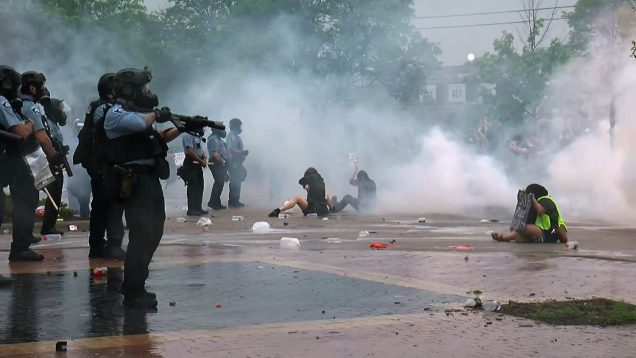
In this day and age we as a nation are facing unprecedented times. From the spread of a new virus which is causing many unforeseen deaths to the protests, riots, and violence taking place due to the alarming death of George Floyd, it appears to be one traumatic event after another. The death of George Floyd has brought out numerous people around the world to stand up for the injustice and racism that took place. Many people questioned why now? Why such a large body of people for George Floyd? He is not the first African American to die in police custody. Frank Leon Roberts, an activist who teaches a course on the Black Lives Matter movement at New York University mentions that there are a number of different factors that can answer those questions.
Floyd’s death was particularly “gruesome, obvious, and clearly recorded on video as opposed to previous instances of police violence where there was partial view of what happened, or the police officer says they made a split-second decision because they feared for their life”. Floyd’s death comes during a pandemic and high unemployment, Roberts states “the US’s 13% unemployment level means that more people than usual can protest and campaign without juggling work commitments”. Floyd’s death also came shortly after the deaths of Ahmaud Arbery and Breonna Taylor and is considered the last straw. Also, the action of the police which forcibly removed peaceful protesters from a square outside of the White House can be considered another reason why many people come out to protest (Cheung, 2020).
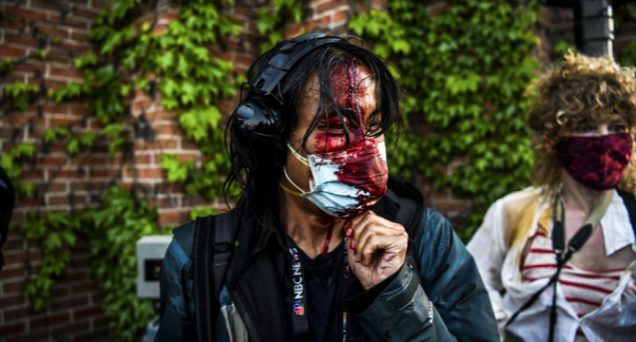
George Floyd protests on May 31, 2020
When we look at media outlets during the last three weeks we see protests all over the U.S. both peaceful and violent. The violent protests depict by both photographs and videos a sense of fear, outrage, sadness, and disgust to the viewer. Watching these photographs and videos of real-life violence can cause vicarious trauma for many people both adults and children. Some who may have been personally affected by these experiences in the past and are reliving them again today.
The experience of trauma does not need to be direct to have an impact on us. Just being witness to trauma in this course can be challenging (Rousseau, 2020). Vicarious traumatization has been known to affect mental health providers, first responders, medical professionals, and other professionals who are exposed to trauma daily. Yet, according to the U.S. Veterans Administration, research generally finds an association between watching media coverage of traumatic events and stress symptoms. Research also found that traumatic materials in the media can lead observers to experience anxiety, difficulties in coping, immense fear, and feelings of helplessness, especially in children (USVA, 2020).

Dr. Stephanie Moulton Sarkis, a Tampa-based therapist and expert in the psychological effect of trauma, mentions that “a lot of people are reporting having nightmares about being abused by police right now.” This is proving to be true amongst many therapists. Dr. Sarkis continues to state that during this time she has seen patients that who have been victims of domestic violence and have say that watching footage is bringing up issues relating to when they have been victimized (Seitz, 2020).
These protests, riots, and violence that is taking place are causing vicarious trauma to both citizens and law enforcement officers. According to a study published by the Pew Research Center, more than three-quarters of U.S. law enforcement officers say they are reluctant to use force when necessary, and nearly as many (72%) say they or their colleagues are more reluctant to stop and question people who seem suspicious as a result of increased scrutiny of police stemming from the death of Michael Brown in 2014 (Madhani, 2017). These same effects can be expected from the death of George Floyd. It effects everyone’s day to day lives.
The media is something we can not get away from. News is presented to us through so many platforms like television coverage, social media, the internet, radio, and newspapers. There is no way to eliminate the news and the vicarious trauma it brings. You have to try to come to an understanding that bad things happen in this world and sometimes to specific individuals. Limit yourself to what you view and protect yourselves from the trauma it may bring by identifying any warning signs and talking about your feelings with a professional, friend, or loved one. This can be a start to addressing the symptoms of vicarious trauma.
Reference
Cheung, H. (2020, June 8). George Floyd death: Why US protests are so powerful this time. Retrieved from https://www.bbc.com/news/world-us-canada-52969905
Madhani, A. (2017, Jan. 11).'Ferguson effect': 72% of U.S. cops reluctant to make stops. Retrieved from https://www.usatoday.com/story/news/2017/01/11/ferguson-effect-study-72-us-cops-reluctant-make-stops/96446504/
Rousseau, D. (2020). Module 1: Introduction to Trauma. Retrieved from https://onlinecampus.bu.edu/webapps/blackboard/execute/displayLearningUnit?course_id=_65989_1&content_id=_7783428_1&framesetWrapped=true
Seitz, M. (2020, June 9). The Quiet Trauma of Watching Police Brutality on Our Screens. Retrieved from https://www.vulture.com/2020/06/police-brutality-footage-vicarious-trauma.html
U.S. Department of Veterans Affairs. (2020). Retrieved from https://www.ptsd.va.gov/professional/treat/care/toolkits/provider/workingWithTraumaSurvivors.asp
I HAVE A DREAM

Joe Palczynski: One Failure of the Mental Health System
In March 2000, the Dundalk neighborhood of Baltimore, MD was terrorized by a string of spree murders and subsequently, a fugitive manhunt, hostage situation, and one of the country’s longest one-man standoffs. I lived in Dundalk and was seven years old in March 2000. My memory of those few weeks has remained vivid for twenty years. Something that was once a personal source of confusion and trepidation has become a paradigm for the broken mental health system in this country. Joe Palczynski, Dundalk’s spree killer, is just one of the endless individuals who was failed by the mental health system and went on to live a life plagued by the correctional system.
Despite growing up in a loving household free from abuse, Joe Palczynski’s tendencies suddenly turned violent and unpredictable in his teenage years, just days after a severe head injury. Palczynski’s family immediately took action to have him hospitalized and evaluated. Nevertheless, he was not given sufficient treatment, experiencing years of constant medication changes aimed at treating bipolar disorder, which were never quite successful. Over the next decade, Joe attacked seven teenage girls and found himself in his first standoff situation in Idaho after a string of assault and battery incidents. Despite all of these run-ins with the correctional system, Joe Palczynski’s mental health was never the focus, even though his behavior had a clear origin. Palczynski never received any significant inpatient treatment, counseling, or a consistent medication regimen. His bipolar disorder was never properly treated and, thus, his violent tendencies continued. This culminated in 2000 when Palczynski kidnapped his ex-girlfriend, Tracy, and murdered the three individuals who were attempting to provide her a safe-haven from his violence. Over the next few weeks, his behavior became more unpredictable and dangerous. He held Tracy captive before deciding to run from the police, murdering a pregnant woman and injuring her toddler during a carjacking. He went on to kidnap another individual, forcing them to drive him back to Dundalk, where he ultimately arrived at the home of Tracy’s family. Twenty days after he kidnapped Tracy, Joe took her family hostage in their own home. After four days of this standoff, in which Joe’s only demand was for the police to hand over Tracy, the family escaped by placing sedatives in his food. The Baltimore police ultimately ended this month of terror by shooting Palczynski twenty-seven times. Officers involved described Palczynski as “unpredictable and prone to severe mood swings” saying “he could be docile at times…then his rage would go off the charts” (Apperson, 2000). Joe was repeatedly characterized as having “previous run-ins with the law- many of them driven by mental illness” (Apperson, 2000).
Palczynski, often referred to simply as “a former convict with a history of mental illness,” is tragically not a unique case (Clines, 2000). “At any given time, 3.9 million [Americans with severe mental illness] go untreated…As a result, incarceration has become the norm for those with severe mental illness. Forty percent of them are incarcerated at some point in their lives” (Snook, n.d.). Joe Palczynski suffered from untreated bipolar disorder, believed to have been the result of severe head trauma experienced during an automobile accident as a teenager. Since this onset, Joe spent brief periods in mental health facilities and years in and out of prison, usually due to domestic abuse incidents and other violent behavior. With proper support and treatment, those with serious mental illness are no more violent or dangerous than any other individual; however, untreated “mental illness is associated with increased risk of violent behavior, with most of the evidence [pertaining] to bipolar disorder” (Volavka, 2000). This fact does not excuse violent or criminal behavior, but does provide a clear explanation and solution. Joe Palczynski’s history of undesirable behavior had a clear link to his bipolar disorder. The root cause of his criminal and violent actions- his mental health- was not properly addressed or treated for over a decade, despite a diagnosis and acknowledgment by both law enforcement and mental health professionals. “Individuals with psychiatric diseases…like bipolar disorder are ten times more likely to be in a jail or prison than a hospital” which, in cases like Palczynski’s, leads to spiraling mental illness and escalating criminal behavior (Snook, n.d.). The tragedies and violence that took place in Dundalk in March 2000 seemingly were preventable, if only the mental health system did not fail to provide the treatment Joe Palczynski required.
Apperson, J. (2000). Police reveal tale of terror. The Baltimore Sun. https://www.baltimoresun.com/news/crime/bal-pal14-story.html
Clines, F.X. (2000). Suspect’s death ends siege; hostages are safe. The New York Times. https://www.nytimes.com/2000/03/22/us/suspect-s-death-ends-siege-hostages-are-safe.html
Snook, J. (n.d.). America’s crime problems being fed by a broken mental health system. Treatment Advocacy Center. https://www.treatmentadvocacycenter.org/fixing-the-system/features-and-news/4112-americas-crime-problems-being-fed-by-a-broken-mental-health-system
Volavka, J. (2013). Violence in schizophrenia and bipolar disorder. NCBI. https://www.ncbi.nlm.nih.gov/pubmed/23470603
Sexual Abuse in the Military
When it comes to sexual abuse I always lean towards the military. I have been serving for over 6 years and sexual abuse is something I have seen first had as well as experienced in the military. I have had many soldiers come up to me telling me they needed to talk because something had happened from both genders. Sexual assault over the years has only risen in the military among all branches, the statistics show that the under reporting rate, as well as the reporting rate is rather high. The actual number of reported incidents of sexual assault has also increased in the past two years, up 26% from 4,794 to 6,053(Kime, 2019). Showing that only a third of all cases are reported, most woman don't report because 43% them stated that they had a negative experience when doing so.
Females and males in the military fear reporting because of the shame of what their peers, or commanding officers will say. I know as the years have progressed sexual offenses of any kind are not tolerated and more offenders have been punished. But the stigma of the military is that we are built tough, for any gender it is a very hard topic to come out and say that something of that nature has happened it is almost embarrassing.
Being someone who was once sexually assaulted in the military I honestly didn't want to tell anyone after it happened I was afraid of what people would say. But if it wasn't for my battle buddies they gave me the strength to stand up and say something. It was not a easy task and for the longest time I believed it was my fault, it took over a year before I trusted anyone again. But from it I learn all the right words and actions to take in case it ever happened to any other soldier.
Alcohol plays a major role almost 62% of assaults geared from it, many junior enlisted men and woman are at higher risk for sexual assault. For many people they may not understand why but for the ones who are in or served we understand how hard it is when you start out. It is just like any job you want to put your best foot forward, and your afraid of failure. The same goes in the military you want to show everyone including your family that you can do this, and sometimes you are placed in a situation as a young soldier that you don't know how to get out of. Unfortunately it is still happening to this day with no end in sight.
There are many treatments that help sexual assaulted victims because frankly many of them experience (PTSD) Post Traumatic Stress Disorder, social awkwardness, depression, or suicidal thoughts. It is a hard road for anyone to have to deal with if you do not have the proper support chain to help you get through it. I am blessed to have had that chain, and now am the support for others it is a rather rewarding feeling. Even though it came with terrible circumstances it helped me to understand psychology and respect it so much more.
It is often said that a sexual assaulted victim is victimized twice once by the criminal justice system and the other by the perpetrator(Bartol & Bartol, 2021). Self blame is also very real and one that took me so long to get over, but once I realized that I was not the problem I was able to become a advocate for others in the military for many that is not the case.
Bartol, C. R., & Bartol, A. M. (2021). Criminal behavior: a psychological approach. Boston: Pearson.
Kime, P. (2019, May 2). Despite Efforts, Sexual Assaults Up Nearly 40% in US Military. Retrieved from https://www.military.com/daily-news/2019/05/02/despite-efforts-sexual-assaults-nearly-40-us-military.html
Trauma Related to Drug Abuse
One day while at work I was standing in a lobby when I noticed a woman in her early 30s who was rushing through the door and appeared panicked. As she passed through the lobby she began crying, short of breath and fell to the ground while talking on her cell phone. When she fell I ran over to her to provide assistance in any way I could. I asked her if she was okay and if there was anything that I could do to help her. She looked at me with tears in her eyes and told me that a family member had just overdosed on heroin. At first I was shocked and felt so bad for her and then tried to help her back to her feet and then escort her to her office where I was met by her friends who consoled her and care for her during that awful time for her.
While I understand that addiction is a very complex dilemma to be in and the problems that addiction alone presents can be quite traumatizing. According to the Massachusetts Department of Public Health heroin was listed as the primary drug of abuse in 50.3% of treatment admissions. Heroin is a highly addictive opiate that caused 2,000 overdoses in the state of Massachusetts in 2016. With the drug being so addictive and extremely difficult to break the habit which could be predicated by the fact of trauma that the victim is enduring. Not only is heroin and other opiate usage dangerous, but the circumstances and dangers of that lifestyle are traumatic as well. Addicts are susceptible to perilous situations including homelessness, dangerous environments, dangerous people, and some even resort to crime to pay for their habit.
The toll that living on the streets has shown to be traumatic for the body and mind as well. According to the Boston University School of Public Health homeless individuals are more susceptible to premature deaths that can be attributed to poor sleep, lacking hygiene, and an abundance of other complications that come from living out in the elements. With many addicts resorting to living on the streets there becomes only a few ways to acquire money for their addiction.
One way of sustaining their habit is prostitution. In one article by (Silbert, Pines, & Lynch, 1982) it was estimated that between 40-85 percent of prostitutes were suffering from some form of addiction. As stated before addicts are exposed to many dangerous and traumatic situations. Using prostitution to fuel the source of their addiction can lead to many emotional, psychological, and physical traumatic events. Having to live with what they have resorted to do for their addiction can be troubling, and depressing which drives them to feel the euphoric numbness of the opiate. One study by (Farley, 2018) noted that women who participate in prostitution have a 99% greater risk for physical violence than any other highly dangerous job.
Though the affects of drugs are severe and life threatening, we must also address traumatic events that can arise as a byproduct of addiction. Risk factors involved with drug addiction are very dangerous and present a complex and difficult lifestyle. Effects of these epidemics are not centralized to the user, but as stated above can be traumatic for family and friends as well.
Farley, M. (2018). Risks of Prostitution: When the Person Is the Product. Journal of the Association for Consumer Research, 3(1), 97–108. doi: 10.1086/695670
MA Heroin Treatment Stats. (n.d.). Retrieved from https://adcare.com/massachusetts/heroin/
McInnes, K. (n.d.). Homelessness, Its Consequences, and Its Causes: SPH: Boston University. Retrieved from https://www.bu.edu/sph/2016/02/28/homelessness-its-consequences-and-its-causes/
Silbert, M. H., Pines, A. M., & Lynch, T. (1982). Substance Abuse and Prostitution. Journal of Psychoactive Drugs, 14(3), 193–197. doi: 10.1080/02791072.1982.10471928
Childhood + Complex Trauma
I'm very closed off when it comes to my experience with childhood trauma; only a handful of people know what has happened in my life. For this post, I won't go into detail about what has happened specifically over the course of my life, but rather how it has impacted me as an adult. I will say, my trauma relates to substance abuse and instability, though not in the way one may assume.
A psychiatrist not too long ago told me I seemed detached from my past, and he's not wrong. As I've gotten older, I have taken inventory of all the emotional, social, and mental changes my childhood has caused. In essence, I don't know how to cope or communicate my emotions effectively; I've adap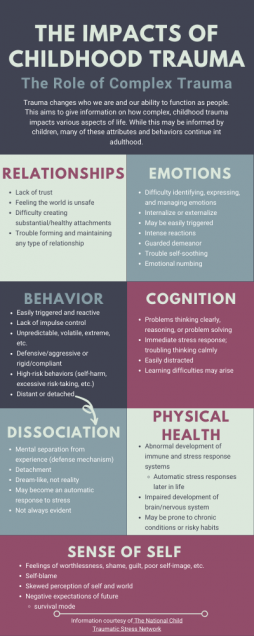 ted in perhaps not the best of ways.
These drawbacks, however, have given me inspiration. I know it's not just me that has gone through trauma that has shaped the personality, and that has encouraged me to educate a more neurotypical community and advocate for those like me.
According to The National Child Traumatic Stress Network, complex trauma, "describes both children’s exposure to multiple traumatic events—often of an invasive, interpersonal nature—and the wide-ranging, long-term effects of this exposure. These events are severe and pervasive." In general, it may seem obvious that persistent trauma would impact children in several ways, but it is incredible just how many areas trauma can reach into. I have outlined these in the infographic to the left.
But what happens when these children grow up? We turn into adults with a history, one that may constantly worm its way into our present. The areas impacted by trauma that I mentioned don't just affect the child in the face of trauma, but the adult they become in the wake of it.
Harvard psychiatry professor, Dr. Kerry Ressler, says "Early childhood trauma is a risk factor for almost everything, from adult depression to PTSD and most psychiatric disorders, as well as a host of medical problems, including cardiovascular problems such as heart attack and stroke, cancer, and obesity."
From my own experience, all of this makes sense. When you are faced with a trauma, you jump into survival mode even if you aren't in any true danger. When this is a persistent feature in one's life, it seems fair to assume this may carry on across the life span. To me, treatment needs to focus on healing the traumatized child still within us. Only then can we proceed with learning to function as an adult.
Intimate Partner Abuse
I see a therapist every other week. I adore this class because I absolutely devour anything and everything that has to do with crime and mental health. I have the kind of anxiety that is incredibly beneficial in preparing for a break-in, a house fire, and the seediest parking garage you’ll ever be forced to navigate. I’ve been on my own for almost half my life and like to think I know some things. Here’s the thing, though – none of that prepares you for abuse you don’t know is happening.
Years ago, I got into and then out of a relationship that I considered to be one of the less enjoyable I’ve had. The way I had acted and treated myself during that time stuck with me, and I felt incredibly weak and ashamed. I was so angry, and I couldn’t stop being angry.
It was only during a series of guest speakers a few weeks ago that I realized I had missed plenty of signs, and that I had been in an abusive relationship. I was blaming myself for someone else’s actions, because I “should have known better.” Because I was smarter than that. But it’s not about intelligence – it can happen to anyone.
Here are some things I wish I knew, some things I knew but thought didn’t apply to me, and what self-care is and is not.
A disclaimer: This is colloquial, and I use humor as a coping mechanism. It doesn’t mean that I don’t understand how serious this topic is; it’s just my way of telling my story.
Things I Wish I Knew
- Your friends should like your significant other.
Sounds obvious, right? Well, what if you haven’t always had great friends? Or they just don’t know him like you do? Or they did like him, but now they don’t?
Yeah… they should still like him. My friends didn’t, not after a while. I cared because it was inconvenient, but it didn’t affect me day to day. Those social circles mixed seldom. Later, my friends told me they used to invite me to things last minute so that he couldn’t “weasel his way into coming.” Direct quote.
But they did like him originally, so what happened? Well, they picked up on a red flag that I buried in the sand, pun intended (you’ll see). Long story short, he emailed one of my friends and asked her to help him set up a proposal on the beach (see?!). When I said “yes” – not if, when – he would have all our friends and family and a justice of the peace emerge from the trees and say something along the lines of “Great! We can do it right now!” He wanted to surprise marry me, not propose. My friends told me it sounded like he was trying to “trap me.” I chocked it up to him being overly caffeinated and overzealous.
- If you can’t seem to see your boyfriend’s side of the argument but still manage to cry at literally every new episode of Queer Eye, you aren’t a cold person.
This was his main argument when I couldn’t find my way to seeing his side of things. It wasn’t that he was wrong, or I was standing up for myself, or had lost patience with him. It was that I was cold and didn’t care about his feelings. I just didn’t feel things like I should, I block them out, and that’s why I wasn’t understanding him. Mind you, I have almost dehydrated myself watching Queer Eye, so it isn’t a lack of feeling. It was probably a moment of clarity, but I listened to him instead of myself. I thought that I was a cold, uncompromising girlfriend, and I needed to try harder. For him. For us.
Things I Knew but I Thought Didn’t Apply to Me
- Your significant other should support your dreams, not try to talk you out of them… or into theirs.
There are a few things I was always upfront about when starting a new relationship: I’m not sure I want to get married, I don’t want kids, and I will not stay in New England. He was agreeable to those terms at first, but as you already read, he had other plans. He just needed to convince me and then it would all fall into place.
He hated my job. He hated that it would take me away from New England eventually and that I wanted to go, so he would say things like “What am I going to do if we move?” or “My family is here – we can’t leave my family.” He would tell me I should pursue other fields or stay here until he gets a degree. He didn’t have one and it would have taken years, but I could work on my masters in the meantime. Just put the job off for a little while.
Towards the end, he kept bringing up children. I had never budged on this. I did not want kids, and to be honest, the thought of raising children with him was terrifying. But he kept pushing, saying that I would be a good mother, and that he owed it to his family to have children, and he couldn’t imagine it with anyone else. He would get angry and pick a fight when I wouldn’t engage, so I would list names I liked occasionally to stave off the aggravation. And that’s how I thought of him at that point – an aggravation. And I still didn’t leave.
- Manipulation is abuse.
- Nostalgia isn’t good enough to keep going.
- It takes more than one attempt to leave.
I never had any bruises and he never threatened to hurt me or himself. I had my own apartment, friends and family that did not like him, and financial independence. And I didn’t leave.
We had some good times when we started dating, but it took a turn after about six months. We were apart and he was insecure, and I was starting to realize how much better I felt alone. But I stayed because of those first few months. I would get angry and we would fight, but then I would remember that I was just being cold. I hadn’t always been cold, so maybe we could get back to that. I just had to try harder to see his side.
I broke up with him twice, but I let him come back for about a month each time. I finally broke up with him for good and we haven’t spoken since, but I have struggled with the amount of time I wasted after that initial break-up. I gave him more of me even when I knew there was something off. I gave up time and happiness that I will never get back.
Self-Care is Not
- Calling out of work to go to the beach alone and then lying about your day.
- Working upwards of 60 hours a week “for the overtime.”
- Considering cheating because it will be easier than breaking up.
Self-care is leaving and healing, and maybe writing about the experience for a class about mental health, who knows…
I have never worked harder than I did during this time in my life. I worked every weekend that summer, and when I finally needed some time off, I kept it a secret.
When I took a trip for work, I almost met an old boyfriend for drinks. I didn’t, but my friends told me they wish I had. They were actively rooting for it.
--------------------------------
In the spirit of fairness, and quite frankly because this is public, I feel the need to say that I don’t believe my ex is a bad or malicious person. He is an insecure person, with a plethora of life experiences that have amplified that trait. I think we did care about one another at one time, but as it started to deteriorate, he grasped at anything that would keep us together. I hope we both look back on it and realize what it was.
So yes, there are cases far worse than mine. There are people who stay longer, suffer physical trauma to mirror the emotional, who never leave. But abuse doesn't have a threshold. I was manipulated, coerced, and shamed. I blamed myself – a part of me still does. It set me back. But it counts, and I count, and hopefully by sharing this example, another person will realize sooner than I did.
The Effects of Covid-19 on Sexual Assault Survivors
Amidst the ongoing pandemic, the necessary quarantining that global citizens are partaking in has taken a drastic toll on many people’s lives. Whether it be the people hunkering down in shoe box apartments in New York City, or single mothers balancing work, household responsibilities, and now homeschooling, or even the millennials woefully returning to their parents’ homes to live in their childhood bedrooms, it is safe to say that people everywhere can relate to the hardships that Covid-19 has so eagerly presented. That being said, in these moments of hardship it is imperative to pay attention to the citizens who are facing the most turmoil during these difficult, unprecedented times. My sister living in Hell’s Kitchen, Manhattan, might be cohabitating with two other humans in an apartment that would be much better suited for one (preferably small) human, but she expresses daily her sympathy and profound respect for those who are balancing the chaos of the current state of the world and parenting. Likewise, it might not have been my dream as a 23 year old to be living in the room that I experienced adolescence, puberty, and a rather unfortunate Justin Bieber phase in, but I wake up every day in a safe place knowing that there are two people in the other room who I can trust, and who I know will provide me respect, space, and as much spaghetti as my heart desires. Not everyone is as fortunate. Currently there are hundreds of thousands of sexual assault survivors out there who are not able to have the privilege of feeling safe, either in their own homes or even in their own bodies.
The process of healing from trauma is already taxing due to the psychological, physical, and societal effects sexual assault has on a survivor. Now given the current climate it is extremely likely that these conditions will intensify said effects. Not only do the current conditions impede upon a survivor’s healing process, but these conditions can also increase the likelihood of future assaults. Despite this, public discourse surrounding this issue has been lacking, even with it currently being sexual assault awareness month. In order to address this, it is essential that as a society we look at the ways in which survivors are potentially being impacted during this time. Medical systems are currently over-run, making it difficult to access the intensive care that might be necessary. Reynolds (2020) states, “in March of last year, forensic nurse examiners in Washington, D.C., had encounters with 42 patients seeking treatment for sexual assault. As the novel coronavirus spread during the same month this year, they saw 24 patients, a 43% decrease from 2019”. Although the decrease could be associated with the overall decrease in crime, it is important to look at the fact that domestic abuse rates have increased, and sexual assault can be very much a part of domestic abuse. In addition to medical services, therapeutic services, whether it be talk therapy or trauma informed embodied approaches, are more difficult than ever to access and for survivors pursuing legal aid, assistance from law enforcement has the potential to be diluted due to severity of current Covid-19 related conditions (Me Too Movement, 2020). Sexual assault previously had the lowest reporting rate of all violent crimes (Bartol & Bartol, 2017, p. 378), so it is devastating to consider the impact the current climate might have on the rates of reporting.
The lack of necessary resources can be extremely dangerous for survivors, especially when combined with the fact that many survivors are being forced to quarantine in unhealthy households, which can play a negative role on survivors’ mental health. Toxic households have the potential to trigger negative effects of sexual assault on survivors. Additionally, dangerous living conditions can increase the chances of future assault and revictimization. Similarly, survivors in toxic workplaces, or in low wage jobs, are at an increased risk for heightened post-trauma symptoms and revictimization as well. Despite all of these troubling realizations, there was no explicit funding for sexual assault survivor programs and advocates (Me Too Movement, 2020). As a society we must spread awareness about the realities of what sexual assault survivors are facing daily. Organizations such as the National Sexual Violence Resource Center (NSVRC) and the Rape Abuse & Incest National Network (RAINN) offer resources and confidential hotlines to survivors. We are all capable of helping this cause through small steps such as, sharing links to these organizations and staying informed about the effects of Covid-19 on sexual assault and domestic violence survivors. We have to keep the conversation going.
Citations:
Bartol, C. and Bartol, A. (2017). Criminal behavior: A psychological approach (Eleventh Edition) Upper Boston: Pearson.
#MeTooVoter response to COVID-19 for Sexual Assault Survivors. (2020). Retrieved April 26, 2020, from https://metoomvmt.org/advocacy/metoovoter-response-to-covid-19-for-sexual-assault-survivors/
Reynolds, M. (2020, April 23). How the COVID-19 Pandemic Creates Obstacles for Sexual Assault Survivors. ABA Journal. Retrieved from https://www.abajournal.com/web/article/how-the-pandemic-creates-obstacles-for-sexual-assault-survivors
Examining Solitary Confinement in the United States
Earlier this semester, I completed a documentary review on Solitary Nation, an episode of Frontline which documented the experiences of inmates in solitary confinement in Maine State Prison. The episode, which was the seventh episode of the 32nd season of Frontline, first aired on April 22, 2014 and was directed by Daniel Edge. Ultimately, this documentary uses gruesome images and emotional case studies to show the need to drastically reform solitary confinement in the United States. It also documents the journey of the new prison warden, Rodney, in his mission to reduce the use of solitary confinement and implement other strategies to deal with violent inmates. I thought the film was incredibly well-done; however, it was limited in the fact that it only focused on a few inmates in one prison. After watching, I was prompted to read some broader, more recent research on solitary confinement in the United States today.
Conditions differ depending on the state and prison, but in general, solitary confinement means that the inmates are confined behind a steel door 22-24 hours a day with extremely limited human contact. There are an estimated 80,000-100,000 people in solitary confinement in the United States (Edge, 2014). Common factors of living in isolation include: limited access to rehabilitation or educational programs, limited mental health and medical treatment, and, in some cases, forms of torture such as permanent bright lighting, extreme temperatures, or stun grenades (“Solitary Confinement Facts”).
In terms of reform, there have been recent efforts to limit the amount of solitary confinement allowed. In 2017, some bills were introduced in Massachusetts, including one that restricted the use of solitary to 180 days a year rather than a decade (Zoukis, 2018). Additionally, in 2018, The American Bar Association passed a resolution for state officials to limit its use as a “last resort” and “for no longer than is necessary.. Typically not to exceed 15 consecutive days” (Zoukis, 2018). There have also been efforts to restrict the use of solitary on juveniles and the mentally ill, including the Solitary Confinement Reform Act introduced in 2018 (115th Congress, 2018).
The Texas Department of Criminal Justice eliminated the use of solitary confinement as a form of discipline, effective in 2017. However, this only affected 76 prisoners; the other 4,000 prisoners in isolation were reportedly there for the protection of themselves and others (Zoukis, 2018). The case in Texas is similar to an issue faced by Rodney, the prison warden, in the documentary. While he is trying to reduce the use of solitary in his prison, to do so ultimately means putting other prisoners and staff at risk. In one scene, Rodney is at a meeting with other prison staff and trying to pick an inmate to pull out of the isolation unit. The other staff members, particularly the ones who have to directly deal with these inmates, express their concern and fear of getting hurt, as some of them have been in the past. The documentary also states at the end that one inmate who they released from solitary ended up murdering another inmate after being back in the general population.
These scenes in the documentary demonstrate that while solitary confinement is certainly in need of reform, the actual process of pulling people out who have been in there for years can be very dangerous. Thus, in terms of reducing solitary, reformers face a dilemma in which they must decide between trying to help people who have been isolated for years or ensuring the safety of prison staff and other inmates. Furthermore, while I had originally thought of solitary confinement as merely a form of punishment within prisons, doing this research helped me realize that in many cases, the inmates are just too dangerous (or in too much danger) to have around other people. This is why some prisons, lacking the proper resources for psychological treatment, turn to what seems to be the only option: isolation.
Using solitary confinement for prisoners who are deemed dangerous is referred to as administrative segregation (Weir, 2012). In fact, prisons began using solitary as a means of protecting people in response to growing gang violence within prisons (Weir, 2012). However, segregation for safety purposes has never actually been proven to make prisons safer (Weir, 2012). Instead, it seems that placing people in solitary for years on end only makes it more difficult for them to return to the general population, because being there causes so much trauma. This is shown in the documentary I watched, which follows one inmate, Adam, as he enters solitary for the first time. In the beginning, Adam tells the director that he is confident he can handle solitary confinement, and even expects to enjoy the extra downtime. However, by the end of the documentary, Adam is regularly self-harming, starts riots in the unit, and is even shown pushing feces under his door and flooding his cell. Eventually, Adam is sent to the mental health unit in the prison.
While some progress has been made in recent years to reform solitary confinement in prisons, more still needs to be done to reduce its use, especially as a punishment. In my opinion, there must be more of a focus on mental health treatment for ‘problematic’ prisoners. Even in the documentary, prisoners who are sent to the mental health unit are shown to be in a much better place afterward. However, for many of them, they are only sent there for a few months after self-harming, only to return back to solitary immediately afterward. We need to start looking at long-term solutions that can help integrate these forgotten prisoners back into regular social interactions.
Sources:
Edge, Daniel (Director). (April 22, 2014). Solitary Nation (Season 32, Episode 7) [TV Series Episode]. In D. Fanning (Executive Producer), Frontline. PBS.
115th Congress (April 19, 2018). “S.2724 - Solitary Confinement Reform Act.” Congress.Gov. Retrieved from: https://www.congress.gov/bill/115th-congress/senate-bill/2724/text?format=txt
“Solitary Confinement Facts.” American Friends Service Committee. AFSC.Org. Retrieved from: https://www.afsc.org/resource/solitary-confinement-facts
Weir, Kristen (May 2012). “Alone, in the hole.” American Psychological Association. Retrieved from: https://www.apa.org/monitor/2012/05/solitary
Zoukis, Christopher (October 8, 2018). “Solitary Confinement Reforms Sweeping the Nation But Still Not Enough.” Prison Legal News. Retrieved from: https://www.prisonlegalnews.org/news/2018/oct/8/solitary-confinement-reforms-sweeping-nation-still-not-enough/