Missions and Projects
Each of the space missions and research projects in the lab have a dedicated page. Click on the mission name to be brought to the mission description.
Space Missions:
Developing Technology:
Solar Wind-Magnetosphere Interaction:
Current Space Missions:
LEXI
 The LEXI (Lunar Environment Heliospheric X-ray Imager) instrument will take global soft X-ray images of the interaction between solar wind and Earth’s exospheric neutrals. These images will define the boundary location of the magnetopause, the edge of Earth’s magnetic field, and display the dynamics of this boundary. The instrument will be deployed and operate from the lunar surface in 2024 as part of the first set of landers from the United States traveling to the moon in almost 50 years.
COSSMo
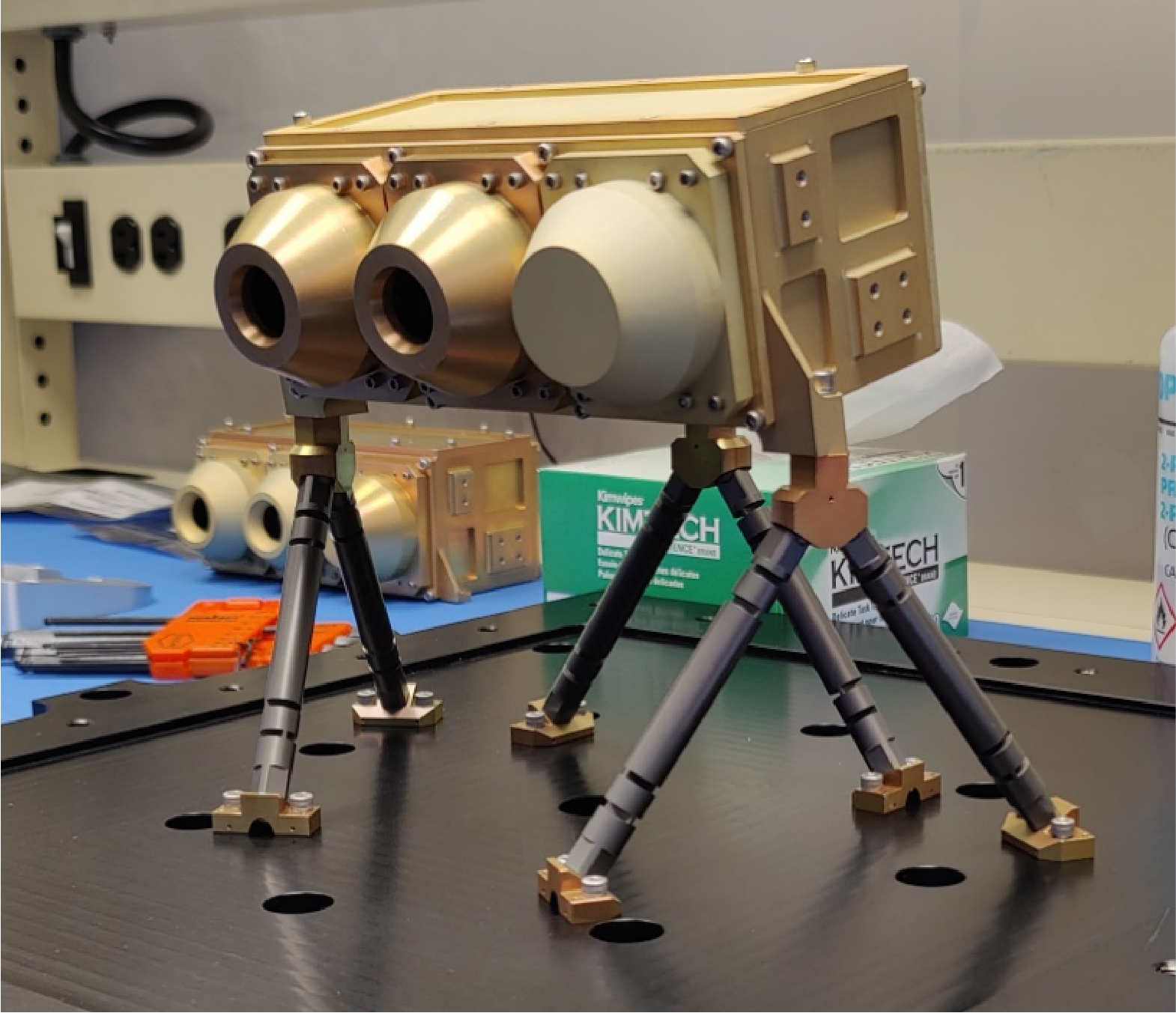 COSSMo (Carothers Observatory Student Solar Monitor) is a student collaboration instrument for the Carruthers Geocorona Observatory (CGO). CGO will observe Earth’s exosphere, and the ultraviolet light emitted from it to study its response to solar storms. COSSMo will collect Lyman-alpha and soft X-ray data from the sun while other instruments on CGO instruments observe Earth’s exosphere. COSSMo is scheduled for delivery to Space Sciences Laboratory during the summer of 2023. After a long sequence of integration and test, CGO will launch with the IMAP mission in 2025.
CuPID

The CuPID (Cusp Plasma Imaging Detector) Cubesat Observatory was a 6U CubeSat launched in September 2021. CuPID carried three instruments on board, a magnetometer, micro-dosimeter suite, and single optic wide field-of-view soft X-ray telescope. Targeting X-rays in the magnetospheric cusp, CuPID aimed to answer questions regarding the global properties of magnetopause reconnection.
Current Research Projects:
BEAR Chip
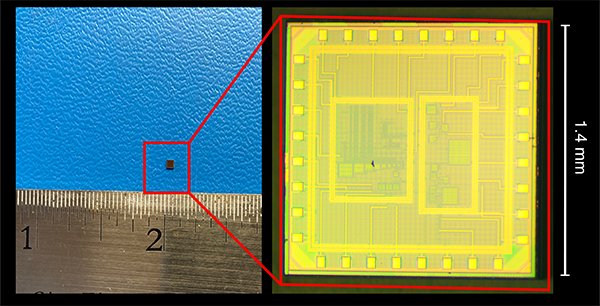
The BEAR (Boston Extended Amplitude Range) chip is a custom readout ASIC (Application Specific Integrated Circuit) being developed for a solar energetic particle telescope to improve the energy sampling capability of traditional particle instruments. Typical readout circuits use a charge sensitive amplifier (CSA) as the first stage and the detectable energy range depends on this amplifier. The BEAR chip uses a set of switchable capacitors to extend the energy range of the CSA. The first run of the chip was designed using TSMC’s 130nm technology and are mounted in 32 pin QFN packages. These chips are currently being tested in the lab.
Modeling of the Solar Wind and Magnetosphere
Past Missions and Research Projects:
ANDESITE