CuPID CubeSat Observatory

Check out CuPID’s development history through the updates that were initially published on CuPID’s website.
Log of the CuPID Blog
Overview:
The CuPID (Cusp Plasma Imaging Detector) CubeSat Observatory is designed to test competing models of solar wind-magnetosphere coupling. The 6U spacecraft is roughly the size of a toaster oven and will carry a wide field-of-view soft X-ray telescope, the first of its kind to be placed into orbit. In orbit the spacecraft will measure soft X-rays emitted from the process of charge-exchange when plasma from the solar wind collides with neutral atoms in the Earth’s distant atmosphere. The spatial and temporal patterns of X-ray images will be used to address scientific questions.
Science:
The spacecraft seeks to answer two questions related to how energy is transferred from the sun to the Earth’s plasma environment. Both are focused on the process of magnetic reconnection in which magnetic fields break and rejoin with each other. The process is widely recognized as the primary mechanism through which energy is transferred from the sun to the Earth’s space environment, however many of its properties remain unknown. The questions targeted by CuPID are:
1. What conditions favor single versus multiple reconnection sites?
Researchers have found evidence for re connection that occurs a long a single line as well as a re connection process which occurs multiple locations simultaneously. We seek to address these possibly contrasting models and identify what factors may control this spatial property.
2. What conditions favor steady versus bursty reconnection?
Evidence has also been shown for two types of temporal behavior. Some have demonstrated re connection can occur in spurts and short bursts, while others have shown a steady and continuous reconnection. Understanding if one behavior is more common than the other and what factors (if any) may control this property is also a primary goal of the mission.
These questions will be addressed through imaging X-ray emission from ion dispersion in the magnetospheric cusps.
Spacecraft and Systems:
For more extensive descriptions of the hardware, check out the CuPID Blog (Link at top of the page!)
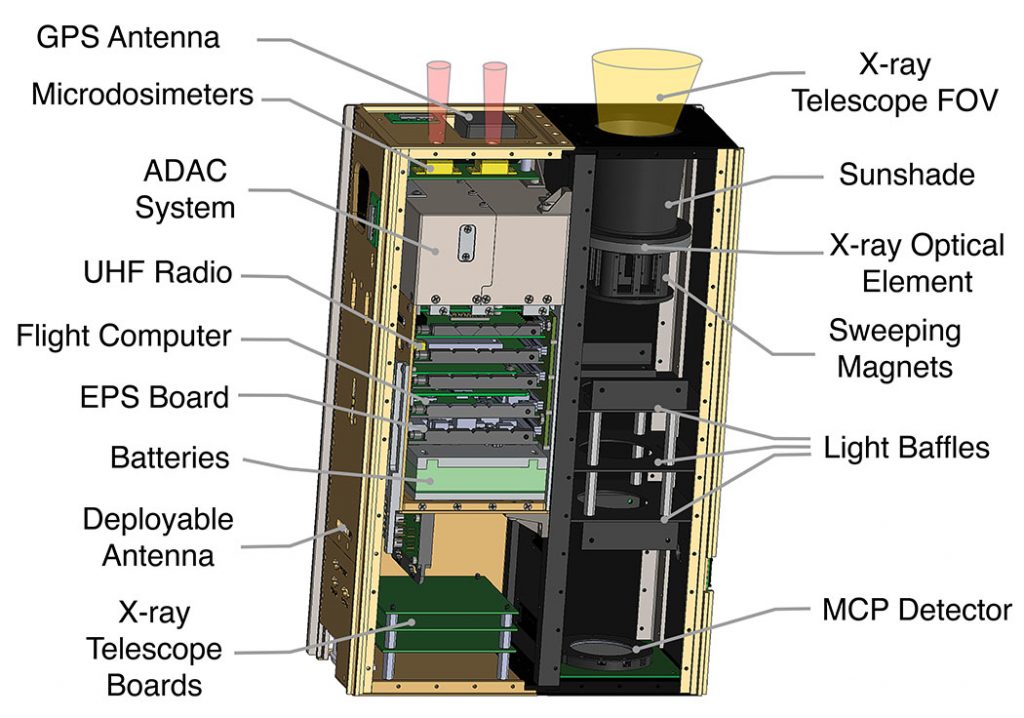
The 6U CuPID cubesat is a small volume (10cm x 20 cm x 30 cm), small mass (8kg) spacecraft comprised of a number of subcomponents working together to address the goals of the mission. The autonomous vehicle contains all the necessary components to generate and store power, point in the appropriate directions, communicate with the ground, and collect scientific measurements. A model of the spacecraft is below.
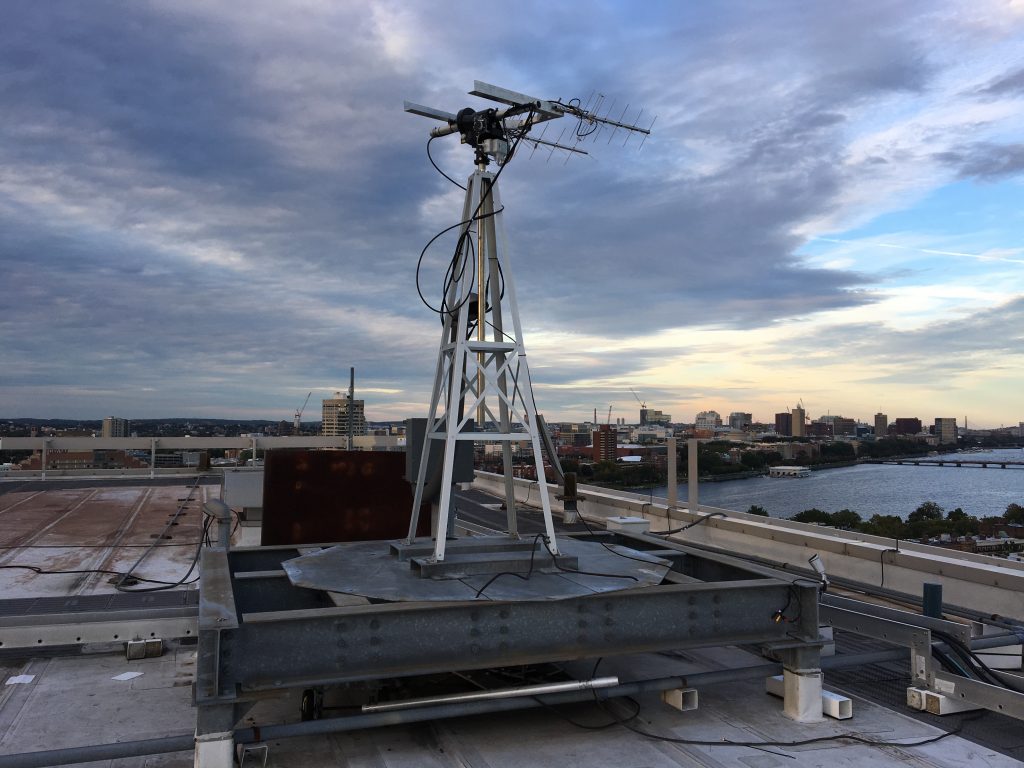
In flight, the spacecraft is controlled with a single microcontroller. Pointing knowledge comes primarily from sun sensors and a star tracker while control comes from reaction wheels and magnetorquers. Communication with the ground is conducted over UHF radio with a ground station at Boston University at 400.5MHz.
Heritage:
The CuPID mission has heritage with multiple missions. CuPID was not the first soft X-ray imager nor will be the last!