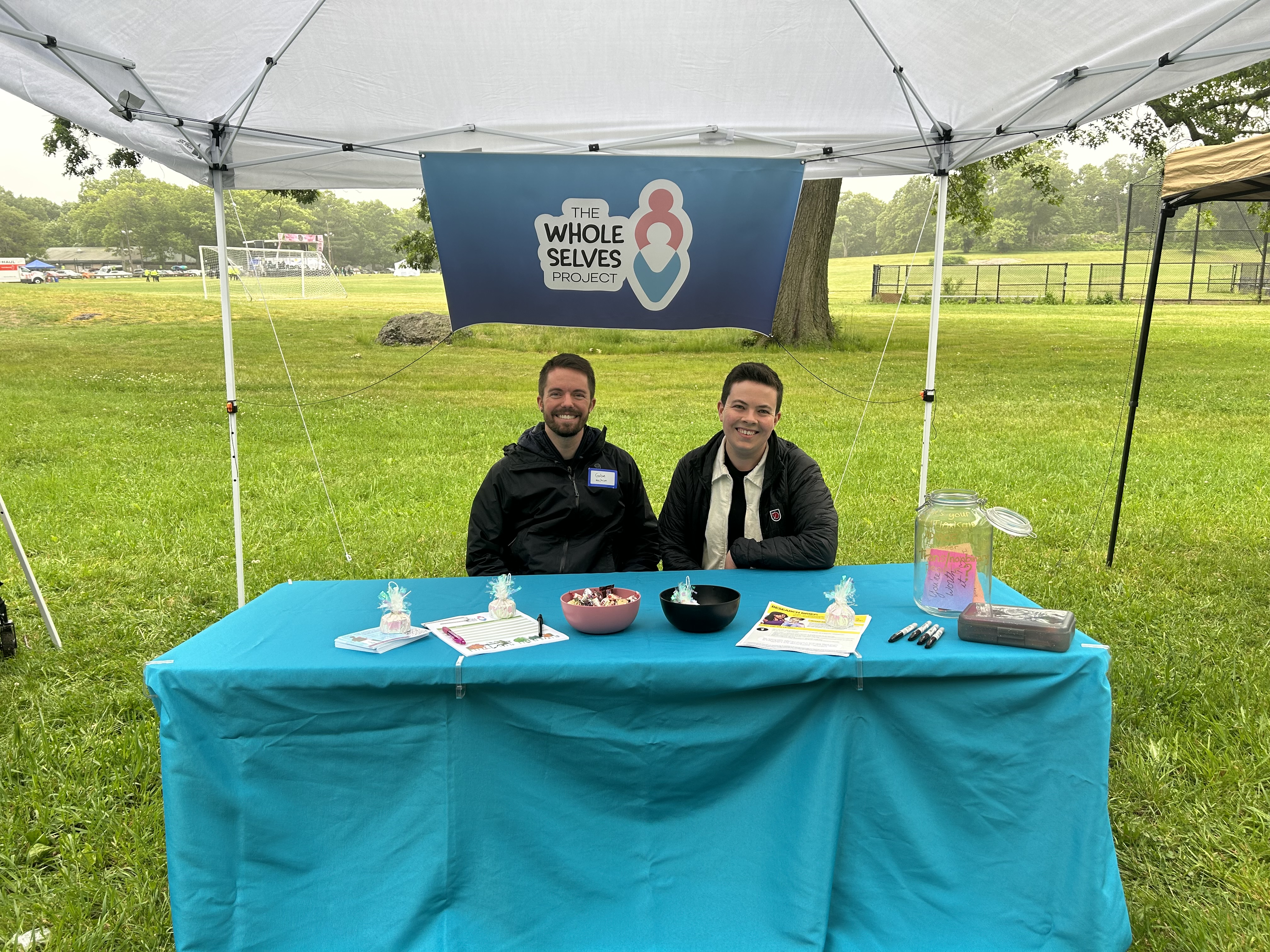
The Whole Selves Project
 The Whole Selves Project is a community-engaged research project exploring how trans/nonbinary young build supportive romantic and platonic relationships. The project is based at the Boston University School of Public Health, with input from trans/nonbinary people across the U.S. and beyond.
Over the course of the project, we’ve…
- Interviewed 30 trans/nonbinary young adults about their romantic relationship experiences, and used what we’ve learned to develop the Identity Needs in Relationships Framework, a new way of understanding how trans/nonbinary young adults build supportive romantic relationships in the context of interpersonal and structural marginalization. This work was part of B*SHARP, a broader mixed-methods research project funded by the Boston Children’s Hospital Aerosmith Endowment Fund (PI: Gordon).
- Interviewed six trans/nonbinary young adults, and surveyed 300 trans/nonbinary people of all ages, to create the Identity Needs in Relationships Scale: a series of questions that assess what kinds of identity-related support a trans/nonbinary person is receiving from a romantic partner. This work was made possible by a seed grant from the Yale University Women Faculty Forum.
- Surveyed 300 trans/nonbinary young adults about their romantic relationship experiences, their experiences with marginalization, their mental health, and their use of alcohol—checking in once per week for more than two months. This detailed dataset is helping us paint a much clearer picture of how romantic relationships may affect trans/nonbinary young adults’ health and wellbeing. This work was funded by the National Institute of Alcohol Abuse and Alcoholism (K99AA030601; PI: Murchison).
- Worked with a community-based team of 10 participants—most with both professional and lived expertise related to the project—to co-design a brief online intervention that will help trans/nonbinary young adults reflect on their experiences with alcohol use and romantic relationships. This work was previously funded by the National Institute of Alcohol Abuse and Alcoholism (R00AA030601; PI: Murchison).
Tools
We encourage community members, clinicians, and researchers to make use of the Transgender/Nonbinary Identity Support from Partners Scale (TISPS), which measures five dimensions of transgender/nonbinary identity support in romantic relationships. You don’t need to ask permission to use the TISPS; we just ask that you cite it using the information at the bottom of the questionnaire. 
We have published a paper describing the TISPS and how we developed it:
- Murchison, G. R., Paglisotti, E., Vives, G., Daley, M., & Pachankis, J. E. (2025). Development and validation of the Transgender/Nonbinary Identity Support from Partners Scale. Psychology of Sexual Orientation and Gender Diversity. Advance online publication. doi: 10.1037/sgd0000868
You can read the TISPS paper for free online.
Other Publications
To date, in addition to the TISPS paper described above, we’ve published two other journal articles describing this work.
In the first paper, we used in-depth interviews to develop a conceptual framework for understanding how trans/nonbinary young adults navigate romantic relationships in the context of prejudice and structural disadvantage:
- Murchison, G. R., Eiduson, R., Agénor, M., & Gordon, A. R. (2022). Tradeoffs, constraints, and strategies in transgender and nonbinary young adults’ romantic relationships: The identity needs in relationships framework. Journal of Social and Personal Relationships, 40(7), 2149-2180. doi: 10.1177/02654075221142183
You can read the conceptual framework paper for free, and you can also check out a research brief (PDF) explaining some key findings.

In the second paper, we used quantitative survey data to evaluate two potential ways that cisgenderism may put transgender/nonbinary young adults at greater risk of controlling romantic relationships (i.e., when their partners have excessive control over decisions that should be shared or made independently, like who they spend time with). We found that economic disenfranchisement, particularly housing instability, may play an important role in this process:
- Murchison, G. R., Eiduson, R., Austin, S. B., Reisner, S. L., Agénor, M., Chen, J. T., & Gordon, A. R. Controlling partner dynamics in transgender/nonbinary young adults’ romantic relationships: Exploring the roles of cissexism-related beliefs and material-need insecurity. Psychology of Sexual Orientation and Gender Diversity. Advance online publication. doi: 10.1037/sgd0000730
You can read the controlling relationships paper for free online.
Team
Our current team includes…
- Gabe Murchison, PhD, MPH, Principal Investigator
- Aster A., Graduate Research Assistant
- Devanshi P., Postgraduate Research Assistant
The illustrations and graphic design for this project were done by Bohigent, a queer artist based in New England.