
Nepal trip
Revolution!
So there I was, collecting data on reduplicated numerals in Newar, with Dipak Tuladhar’s very generous help in introducing me to Newar speakers, when I got a text from a friend of mine who has colleagues in Nepal, warning me that WhatsApp would soon stop working at midnight that night. I went to the hotel desk and said I had heard a rumor to this effect, and they said indeed, there is such a rumor. According to the government’s messaging, all of these social media companies (WhatsApp, Meta, YouTube, Discord…) had missed the deadline to “register” with the government. TikTok and Viber still worked, because supposedly these companies had registered. (Very curious what this “registration” process involved.) The hotel staff person told me he hoped it would not happen, but he feared it might. Indeed, that night, I lost access to Facebook and Instagram, and the next day I lost access to WhatsApp. I had to go to the cell phone company Ncell’s store to figure out how to get Viber working; I kept getting an error, and that was my only remaining way to communicate internationally.
By pure coincidence, it was on social media that Gen-Z had been complaining about corruption and the lavish lifestyles of the corrupt government ministers and their family members.
A few days after the social media ban went into effect, as you probably read, there was a peaceful protest against government corruption (*triggered* by the social media ban, but not specifically *about* the social media ban) by the Gen-Z movement. The police used water canons, rubber bullets, and…. REAL BULLETS against the young people protesting. There’s proof; they found the casings (I saw it on TikTok). It was initially reported that 19 young people aged 15-25 had been killed. Hundreds more were injured. Ultimately the death toll for Gen Z protesters would reach 35. Imagine their parents.
That night, the Internet Service Providers reopened access to social media without the permission of the government (bold!). I saw a TikTok that night in which a young Gen Z man passionately urged the army to stand by the citizens of Nepal. Amazingly, it seems that this call was heeded. The next day, Gen Y joined Gen Z in the streets, and they started setting fire to the lavish possessions of the corrupt government ministers, including homes and the Hilton hotel, which was bought by the son of a corrupt government minister for billions of rupees that had been stolen from the people. A curfew was put in place by the army, but it was ignored by the protesters. Nevertheless, the army did not harm any of the protesters. Personally, I was lucky to be in a non-corruption-derived hotel that had a kitchen with breakfast, and interesting people to talk to, including staff members and a brilliant Slovak artist, who told me about the revolution in his country in 1990.
Here’s a picture I took from the rooftop of my hotel during that period, with crows going crazy about all the smoke:

They were burning tires everywhere, and the smell of smoke was oppressive.
The Deubas were taken forcefully from their homes by protesters; the finance minister was seen swimming for his life in the river while things were being hurled at him. The airport closed down. Hospitals were overwhelmed. The policeman who gave the order to shoot the Gen-Z protesters with real bullets was beaten up and killed in the street. (The total death toll for non-Gen-Z people was eventually put at 5.) Members of parliament fled for their lives. We saw, felt and heard the military helicopters overhead rushing them to safety.
I asked a young woman working at the hotel how she was getting updates on the situation and she gave me the tip to follow “Routine of Nepal Banda” on Facebook. From there, I was able to stay abreast of the developments. It was interesting to see what people were commenting. A very common slogan made reference to other revolutions that had recently taken place in the world.
I was safe at the hotel, with the exception of the oppressive smoke. It was interesting learning about the situation from the young people working at the hotel. One young man working there told me about Rabi Lamichane, a jailed political leader. According to him, he was jailed even though he was exonerated by a jury just because he was mounting a credible opposition to the party leadership. An older man, on the other hand, characterized him as a criminal, and clarified that he was not actually exonerated; he just never got charged with a crime. Another man, halfway between their ages, told me that someone else took the fall for him, and that’s why he never got charged with a crime. Controversial figure.
Among the crazy things that happened that day was that they freed a bunch of prisoners, including Rabi Lamichane (“the king is back” read the caption with the image of a freed Rabi Lamichane).
But crucially, and amazingly, the prime minister resigned that day! Revolution!
So… Peace? At that point opinion seemed to splinter, with some people calling for continued fighting (many posted “Blood must be met with blood”), and people not feeling satisfied with such a quick and easy resolution after so many years of being taken advantage of.
I wonder whether the form of government in Nepal at this point was technically “anarchy”. I suppose the army had it under control, though, so it was perhaps more of a benevolent military coup. Not sure.
Unfortunately, even after the resignation, there was looting and burning of important cultural heritage sites such as Singa Darbar, a huge and very important piece of architectural heritage that actively housed important government and historical records. Here are two notices that were put out by the army during this period.
Things like the burning of Singa Darbar did NOT represent the Gen-Z movement.
After the resignation, Routine of Nepal Banda advocated peace and restraint, and uplifted heroes who were doing community work like saving important documents from Singa Darbar and keeping things safe and peaceful. Praise was given for acts of heroism on behalf of the community like helping to clean up the mess and protecting cultural heritage sites from looters. A young Nepali man that I talked to told me that since the police station in his village had burned down, he had been helping to patrol the village and keep it safe along with a group of his neighbors. Once the police station is rebuilt, the police will be able to work in the village again. People commented “They are the real Gen-Z” about these heroes.
During this phase, there was also a lot of online discussion about what should happen next politically. Many options were on the table, including even bringing back the monarchy (there had been pro-king rallies), but mostly the discussion centered on who should be the interim prime minister. Many people commented that “Rabi is not the one.” Another popular option was a mayor, a rapper who goes by “Balen”. Dipak Tuladhar favored Kul Man Ghising, who was famous for resolving the load-shedding crisis, where people would be out of electricity for 18 hours in a row on a regular basis. He’s an ex-engineer, and he can get things done.
Eventually, via a Discord server (!), Gen-Z opinion coalesced around Sushila Karki, a female ex-judge who is viewed as having great integrity. It took a couple of days for the issue to be resolved. One man I talked to (an older Newar man) told me that the reason it took so long is that Karki wanted to ensure that the parliament would be dissolved during the interim government, "so that she could work".
Soon after the interim prime minister was chosen, the curfews had lifted, the airport had reopened, new elections had been set for March, and Nepal announced to the tourists that it was back in business!
Sushila Karki did indeed get right to work. On her first day, she visited the injured Gen-Z protesters at the hospital. One of her first reforms was to eliminate VIP status at the airport. She also moved the government bodies responsible for evaluating government transparency and accountability out from under the Prime Minister’s control, and into an independent body of government. They also set up a hotline that you can call if you see an instance of government corruption. She appointed Kul Man Ghising as Energy Minister. As Energy Minister, Kul Man Ghising has also gotten to work.
The martyrs are also being honored and remembered.
Overall, I was amazed by the power, focus, wisdom, and restraint of the Gen-Z movement and the Nepali people in general. Maybe it’s not that surprising for a country whose main export is enlightenment.
Fieldwork practicalities
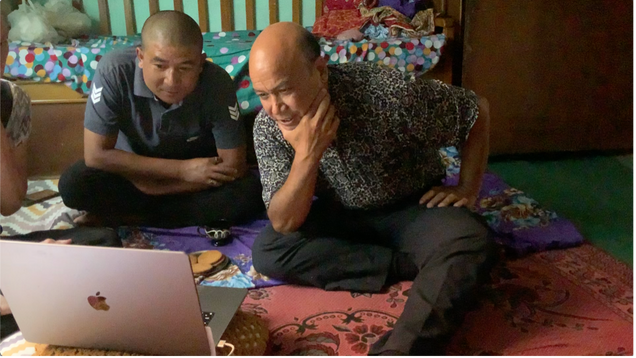
To learn about reduplicated numerals, I decided to use a setup with a Google Slides document with pre-loaded sentences and images that we could type into. I recorded the screen on the laptop and filmed the session using an iPad. Here is a shot from the iPad, with Riden Maharjen and Dipak Tuladhar.
To capture the face and audio along with the screen I used QuickTime. You initiate a movie recording, select "Float on top" to keep the video image in the foreground, and then do a screen recording rather than a movie recording; the video image stays there and the screen recording records that. I used a piece of paper to cover up the part of the screen with the movie recording so we wouldn't feel self-conscious.
Here's a shot from the laptop with Raj Kaji Shakya.

This is an example of a question of the form "Does the sentence match the picture"? In the sessions we could create new pictures by manipulating clip art in Google Slides. Some questions did not involve pictures; they could be of the form, "is this a good sentence of Newar?" and "what if I took out this word, would it still be a good sentence?"
Since I did not know a lot about the language going in, I started with examples of reduplicated numerals that I had found on the web, and asked my consultants to help me understand them. This example is from a Newar proverb that I found about specialization, which urges giving one job to each person. It has a nice reduplicated numeral in it:
सकसितं छगू छगू ज्या बियादिसँ ।
saka-sitaṃ chagū chagū jyā biyādisaM
every-to 1-clf 1-clf work give
`Give one job to each person'
Cha means 'one' and gu is an inanimate classifier.
In the picture, I tried changing the numeral to ni 'two'. It worked!
Counting riddle solved and so much more!
I presented the counting riddle that Sunita Junu had published on Tiktok with her daughter to Dipak Tudladhar. I asked if he recognized it.
Dipak told me that it reminded him of a song that he had learned when he was young! I asked him to write it down for me and translate it. I also tried to gloss it.
Note: "ka" can be a particle that appears in enumerations. From Kölver's dictionary:

Where I think we have this use of it, I'm glossing it as "enum".
Here's how it goes.
Newar Counting Rhyme (as recalled by Dipak Tuladhar)
1 (cha)
पाँय्म्व: निम्व: छतका
pāṁymva: nimva: chatakā
coins two one-rupee
2 coins of rupee one
2 (ni)
लोहंमाय् अचार् नित का
lohaṃmāy acār nita kā
in.grinder pickles grinded enum
Grinded pickles in traditional stone grinder
3 (sva)
व मिसां जित: स्वत का
va misāṃ jita: svata kā
that lady at-me looked enum
That lady looked at me
4 (pya)
जा नयेगु प्यतका
jā nayegu pyata kā
rice eating four-th enum
Eating rice on fourth (dining) floor
5 (nya)
लखय् वैपिं न्यात का
lakhay vaipiṃ nyāta kā
in-water come fish-pl enum
Fishes come in water
6 (khu)
चान्हय् वैपिं खुँत का
cānhay vaipiṃ khuṁta kā
at-night come thief-pl enum
Thieves come at night
7 (nhay)
स्वाहाने त्वाथः न्हय्त का
svāhāne tvāthaḥ nhayta kā
step ladder seven-pl enum
Ladder has 7 steps
8 (cya)
भुतुलिइ मि च्यातका
bhutulii mi cyāta kā
kitchen fire burning enum
Fire at kitchen stove
9 (gu)
भ्वाथ:गु लं गुतका
bhvātha:gu laṃ guta kā
clothes old torn enum
Old clothes torn
10 (jhi)
व मिसा छम्हं झीतका
va misā chamhaṃ jhīta kā
that girl take for-us enum
Take that girl for us
The last word of each line has a double meaning. In addition to the meaning given in the translation, it can mean 'N rupees', where N is the number of the line. For example, jhi also means '10', so jhitaka means '10 rupees'.
I am hoping that Dipak will teach his version to the kids at his school, so I made a handout that he can use for this, with pictures for each line:
Counting song - ink no English
From another consultant named Raj Kaji Shakya, I got translations for all of the lines in Sunita Junu's version.
Newar Counting Rhyme (as presented by Sunita Junu)
English translation in collaboration with Raj Kaji Shakya
1 (cha)
छम्वः छम्वः छतका
chamvaḥ chamvaḥ chataka
one-mohar one-mohar one-rupee
One mohar + one mohar = one rupee
2 (ni)
झी निम्ह नित का
jhī nimha nita kā
1pl two-cl.anim two-pl enum
We two make two
3
हुं मनुखं स्वत का
huṃ manukhaṃ svata kā
that person look enum
That person is looking [for us]
4
भ्वाथःगु छेँ पित का
bhvāthaḥgu cheM pita ka
entire house demolish enum
The house is being demolished
5
कुन्ति देगः न्यातें का
kunti degaḥ nyāteṃ kā
kunti temple five-? KA
The Kunti temple [in Patan] has five steps
6
मंगलय् कापः खुत का
maṃgalay kāpaḥ khuta kā
[place name] clothes tattered/torn KA
Mangalay clothes torn apart
7
स्वाहाने त्वाथः न्हय्तँ का
svāhāne tvāthaḥ nhayta kā
step ladder seven steps
[traditional Newar houses have seven steps]
8
बहनी मतः च्यात का
bahanī mataḥ cyāta kā
evening light born enum
The evening light was born
9
भ्वाथःगु लं गुत का
bhvāthaḥgu laṃ guta kā
old clothes torn enum
Old clothes torn apart
10
न्यातका न्यातका झितका
nyātakā nyātakā jhitakā
five-rupee five-rupee ten-rupee
Five rupees and five rupees make ten rupees
So interesting to see the similarities and differences between the two versions! Raj Kaji Shakya said that he thought that Sunita Junu's version was from Patan, based on a number of Patan-specific things in the song.
Dipak Tuladhar’s language preservation campaign

Here is Dipak Tuladhar in his office with Newar curriculum that he developed.
It was fascinating and inspiring to meet Dipak Tuladhar, who founded the Modern Newa English School in Kathmandu in 2003. It was the first minority language preschool in Nepal. At the time when he started, children were forbidden from speaking anything but Nepali in school, and could be punished for speaking their mother tongue. There was one incident in which his niece came home with a bloody hand, and when they asked her why she didn’t seek medical attention, she said that she didn’t know the words in Nepali. Many Newar kids apparently drop out of school because they’re not getting anything out of the lessons, since they only learned their mother tongue at home and not Nepali. He considers this a violation of human rights.
Dipak Tuladhar had been a businessman. In 2003 he decided to take a risk on starting a pre-school. He was on the hook for everything -- the building costs, the teacher's salaries, everything. He needed 12 students in order to make it sustainable. At first, nobody signed up. He despaired. But eventually, people started signing up. He reached his maximum capacity of 25 for the youngest cohort (called "play groups"). Eventually it grew to the point where there are four play groups with different ages, ranging from 3 years old to 6 years old. Some students spend four years there. He designed much of the curriculum himself, creating learning materials that allow students to learn both about and in their native language. It was successful! And all without any government funding. Teachers are paid fairly, and receive a bonus on the holidays that they celebrate. (Most teachers are of Newar ethnicity and celebrate Newari holidays, but when I visited on August 25th, 2025, there was one whose holiday was the next day, so she got her bonus that day.)
He went to Kritipur, a Newar-majority town, and started a school there. He helped to start a total of 10 private Newar-immersion pre-schools throughout the country, each with their own leader. He has also lobbied municipality mayors to include local languages as part of the school curriculum. The constitution of Nepal had changed in 2015 to consider every mother tongue a national language, but there was no meaningful practical support for this. But due to the introduction of federalism, a political change that gave more power to local governments, local leaders got the power to implement changes in educational policy at the local level. He has successfully convinced political leaders in many different municipalities near Kathmandu to include instruction in the local mother tongue, and has worked to produce instructional materials not only for Newar but also for other local languages too, including Tamang, Maithili, and Awadhi.
Typing in Newar
I learned how to type in Newar! Dipak Tuladhar taught me. No more studying long tables to find a match and copy-pasting. No more Google Lens to grab the character. Typing any letter, like a boss, even ones with ligatures (which are apparently called half-letters).
The easiest way to type on a computer is with Nepali Unicode Romanized keyboard:
Install Nepali Romanized as a keyboard layout. Download it here.
Here is the layout:
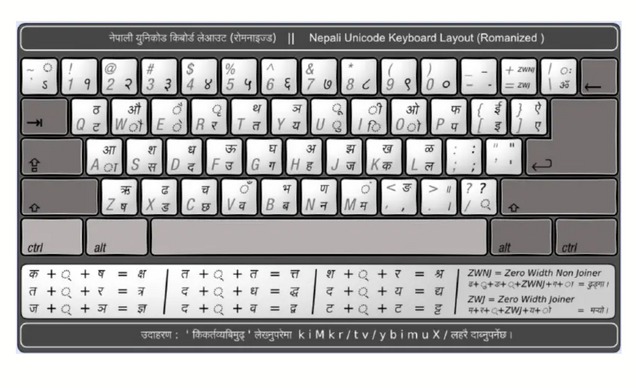
This image seems mostly to match what I get with Nepali Romanized keyboard activated, with some small exceptions (c and shift-c are switched).
On iPhone, one option is Hamro Keyboard (annoying though because it's hard to switch out of).
The nasal diacritics are made with capital V and capital M, respectively:
- Chandrabindu: V, as in छेँ - typed `CeV'
- Anusvara: M, e.g सकसितं - typed `sksitM'.
For Newari, the convention (I believe) is to use the chandrabindu (the crescent-shaped nasal) for nasalized short vowels and the anusavara (which looks like a dot) for nasalized long vowels. In the case that the nasalized long vowel is `a', the explicit vowel sign is optional (?).
You can make ligatures using /.
There are three ligatures that are special for Newari, not found in the Nepali alphabet:
- ल्ह - l/h
- म्ह - m/h
- न्ह - n/h
The visarga is not the same as the colon. The visarga is typed using | (above backlash).
You can use Control+space to switch between keyboards on a Mac.
Certain distinctions are not made in Newari (or Magar) even though they are made in Nepali (no retroflex consonants):
-
- त ट
- थ ठ
- द ड
- ढ ध
- न ण
The latter members of each pair are not part of the Newari alphabet.
Dipak was the only speaker I talked to who knew this typing method. Lucky that I encountered him early in the process!
Newari counting riddle (line 1)
Nepal Bhasa language teacher/activist Sunita Junu, who can be found not only on Facebook but also on TikTok, has posted a video with her daughter reciting this Newar counting riddle.
@sunita.junu एकमोहर एकमोहर - एकरुपैया हामी दुइजना - बेरियौँ नि ऊ त्यो मान्छेले - हेर्यो नि पुरानो घर - भत्कायो नि बगलामुखी महादेवको मन्दिर - पाँच तल्ला मंगलबजारमा कपडा - च्यातियो नि भर्याङ्गको खुड्किलो - सात खुड्किलो राती बत्ती - बल्यो नि पुरानो लुगा - फाटियो नि पाँच रुपैयाँ पाँच रुपैयाँ - १० रुपैयाँ This famous newār counting riddle was taught to Mr. Suprasanna Bajracharya @Supra Bajra by his lovely and respected mother Ms. Prem Laxmi Bajracharya (Dhapagaa:, Patan). this recalls our childhood memories. As a lingustic student, I had to shuffle some words in this riddle so I had to amend little bit on it. Today, I am teaching this riddle to my daughter as well. #sunitajunu #learn_nepalbhasa_with_sunitajunu #newarriddle #conuting_in_nepalbhasa
Junu has included a transcription in the video, and she has posted a translation into Nepali. If you paste the Nepali into Google Translate, this is what you get:

Clearly it has something to do with counting, going one, two, etc. with each line. This English translation is also clearly way off.
What do all of the words mean in Newari? How do you even type it? You can't copy and paste from the video. But I must know. It's so cute.
First step: Take screenshots of all of the transcriptions.
Here is the first pair of lines.

Clearly, she is using Devanagari script. The first symbol appears to be the consonant ch. I've been finding this Devanagari keyboard from Lexilogos handy. Look! There's cha.

And that makes sense, because the word for "one" in Newari is cha. Here's an excerpt from Kölver and Shresthacarya's (1994) "A Dictionary of Contemporary Newari".


By the way, look at that beautiful numeral reduplication construction! -gu is the default numeral classifier for inanimates, and -mha is the default numeral classifier for animates. Raises a lot of questions... research questions! 💡
OK, but what about the next syllable?

It looks a bit like an m (म) and it clearly has a visarga at the end.

But it's not just मः, there's something more going on there. It's not listed among any of the consonants.
A clue came as I was reading in the front matter of KS dictionary and came across the word "ligature".

Googling about ligatures in Devanagari, I came across a Wikipedia article on Devanagari saying that "Aspirated sonorants may be represented as conjuncts/ligatures with ह ha: म्ह mha, न्ह nha, ण्ह ṇha, व्ह vha, ल्ह lha, ळ्ह ḷha, र्ह rha."
But none of these are our guy! What is that symbol?
Finally I found the Technical Manual of Itranslator 99 by Ulrich Stiehl. This Ulrich was not messing around. On page 13 I found the symbol. It's mva.

And guess what. If you type mva into the Lexilogos Devanagari tool, you get back that symbol! And you can even type mvH to get the visarga as well. Copy and paste it, be my guest!
म्वः
Not only type it, now I can look this word up in in the KS dictionary. The Roman spelling helps. Drumroll please... It means mohar! It's a shortening of a longer word that sounds more like mohar; this is the variation that is listed after the main entry.

And that has got to be it, because it's half a rupee, and takā means rupee!

Solution for line 1:
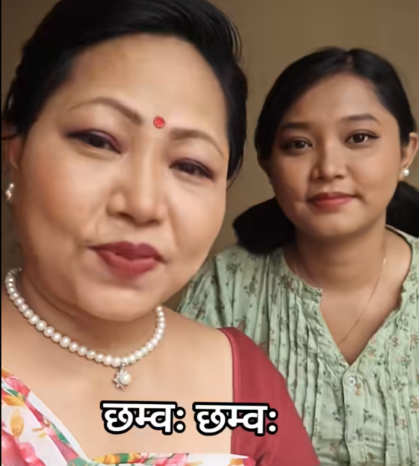
छम्वः छम्वः
|

छतका
|


Field trip to Nepal!
I am going on sabbatical this fall, and I've decided to visit Nepal!

Why Nepal?
- It sits at the crossroads of several different language families, the two biggest being
- Indo-Aryan from the west and south, including the national language Nepali, an Indo-Aryan language (closely related to Hindi)
- Tibeto-Burman (part of Sino-Tibetan, more closely related to Chinese than to any Indo-European language) from the north and east, including Nepal Bhasa, the language I'll be studying (also known as the Newar language, or Newari).
- Furthermore, the mountainous nature of the region, in some ways similar to the famous archipelagos of the Pacific that also furnish great linguistic diversity, helps keep languages separate from each other, all within the same country. There are 14 official regional languages, and it is estimated that there are around 100 different languages spoken throughout the country.
- Many of these languages have a rich history and culture of writing. That's good for a non-phonologist like me! (Unlike my new colleague at notaphonologist.com, I am actually not a phonologist.)
- The scripts in these languages are extremely beautiful. Already, the Devanagari script, which is used to write Hindi, is totally gorgeous, but then there are other ones as well. Nepal Bhasa has its own script, Nepal Lipi (alt. Ranjana), which was used in early Buddhist religious texts and was previously banned.
 Even though it can be written in this more traditional script, Nepal Bhasa is standardly written in Devanagari, just like the Indo-Aryan national language, Nepali. So the kids only have to master two-ish alphabets (Devanagari and Roman).
 - I am fascinated by numeral classifiers and they are all over this region. In the following picture, the black dots are languages with numeral classifiers. Both Nepali and Newari/Nepal Bhasa have rich classifier systems.

Unofficial reason #6: Via Facebook, I know someone who runs an English-language school for Newar kids in Kathmandu called Modern Newa English School, and he's very nice.
There are several names for the language that these kids speak (or learn to speak) in the school, which I now usually call Nepal Bhasa. Newari is a name that I have used in the past, but it seems to be falling out of favor. "Newar" is apparently considered more polite than "Newari". In name "Nepal Bhasa", "Nepal" really just refers to the Kathmandu Valley; that's the origin of the name for the country. Bhasa just means "language". The Tibeto-Burman Newars had settled the area centuries before the Indo-Aryans came. In 1906 Nepal Bhasa was banned from education in the the schools, and many other minority languages were silenced. But there has been a change in policy more recently, and language activists have worked successfully to keep minority languages alive. Now, according to the Constitution of Nepal,
All languages spoken as the mother tongue in Nepal are the languages of the nation.

Although its status is "threatened", Nepal Bhasa is a healthy minority language, thanks to the dedication of many scholars and activists. It is quite well-documented, with several dictionaries, grammatical descriptions, and digital online resources. There is even a feature-length film coming out this summer. It is a beautifully animated Newar folk tale. I learned about this from the Facebook page of Nepal Bhasa language activist Sunita Junu, who also produced a video of an amazing counting riddle that I am now obsessed with. This will be the subject of my next post.
If you'd like to follow along on my journey, you can find my latest posts here.