Updated food recommendations, new student profile
Many thanks for the kind welcome our new student blog has received from the Gastronomy community. We welcome your feedback and involvement as the blog continues to take shape.
Be sure to visit the Cooking + Eating in Boston section, as it's been updated with your suggestions. And check out the new student profile on David Strock, who'll be graduating soon and leaving Boston behind for Spain.
Outside of the classroom: Avi Schlosburg & Slow Money

by Avi Schlosburg
I’m a second-year student in the Gastronomy program, and I’m focusing on policy and systems. I’m also a research and development intern at Slow Money. Slow Money is a nonprofit organization working to catalyze venture capital and investments into small food enterprises across the country. Their model is similar to Slow Food, with a large national umbrella organization that incubates smaller local chapters. These local chapters are bringing entrepreneurs together with investors, finance experts, and various food systems stakeholders to get money flowing into regional and local food systems.
When I moved up to Boston from Maryland in January 2010, I was scrambling around to find a job or internship relevant to my Gastronomy studies. I came across a position on Sustainable Food Jobs for an Executive Assistant/Social Media Expert with Slow Money and of course applied. I didn’t even get a “thanks but no thanks” and was pretty bummed about it, despite being wholly under qualified. Still, getting a position with an organization like Slow Money was basically the reason I picked up my life and moved to Boston.

After settling for a temp job at MBTA for the summer doing mindless work that had absolutely no relevance to what I was studying or wanted to do with my life, I decided I needed to convince Slow Money to give me another chance. I didn’t have anything to lose, so I emailed the contact person on their website and poured my heart out about how I wanted to create a just and sustainable food system and how my past experiences would help Slow Money do just that, which at the time was a bit of an exaggeration. Now, seven months later, I’m writing grant proposals, helping to organize their national event, and conducting extensive research for their nationwide communications efforts.
In all the work I do for Slow Money, I find myself relying heavily on the knowledge I have accrued in the Gastronomy program. From discussing Slow Money’s impact on the growth of alternative food systems when I write grant proposals to writing reports on the market and investment potential for CSAs, alternative supply chains, and organic farms, I find myself consistently using my library of books and articles from my last year as a student of Gastronomy.
The moral of the story? Boston University Gastronomy program + being creative/proactive/maybe a little pushy = working on things you actually care about.
This is the first in a series of posts from Gastronomy students on how they're putting their classroom knowledge to work and expanding their education through internships and volunteer opportunities. To write about your own internship, volunteer position or job, send an email to gastronomyatbu@gmail.com.
Food news roundup: February 25
Here are a few interesting bits of food news from around the web this week. Please feel free to share thoughts, reactions and anything else of interest in the comments section.
Mayor Rahm Emanuel's plan to address Chicago's food deserts and turn the city into a "Let's Move" metropolis
A victory for sustainable seafood advocates: Costco agrees to remove controversial seafoods from its shelves
Google throws its considerable weight behind the push for more home cooking with new Recipe View function
New study finds that a tax increase on high-calorie foods reduced the amount consumed, but only in the absence of calorie count information
USDA and private contributors make $5 million investment in East Coast broccoli
Event announcement: Dr. Psyche Williams-Forson lecture
 Dr. Psyche Williams-Forson, Associate Professor of American Studies at University of Maryland, will be visiting BU and discussing her studies of visual and material culture as they relate to food in a lecture called "Do You See What I See? Bringing Visual and Material Culture Approaches to the Study of Food." Here's additional information about the lecture topic:
Objects speak! Objects speak volumes, in fact. They tell us much about how they were made, who made them and when they were made as well as their social, cultural, and political contexts. In his essay “Mind in Matter," Jules Prown writes “material culture is the study—through artifacts—of the beliefs–values, ideas, attitudes, and assumptions–of a particular community or society at a given time.” In addition to bespeaking our communities, objects also denote our class and social status, among other aspects of our lives. Food, as an object of material culture, is no exception. This discussion will consider groups of foods—singular and collective—and argues for ways that methods like object analysis inform our lives, histories, and cultures, laying it all bare and making it all the more porous.
EVENT INFO
Tuesday, March 8
6-7:30pm
Room 527, College of Graduate Studies Building (871 Commonwealth Avenue)
Report from the front lines: TEDx Manhattan
by Emily Olson
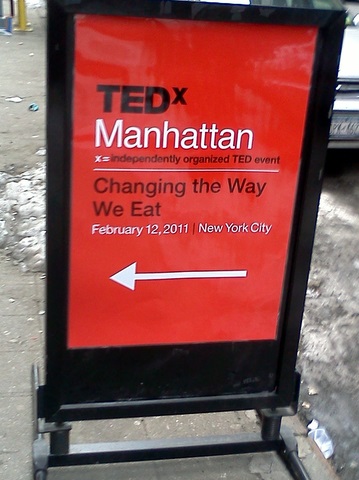
The TEDx Manhattan "Changing the Way We Eat" conference was an assault on the senses. Music was heard, experts were seen, and food was tasted and touched. I was thrilled and excited to attend the conference in person, but I didn't know what to expect other than a “TED” style of learning. The event focused on sustainable food and farming, with the goal of creating new connections and collaborations across various disciplines (academia, restaurants, writers, farmers, and researchers).
Stepping into the Prince George Ballroom, gilded chairs were set in tightly packed rows forcing a bit of networking and creating a sense of intimacy for participants and presenters. The conference’s main organizer, Diane Hatz of The Glynwood Institute for Sustainable Food & Farming, opened the conference with some TED house rules: turn all technology off, be open to the possibilities of new ideas and people, and have fun. The program kicked off with ETHEL, a three-piece string “house band” performing a portion of Coldplay’s “Viva la Vida”.
The day was divided into three parts: what happened, where are we, and where are we going. In total, 22 speakers delivered powerful and thought-provoking messages in rapid succession. No lengthy introductions, and no question-and-answer session from the audience. Each speaker had the spotlight for 10-15 minutes. Distilling all the information from the 22 presenters was difficult to do. Below are three presenters, one from each session, who delivered something I found innovative, remarkable, and actionable.
Click to read more about the speakers (and food) that left a lasting impression on Emily.