Food and the City Conference Gastronomy Prize Presented to Gary Chi-hung Luk
Dr. Rachel Black, Assistant Professor and Gastronomy Program Coordinator, presents the Gastronomy Prize at the Food and the City Conference, February 24, 2012, to Gary Chi-hung Luk, Ph.D. Candidate in Chinese Studies, Oxford University, for his paper, "Food Hawking and Public Markets in Early Colonial Hong Kong, 1841-48."
Sating the More Insistent Hungers at the BU Food and the City Conference
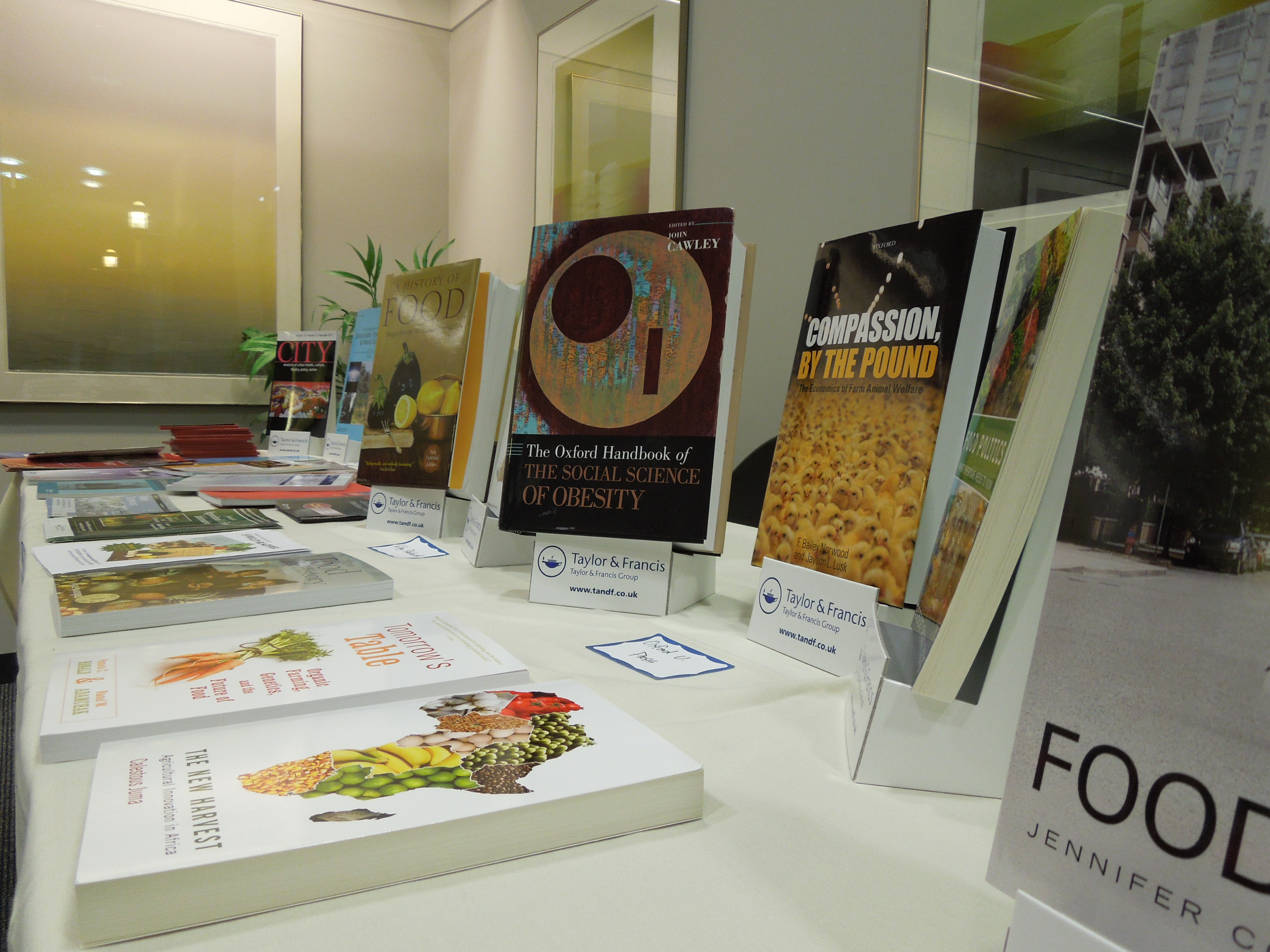
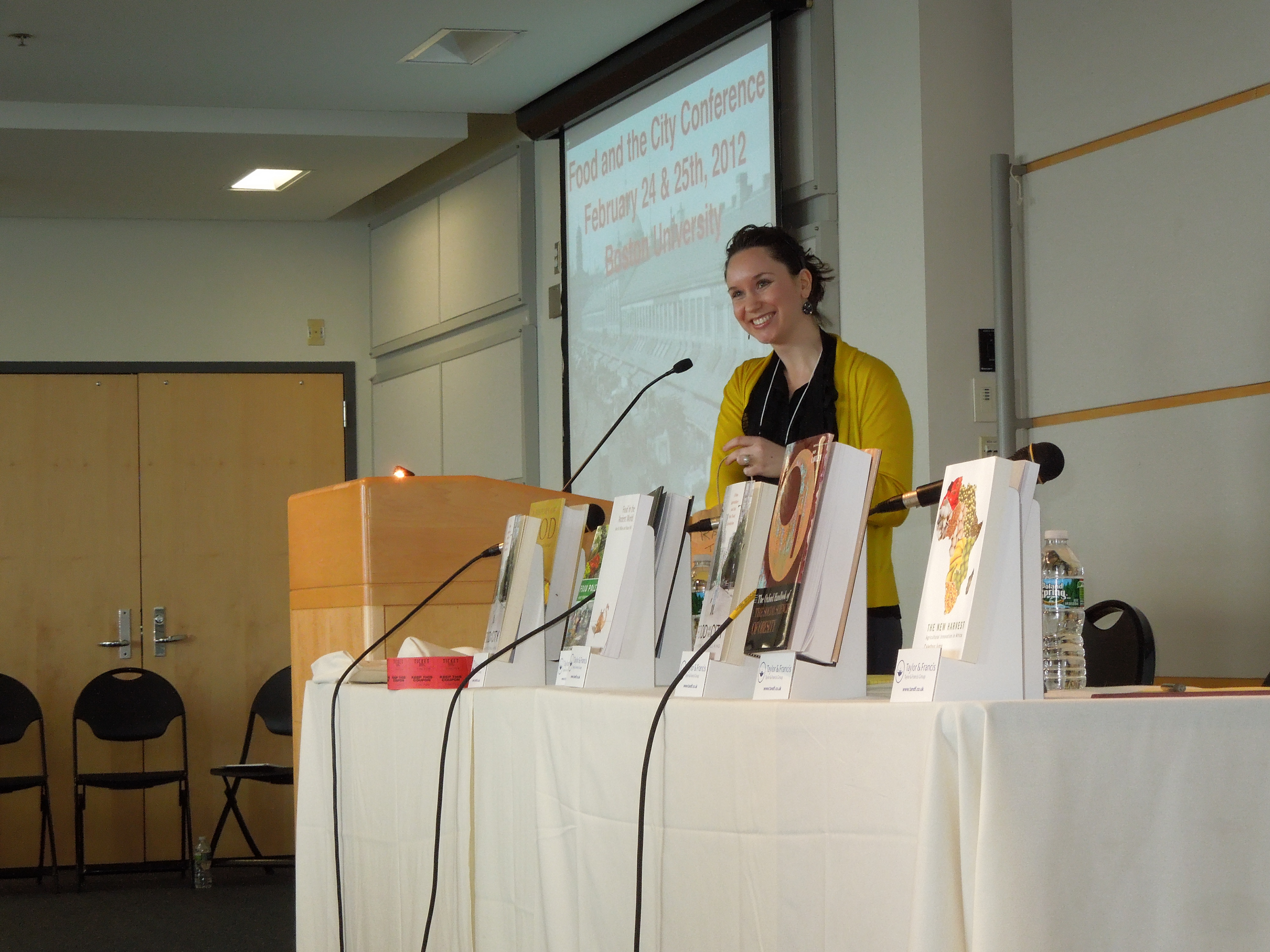
by Brad Jones | with photos by Lucia Austria
As the first food and history symposium to be sponsored by Boston University, the Food and the City Conference went extraordinarily well. The Gastronomy Program’s very own Ken Albala set the event's tone in his conference keynote. He suggested a very historical perspective through which to see the contemporary American cultural zeitgeist of locavorism, artisanship, integrity, and tradition. He posited that history operates in cycles and that the current movement away from industrialism and modernity is merely a particular incarnation of the age-old conflict between progress and romance—between looking forward and looking back.
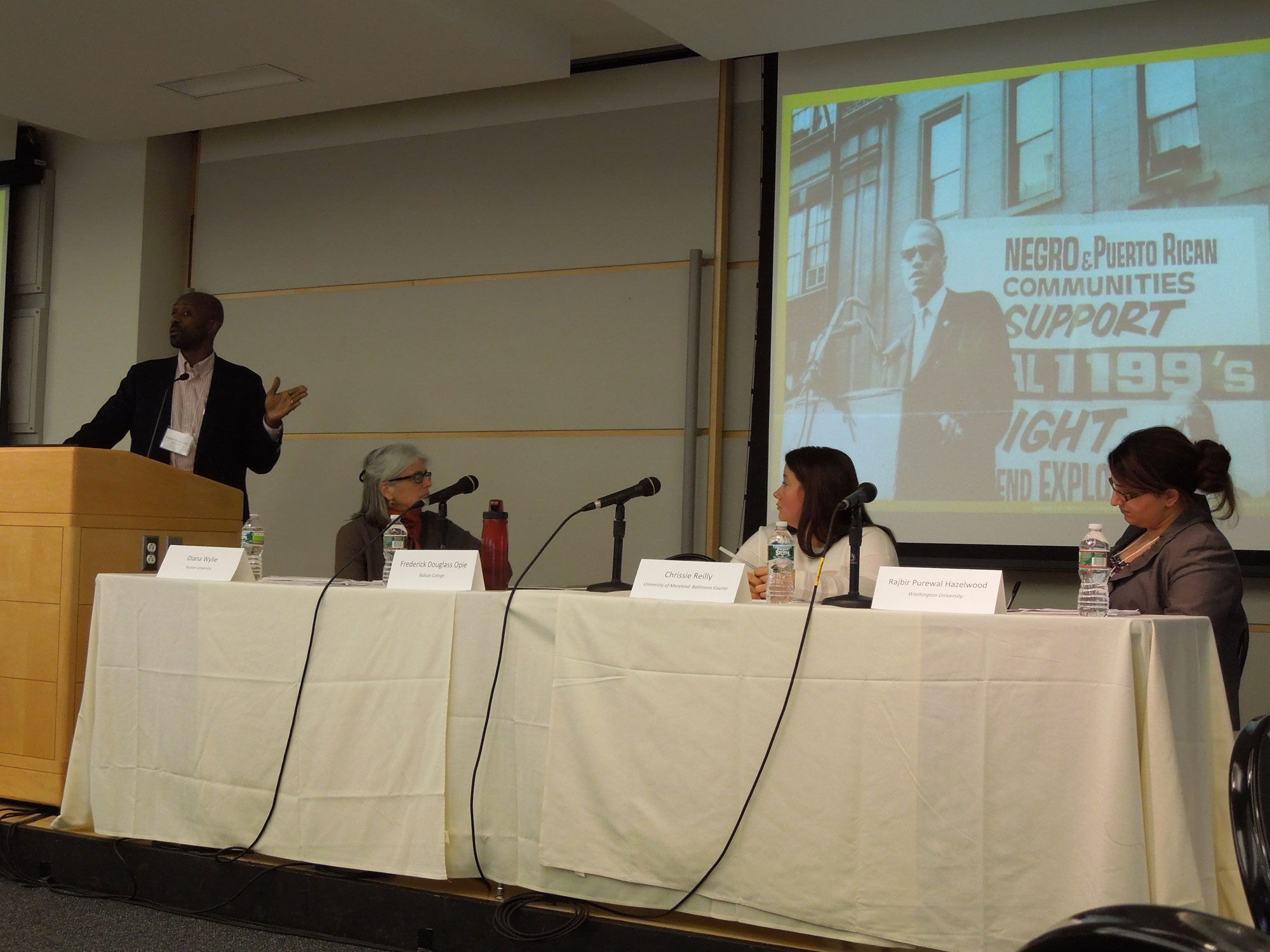
While this thesis may certainly engender disagreement, I have my own concerns with thinking about the past and its influence on the present in a structurally conditioned way. Ken highlights the way in which history, and food history more specifically, can be and is an important and fruitful conceptual lens toward thinking about not only our contemporary world but also the world we will inhabit to come. Alas, Babson College professor Fredrick Douglass Opie was incessant in suggesting that food culture and food practices of the past should be neither anachronisms nor artifacts: that any good historical research is sure to inform an ongoing discourse in the present. Dr. Opie's blog, Food as a Lens, does just that by exploring "the history of food traditions, culture, and systems and the history of campaigns and movements for, about, and involving food."
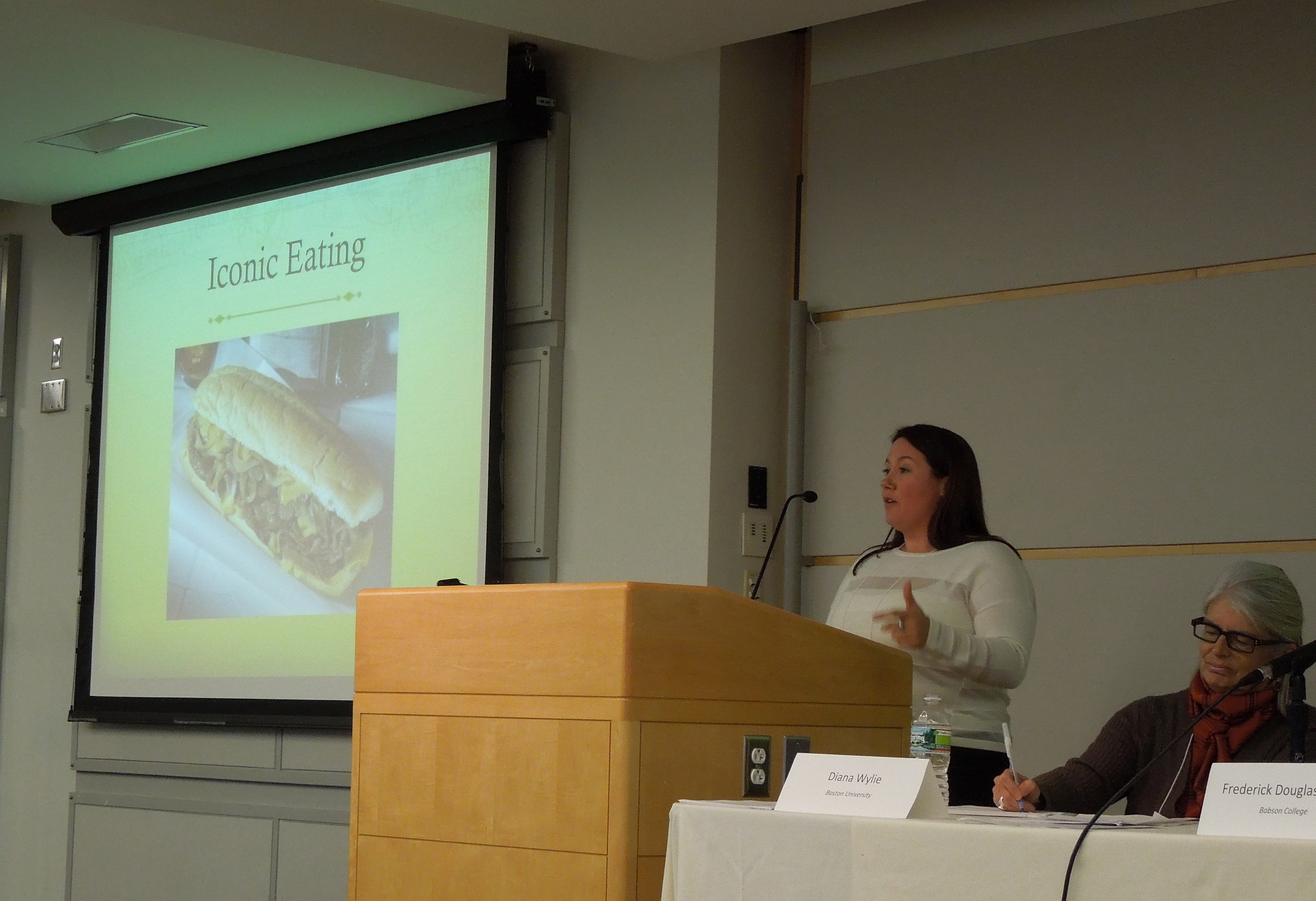
Indeed the conference informed present discourse! The topics presented at the conference were of great depth and breadth and they reveal just how important an interdisciplinary approach is when conducting food studies. While positioned in the discipline of history, we heard papers on markets, economics, policy, activism, identity, nationality, culture, social class, and social change. Arguably the most enthusiastic presentation was given by Chrissie Reilly, a PhD student of Warren Belasco, who proved once again, this time through the lens of the Philly Cheesesteak, that food can not only be delicious to eat but nourishing to think in her paper “Hungering for Authenticity: Consuming the Cheesesteak in Philadelphia and Beyond.”
BU History Chair Bruce Schulman in his welcome went so far as to suggest that it is with food that we attempt “to sate our wilder, more insistent, hungers”—not mere visceral desires but pangs of justice, truth, civilization, nature, and, in the end, what it means to be human. I must confess for my own part, that rather than being sated at the Food and the City conference, these appetites were only increasingly whetted.
Brad Jones is a Gastronomy student. He also works at Formaggio Kitchen.


Food News Round Up

If you didn't watch the Oscars last night, you might have missed that The Muppets won for Original Song. And any Muppet lover knows that Jim Henson is also responsible for the characters of Sesame Street. In a, we'll admit, slightly bizarre six-degrees-of-separation-kind-of-way, that explains why we're doing Food News Round Up Sesame Street-style this week.
Thus, this smattering of food news is brought to you by the Letter "F" and the Number "5."
1. Fix the Food System
- A report from Food & Water Watch claims that Walmart can’t fix the food system
- Learn 9 things you've never heard about America's food from Tracie McMillan
- Please mark your calendars for Tracie McMillan's Gastronomy Lecture, March 29 at 6 pm, SHA Auditorium and RSVP here.
2. Follow Food Politics and Economics
- Obama administration creating school vending guidelines
- Connecticut bill would require labeling of genetically modified foods
- As feed prices increase, thousands of chickens die on Central Valley egg farm
- Essay by politics professor, Aaron Bobrow-Stain, previews his book, White Bread
3. Figure out Fast Food
- Yum Brands CEO, David Novak, discusses U.S. fast food business abroad
- Sandelman study finds McDonald’s brand perception declines as sales soar
4. Focus on Cuisine
- NPR’s “the salt “considers English cuisine à la Downton Abbey
- Analysis of a 1947 Chiquita cookbook reveals banana politics
- Chef, Sara Jenkins, asks what is authentic Italian food and does it really matter?
- Fox News releases list of restaurants where mere mortals will never get a reservation
- “Wild girls of food” discuss gender inequality in the industry
5. Find Food Trends
- Greek yogurt stirs up the food industry
- Scandinavian food popularity increases in the UK, but why?
Introducing a New Graduate Assistant
Allow us to introduce our newest graduate assistant, Lucia Austria. She’ll be helping out with this oh so marvelous blog, as well as supporting program events and special projects.
 Lucia has long been intrigued by food and culture. “My parents are Filipino immigrants, and my interests in food and culture sprouted from my family's love of their native cuisine,” she says. But after earning a degree in business from Boston College, Lucia realized she would rather be on her feet and work with food than sit in an office. Inspired to change course, she attended Le Cordon Bleu in Cambridge, Massachusetts and then worked as a cook for a year. She began the Gastronomy program in 2010, while finishing her externship at The Gallows in the South End.
Her primary interest is food history, focusing on Spanish colonial foodways in the Philippines. She explains, “There's a lot of literature on Latin American foodways shaped by past European pursuits, but there's little done on the foodways of Spanish Philippines. I think there's a lot that can be discovered and understood about the foodways during this era in Philippine history, and how it has influenced the consumption habits of Filipinos at home and abroad.”
Currently, Lucia puts her love of working with food to, well, work at Taza Chocolate in Somerville where she is as an artisan Chocolate Maker. After graduation, she hopes to pursue her research goals in the Philippines and Spain.
Labor Across the Food System
by Alex Galimberti
When you go out with your friends to eat at a restaurant, do you think about the people who cooked your food? Cleaned your dishes? Set your table? When you buy ingredients at the store, do you think about the people who harvested your vegetables? Or about the person who safely packaged it for travel? Delivered it to your city? What about the cashier at your local store? When you cook a piece of animal protein, do you think about the person who slaughtered it? Fished it? Butchered it?
What do you know about the multiple hands that touched your food? Are the people who bring food to your plate well paid? Do they receive any benefits? Are they forced to go to work when they are sick? Are they oppressed? Abused? Raped? Displaced from their countries? Enslaved?
All of these questions are too big to be ignored by the food movement. They are too big to be ignored by food studies. This is the reason why on February 3 and 4, a group of researchers, professors, students, and activists, gathered at the University of California, Santa Cruz, for a day-long conference entitled Labor Across the Food the System.
The conference started with a keynote lecture by California historian Frank Bardacke who laid the tone for the conference by giving a compelling account of his experience as a farm worker in the Salinas Valley during the seventies. His vivid description of struggling to learn the complex craft of working the fields as a lechuguero (lettuce picker) and an apiero (celery picker) emphasized the historical undervalue given to the “keenness of the eye and cunning of the hand” required to work with the uneven and unpredictable nature of a living vegetable. Bardacke concluded by pointing that the problems with our agricultural system will not be fixed until the industry acknowledges that inexperienced and unskilled workers cannot maintain productivity and profitability. An example that proves his point is the fact that the state of Georgia lost several crops last year after strict anti-immigrant laws caused an exodus of skilled farm workers.

After such a poignant opening to the conference the following four panels that took place all day on Saturday showed specific examples of struggles and successes to achieve better work conditions throughout the food system. Noteworthy speakers included Lucas Benitez from the Coalition of Immokalee Workers, Mónica Ramírez from the Southern Poverty Law Center, Deborah Barndt from York University, Carolina Bank Muñoz from the Department of Sociology at Brooklyn College CUNY, Saru Jayaraman co-director of The Restaurant Opportunities Center United. These and all of the other speakers and organizations present at this conference are valuable sources for any Gastronomy student, especially if you are taking Dr. Counihan’s Food Activism or Dr. Messer’s Food Policy classes. Every panel was perfectly tied together and if anybody wants more details I can happily share notes.
The speaker for the wrap-up lecture was Eric Holt-Giménez, executive director of the Food First Institute for Food and Development Policy. His talk tried to break down the myth that the global food system is ‘broken’: regardless of the global food crises of 2008 and 2011 the major food corporations continue to report record food profits every year. This means that the system works perfectly fine to protect the interests of the corporate industrial food complex. Holt-Giménez observes that the food movement is stuck in a bubble; it ignores other movements, mainly the labor movement and social justice movements. His recently edited book Food Movements Unite! shows the idea that the diversity of different social movements should be used as a weapon to bring systematic change. This change must come through the re-politization of social movements. This call to action resonates with the previous speakers who emphasized the need to bridge the gap between academic research and activism.
Six Smashing Food Exhibits: No Tickets, Shoes, or Shirts Required
by Emily Contois
 One of my favorite things on a weekend afternoon, a weekday evening—well, we can go ahead and say just about anytime—is to spend a few glorious hours of levity and escape at a museum. I'm lucky to live in Boston where world-class museums abound as plentifully as colleges and universities, but sometimes, I hear you, we get busy and don't make it out the door to enjoy the many intriguing exhibits on display. Here you'll find six smashing online food museum exhibits that you can visit anytime you like from your computer—and in your pajamas if you so desire. There are likely many more delightful virtual expos, but these six, listed in no particular order, can be a very filling place to start...
- Julia Child's Kitchen: Even if you aren't in Washington D.C. you can peek in the drawers and cupboards of Julia Child's kitchen, view selected culinary objects, and peruse an interactive timeline that chronicles her love with cooking. Exhibit by the Smithsonian, National Museum of American History.
- War-Era Food Posters: Check out dozens of posters from during and between the World Wars with food-focused messages, such as "Eat more cottage cheese," "Every garden a munition plant," and "Have you eaten your pound of potatoes today?" Exhibit by Cory Bernat from the Collection of the National Agricultural Library.
- What's Cooking Uncle Sam? Trace the Government's effect on how Americans eat, exploring the farm, factory, kitchen, and table. Exhibit by the National Archives.
- counter space: design + the modern kitchen: Explore the twentieth-century kitchen as a nexus of technology, design, culture, and aesthetics. Exhibit by the Museum of Modern Art.
- Key Ingredients: America by Food: Emphasizing regional traditions and international influences, this exhibit takes you coast to coast through 500 years of food in America. Exhibit by the Smithsonian Institute.
- Chosen Food: Click through this online exhibit dedicated to American Jewish identity, cuisine, and culture. Exhibit by the Jewish Museum of Maryland.
Emily is a current gastronomy student and graduate assistant, editing the Gastronomy at BU blog, January-August, 2012. Check out her research in food studies, nutrition, and public health on her blog, emilycontois.com.
A Dietitian’s Digestion of Gastronomy
by Emily Gelsomin
“Is this good for me?” As a dietitian, I get this question quite often. Yet, such simple sounding inquiries are never straightforward. Are you trying to lose weight? Improve your irritable bowel syndrome? Run a marathon? It all depends. Nutrition can easily become a complex science of food dissection. Red ripe tomatoes become a way to protect your eyesight (lycopene!). But not if you have heartburn. Aged blue cheese becomes a way to clog your arteries (saturated fat!). But not if you need more calcium. Things only get maddeningly more complicated from here once you remember that we are humans, not machines. Humans—no less—that eat food in social settings, not vacuums. It is also here where things get increasingly more interesting; and it is here where the gastronomy program picks up the crumbs of science and transforms food into language.
 A fork and knife have never been, ahem, lonely in my presence. Similarly, foods like cheese—touted health perils and all—have always charmed me. But now I’ve become charmed by the likes of Elizabeth David and Emile Zola. I’ve also become a bit more cynical about the power of food thanks to Karl Marx and Pierre Bourdieu. As for Brillat-Savarin? Well, let’s just say he and his aphorisms have caused some renewed anxiety on the science of hosting dinner parties.
It is precisely here where gastronomy—and, debatably, Brillat-Savarin—shines, straddling the line between science and art. Gastronomy transforms food into a holistic language. A language for which there are many dialects. While cuisines can offer unique cultural expressions, we all use food to communicate. We use it to assert agency, apathy, love, and loneliness. It is here that gastronomy makes the very question of “good for me” insanely more complex.
The question of whether blue cheese is “good for” something is thus no longer a debate solely on its medical merits. Where did the cheese come from? What are its food miles? How were the cows treated? Were they soothed with jazz music? Were they given growth hormones? Did the dairy farmer receive a fair price for it? Are you feeding it to someone special (love!)? Are you eating your feelings (grad school is ruining my social life!)? Are you demonstrating your wine pairing savvy (Sauternes!)? Or your hip, counter-culture indifference (PBR!)? What makes this program so enriching is that it opens the oven door up to a banquet of questions. “Is this good for me?” becomes “is this good for my being, my trajectory, my gender, my planet?” What I’m learning is that such questions are not only good for dietitians: they are good for everyone. Which has made digesting gastronomy invaluable, each and every bite.
Emily Gelsomin is a registered dietitian, gastronomy student, and lover of all things food-related. She also writes a food blog called A Plum By Any Other Name, which touches on the joys of cooking and – with any luck – offers a little comfort when the pot of life boils over.
Food News Round Up-ing
 As the news overflows with tasty morsels of food-related stories, it can be hard to stay up-to-date. In this edition of Food News Round Up you'll be served a satisfying plate of delectable tidbits from the world of food—all in piquant present participles.
Sensing Food
- Testing the food pairing hypothesis
- Researchers explore connections between music, smell, and taste
Reading Food
- Turns out, people read menus like books
- Female Texas inmates release cookbook: 'From The Big House To Your House'
Politicking Food
- Trader Joe's signs Fair Food Agreement on tomatoes with Immokalee workers
- Global food prices increase in January, ending 6-month downtrend
- Chinese inflation and food prices cause concern
Seeking Healthy Food
- Walmart to label healthy foods
- Trans fats declining in foods and bodies, study finds
- Students assesses Concord, Massachusetts for local food possibilities
Changing the Way We Eat Starts with a Party
by Erin Powell
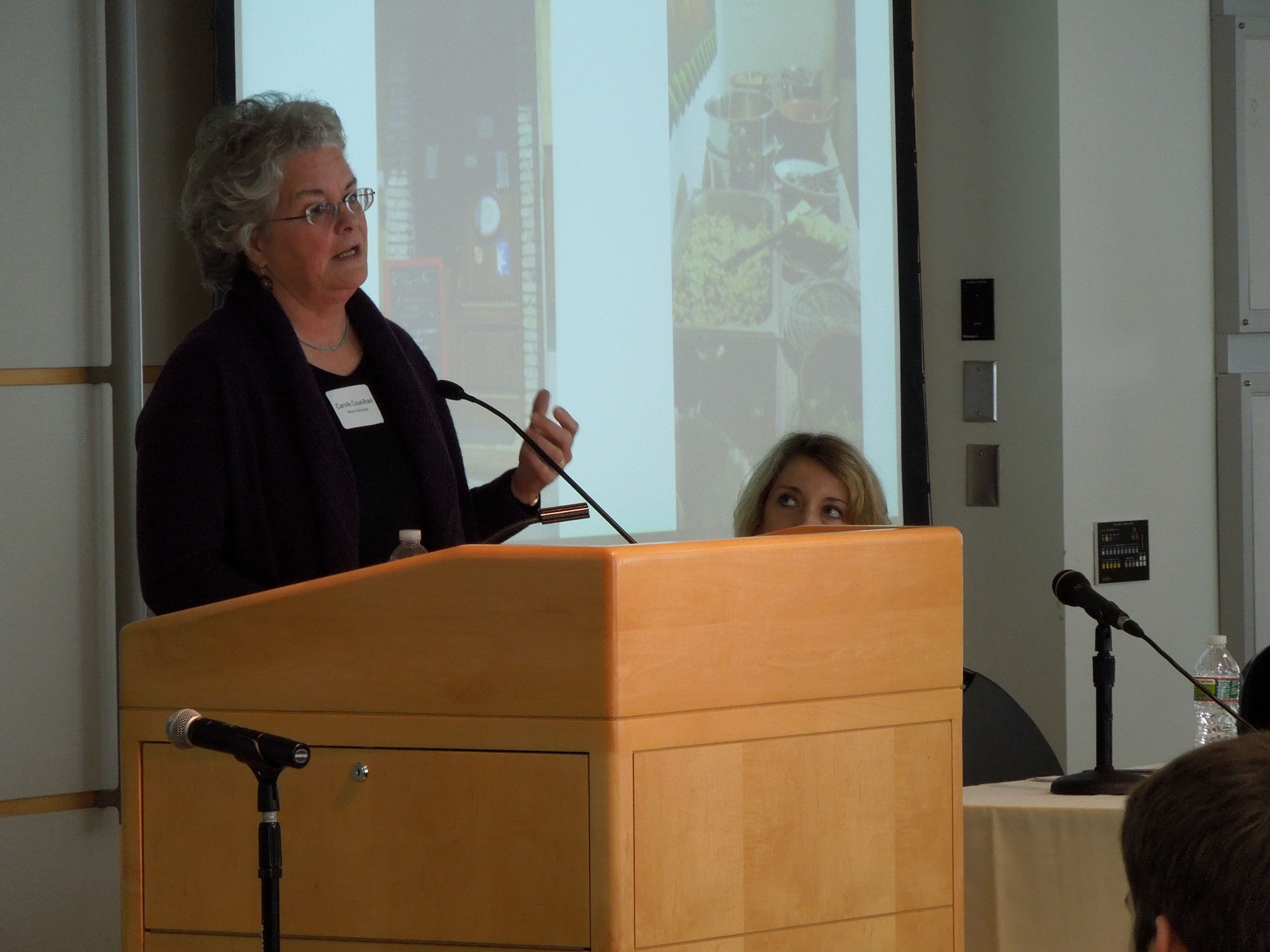
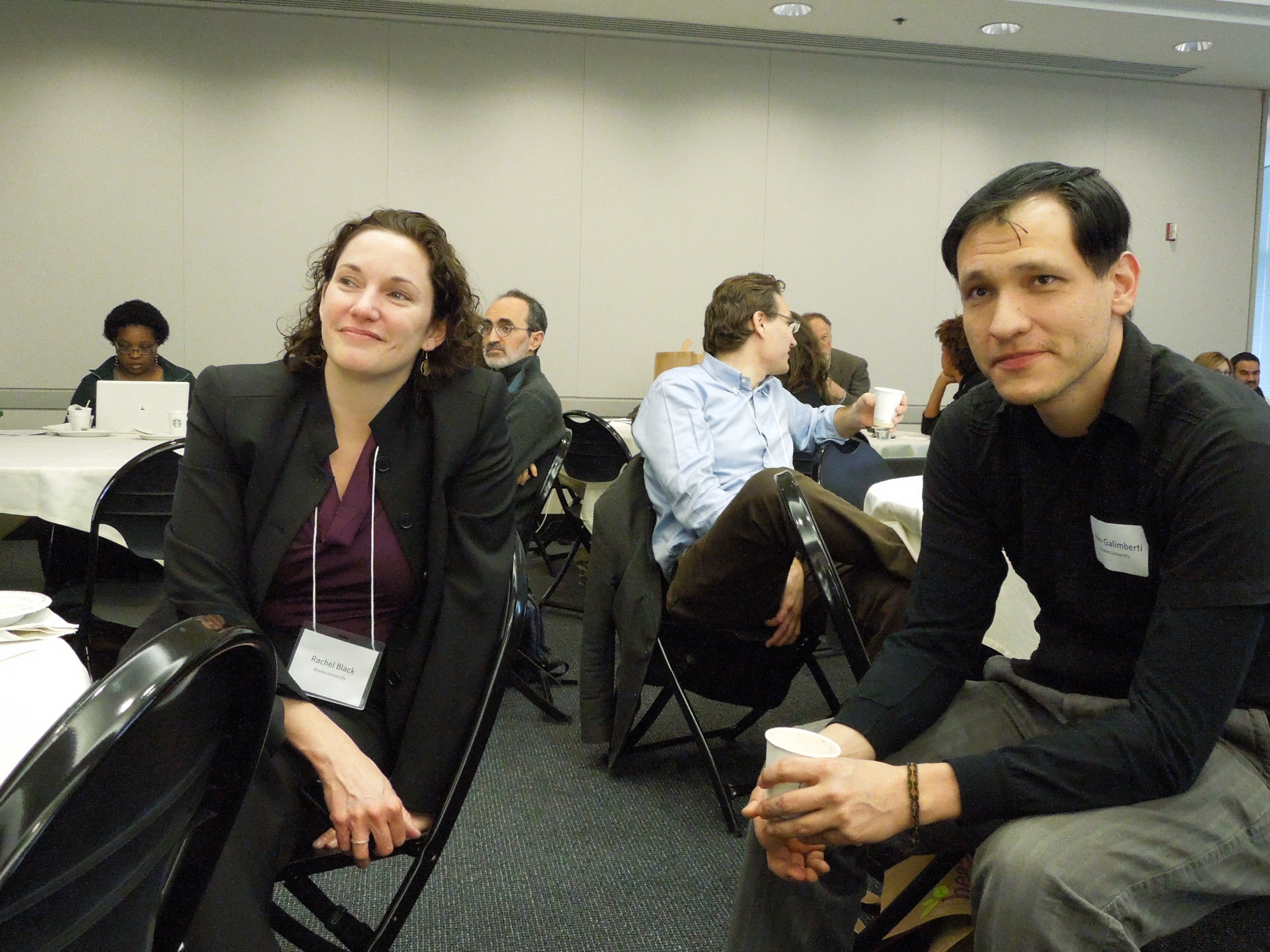
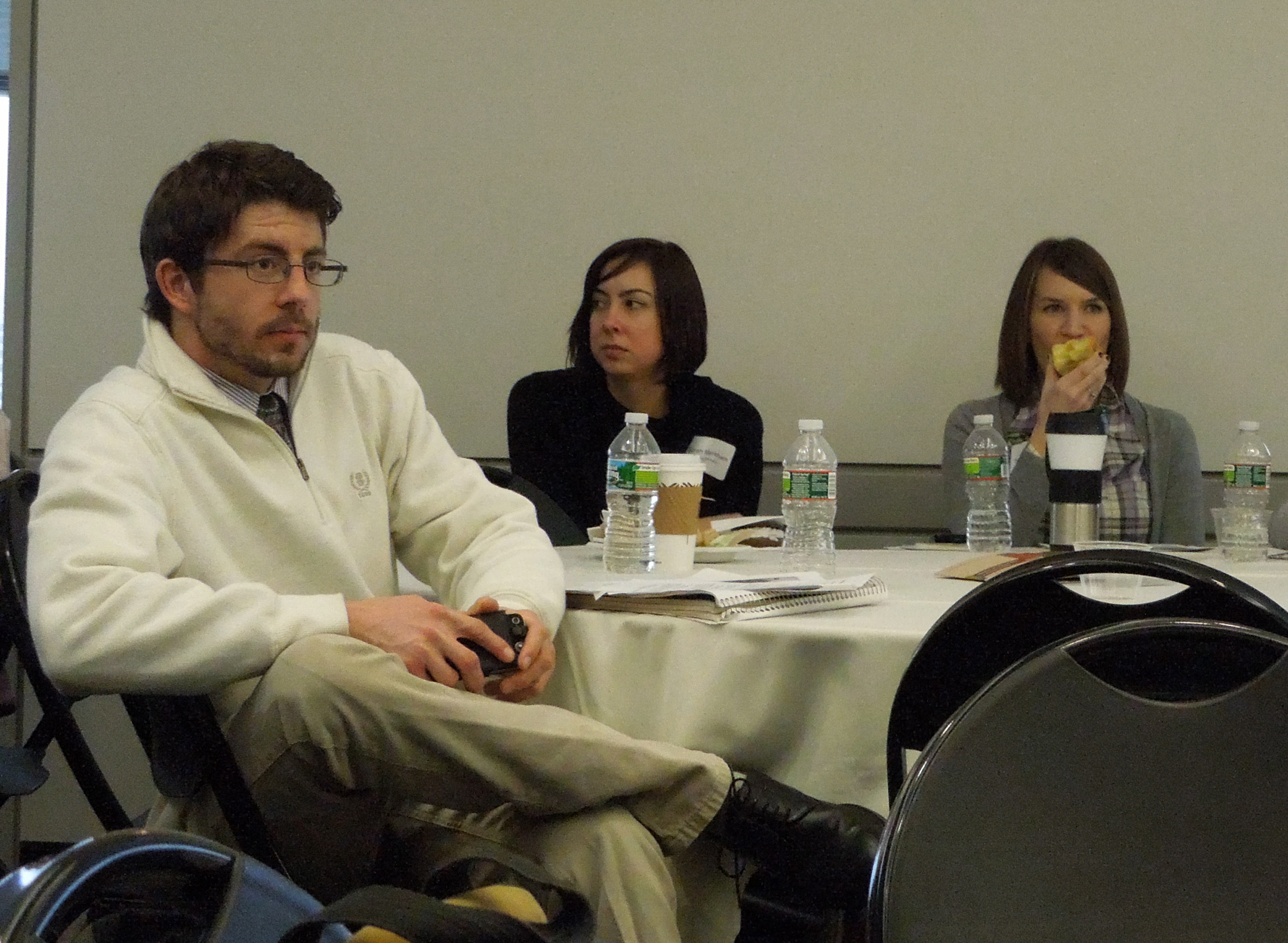
 It was a windy, snowy day in Boston for the BU viewing party of TEDx Manhattan 2012: Changing the Way We Eat, but a hearty group of brave souls made it to campus. Led by Visiting Professor Carole Counihan and Assistant Professor Rachel Black, students and fellow Bostonians alike discussed important issues surrounding our food system in between streaming video sessions.
Though we watched the opening performance by in-house band, ETHEL, in silence due to sound problems, volume returned for the first session addressing Issues. Urvashi Rangan of Consumer Reports proved to be one of the most interesting speakers of the session. Rangan discussed the controversy surrounding food labeling regulations, contending that consumers can hardly rely on labels like natural, free-range, and fresh. She argued that consumers must seek truth, transparency, and trust in how our food gets labeled so that we can know what we’re buying.
After lunch, we returned to what was arguably the most interesting of the three sessions: Impact. Jamie Oliver’s video started the session on a troubling, but inspirational note with the charge – school food has got to change! Notable speakers in this session included Fred Kirschenmann who talked about the importance of soil in our food system; Howard Hinterthuer who started a veteran’s garden therapy program to help those with post-war trauma; and Stephen Ritz, whose breathless story (literally!) of how his edible food walls have changed the lives of kids in the South Bronx left the crows inspired, amazed, and on its feet.

We ended the day with Innovation, hearing from leaders in the field who have embarked upon novel solutions to food problems. Cara Rosaen solved the problem of knowing where food comes from with her website, Real Time Farms, which tracks where restaurants source their local food. Through her grandmother’s inspiration, Kavita Shukla discovered natural food packaging paper, which keeps produce fresh longer, reducing food waste. The final speaker of the day, Gary Oppenheimer, ended on a humbling note. He shared the Ample Harvest program, where gardeners can donate excess produce to soup kitchens so that they can enjoy fresh foods, as well as non-perishables.
Despite the snow blowing outside, the energy of the TEDx Manhattan event left me feeling inspired as I returned to the cold. Hearing about the ways in which people are working to fix the kinks in the food system gives me hope, but I also realize there is much progress to be made.
Alumnus Profile: John Pladocostante
by Emily Contois
 Family is not only a huge part of Gastronomy alumnus John Pladocostante’s life, but also a focal point of his career in food. Originally from Utica, New York, Pladocostante was first introduced to gastronomy at the elbows of his grandparents. “I grew up living in my grandparents’ apartment building. I learned how to care for a garden and make wine with my grandfather, and how to cook and bake with my grandmother,” he says.
Inspired to pursue a culinary career, he received his Bachelor of Culinary Arts degree from Paul Smith's College, and earned his Master of Liberal Arts in Gastronomy at Boston University in 2011. One of his favorite courses was Food and Archaeology with Dr. Karen Metheny. He says, “A degree in gastronomy is so much more than food and cooking. The Food and Archaeology course is a great example of exploring food through thousands of years of history. Being able to explore the world of early humans and reconstruct their diet by learning about how plants were first harvested and domesticated helps you to be more of a well rounded culinarian.”
Pladocostante is currently a culinary instructor at Remington College’s Culinary Arts Degree program in Dallas, Texas. He is also well on his way to bringing his MLA thesis to life in Plano, a suburb of Dallas. For his thesis, he created a business proposal for a gourmet Italian foods company. Since graduating, he has started it, calling it Femia after his maternal grandparents. The central theme of family has already come full circle in Pladocostante’s life. With plans to expand Femia into an upscale Italian café in the future, he says, for now, it is satisfying to create a product that people appreciate. Dallas has long been known as a barbeque haven; and much of the young population in Plano tends to frequent chain restaurants and don’t yet demand good quality ingredients. But this means a growing and exciting market for Femia. Pladocostante says, “For people who have never been exposed to true Italian cuisine, or can’t cook, they love buying food that has a story, and that they can share with family and friends. That’s the essence of Italian food, it brings people together to enjoy life.”
John Pladocostante’s story is far from over and we are excited to see where life takes him as he brings sophisticated, high quality, Italian cuisine to the land of barbeque and Tex-Mex.