Student Work Highlight – Francesca Furey
This week we’re highlighting the work of Gastronomy student Francesca Furey who recreated a historical recipe as a part of Dr. Karen Metheny’s Cookbooks and History class this past semester.
Recreating Halibut Chowder from 1923
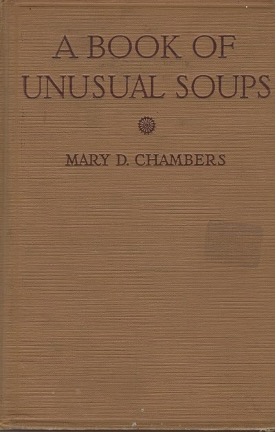 Forget deviled eggs, charcuterie boards, and savory dips this holiday season. Could soup be the star of a social hour? Mary D. Chambers, once the associate editor of “American Cookery Magazine” and a former professor of home economics at Rockford College, Illinois, argued such in A Book of Unusual Soups from 1923. In fact, she believes “no formal dinner, of even the least elaborate kind, deserves name unless there is a soup course (Chambers 1923: 1).
This 130ish-page cookbook dives into all things soup—from a quick primer on soup courses to accompaniments and garnish 101—before offering four chapters on sorts of soups that are considered “unusual.” What does unusual mean here? After flipping through odd and obscure (or perhaps revolutionary, modern, or haute) recipes like Veal and Pineapple, Cream of Raisin, and Hard-Cooked Egg soups, I determined a common denominator. An “unusual soup” doesn’t have to be unusual in ingredients, rather it could be something unexpected. The recipes Chambers crafted were written in hopes to impress diners at intimate luncheons, formal dinners, and parties. Yes, quirky ingredients could make a lasting impact. But so could soups made with French or global techniques, those from near and far (from France’s bouillabaisse to Russia’s borscht to Louisiana’s gumbo), or even if served in outlandish dishes or “pretty china.” Ultimately, the goal of cooking any unusual soup is to “let your friends ask you for the recipe—and find themselves unable to make the soup—for it is your own” (Chambers ix).
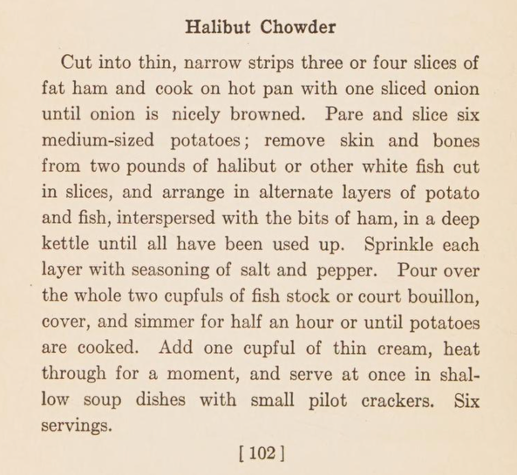
For my recreation recipe, I chose Chambers’ Halibut Chowder, which is designated as something “Soups-Plus” (102). A majority of the recipes were international sorts of soups. The author writes: “We have chosen for our section on ‘Soups Which Are Soups-Plus’ a number of the old-world and old-time soups that are really complete dinners” (Chambers 99–100). To Bostonians and New England natives, chowder is a lifeblood. It may even be the first type of soup they think of. And while it’s not extremely unusual by any means—or from somewhere Chambers considers “exotic in origin”—it could be something unexpected on the holiday dinner table. Chowder is a fisherman’s stew, something whipped up with scraps, leftovers, or excess seafood to feed the crew or family. That being said, could 100-year-old halibut chowder originally developed for Golden Age parties wow a crowd today? Let’s find out…
Shopping for Halibut Chowder
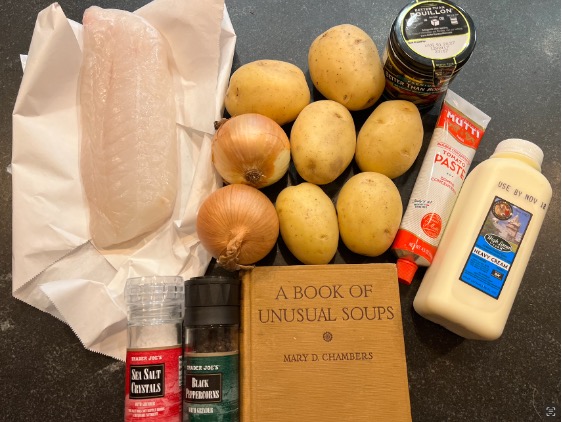
Before cooking comes shopping. I had most of the ingredients at home (onions, stock, seasonings) but went on the hunt for halibut and potatoes. Here, I experienced two hiccups: 1) seeing the exorbitant price of fish at a specialty food store and 2) trying to delineate the meaning of “medium-sized” potatoes in a 1920s context.
Imagine my surprise at the fish counter when I saw halibut was $37/pound. No thanks! It was baffling to consider how expensive fish is in the context of chowder being a blue-collar dish. I redirected my thinking to the middle- to upper-class audience of the cookbook, and felt a bit better. But I couldn’t imaging buying two pounds of halibut ($75 total) for this project. Sorry Dr. Metheny! The recipe said you could swap out other types of white fish. I chose the Icelandic cod at a lower (but still painful) price of $25/pound. I only bought one slab. Going with quality over quantity here… fingers crossed it works out.

As for the potatoes, I did some digging and found archival images from 1907 of Burr Oak, Michigan, once considered the “Potato Capital of the World” (above). After zooming in as best as I could, I believed that potato sizes then were comparable to how they are now. I chose Yukon Golds (the recipe didn’t specify type, I went with my gut) and chose potatoes that weren’t too big but weren’t too small either. I guess that’s what “medium” truly is. A Goldilocks gold potato, if you will.
Preparing the Halibut Chowder
A lot of cookbooks from this time period kept recipes in big chunks of paragraphs. So, I broke down each sentence into steps to make preparation easier.

Step 1: “Cut into thin, narrow strips three or four slices of fat ham and cook on hot pan with one sliced onion until onion is nicely.”
I was cooking with a fellow classmate, Kitty, who is pescatarian. I swapped out the ham and cooked down tomato paste (umami/complexity) in butter (fat) to achieve a similar flavor profile. The only thing this adaptation choice might have affected was the end color of the chowder, which had an orange hue.

Step 2: “Pare and slice six medium-sized potatoes; remove skin and bones from two pounds of halibut or other white fish cut in slices, and arrange in alternate layers of potato and fish, interspersed with the bits of ham, in a deep kettle until all have been used up. Sprinkle each layer with seasoning of salt and pepper.”
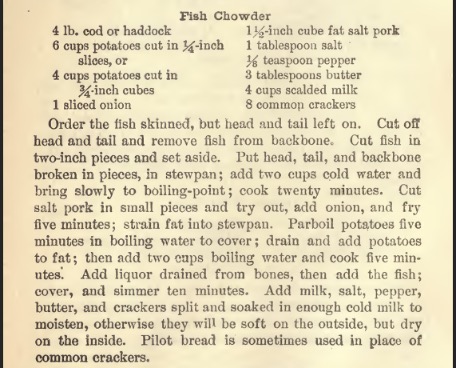
I found other recipes (ex: Fannie Farmer’s version in The Boston Cooking School Cookbook, below) that called for cubed potatoes, rather than sliced. I much prefer cubed as they cook faster and evoke some sort of nostalgia for the chowders I’ve had throughout New England in the 21st century. Alas, I sliced the potatoes to follow the recipe. My fish was already skinned and deboned (huzzah!) from my grocery store purchase. I used a Dutch oven, which is comparable to soup kettles of the 1920s, as my vessel.
I found the arrangement of alternate layers of potato and fish quite unusual. (Hah!) Another classmate Alice called this method “casserole-like” and I agree. I was concerned that piling these heavy ingredients on top of the onion would make the bottom burn. And what if I need to stir the chowder? Would this ruin the layers? Why even layer the potato and fish?
I was pleasantly surprised that Chambers called for seasoning with salt and pepper in each layer. It may be a stereotype, but I was expecting the end result to be bland. Not so.
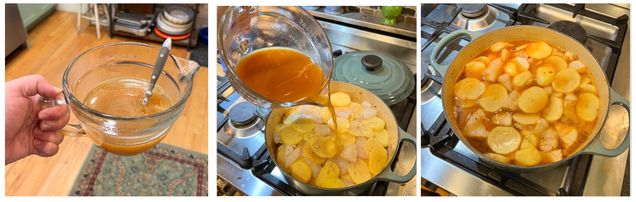
Step 3: “Pour over the whole two cupfuls of fish stock or court bouillon, cover, and simmer for half an hour or until potatoes are cooked.”
No matter the vessel used (I chose a Dutch oven), I believe two cups of stock would not be enough at all! After pouring two cups, I deemed another cup was needed to completely submerge all the layers of potato and fish. Imagine if I used another pound of fish!
In 1923, the soup kettle Chambers used would’ve been placed over a fire or hearth. I was using a gas stove, so I fenagled with the heat settings until a simmer was achieved. I could only imagine the constant adjusting over the fire (or near it, to keep warm) when using a source of heat that cannot be tamed.

Step 4: “Add one cupful of thin cream, heat through for a moment, and serve at once in shallow soup dishes with small pilot crackers. Six servings.”
I traded thin cream for High Lawn Farm’s luscious, super-fresh heavy cream. That might’ve been the star! I made the executive decision to stir the cream (the recipe didn’t say whether or not you should), otherwise it would’ve sat on the top. Heat through for a moment? I kept it simmering for about 3–4 minutes to incorporate flavors and ingredients.
Final Thoughts and Flavors
For a soup (which I consider to be one of my specialties) where I let the author’s directions do most of the work, I was pleasantly surprised. It wasn’t thick or overly creamy like the cups and bread bowls served at seafood shacks. While I love those sorts of chowders, they have a time and place. I’m not sure the coastal chowder we’re used to would be a “winner” at social events and cocktail hours. This, though, could be. The potatoes were cooked through quite well and the fish flaked into tinier pieces, so every spoonful had a mish-mosh of ingredients. It required no more seasoning (shocker) and wasn’t too filling after we ate small portion. I think it could easy double as a soup course or main event, no matter the case. View my presentation here.
Works Cited
Chambers, Mary D. 1923. A Book of Unusual Soups. Boston: Little, Brown and Company.
Farmer, Fannie. 1918. The Boston Cooking School Cookbook. 3rd edition. Boston: Little, Brown and Company.
- “Farmers Unloading Their Potatoes in 1907.” Photograph. Provided by Ted G. The Burr Oak History Project. https://www.burroakhistory.com/potato-capital-of-the-world
References (for Project)
Schmidt, Stephen. March 2019. “On Adapting Historical Recipes.” Manuscript Cookbook Survey. https://www.manuscriptcookbookssurvey.org/on-adapting-historical-recipes/
Giard, Luce. 1998. “Gesture Sequences” in The Practice of Everyday Life, Vol. 2: Living and Cooking, by Michel de Certeau, Luce Giard, and Pierre Mayol, 199-213. Trans. Timothy J. Tomasik. Minneapolis: University of Minnesota Press.