Join Our Research
We are currently enrolling families to participate in our studies. Participation is safe, child-friendly, and helps advance research that benefits children everywhere.

By participating in our studies, you help us understand how motor skills develop in infants and children and how early experiences shape the brain. This knowledge directly informs new therapies for children with cerebral palsy.
Participation is completely voluntary. As a thank you, we offer a $25 gift card per visit and will reimburse travel costs or parking.
Jump to the study for your child’s age:
Study 1
Infants 2-5 months old
Typically developing infants and infants born preterm
What do we study?
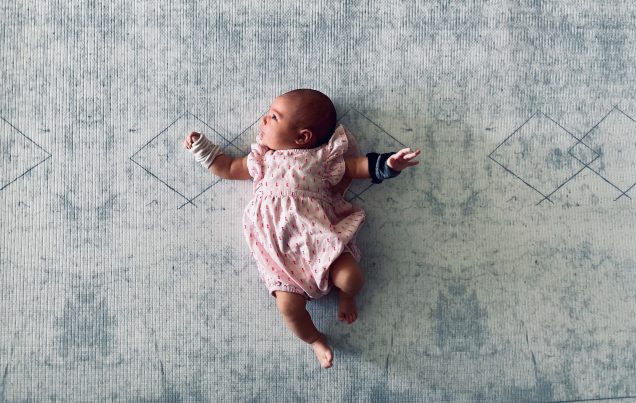
We are interested in understanding how a baby’s natural movements help shape brain development. By understanding how babies move their arms and legs, and how this activity is represented in the brain, we hope to learn about potential therapy strategies for other babies who might be at risk for motor impairments.
What does participation involve?
Participation is completely voluntary. We will ask you to visit our lab once a month from 2-6 months and again at 12 months (6 visits total). We strive to be flexible and will schedule visits around feeding and nap times.
During your visit, we will measure your baby’s natural movements using child-friendly sensors worn on the hands and legs like bracelets, while your baby lies on their back. We will also measure brain activity using a soft cloth cap with light-measuring sensors (fNIRS). These sensors do not hurt or affect your baby’s brain.
Study 2
Infants 6-12 months old
Typically developing infants and infants born preterm

What do we study?
We are interested in understanding how a baby’s hand movements help shape brain development. By understanding how babies reach for, grasp, and handle toys, and how this activity is represented in the brain, we hope to learn about potential therapy strategies for other babies who might be at risk for motor impairments.
What does participation involve?
Participation is completely voluntary. We will ask you to visit our lab every three months from 6-24 months for up to 7 visits. We strive to be flexible and will schedule visits around feeding and nap times.
During your visit, we will measure your baby’s hand movements using child-friendly sensors worn on the hands like bracelets, while your baby sits on your lap or in a high chair. We will also measure brain activity using a soft cloth cap with light-measuring sensors (fNIRS). These sensors do not hurt or affect your baby’s brain.
Study 3
Children 6-18 years old
Typically developing children and children with cerebral palsy

What do we study?
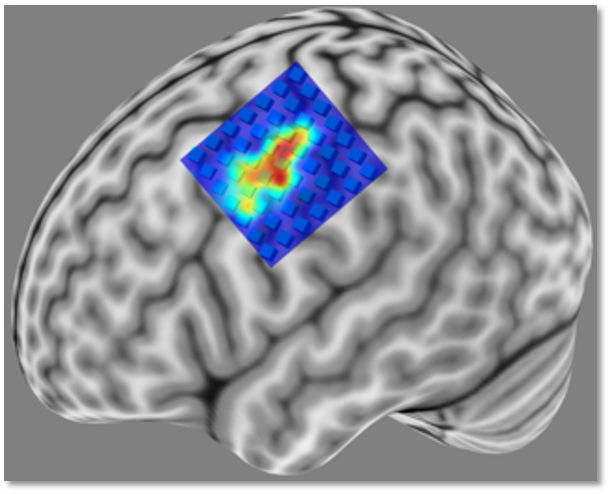
We study how the pathways in the brain that control the hands and arms are organized, and how these patterns relate to the way children use their hands when performing movements. Our goal is to understand how the brain develops or changes following an early brain injury, and to use this information to develop future hand therapies for children with cerebral palsy.
What does participation involve?
Participation involves 2 study visits on different days, each lasting 1-2 hours.
Visit 1 – Cognitive Neuroimaging Center, BU
MRI (~60 min): Your child lies still while the scanner creates a picture of the brain. They can watch a movie the entire time.
Assisting Hand Assessment (~15 min): Your child plays a game with toys of different sizes and shapes.
Grip Force Assessment (~40 min): Your child squeezes a handheld device to measure hand strength.
Visit 2 – DEMR Lab, BU
TMS (~75 min): A painless magnetic coil maps brain areas that control each hand. Your child sits comfortably and watches a movie.
fNIRS: A soft cap measures brain activity while your child grasps wooden blocks. This causes no sensation except slight pressure.
Get involved
Ready to participate?
Fill out our short participation survey and we will be in touch to find a study that fits your child’s age and schedule.
Phone
Location
635 Commonwealth Ave, Boston
5 min from Blandford St or BU East T-stop