NEWS
Kenny and Alex’s beautiful paper on multi-channel SCOS for mapping human cerebral blood flow is online now! Congrats!
Check this beautiful setup here:
https://www.nature.com/articles/s42003-025-08915-x
Kim, B.K., Howard, A.C., Cheng, T.Y. et al. Mapping human cerebral blood flow with high-density, multi-channel speckle contrast optical spectroscopy. Commun Biol 8, 1553 (2025). https://doi.org/10.1038/s42003-025-08915-x
Congratulations to Chenyi winning Undergraduate Research Opportunities Program (UROP)!
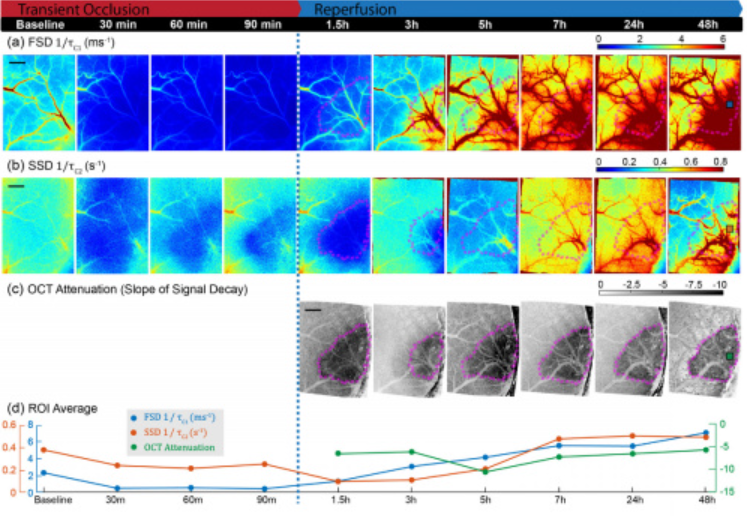
Congratulations to Bingxue and Rockwell for publishing the paper on mapping the tissue dynamics using speckles!
This is a discovery of a new signal measured using laser speckle contrast imaging:
https://opg.optica.org/boe/fulltext.cfm?uri=boe-16-9-3712&id=575866
Alex’s first first-author paper is published!
This work tests the linearity in SCOS measurements. It also indicates that linear methods developed for functional near infrared spectroscopy (fNIRS) can also be applied to SCOS.
Howard, Alexander C., Byungchan Kim, Laura Carlton, Meryem A. Yücel, Bingxue Liu, David A. Boas, and Xiaojun Cheng. "Validation of the Linearity in Image Reconstruction Methods for Speckle Contrast Optical Tomography." IEEE Journal of Selected Topics in Quantum Electronics (2025).
Abstract:
Speckle contrast optical spectroscopy (SCOS) is an optical technique capable of measuring human cerebral blood flow and brain function non-invasively. Its tomographic extension, speckle contrast optical tomography (SCOT), can provide blood flow variation maps with measurements using overlapping source-detector channel pairs. Linearity is often assumed in most image reconstruction methods, but non-linearity could exist in the relations between measured signals and blood flow variations. We have constructed a forward model for SCOT using the Rytov approximation to solve the correlation diffusion equation and compared it with the first Born approximation as well as the more accurate, but computationally expensive Monte Carlo simulation approach. We have shown that the results obtained using the Rytov approximation are in good agreement with the Monte Carlo simulations, while the first Born approximation deviates from the other two methods for large blood flow variations. For instance, the first Born approximation breaks down at around 30% cerebral blood flow (CBF) changes within a volume of size
Bingxue, Congratulations!
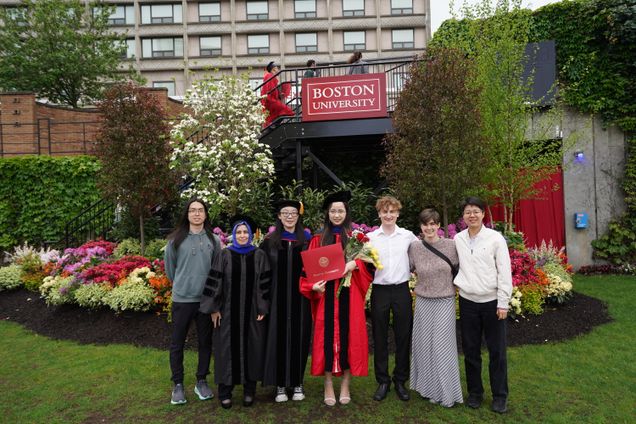
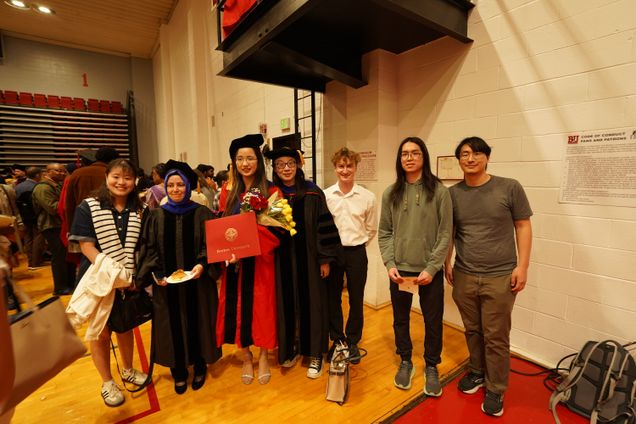
Congratulations to Kenny winning the Best Dissertation Award!
See below:
https://www.linkedin.com/posts/byungchan-kenny-kim-5829936a_mapping-human-cerebral-blood-flow-with-high-density-activity-7351034977737687040-IoTb?utm_source=share&utm_medium=member_desktop&rcm=ACoAABG3PHMB4hN-mB_80xaAk5GTYHo1rDdBamg
Congratulations, Dr. Kim!
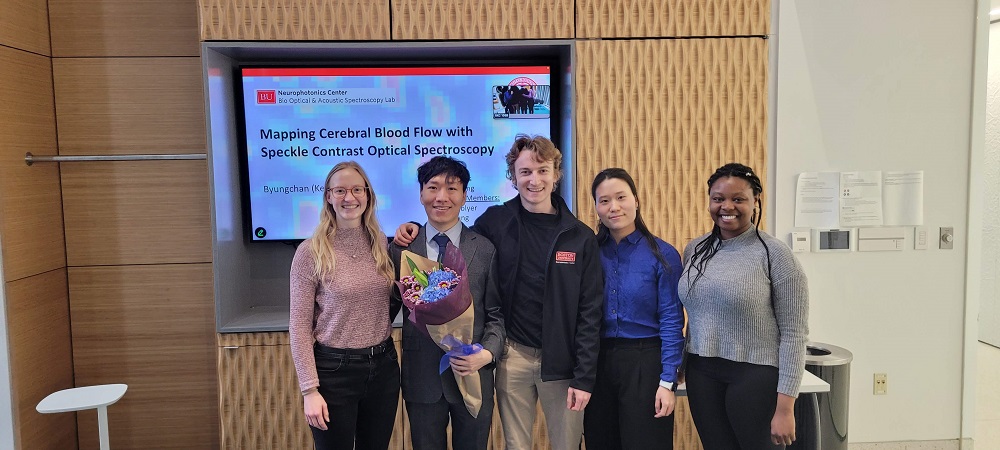
Congratulations, Dr. Bingxue Liu!
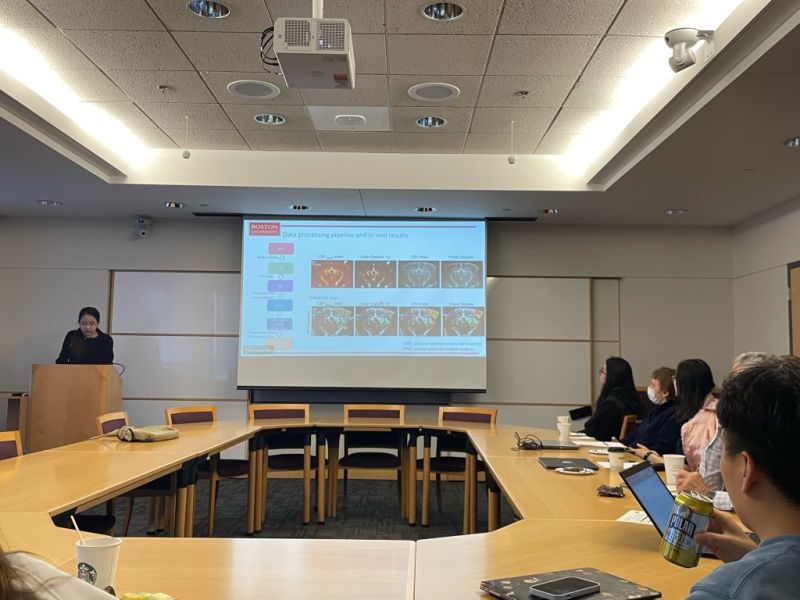

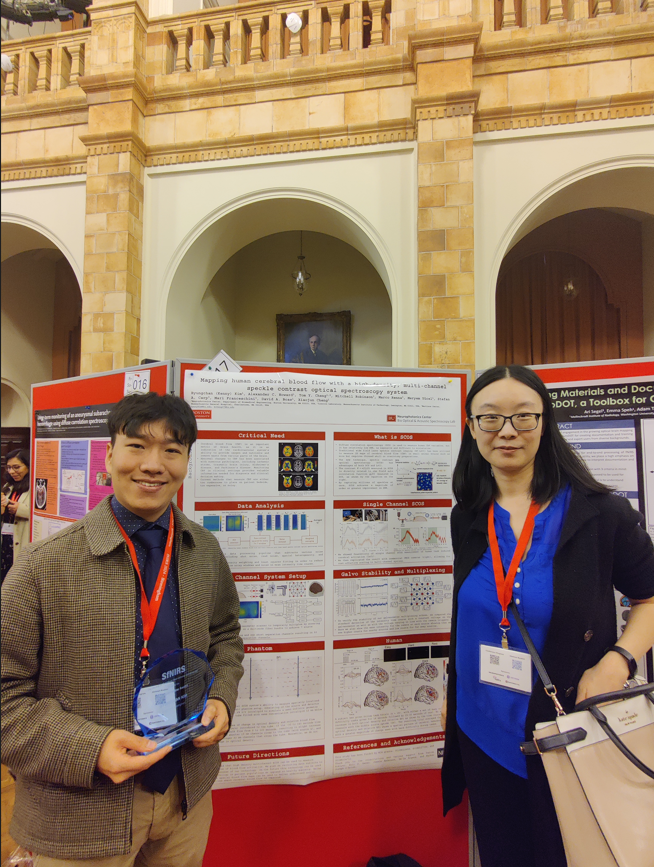
Kenny won the fNIRS 2024 Student Fellow Award for his contributions to human SCOS system development!
We were at SfNIRS conference in Birmingham, UK
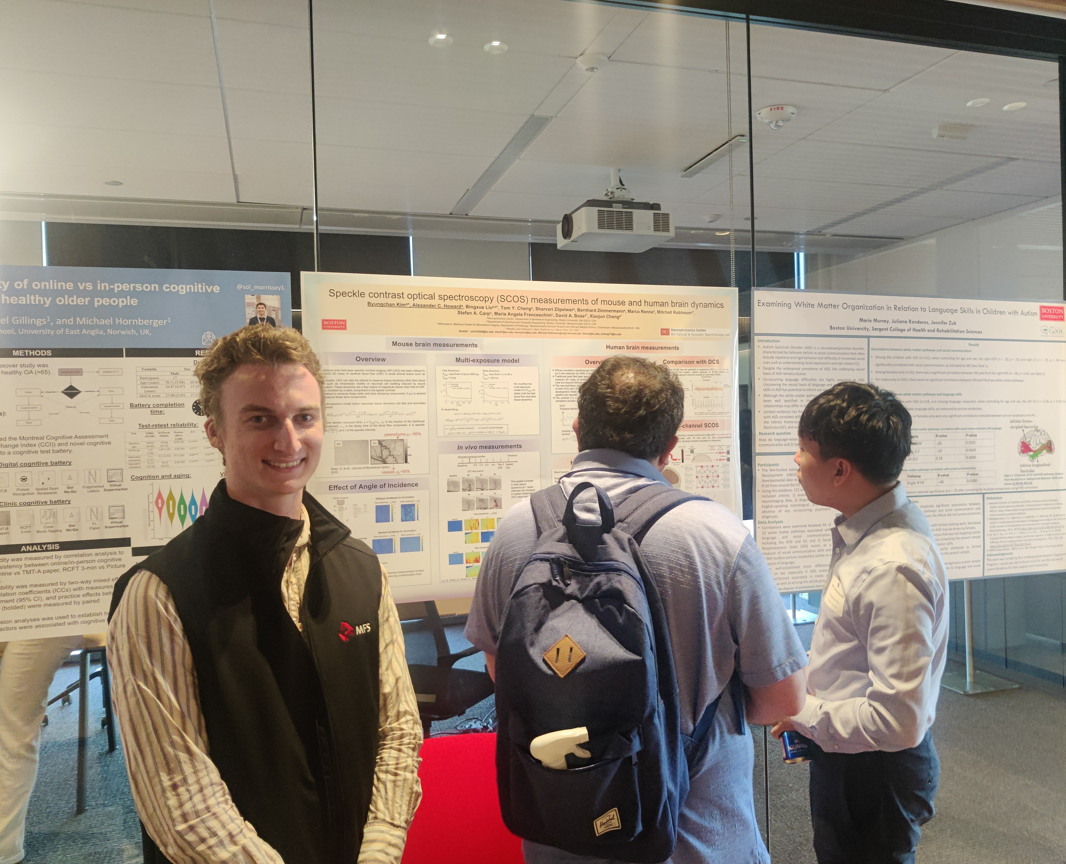
We were at the NEW conference in Boston
Allen has joined our group! Welcome!
Allen Zhou is going to work on speckle analysis in functional ultrasound.
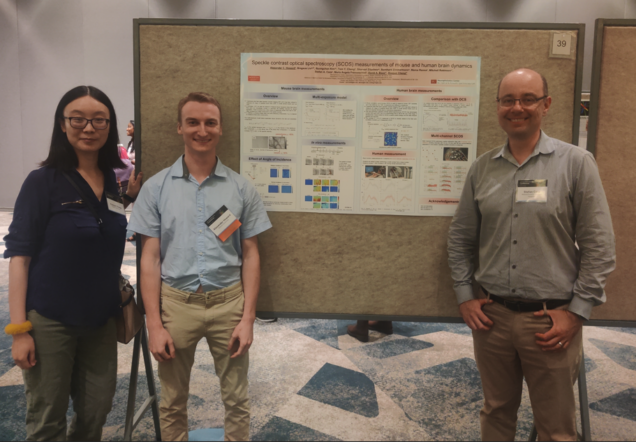
Alex has done a nice job presenting his poster at NIH Brain Initiative meeting! Congrats!
Dr. Xiaojun Cheng (left), Alexander Howard (middle), Dr. Stefan Carp (right)
Congratulations to Tom and Kenny for publishing their latest work of characterizing cameras for SCOS measurements!
More details:
https://www.nature.com/articles/s41598-024-62106-y
Cheng, Tom Y., Byungchan Kim, Bernhard B. Zimmermann, Mitchell B. Robinson, Marco Renna, Stefan A. Carp, Maria Angela Franceschini, David A. Boas, and Xiaojun Cheng. "Choosing a camera and optimizing system parameters for speckle contrast optical spectroscopy." Scientific Reports 14, no. 1 (2024): 11915.
Shangzhou has defended. Great job!

Bingxue has presented at OSA Biophotonics conference!
Teah has defended. Congratulations!
Alex Howard will join us! Welcome!
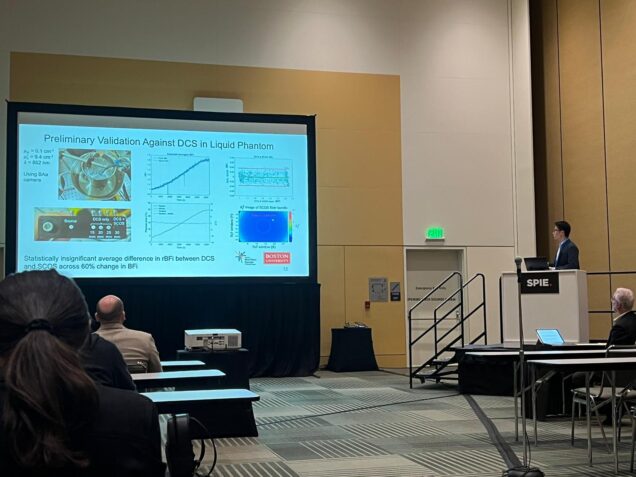
Tom Cheng has done a nice job presenting his work at SPIE Photonics West!
New publication from Bingxue Liu
Congratulations to Bingxue Liu for publishing the first paper of the Speckle group in Year 2024! This work summarizes the mathematics behind the theory of dynamic light scattering (DLS) and laser speckle contrast imaging (LSCI). It serves as a valuable resource for experimentalists to choose the correct model and for students to follow through with the details of calculations.
Dynamic light scattering and laser speckle contrast imaging of the brain: theory of the spatial and temporal statistics of speckle pattern evolution
Biomed. Opt. Express 15(2), 579-593 (2024)
https://opg.optica.org/boe/fulltext.cfm?uri=boe-15-2-579https://lnkd.in/gmN8pmga
We are recruiting!
Title: A transformative method for functional brain imaging with speckle contrast optical spectroscopy (SCOS) and functional near infrared spectroscopy (fNIRS)
Faculty: David A. Boas (dboas@bu.edu), Xiaojun Cheng (xcheng17@bu.edu)
Description: We are looking for a PhD student to work on the project of developing a multi-channel SCOS-fNIRS optical system to achieve high quality measurements of human brain blood flow, oxygenation, and function. Please contact us if you want to rotate with us and/or want to learn more about this project.