News
EuroWD Conference, August 2026

Five members of the BU White Dwarf group attended the 24rd European Workshop on White Dwarfs, held in August 2026 in Vienna.
The outburst in GD 1212
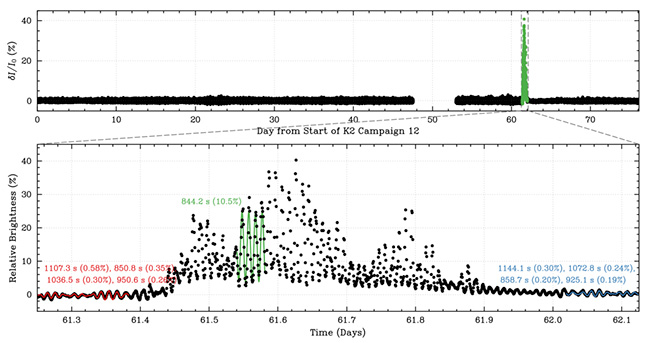
In August 2026, a manuscript led by BUWD PI JJ Hermes (Hermes, Bell, Dublin, et al. 2026) was published exploring an extreme example of an "outburst" in the pulsating white dwarf GD 1212. The outburst was likely powered by a parametric resonance, where mode energy from the stellar pulsations rapidly transferred from driven to damped modes; those waves broke at the surface, heating the photosphere by 850 K in just a few hours, getting nearly 20% brighter overall. Some day in a few billion years our Sun will probably undergo something similar. The manuscript has been accepted in The Astrophysical Journal.
A massive ONe-core white dwarf
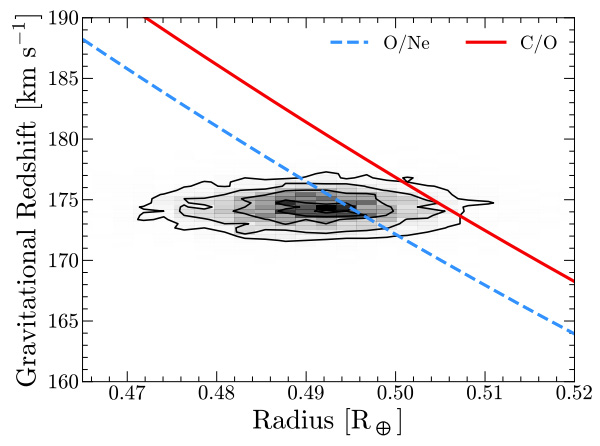
In August 2026, a manuscript led by graduate student and BUWD member Stefan Arseneau (Arseneau, Hermes, Chandra, et al. 2026) was published with an exceptionally cool test of the core composition of a massive (1.226 solar mass) white dwarf. Spectroscopy from 8.2- and 6.5-meter telescopes helped measure the velocity of this star relative to its wide binary companion. The mass of this compact object has bent space so much that light is redshifted by more than 170 km/s from its surface! This is more in line with predictions from an oxygen-neon core white dwarf, compared to a carbon-oxygen white dwarf. The manuscript has been accepted in The Astrophysical Journal.
Paper Cakes at BU

Paper Cake is a great tradition our group has mugged from astronomers at the University of Warwick. During Paper Cake, you are encouraged to bake a cake and share it along with a discussion of a new paper posted to arXiv. Here is a celebration of a recent BUWD paper on 6 Mar 2026!
White Dwarf Envelopes and Gravitational Redshifts
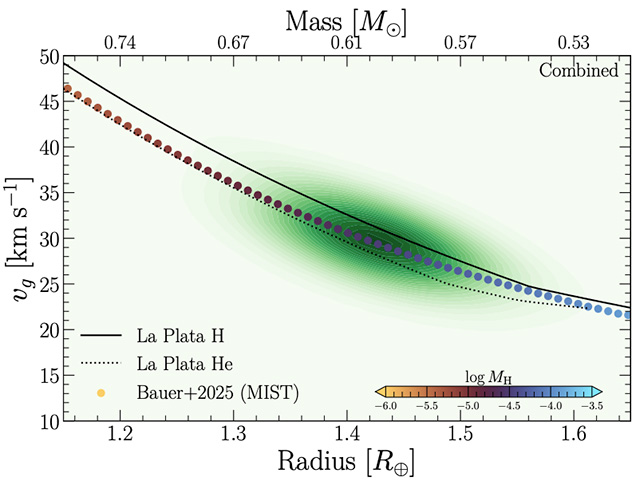
In March 2026, a manuscript led by graduate student and BUWD member Stefan Arseneau (Arseneau, Hermes, Camisassa, Raddi & Bauer 2026) was accepted laying the foundations to constrain the envelope structure of white dwarfs using gravitational redshifts. The hydrogen envelope mass in most white dwarfs is poorly constrained but critically affects the inferred masses and cooling age of these stars. This work combines precise gravitational redshifts and Gaia-inferred radii for nearly 500 objects to measure the mass–radius relation. The results favor evolutionary models with thick, mass-dependent hydrogen envelopes (e.g., MIST). The manuscript has been accepted in The Astrophysical Journal.
Delayed Q Branch White Dwarfs Lack Strong Magnetism

In February 2026, a manuscript led by graduate student and BUWD member Lou Baya Ould Rouis (Ould Rouis, Hermes, Guidry et al. 2026) was accepted which we hope will change the way we think about some white dwarf merger remnants. Ultramassive white dwarfs in the Gaia "Q branch" exhibit multi-Gyr cooling delays, likely linked to merger origins, but our volume-limited spectroscopic study within 100 pc reveals unexpected trends in composition and rotation of the most delayed Q branch white dwarfs. Contrary to expectations for merger products, the most delayed objects show little magnetism or rotational variability. We also add new detections of pulsations in DAQ white dwarfs which suggest a possible extension of the DAV instability strip to hotter, thin-hydrogen atmospheres. The manuscript has been accepted in The Astrophysical Journal.
Transits (that vanish) around a white dwarf every 4.97 hr

In August 2025, a manuscript led by graduate student and BUWD member Joseph Guidry (Guidry, Vanderbosch, Hermes et al. 2025) was accepted which announced the discovery of deep, irregular, periodic transits from rocky exoplanetary debris towards the white dwarf ZTF J1944+4557. This retired star dims by more than 30% roughly every five hours, as clumps of debris block off light from the white dwarf. For the first time we have also observed transits around a white dwarf completely stop, and completely return roughly a year later, giving us a new laboratory to watch how shattered rocks evolve around dead stars. The manuscript has been accepted in The Astrophysical Journal.
Gravitational redshift bias in white dwarf spectra

In August 2025, a manuscript led by graduate student and BUWD member Stefan Arseneau (Arseneau, Hermes, Zakamska et al. 2025) was accepted which showed that substantial biases (5-15 km/s) exist in low-resolution radial velocity measurements, indicating that all the physics of line formation in high-density plasmas is not fully accounted for in state-of-the-art white dwarf model atmospheres. Using large samples from SDSS-V, we attempt to measure this bias and provide simple corrections for surveys like SDSS, DESI, and 4MOST. The manuscript has been accepted in The Astrophysical Journal.
NASA’s Hubble Uncovers Rare White Dwarf Merger Remnant
In August 2025, a manuscript led by Snehalata Sahu at the University of Warwick and including members of the BUWD group (Sahu et al. 2025) announced the discovery of carbon in the atmosphere of an otherwise normal-looking hot hydrogen-rich white dwarf, a tell-tale sign of a merger in the history of the system. The discovery could not have been made without the ultraviolet capabilities of the Hubble Space Telescope. The discovery was featured in a video summary by NASA Goddard, as well as with a NASA/ESA press release and subsequent news coverage by Popular Science and Space.com. The manuscript has been accepted in Nature Astronomy.
Probing Exoplanets Around Massive Stars

In November 2024, a manuscript led by graduate student and BUWD member Lou Baya Ould Rouis (Ould Rouis, Hermes, Gaensicke et al. 2024) was accepted which showed that the most massive white dwarfs (>0.8 solar masses) show metal pollution significantly less frequently than more normal-mass white dwarfs. Specifically, just 11% of white dwarfs that begin their lives as stars >3.5 solar masses on the main sequence show metals from remnant planetary systems, while 44% of white dwarfs that begin their lives as stars <2 solar masses show metals. We have also shown that mergers are unlikely to be the main explanation for this discrepancy. The findings likely have implications for planet formation and/or survival around massive stars on the main sequence which are hard to search for exoplanets using traditional techniques. The manuscript has been accepted in The Astrophysical Journal.