The BU White Dwarf Group
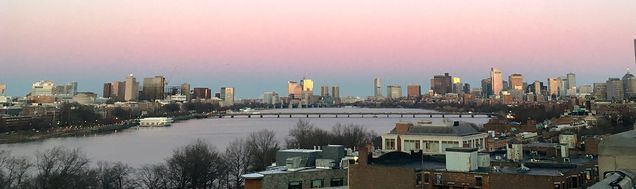
Welcome to the home page of the BU White Dwarf group, headquartered a few blocks from Fenway Park in Boston, MA, USA.
Our research focuses on white dwarf stars and their connection to the endpoints of stars, binary, and planetary systems. Our work is supported by Boston University, the Institute for Astrophysical Research, the National Aeronautics and Space Administration (NASA), the National Science Foundation (NSF), and the Massachusetts Space Grant Consortium.
Recent news and group updates:
Research updates can be found below and on the news page.
EuroWD Conference, August 2026

Five members of the BU White Dwarf group attended the 24rd European Workshop on White Dwarfs, held in August 2026 in Vienna.
The outburst in GD 1212
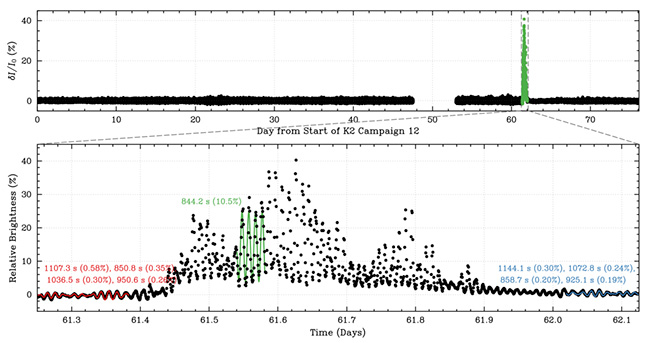
In August 2026, a manuscript led by BUWD PI JJ Hermes (Hermes, Bell, Dublin, et al. 2026) was published exploring an extreme example of an "outburst" in the pulsating white dwarf GD 1212. The outburst was likely powered by a parametric resonance, where mode energy from the stellar pulsations rapidly transferred from driven to damped modes; those waves broke at the surface, heating the photosphere by 850 K in just a few hours, getting nearly 20% brighter overall. Some day in a few billion years our Sun will probably undergo something similar. The manuscript has been accepted in The Astrophysical Journal.
A massive ONe-core white dwarf
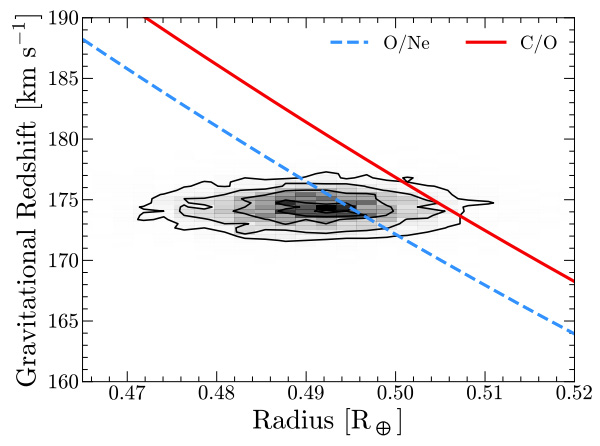
In August 2026, a manuscript led by graduate student and BUWD member Stefan Arseneau (Arseneau, Hermes, Chandra, et al. 2026) was published with an exceptionally cool test of the core composition of a massive (1.226 solar mass) white dwarf. Spectroscopy from 8.2- and 6.5-meter telescopes helped measure the velocity of this star relative to its wide binary companion. The mass of this compact object has bent space so much that light is redshifted by more than 170 km/s from its surface! This is more in line with predictions from an oxygen-neon core white dwarf, compared to a carbon-oxygen white dwarf. The manuscript has been accepted in The Astrophysical Journal.
Paper Cakes at BU

Paper Cake is a great tradition our group has mugged from astronomers at the University of Warwick. During Paper Cake, you are encouraged to bake a cake and share it along with a discussion of a new paper posted to arXiv. Here is a celebration of a recent BUWD paper on 6 Mar 2026!
White Dwarf Envelopes and Gravitational Redshifts
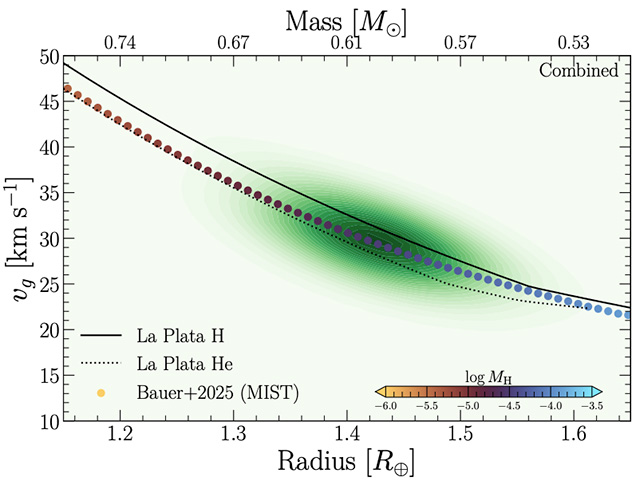
In March 2026, a manuscript led by graduate student and BUWD member Stefan Arseneau (Arseneau, Hermes, Camisassa, Raddi & Bauer 2026) was accepted laying the foundations to constrain the envelope structure of white dwarfs using gravitational redshifts. The hydrogen envelope mass in most white dwarfs is poorly constrained but critically affects the inferred masses and cooling age of these stars. This work combines precise gravitational redshifts and Gaia-inferred radii for nearly 500 objects to measure the mass–radius relation. The results favor evolutionary models with thick, mass-dependent hydrogen envelopes (e.g., MIST). The manuscript has been accepted in The Astrophysical Journal.