Superresolution by centroid reassignment
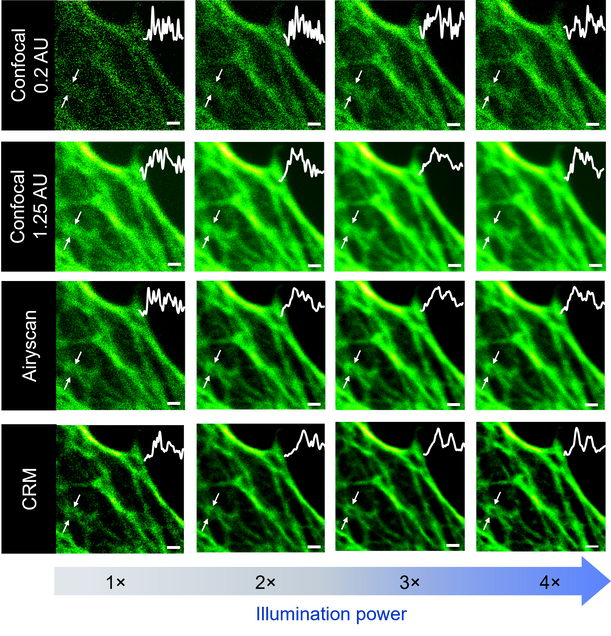
Superresolution imaging has become one of the most important recent advances in microscopy development. However, most superresolution methods are ill-adapted for live-sample imaging because they are unacceptably slow, susceptible to artifacts, or require the use of specialized fluorophores and labeling protocols. We introduce a superresolution method called centroid reassignment microscopy (CRM) that overcomes these limitations. CRM is a simple variation on confocal microscopy wherein the single-element detector and small pinhole are replaced by a centroid detector and larger pinhole. Superresolution is obtained by reassigning the detected fluorescence to its centroid location of as a function of the scanning excitation focus location. Our method bears resemblance to the method of image scanning microscopy, which involves the use of an array detector, with the advantage that CRM provides improved resolution for the same number of detected photons while being simpler to implement and less sensitive to noise. CRM is light-efficient, fast (single-frame), robust to defocus aberrations, and requires no changes whatsoever in standard fluorescence imaging protocols, making it uniquely attractive for superresolution imaging of live, dynamic samples.
- C. Li, Q. Le, J. Kimura, B. Zhao, Y. Li, J. Zhao, T. Bifano, B. Weissbourd, J. Ngo, J. Mertz, “Superresolution imaging of live samples by centroid reassignment microscopy”, bioRxiv 2025.08.03.668310 (2026). link.