Spatially variant deconvolution
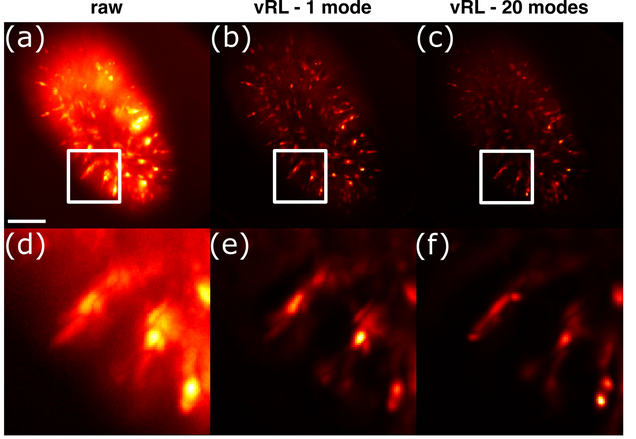
Deconvolution is the most widely used aberration correction technique in microscopy, however most techniques assume that the aberrations are the same for each point in the image, which is rarely true. Methods for tracking spatially varying aberrations require burdensome calibration or computation, or require symmetries in the aberration patterns. Here, we expand on existing modal deconvolution methods to demonstrate 3D fluorescence deconvolution in imaging systems that exhibit no simple symmetry. Our method is based on a space-variant generalization of Richardson-Lucy deconvolution that makes use of point spread functions derived entirely by ZEMAX, enabling a hybrid combination of physics-based modal deconvolution and simulation-based PSF modeling. Importantly, it obviates any requirement for guide stars or measurements for PSF calibration. We validate the performance of our method by applying it to snapshot multiplane imaging of both bead samples and biological specimens, and show that modal decomposition is a practical solution for deconvolving spatially varying aberrations that do not display clear symmetries.
- J. Czuchnowski, C. Li, H. Ni, B. Weissbourd, and J. Mertz, “3D space-variant modal deconvolution with computed point spread functions”, arXiv 2512.00225 (2025). link.