March 12: Centre de Cultura Contemporània de Barcelona (CCCB)
By Meixi Huang
Walking through the narrow streets of El Raval on a sunny afternoon, it was hard not to notice the contrast between the everyday life of the neighborhood and the large glass façade of the Centre de Cultura Contemporània de Barcelona (CCCB). During this study tour, I was greatly excited to have the opportunity to listen to Maria Ribas, Head of Audiences Unit. Her insights provided us with a crucial perspective on how cultural institutions design audience engagement and educational programs.

One idea that particularly stayed with me was CCCB’s core mission. As Maria Ribas explained, the center aims “to make people think critically… not to teach, but to make people think.” This statement challenged my previous assumptions about museum education. Instead of focusing primarily on knowledge transmission, CCCB approaches exhibitions and programs as spaces that encourage reflection, dialogue, and curiosity.
The relationship between the institution and its local context also left a deep impression on me. CCCB is located in the Raval neighborhood, a culturally diverse area of Barcelona with complex socioeconomic conditions. Consequently, the institution actively collaborates with community associations and schools. As Maria stated, through these partnerships, they strive to “break the barrier of coming here.” This strategy suggests that audience development is not simply about increasing visitor numbers, but about building trust and accessibility.
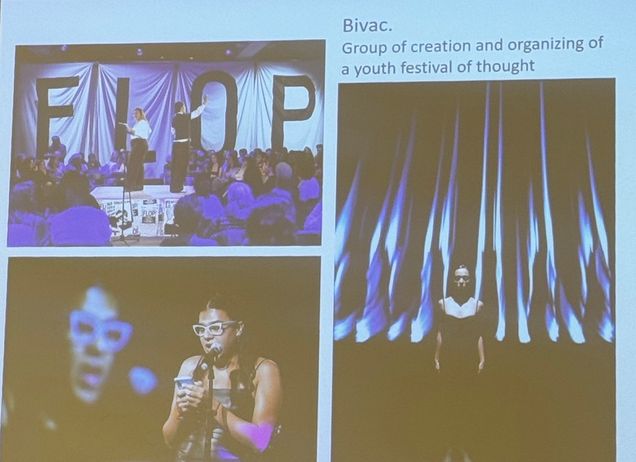
I was particularly interested in their youth programs. For example, CCCB runs an open call where young people aged 15–25 are selected to organize their own festival, including programming, communication, and production decisions. This structure shifts young participants from passive audiences to active cultural producers.
Another moment that stayed with me was the installation from the exhibition “Tenim disset anys: un retrat col·lectiu,” which explores how teenagers see themselves today. The large green cushions invited visitors to sit or lie down while watching the projected films, turning the gallery into a shared viewing space.
 |
 |
 |
This simple design encouraged visitors to slow down and spend time with the stories created by young people themselves, reminding me how exhibition design can subtly shape audience engagement.
This visit left me with a simple but important question: if cultural institutions aim to make people think, how can exhibition design, programming, and audience strategies work together to create that space for reflection?