March 9: Barcelona City Tour
By Yue Yao
This morning we gathered at Plaça de Sant Jaume, the square where Barcelona City Hall and the Government of Catalonia are located. Our guide began by explaining that this place has served as the city’s political center for a very long time. Even during the Roman period, it was the heart of the city, with the forum of the Roman settlement Barcino likely situated in this area. So in a sense, it has been the city center for two thousand years. Standing here evokes a remarkable sensation—as if countless pivotal decisions and historical events unfolded in this very spot, while the surrounding architecture underwent successive transformations.
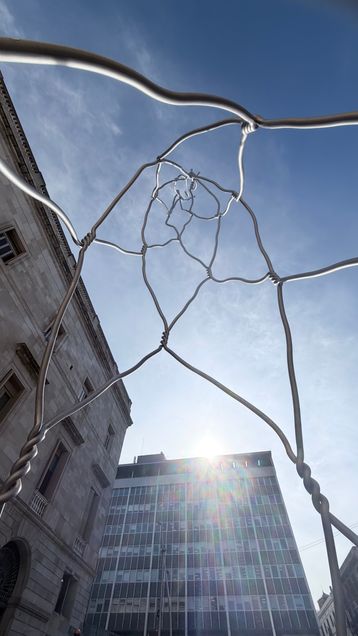
Near the square, we also encountered a towering metal sculpture resembling stacked steel structures. Titled Homenatge als Castellers, this piece pays homage to Catalonia’s deeply rooted tradition of Castellers (human tower building). Castellers involve stacking people layer by layer to form human towers. This sculpture uses abstract metal structures to express that sense of upward accumulation.
 |
 |
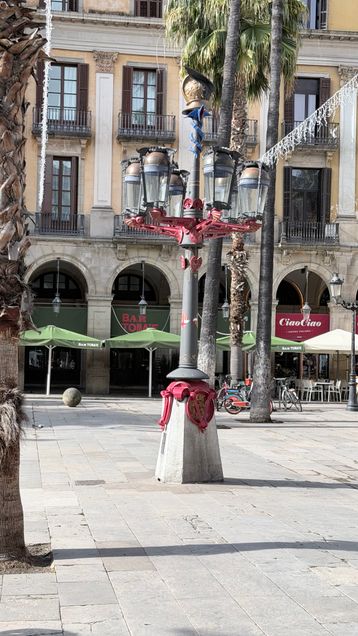
Leaving City Hall, we walked to Plaça Reial. This square suddenly opened up, surrounded by restaurants, cafes, and residences, with a much more relaxed atmosphere than before. Several distinctive street lamps stood in the square’s center. Our guide explained these were early designs by Gaudí. Two small dragons coiled around each lamp post, their bodies twisting like vines. The blue dragons appeared slightly playful. Honestly, without knowing their origin, one might mistake them for ordinary decorations. But learning they were Gaudí’s creations made them fascinating.
 |
 |
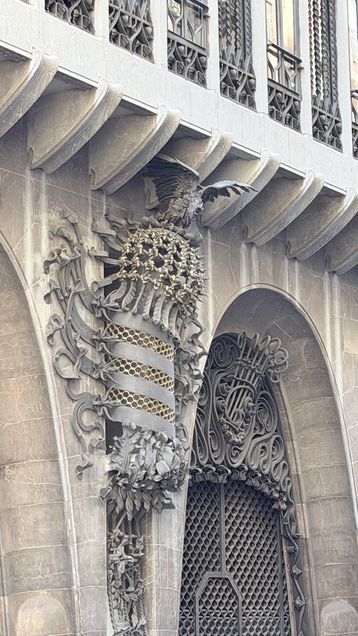
Next, we proceeded to Palau Güell. This was a private residence designed by Gaudí for industrialist Eusebi Güell. The iron entrance gate was strikingly ornate, covered in intricate metalwork. Standing before it felt somewhat theatrical, like an entrance to a stage. While the surrounding buildings were rather ordinary, this one stood out distinctly. From an urban spatial perspective, it seemed like a modernist structure suddenly inserted into the old city fabric.
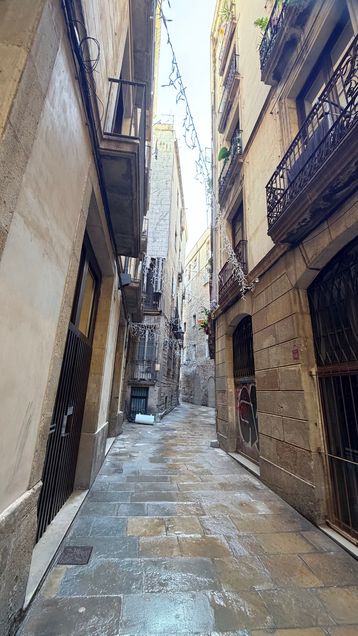
After leaving Palau Güell, we entered the Gothic Quarter. The streets here are incredibly narrow, with buildings so close together that sometimes you can only see a sliver of sky when you look up. When I was doing urban planning and architecture assignments, I mostly studied city structures on maps—axes, blocks, functional zones, and such. But walking through these streets reveals that real cities aren’t neat systems at all; they’ve grown slowly over time. Many buildings, streets, and spaces have been continuously remodeled and layered over time. Simultaneously, practical challenges become apparent—like some streets with inadequate drainage. The ground slopes gently, and drainage outlets are scarce. During heavy rain, this medieval street layout struggles to accommodate modern cities’ dense foot traffic and tourist activities.
 |
 |
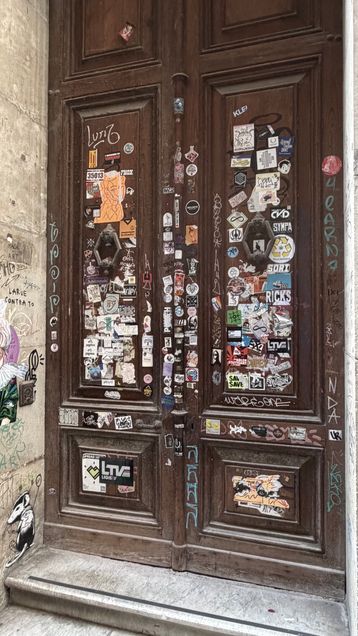
Amidst the medieval architecture in the Gothic Quarter’s alleys, vibrant street culture is also strikingly visible. For instance, passing by the entrance of ArteVistas Gallery, we saw walls plastered with street art stickers, stenciled graffiti, and small images. Some doors were even covered layer upon layer with stickers from various artists or bands, appearing as if applied gradually over time. These elements create a fascinating contrast when juxtaposed against the centuries-old stone walls beside them.
Later, we passed Barcelona Cathedral and saw the famous Kissing Wall. From afar, it appears as a giant image of lips, but up close, you realize it’s a mosaic composed of countless small photographs.
This city walk left me with a profound realization: cities aren’t replaced layer by layer over time. Instead, different historical periods coexist within the same space. Walking from medieval neighborhoods to Gaudi’s architecture and then encountering contemporary public art in a single day, you gradually understand that a city is more like a book constantly being rewritten—not a story that’s already finished.