Category: Uncategorized
Elevated arousal levels enhance contrast perception
Journal of Vision (2017)
Dongho Kim, Savannah Lokey & Sam Ling
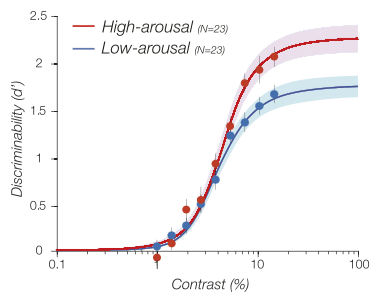
Our state of arousal fluctuates from moment to moment—fluctuations that can have profound impacts on behavior. Arousal has been proposed to play a powerful, widespread role in the brain, influencing processes as far ranging as perception, memory, learning, and decision making. Although arousal clearly plays a critical role in modulating behavior, the mechanisms underlying this modulation remain poorly understood. To address this knowledge gap, we examined the modulatory role of arousal on one of the cornerstones of visual perception: contrast perception. Using a reward-driven paradigm to manipulate arousal state, we discovered that elevated arousal state substantially enhances visual sensitivity, incurring a multiplicative modulation of contrast response. Contrast defines vision, determining whether objects appear visible or invisible to us, and these results indicate that one of the consequences of decreased arousal state is an impaired ability to visually process our environment.
 Download it here
Perceptual learning increases orientation sampling efficiency
Journal of Vision (2016)
Denise Moerel, Sam Ling & Janneke Jehee
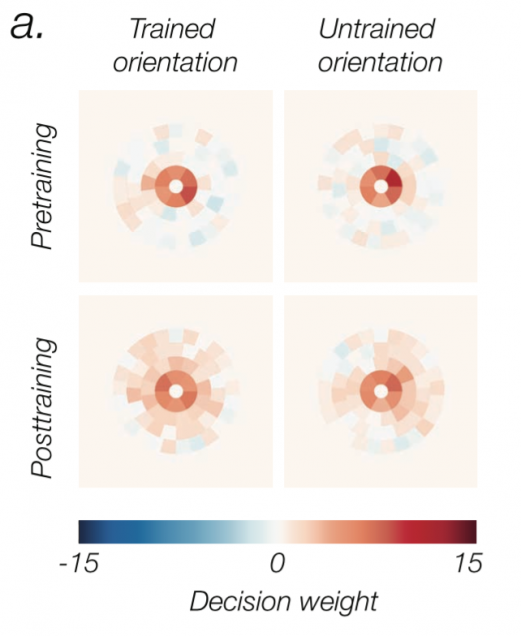
Visual orientation discrimination is known to improve with extensive training, but the mechanisms underlying this behavioral benefit remain poorly understood. Here, we examine the possibility that more reliable task performance could arise in part because observers learn to sample information from a larger portion of the stimulus. We used a variant of the classification image method in combination with a global orientation discrimination task to test whether a change in information sampling underlies training-based benefits in behavioral performance. The results revealed that decreases in orientation thresholds with perceptual learning were accompanied by increases in stimulus sampling. In particular, while stimulus sampling was restricted to the parafoveal, inner portion of the stimulus before training, we observed an outward spread of sampling after training. These results demonstrate that the benefits of perceptual learning may arise, in part, from a strategic increase in the efficiency with which the observer samples information from a visual stimulus.
The Occipital Face Area is Causally Involved in Facial Viewpoint Perception
Journal of Neuroscience (2015)
Tim Kietzmann, Sonia Poltoratski, Peter König, Randolph Blake, Frank Tong & Sam Ling
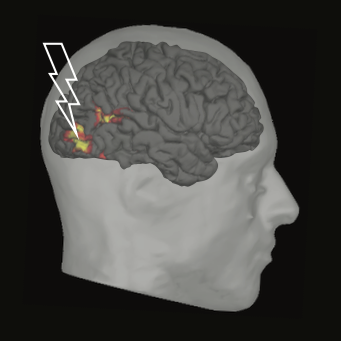
Humans reliably recognize faces across a range of viewpoints, but the neural substrates supporting this ability remain unclear. Recent work suggests that neural selectivity to mirror-symmetric viewpoints of faces, found across a large network of visual areas, may constitute a key computational step in achieving full viewpoint invariance. In this study, we used repetitive transcranial magnetic stimulation (rTMS) to test the hypothesis that the occipital face area (OFA), putatively a key node in the face network, plays a causal role in face viewpoint symmetry perception. Each participant underwent both offline rTMS to the right OFA and sham stimulation, preceding blocks of behavioral trials. After each stimulation period, the participant performed one of two behavioral tasks involving presentation of faces in the peripheral visual field: judging the viewpoint symmetry or judging the angular rotation. rTMS applied to the right OFA significantly impaired performance in both tasks when stimuli were presented in the contralateral, left visual field. Interestingly, however, rTMS had a differential effect on the two tasks performed ipsilaterally. While viewpoint symmetry judgments were significantly disrupted, we observed no impact on the angle judgment task. This interaction, caused by ipsilateral rTMS, provides support for models emphasizing the role of inter-hemispheric crosstalk in the formation of viewpoint-invariant face perception.
Sam joins BU’s Hariri Institute Junior Faculty Fellows
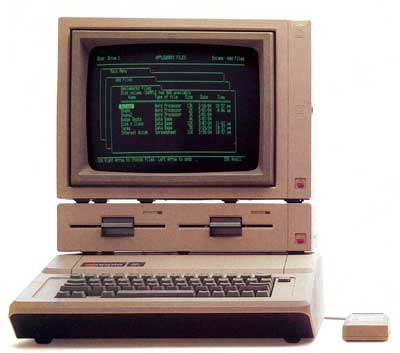 The Ling Lab now has affiliation w/ the Hariri Institute for Computing at Boston University!
Sam was selected as a 2015 Hariri Institute Junior Faculty Fellows. The program recognizes junior faculty at Boston University working in diverse areas of computing and the computational sciences. Institute Fellows help connect like-minded researchers at BU and beyond, also providing a focal point for supporting broader collaborative research.
Official announcement here: http://www.bu.edu/hic/2015/09/28/institute-announces-2015-junior-faculty-fellows/
Sam awarded Peter Paul Career Professorship

More info on the Peter Paul Award (and a brief interview) here: http://www.bu.edu/today/2015/four-junior-faculty-awarded-peter-paul-professorships/
Dongho got a position!!
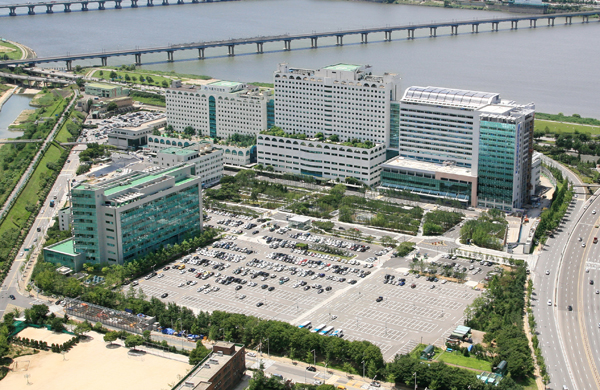
Congrats to Dongho Kim, who just accepted a position as Scientific Consultant at ASAN Medical Center, where he'll be conducting neuroimaging research in a clinical setting.
We're all very excited for you, Dongho!
Sara Receives NIH Computational Neuroscience training grant
Congrats to Sara Aghajari, who received an NIH fellowship to carry out her doctoral research for the coming year!
Congrats to Jianfei Guo
Congratulations to lab member Jianfei Guo, who is joining Joo-Hyun Song's lab at Brown University for grad school!