PROMISE IDD
Policies for Reproductive Outcomes in Medicaid–Improving Services for Enrollees with Intellectual and Developmental Disabilities (PROMISE IDD)
Funding: Eunice Kennedy Shriver National Institute of Child Health and Human Development, 1R01HD109135-01
PI: Eric Rubenstein, PhD ScM
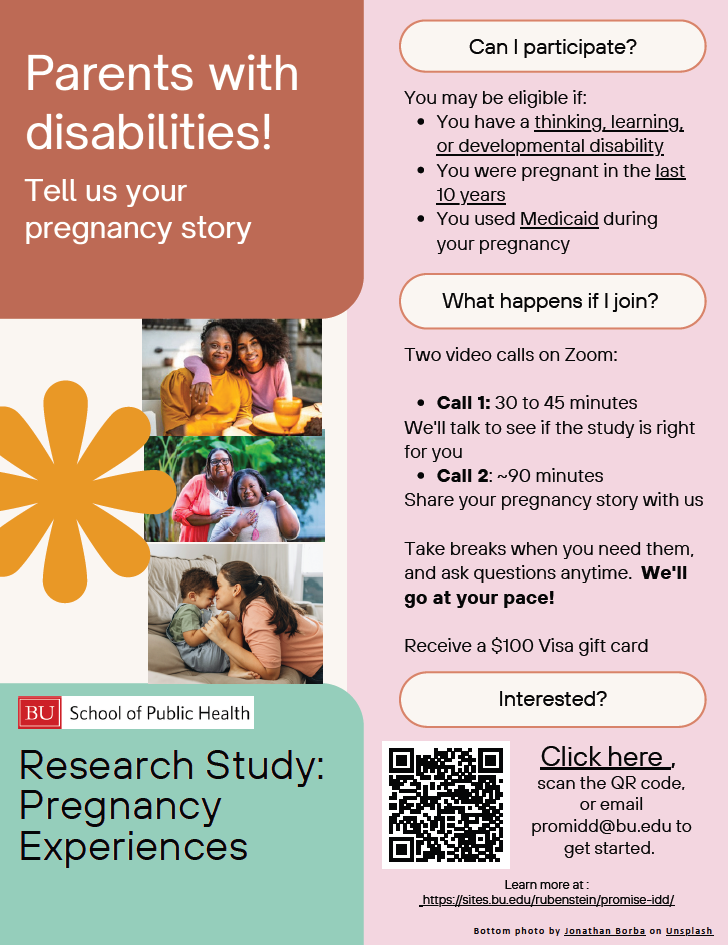
If you are interested in participating or learning more, please fill out this study interest form:
Parents with disabilities: Tell us your pregnancy story!
You may be eligible if:
- You have a thinking, learning, or developmental disability.
- You were pregnant in the last 10 years.
- You used Medicaid during your pregnancy.
For our research study, we are looking for people with autism spectrum disorder, Down syndrome, or other intellectual and developmental disabilities to participate in a one-hour online interview about how using Medicaid affects pregnancy experiences. Participants will receive a $50 Visa reward gift card for their time.
Examples of IDD diagnosis can include various conditions, such as:
- Autism
- Cerebral palsy
- Fragile X syndrome
- Down syndrome
- Language or learning disorders
- and others
You may be eligible if you:
- Have a documented IDD diagnosis
- Are currently pregnant or were pregnant in the past 10 years
- Enrolled in Medicaid during pregnancy
- Lived in the United States during pregnancy
- Be 18 years of age or older
- Speak and understand English
If you are interested in participating or learning more, please fill out this study interest form:
We want to improve the experience of people with intellectual and developmental disabilities during pregnancy. To do this, we will conduct a research study using national data and conduct interviews with people with intellectual and developmental disabilities.
We are interested in three key factors that may influence pregnancy health outcomes for people with intellectual and developmental disabilities:
1. Medicaid: The timing of when people with intellectual and developmental disabilities enroll for Medicaid may influence their pregnancy experience and access to healthcare.
2. Prenatal care: It is understood that good prenatal care improves the health of parents and newborns. However, there is very little research about how prenatal care helps people with intellectual and developmental disabilities.
3. HCBS waivers: Medicaid Home- and Community-Based Services (HCBS) waivers give people with intellectual and developmental disabilities the support they need to thrive in their communities. We want to know how these waivers affect prenatal care for people with intellectual and developmental disabilities.
People with intellectual and developmental disabilities are experts with lived experience. We will interview people with intellectual and developmental disabilities who are or were pregnant to better understand their needs, thoughts, and feelings when navigating the healthcare system.
Our aims are to:
1. Evaluate pre-pregnancy Medicaid enrollment in people with intellectual and developmental disabilities and its association with unwanted/negative pregnancy outcomes.
2. See if when and how people with intellectual and developmental disabilities get prenatal care reduces unwanted/negative pregnancy outcomes.
3. Find out if HCBS waivers and related services are linked to good prenatal care and less hospitalization after birth.
4. Ask people with intellectual and developmental disabilities about their experiences with pregnancy to better understand the legal and healthcare barriers they face.
Learn about our Community Advisory Board!