Lab News
Winston Liu Begins Medical School
The OTO-COATI Lab is proud to announce that our very own Winston Liu has matriculated into Boston University Chobanian & Avedisian School of Medicine's Class of 2030. Since joining the lab in 2023 as a sophomore BU undergraduate student, Winston has become an integral team member, contributing time and expertise to many of our projects. We know that he will make an excellent medical student and future doctor. Congratulations, Winston!

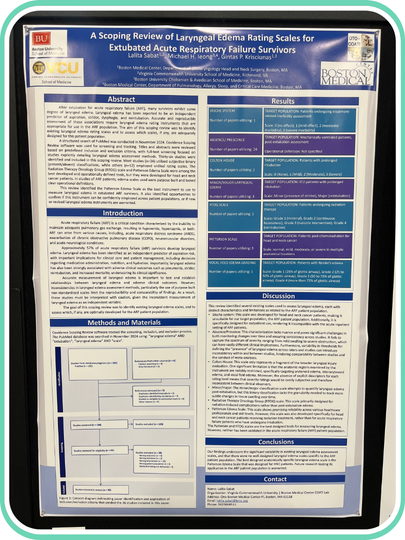
New Publication: Review of Laryngeal Edema Scales for ARF Survivors
The OTO-COATI Lab is excited to announce a new publication in the The Laryngoscope, entitled "A Scoping Review of Laryngeal Edema Rating Scales for Extubated Acute Respiratory Failure Survivors."
Congratulations to the authors, including lab members Lalita Sabat, Winston Liu, Dr. Lauren Tracy, Dr. Gintas Krisciunas, and our close collaborator in the Boston Medical Center intensive care unit, Dr. Michael Ieong.
AHNS 2026 International Conference on HNC
Congratulations to Nikhita Santebennur for her podium presentation entitled "Improving Accuracy of Oral Cancer Screening with ESS" and to Ruby Nguyen for his poster presentation entitled "Social and Structural Determinants of Health as Predictors of 90 Day Readmission Following Head and Neck Cancer Surgery". A huge thank you to the many faculty, staff, and student co-authors who made these projects a success.


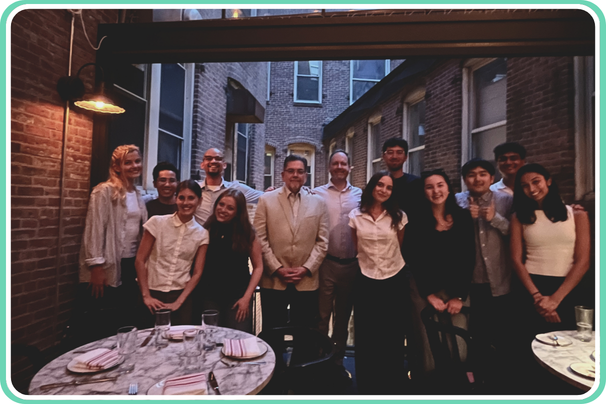
Milestones and Meals: A Night to Celebrate the Lab’s Successes
The OTO-COATI lab comes together for dinner to celebrate recent NIH grant submissions, conference presentations, and a successful annual audit of the lab's clinical research studies. A huge thank you to our research specialist, Lucas Berry, for keeping our research projects in fantastic regulatory order!
The Lab Presents at COSM 2026
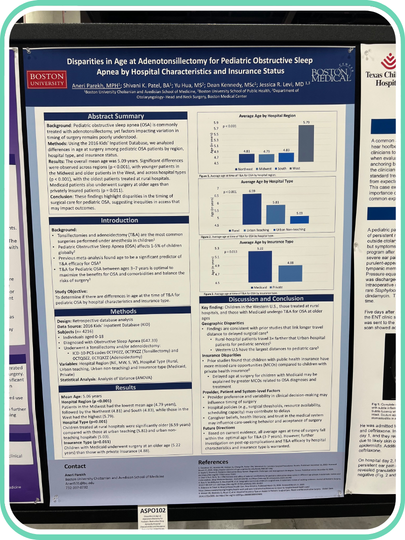
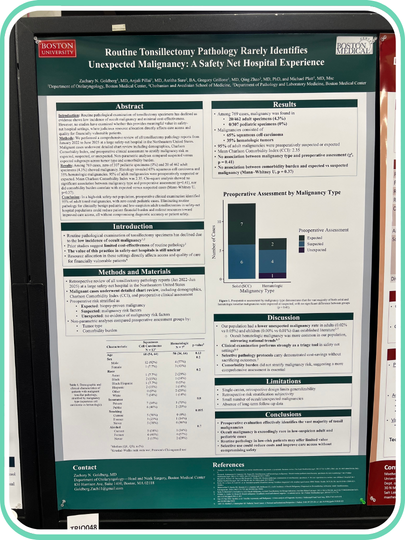
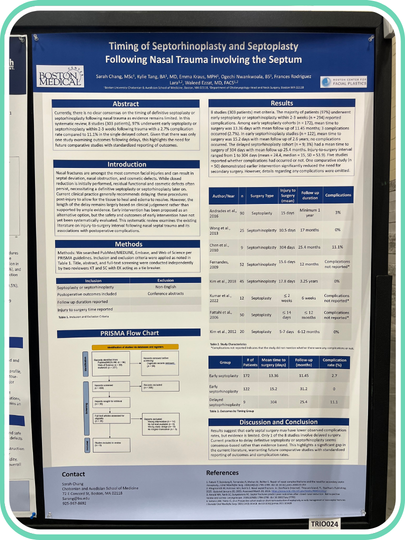
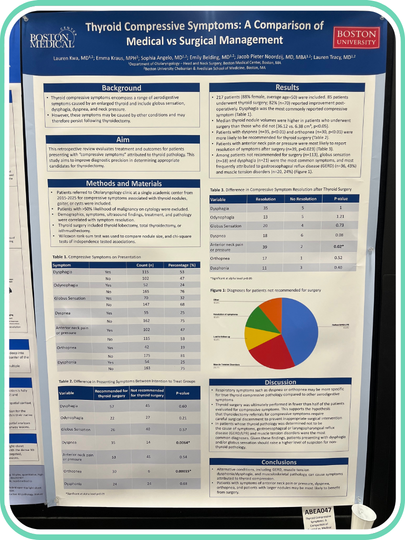
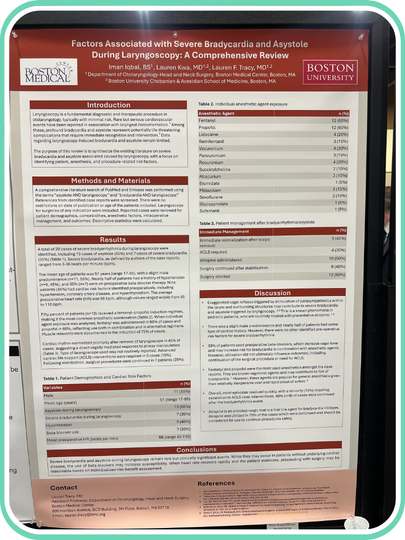
Congratulations to OTO-COATI Lab medical students Emma Kraus, Lalita Sabat, Sarah Chang, and Shivani Patel, and faculty, Drs. Krisciunas, Tracy, and Grillone for presenting multiple posters at the 2026 Combined Otolaryngology Spring Meetings (COSM) in Phoenix, Arizona.

New Research Publication: Spectroscopy Works Across Oral Cavity Sites
The OTO‑COATI Lab is pleased to announce a new paper in the American Journal of Otolaryngology: “A prospective cohort study testing whether oral cavity mucosal tissue variability influences elastic scattering spectroscopy (ESS) measures,” made available online April 14, 2026.
Authors include Mitali Sakharkar (BU medical student, OTO‑COATI Lab), Gabriele Spokas (UNC graduate student, OTO‑COATI Lab), Parth Jalihal (BU medical student), Lucas Berry (OTO‑COATI Lab research specialist), Eladio Rodriguez‑Diaz, PhD (BU), Irving Bigio, PhD (BU), Gregory Grillone, MD (BMC Otolaryngology chief and OTO‑COATI Lab faculty), and Gintas Krisciunas, PhD (OTO‑COATI Lab Director). Special thanks to Devin Lucas (OTO-COATI Lab research coordinator) for contributing an illustration of the oral cavity.
This work was conducted in collaboration with Boston University’s Biomedical Optics (BMO) Lab, a longtime partner in our spectroscopy studies for head and neck cancer detection.
WHY THIS MATTERS
A key aim of our lab is to develop elastic scattering spectroscopy (ESS) to guide surgeons in detecting oral cancers during surgery. Prior work showed ESS is promising for margin guidance, but we lacked clarity on whether normal anatomical differences across the oral cavity would affect ESS readings. In this prospective cohort study, the authors show that ESS measures are largely unaffected by locoregional variations in normal mucosal tissue. Put simply: ESS appears to perform consistently across different oral sites (tongue, inside of the cheek, gums, etc.), supporting its broader clinical utility for oral cancer detection.
For more information, read the full paper here. You can also read about our other studies on spectroscopy here.
Congratulations to the authors and collaborators for this important step toward translating ESS into a reliable surgical and diagnostic tool.
Congratulations to Mitali Sakharkar for Matching into Otolaryngology Residency
We are delighted to congratulate Boston University medical student Mitali Sakharkar on matching into the otolaryngology residency program at the University of Miami!
Mitali joined the OTO‑COATI Lab during her first year of medical school and has since made important contributions to our studies on acute respiratory failure survivors and spectroscopy for cancer detection. Over four years, she approached her research with dedication and curiosity and treated patients and lab colleagues with kindness.
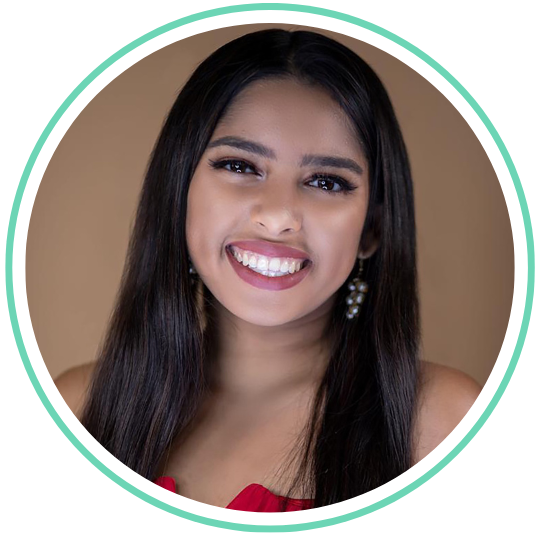
The lab will miss Mitali, but we are extremely proud of her for this well‑earned achievement. Congratulations, Mitali!
Welcome Anna Jacobson & Dr. Anand Devaiah to the OTO-COATI Lab
We are pleased to welcome research assistant Anna Jacobson and Boston Medical Center otolaryngologist Dr. Anand Devaiah to the OTO‑COATI Lab.


Dr. Devaiah — professor of otolaryngology, neurosurgery, and ophthalmology at the Boston University Chobanian & Avedisian School of Medicine — has long been a friend of the lab. He joins us to lead NIH‑funded research on an innovative technology with the potential to improve detection and monitoring of Alzheimer’s disease and related dementias. Anna will be an integral member of the team working on the project.
Welcome, Anna and Dr. Devaiah!
Congratulations to Lucas Berry for Earning SOCRA Certification
Lucas joined the OTO‑COATI Lab in 2020 and is the lab’s longest‑serving staff member. He plays a central cross functional role in the Lab, contributing expertise in research operations, regulatory requirements, and data management for nearly all of the Lab's projects. He also manages lab logistics and is involved in training students and staff.

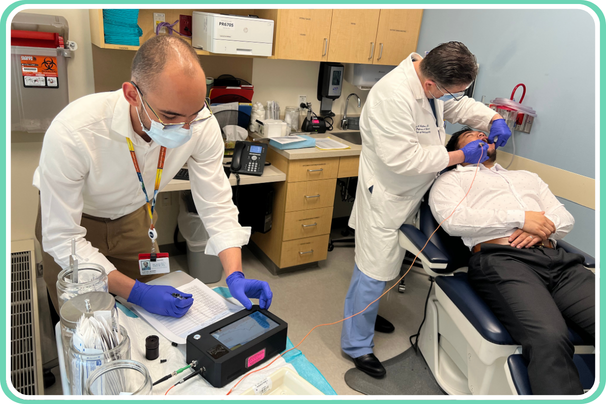

With his CCRP, Lucas brings strengthened regulatory and data‑management expertise to every project. That expertise helps accelerate study start‑up, improve the reliability of study data, and — most importantly — enhance protections for the patients who volunteer for the lab’s research.
Lucas on earning the CCRP:
"First, I must offer my deepest gratitude to everyone in the OTO‑COATI family, especially my mentor Gintas. Earning the CCRP designation from SOCRA wouldn't have been possible without their trust and guidance. I'm lucky to work with brilliant people who are — or aspire to be — clinicians and scientists. While they work to invent new ways to detect cancer during surgery or to improve widely used diagnostic instruments, I am excited to guide them through the minefield of research regulations and processes. These types of collaborative efforts help bring great ideas from bench to bedside, and being able to help my team in this way is a tremendous privilege. I pursued the CCRP so I can do an even better job of it."
Congratulations, Lucas — and thank you for continuing to strengthen the lab’s research quality and patient protections.
New Research Publication: Laryngeal Edema & Aspiration in Acute Respiratory Failure Patients
We're excited to share a new paper from the OTO‑COATI Lab, published in the European Archives of Oto‑Rhino‑Laryngology and made available online March 5, 2026: “Identifying the association between post‑extubation laryngeal edema and aspiration in acute respiratory failure patients.”
Authors include Devin Lucas (OTO-COATI Lab clinical research coordinator), Ryan Peterson, Jared Rieck, Moses Owusu, Edel McNally, Rebecca Scheel, Patricia Cavanagh, Susan Langmore, Ann Kearney, Joseph Levitt, Jonathan Siner, Rosemary Vojnik, Heather Warner, Mitali Sakharkar (BU medical student and OTO‑COATI member), Winston Liu (BU undergraduate and OTO‑COATI member), Alix Rubio (OTO‑COATI alumnus), Marc Moss, and Gintas Krisciunas (OTO‑COATI Lab Director).
This study was done as part of a nationwide consortium looking at complications from acute respiratory failure, with partners from University of Colorado, Stanford, Yale, and a talented group of speech‑language pathologists.
The authors looked at clinical outcomes and FEES (flexible endoscopic evaluation of swallowing) videos from 120 patients who had been intubated, to see how laryngeal swelling after extubation relates to aspiration.
Key takeaways:
- Swelling of the aryepiglottic folds stood out as the strongest predictor of post‑extubation aspiration.
- Weakness independently raised the risk of aspiration.
These findings help us better understand why some patients aspirate after extubation and point toward targets for future research and interventions to reduce those risks.
Huge congratulations to the whole team — and thanks to our consortium collaborators for making this important work possible.
To read the full published article, click here. Also, click here to learn about the consortium's other research on acute respiratory failure.