Fieldwork practicalities
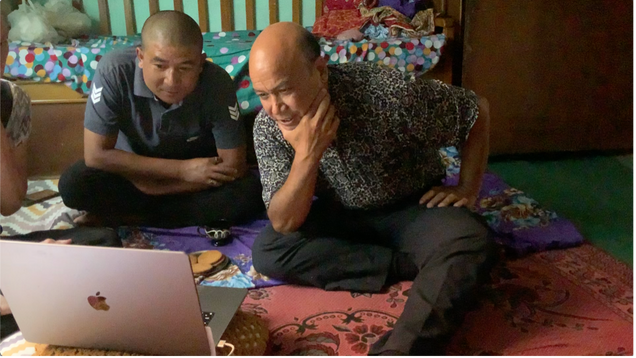
To learn about reduplicated numerals, I decided to use a setup with a Google Slides document with pre-loaded sentences and images that we could type into. I recorded the screen on the laptop and filmed the session using an iPad. Here is a shot from the iPad, with Riden Maharjen and Dipak Tuladhar.
To capture the face and audio along with the screen I used QuickTime. You initiate a movie recording, select “Float on top” to keep the video image in the foreground, and then do a screen recording rather than a movie recording; the video image stays there and the screen recording records that. I used a piece of paper to cover up the part of the screen with the movie recording so we wouldn’t feel self-conscious.
Here’s a shot from the laptop with Raj Kaji Shakya.

This is an example of a question of the form “Does the sentence match the picture”? In the sessions we could create new pictures by manipulating clip art in Google Slides. Some questions did not involve pictures; they could be of the form, “is this a good sentence of Newar?” and “what if I took out this word, would it still be a good sentence?”
Since I did not know a lot about the language going in, I started with examples of reduplicated numerals that I had found on the web, and asked my consultants to help me understand them. This example is from a Newar proverb that I found about specialization, which urges giving one job to each person. It has a nice reduplicated numeral in it:
सकसितं छगू छगू ज्या बियादिसँ ।
saka-sitaṃ chagū chagū jyā biyādisaM
every-to 1-clf 1-clf work give
`Give one job to each person’
Cha means ‘one’ and gu is an inanimate classifier.
In the picture, I tried changing the numeral to ni ‘two’. It worked!