Newari counting riddle (line 1)
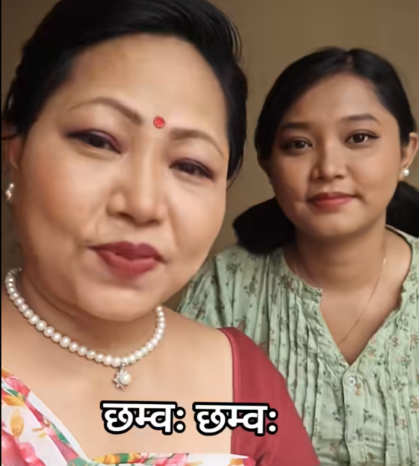
Nepal Bhasa language teacher/activist Sunita Junu, who can be found not only on Facebook but also on TikTok, has posted a video with her daughter reciting this Newar counting riddle.
@sunita.junu एकमोहर एकमोहर – एकरुपैया हामी दुइजना – बेरियौँ नि ऊ त्यो मान्छेले – हेर्यो नि पुरानो घर – भत्कायो नि बगलामुखी महादेवको मन्दिर – पाँच तल्ला मंगलबजारमा कपडा – च्यातियो नि भर्याङ्गको खुड्किलो – सात खुड्किलो राती बत्ती – बल्यो नि पुरानो लुगा – फाटियो नि पाँच रुपैयाँ पाँच रुपैयाँ – १० रुपैयाँ This famous newār counting riddle was taught to Mr. Suprasanna Bajracharya @Supra Bajra by his lovely and respected mother Ms. Prem Laxmi Bajracharya (Dhapagaa:, Patan). this recalls our childhood memories. As a lingustic student, I had to shuffle some words in this riddle so I had to amend little bit on it. Today, I am teaching this riddle to my daughter as well. #sunitajunu #learn_nepalbhasa_with_sunitajunu #newarriddle #conuting_in_nepalbhasa
Junu has included a transcription in the video, and she has posted a translation into Nepali. If you paste the Nepali into Google Translate, this is what you get:

Clearly it has something to do with counting, going one, two, etc. with each line. This English translation is also clearly way off.
What do all of the words mean in Newari? How do you even type it? You can’t copy and paste from the video. But I must know. It’s so cute.
First step: Take screenshots of all of the transcriptions.
Here is the first pair of lines.

Clearly, she is using Devanagari script. The first symbol appears to be the consonant ch. I’ve been finding this Devanagari keyboard from Lexilogos handy. Look! There’s cha.

And that makes sense, because the word for “one” in Newari is cha. Here’s an excerpt from Kölver and Shresthacarya’s (1994) “A Dictionary of Contemporary Newari”.


By the way, look at that beautiful numeral reduplication construction! -gu is the default numeral classifier for inanimates, and -mha is the default numeral classifier for animates. Raises a lot of questions… research questions! 💡
OK, but what about the next syllable?

It looks a bit like an m (म) and it clearly has a visarga at the end.

But it’s not just मः, there’s something more going on there. It’s not listed among any of the consonants.
A clue came as I was reading in the front matter of KS dictionary and came across the word “ligature”.

Googling about ligatures in Devanagari, I came across a Wikipedia article on Devanagari saying that “Aspirated sonorants may be represented as conjuncts/ligatures with ह ha: म्ह mha, न्ह nha, ण्ह ṇha, व्ह vha, ल्ह lha, ळ्ह ḷha, र्ह rha.”
But none of these are our guy! What is that symbol?
Finally I found the Technical Manual of Itranslator 99 by Ulrich Stiehl. This Ulrich was not messing around. On page 13 I found the symbol. It’s mva.

And guess what. If you type mva into the Lexilogos Devanagari tool, you get back that symbol! And you can even type mvH to get the visarga as well. Copy and paste it, be my guest!
म्वः
Not only type it, now I can look this word up in in the KS dictionary. The Roman spelling helps. Drumroll please… It means mohar! It’s a shortening of a longer word that sounds more like mohar; this is the variation that is listed after the main entry.

And that has got to be it, because it’s half a rupee, and takā means rupee!

Solution for line 1:
छम्वः छम्वः
|

छतका
|

