Research & Development
Research & Development: Vinoth Jagaroo, Ph.D.

- Background
- Research/Development Problem
- The Posterior Parietal Mechanism of Spatial Neglect
- Neural/Perceptual Dynamics of Spatial Neglect and Need for Digital Assessment
- Architecture of the Computational Platform
- Technology Stack, Platform Architecture and Key Functionality
- Informatics and Data Science
- Technology Development with a Go-to-Market Plan
Background: In Behavioral Neurology and Neuropsychology, “visuospatial function” is one of the major domains of clinical assessment. Visuospatial dysfunction is expressed across a range of disorders involving the brain. This broad domain, comprised of a complex hierarchy of cognitive and neural operations, has been for decades assessed using ‘paper-and-pencil’ tests or computer-administered versions of such tests. In cognitive neuroscience, neural systems underlying spatial processing have been described with ever increasing precision, but neuropsychology has been slow to articulate a comprehensive brain-based model of what it calls visuospatial function.
This problem is especially compelling when viewed against developments in systems neuroscience and neuroinformatics – altogether compelling neuropsychology at large to align its constructs with neural circuits or neural dynamics. The delineation of quantifiable phenotypes, when databased in a standardized format, bridges a crucial step towards data analytics. This necessarily calls for a neuroinformatics framework for neuropsychology. Yet, neuropsychological assessment, the only formal, standardized, instrument-driven method of cognitive assessment in the clinical context, is anchored in the use of tradition-bound instruments, incongruent with the complexities of cognition and underlying neural systems. They notoriously amalgamate cognitive operations to produce compound neurocognitive constructs. Neuropsychological constructs are also intimately tied to assessment instruments with psychometric roots in the early decades of the 20th century. This practice and its legacy are incompatible with 21st century brain science.
Research/Development Problem: To develop a neuropsychological praxis that is scientifically aligned with contemporary brain science, the discipline needs to take the critical step of reinventing its assessment instruments. The project described here is centered on the development of a computational, informatics-driven platform for the assessment of disorders of spatial processing (“high-level vision” – as known in visual cognitive neuroscience). The platform can be used to assess disorders of high-level vision that manifest in object-centered or scene-centered contexts, e.g., visual agnosia and spatial neglect. Initial theoretical impetus for the platform stemmed from the spatiotopic representational model of hemispatial neglect (described below) though different (affected) neural mechanisms often produce similar clinical manifestations of neglect. The platform’s design gives it wide application in visuospatial assessment.

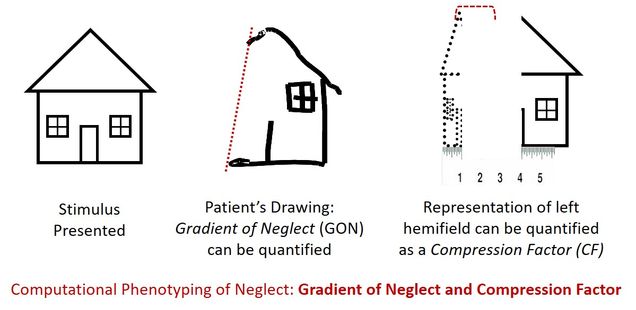
The Posterior Parietal Mechanism of Spatial Neglect (Cognitive Neuroscience): One mechanism of spatial neglect involves Brodmann’s area 7, the posterior parietal cortex (PPC). Convergent evidence drawn from multiple different lines of data across neurology and cognitive neuroscience suggest Area 7 to be a center of 2D and 3D spatiotopic coordinate representation. Neuronal cell fields of Area 7 (e.g. 7a, 7b) either code domain-specific frames of space (allocentric, egocentric, etc.) or utilize a domain general spatial reference frame and apply it to specific contexts. The PPC model of neglect suggests that (a) the PPC of the right hemisphere is a center of spatiotopic representation of the entire external spatial field (left and right); (b) representational compression of the left hemifield or part of it, the result of abnormal neural dynamics following a stroke or other brain insult, leads to an extinguishing of a field, manifesting clinically as spatial neglect.

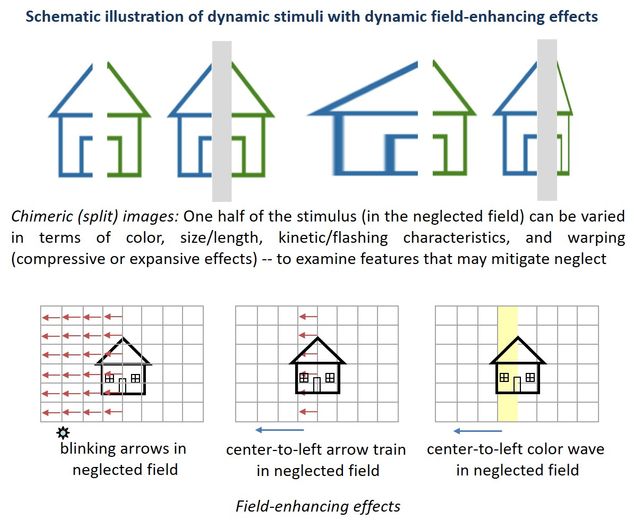
Neural and Perceptual Dynamics of Spatial Neglect and the Need for a Digital Assessment Platform: As evidenced clinically, certain perceptual features introduced into the neglected hemifield can in some patients mitigate neglect. Dynamic priming and saliency effects such as synchronized trains of arrows or stroboscopic effects can aid perceptual registration of the neglected field or object. This occurs under the central fixation condition, i.e., with no saccadic or gaze shifts in the direction of the neglected field. A possible explanation is that neural circuits or modules activated by dynamic or salient effects have afferent excitatory effects of the affected systems. In the case of the PPC, this may result in momentary decompression of the spatiotopic system of the left hemifield and hence momentary perceptual registration. The effects illustrated by the diagrams below can neither be produced nor finely assessed with conventional tools. A digital/computational platform is needed.
Core Design and Functionality of the Computational Assessment Platform: The system designed uses a dual-screen computer setup — a control screen for the clinician and a patient (viewer) screen. Stimuli on the control screen are mirrored exactly on viewer screen. Screens are divided into cells (squares) which altogether comprise a grid matrix. The grid size is adjustable across a fine-to-coarse dimension (size of grid cells) but at any given time, for a given trial, the cell sizes are kept uniform. The grid can be made clear and viewable to the patient, or made opaque, or be hidden, but it will always code the coordinates of stimuli presented. The patient’s screen shows exactly the same stimulus and grid shown (selected) on clinician’s screen, but not the control menu which is only viewable on the clinician’s screen. The clinician positions an image on the grid matrix. The patient uses a mouse, stylus or touchpad to draw over/trace image (direct copy or recall trials). Based on the neglect gradient extracted by the software, the clinician can incrementally move the image and have the patient redraw or retrace the image. Process is repeated until no neglect is recorded – to calculate field gradient. Similarly, the clinician can present a cancellation task. The system generates neglect patterns and neglect gradients alongside timescale information. Dynamic effects (described above) can be used to further probe the patient’s spatial neglect. The software analytic module generates simple plots showing the stimulus regions on the screen where the patient correctly perceived (detected) the stimulus or one part of it. In the current proof-of-concept version of the platform, two kinds of visuospatial test stimuli used in neuropsychological assessment are operational– Letter Cancellation and a few stimuli from the Boston Visuospatial Battery (BVT). The clinician can select either a letter cancellation task or images adapted from the BVT.

Major components of the software include the Control Module and a Database. The Control Module adjusts the grid size, selects stimulus type, position and other characteristics, and records grid coordinate points intersected by stimulus. The Database records session data, patient data, and performance data. [Click to view screenshots of the operating platform]
Technology Stack and Platform Architecture: The tech stack is built using Electron, an open source development framework for cross-platform desktop applications (with JavaScript, HTML, and CSS). Electron also enables the development of additional tools — for data management and user interface (UI) design. The core design of the platform rests on the grid configuration described above, i.e., a matrix of cells of a computer screen. The cells record the coordinates of content displayed. A key feature of the project is the synchronization of three different processes – main renderer, host renderer and client renderer (to serve the two screen interfaces). The grid is an important object shared between the host and client renderer processes. Grid information is sent to two renderer processes through Inter Process Communication (IPC) handlers with synchronous communication – for the clinician screen and patient screen renderings. This allows for the viewing of the same stimulus on the clinician and patient screens but for the control parameters/control menu to be viewed and adjusted only on the clinician screen. Electron loads the preload script before starting the renderer process to expose the functionality of the main processes. The core program logic resides in a .ts file in Electron. The program is bundled into executables in a .config file. Cell parameter files govern how the platform generates a grid cell. Prisma, the object-relational mapping tool was used to create the database structure and to apply a migration strategy to a MySQLite file.

Informatics and Data Science: The basic mathematics for the grid-based mapping involves Manhattan Distance, which is applied to perform coordinate translations — with 0,0 (center grid cell) as the coordinate reference point. This enables functionality to be maintained regardless of screen size.

Machine Learning techniques used in the analysis of patient response data (image and cancellation task) include: Regression – to minimize total distance between data points; Classification – to demarcate class (image component) values; Clustering – to create density plots of images along neglected vs. non-neglected differential; and Dimensionality Reduction (PCA) – to define key vectors of the patient’s drawings.
Envisaged future applications of data science: (a) As datasets increase, Ensemble Methods in ML can be applied to combine several predictive models and data dimensions (supervised ML) in order to achieve high quality predictions of patients’ visuospatial prognosis. (b) Linking a patient’s neglect data (from the computational assessment) to a patient’s brain imaging data, especially fMRI will involve 2D (screen data) 3D (fMRI voxel data) associations. A possible model involves projecting the two types of datasets onto a low-dimensional space and then applying regression to the projection vectors.
Technology Development with a Go-to-Market Plan: Development of the platform completed in April 2025. Platform is scheduled to go online in late 2025 — a version that will be available to clinicians and researchers as a web-based “freemium” version. Clinicians will register to access the web-based version. De-identified patient data will be fed to a cloud server. ML and other analytic services will be offered to clinicians and institutions – for individual patients and data sets drawn from patient groups. Data drawn from usage of the platform will be used to refine the product market fit. Approximately 15 million people globally suffer from a stroke each year, and spatial neglect is seen in about 30% of stroke survivors. The Total Addressable Market (TAM), Service Addressable Market (SAM), and Service Obtainable Market (SOM) are substantial.
The technology is easily adaptable to Augmentative and Assistive Technology (AAC) digital “boards” (computer screens and tablets). The AAC user market in the US is in the millions, and the SOM (SLP clinicians, clinics, and departments) is estimated to be in tens of thousands.
COPYRIGHT 2025 Vinoth Jagaroo (all rights reserved)
_________________________________________________________________________________