Academic Profile
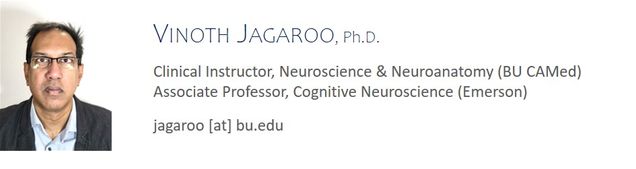
Dr. Jagaroo is a cognitive neuroscientist. His current areas of focus are integrative neuroscience, neuroinformatics and computational tools for neuropsychology, and the interface of the clinical neurosciences with systems neuroscience and the omics environment. He is also very invested in teaching and programmatic structure, especially in the realm of behavioral neuroscience.
He is currently working on the development of a computational, informatics-based assessment platform for the mapping of visuocognitive disorders. The model system he is applying involves isotropic representation in the posterior parietal cortex (Brodmann’s area 7) and its relationship to spatial neglect. The project brings together his interests in neuroscience, neurocognitive biomarkers, and the gearing of neuropsychology with informatics-driven assessment instruments in order to better align diagnostic tools with neural systems in question. This translational neuroscience initiative is in collaboration with SPARK! and the Faculty of Computing and Data Sciences at Boston University, and is being developed with a plan for commercialization.
Dr. Jagaroo’s 2009 book Neuroinformatics for Neuropsychology, was the first to lay out the intersection of the disciplines of neurocognitive assessment and informatics. Following this publication, he was invited by Springer to lead the volume series Innovations in Cognitive Neuroscience, for which he remained series editor from 2012 to 2022. He is also co-editor of one of the volumes in this series, Neurophenotyes: Advancing Psychiatry and Neuropsychology in the Omics Era. In March, 2024, he was appointed as Topic Editor (Neuroinformatics for Neuropsychology) for the journal Frontiers in Neuroinformatics.
He was tenured as an Associate Professor in the Department of Communication Sciences and Disorders at Emerson College (Boston) in 2009, and currently teaches in the college’s biological and cognitive science curriculum. His courses range widely across undergraduate and post-graduate levels, but he specializes in the teaching neuroanatomy and cognitive neuroscience. He has been a highly active and long-standing faculty affiliate in the Behavioral Neuroscience Ph.D. Program at Boston University School of Medicine. He obtained a Ph.D. in Behavioral Neuroscience from the same program (BUSM) in 1998. Prior to that, he studied at the University of Natal in South Africa where he obtained a B.A. and a postgraduate B.A. Honors degree, both in Psychology, with ancillaries in computer science and physics. His interest in neuroinformatics for the clinical neurosciences developed during his postdoctoral years at Boston University, where he combined tracks in informatics and behavioral neuroscience. He has also trained extensively in various techniques of brain dissection, including classical blunt dissection (Josef Klingler’s freeze-thaw method). He trained in the Klingler method under its famed proponents, the late neuroanatomist, Lennart Heimer, and the pioneer of micro-neurosurgery, Gazi Yasargil.
Dr. Jagaroo has a keen interest in the revision of curricula and training programs in the clinical neurosciences in relation to trends in neuroinformatics. His most recent pedagogical-programmatic initiative has been the design and implementation of neuroinformatics and data science course components in the core curriculum of the Behavioral Neuroscience Ph.D. Program at Boston University.